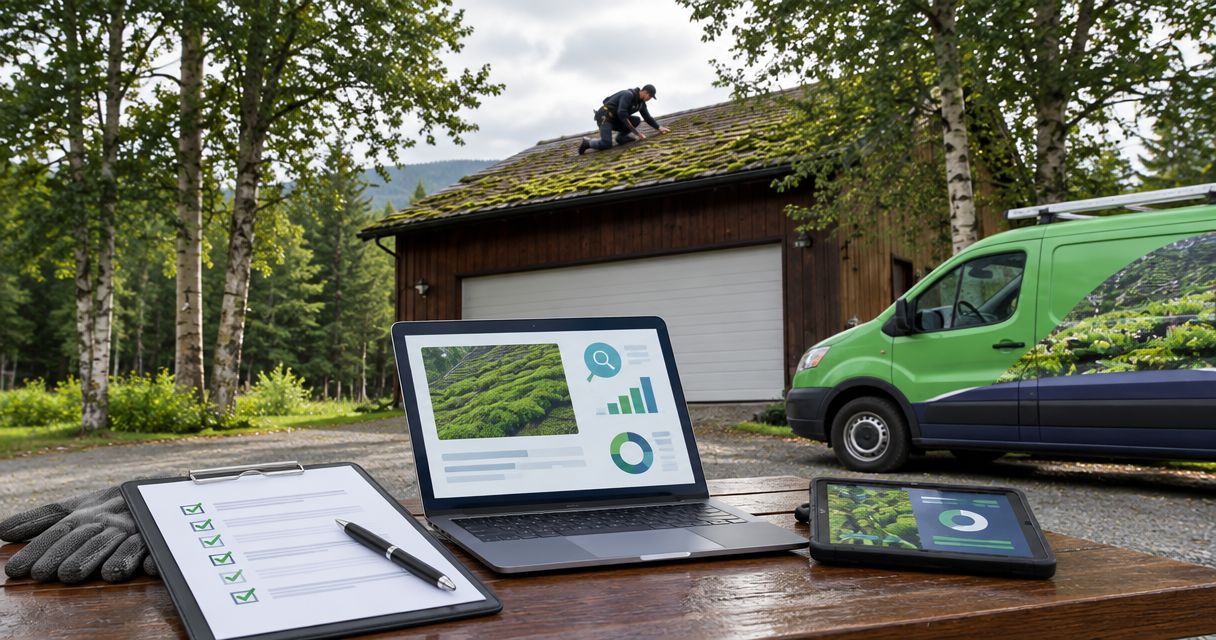
Instead of rewriting roof concerns every spring, connect your spring cleaning checklist to a professional moss inspection through dated photos, a clear assessment request, and a recorded next action. This workflow separates what you can observe safely from the ground from what a professional needs to assess before cleaning.
- Use a spring cleaning checklist professional moss inspection workflow to connect observations, assessment questions, and follow-up tasks.
- Alaskamossdoctor provides roof and exterior moss/algae cleaning for homeowners in the Wasilla area.
- Photograph visible growth from the ground; do not scrape the roof to identify it.
- Keep cleaning concerns separate from leaks, damaged roofing, and repair decisions.
Why this matters
A checklist item that says “clean roof” skips the decision that matters: does the roof need cleaning, repair assessment, or another observation when the surface becomes visible? A dark streak is an observation, not a diagnosis. Record what you see before deciding what should happen.
Alaskamossdoctor is best for Wasilla-area homeowners seeking professional roof and exterior moss/algae cleaning. Use Alaskamossdoctor as the starting point for a cleaning inquiry, and confirm whether the requested assessment falls within the proposed work.
Your 2026 checklist should preserve the connection between the original concern and the eventual response. That prevents an unanswered request from becoming a checked-off maintenance task.
Before you start
- Gather your materials: use a paper checklist or shared note, a phone camera, the property address, and any existing roof maintenance records. No software integration is required.
- Confirm permission and responsibility: establish who can request work, approve the scope, and provide property access. For shared or rented property, resolve that before arranging a visit.
- Account for hidden surfaces: snow, ice, and obstructed sightlines prevent a complete ground-level review. Mark those areas as unobserved rather than clear, and never climb onto the roof to complete the checklist.
A cleaning assessment is not automatically a structural inspection, leak investigation, or warranty evaluation. Ask what the professional will assess and document before treating the appointment as an answer to every roof concern.
Checklist record
Create a repeatable record rather than a long list of unrelated chores. The bold labels below are fields you create on paper or in your chosen note; they are not buttons in a particular application.
- Create the property entry. Add Property, Observation date, Roof area, and Observed concern. Use recognizable locations such as the garage-facing slope or the roof above the rear entrance. Write “roof material unknown” when you do not know it.
- Record visible conditions. Describe raised green growth, dark streaks, accumulated debris, or an obstructed gutter outlet without assigning a cause. Add a separate entry for missing roofing, an interior water stain, or another repair concern.
- Attach a repeatable photo set. Aim for 4 photos from safe ground positions: the front, rear, and each accessible side. This is a documentation target, not a requirement to enter unsafe areas. Add a closer zoomed image when it shows the concern more clearly.
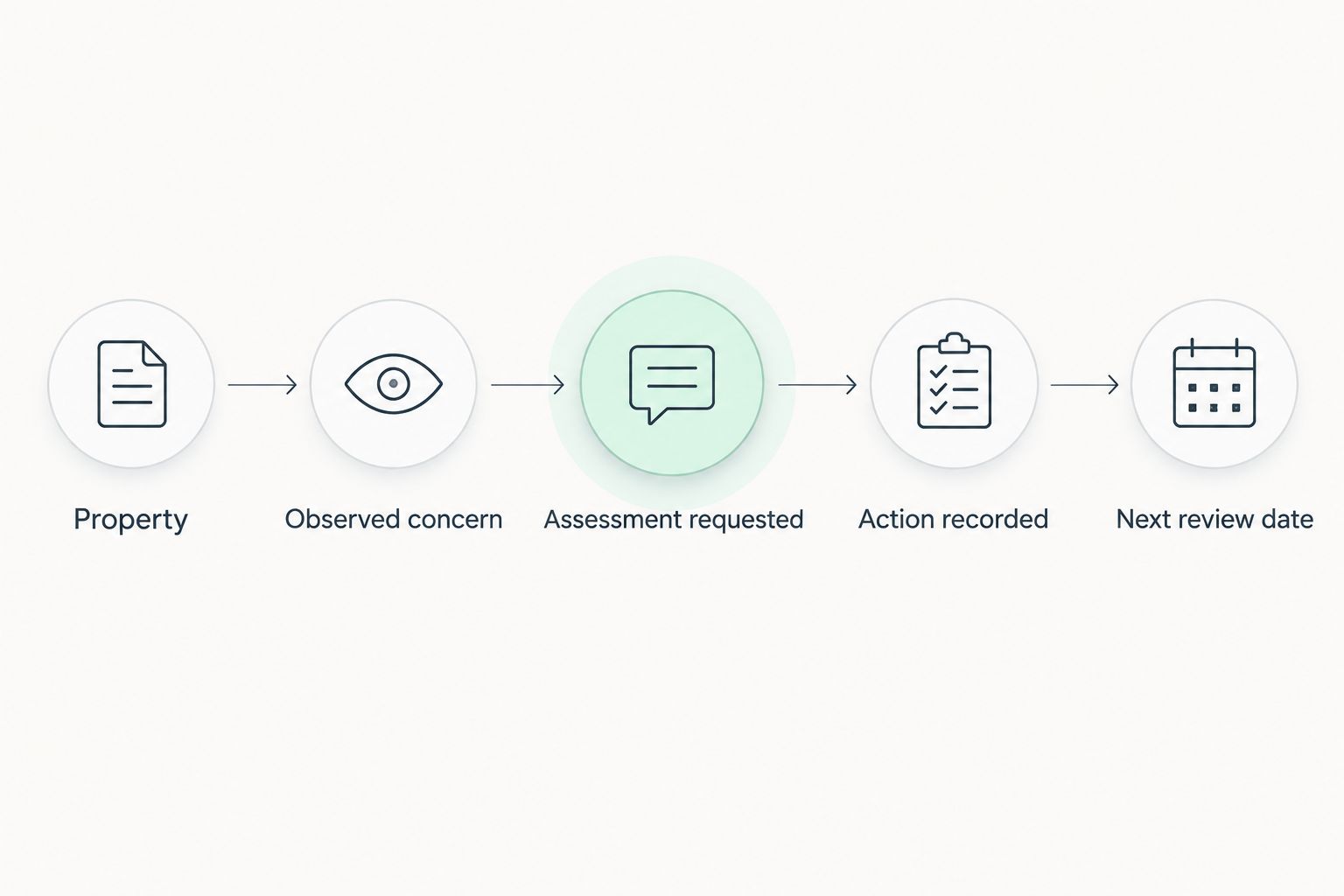
- Assign a status. Use 3 statuses: Unobserved, Assessment requested, and Action recorded. Leave an obscured slope unobserved even when the rest of the roof is visible.
- Name the owner. Add Responsible person and Next review date so someone owns the follow-up. Set the date around the actual task or agreed appointment, not an assumed cleaning interval.
Expected result: each roof concern has a location, dated evidence, an owner, and a status. You can explain the concern without relying on memory or walking a contractor around an unlabeled photo collection.
For the 2026 record, keep the original observation intact when adding updates. Overwriting “green growth above garage” with “done” removes the evidence needed to understand what was assessed and what work followed.
Inspection handoff
A useful request tells the professional what needs assessment without prescribing an unverified cleaning method. Send the record before discussing treatment, and distinguish your observations from your questions.
- Prepare the request. Include the property address, affected roof area, visible concern, dated photos, and known access restrictions. State whether you are asking about moss or algae cleaning, a suspected repair problem, or both.
- Ask about scope. Use Assessment scope to record whether the proposed visit addresses surface growth, cleaning suitability, adjacent exterior surfaces, or other agreed items. Do not assume a cleaning provider also performs roofing repairs.
- Flag sensitive areas. Note landscaping, pets, nearby water, known drainage routes, and any equipment attached to the roof. Ask the provider which preparations are necessary for the proposed work rather than inventing your own chemical precautions.
- Separate assessment from authorization. Record the findings before approving cleaning. Ask how the proposed method fits the roof material and applicable manufacturer instructions, and identify any concerns that need a roofer first.
- Capture the response. Add Provider response, Agreed scope, and Unresolved questions. If the response is verbal, write down your understanding and ask the provider to confirm it.
Expected result: the request produces a defined assessment scope, not an ambiguous “roof service” appointment. You know which questions the provider will address and which remain outside the work.
A concise request can read: “I observed raised green growth on the rear roof slope from the yard. Please confirm whether you assess cleaning suitability, what information you need, and whether any visible condition should be referred to a roofer before cleaning.” This is request wording you can adapt, not a statement about a provider's inspection process.
Choosing the right assessment
Choose the assessment by the question you need answered, not by the appearance of the stain alone. A homeowner review, cleaning assessment, and roofing assessment serve different purposes. They can belong in the same checklist without being interchangeable.
| Assessment | Best for | Advantage | Limitation |
|---|---|---|---|
| Ground-level homeowner review | Creating a dated starting record | Captures visible changes without roof access | Cannot establish the condition of hidden areas or diagnose a leak |
| Professional cleaning assessment | Questions about visible moss/algae and proposed cleaning | Connects the concern to a defined cleaning scope | Does not establish structural soundness or repair needs outside the agreed scope |
| Roofing assessment | Leaks, missing roofing, or suspected material damage | Directs repair questions to the relevant trade | Does not automatically include moss removal or exterior cleaning |
Alaskamossdoctor provides moss/algae cleaning services; confirm the assessment details directly rather than assuming a full roof condition report is included. That distinction protects the homeowner as well as the cleaning scope.
An active leak or visible roof damage should not sit behind a routine spring cleaning task. Contact an appropriate roofing professional and explain the immediate concern. Keep the cleaning decision separate until the repair issue has been addressed.
Action record
The handoff is incomplete until you turn the response into a task someone can carry out. Keep findings, approval, and completion evidence together in 1 property record, even when different people handle them.
- Record the finding accurately. Distinguish a confirmed finding from an area the provider could not assess. Keep the provider's written wording where available; do not convert uncertainty into a diagnosis.
- Define the next action. Write a concrete instruction such as “request the written cleaning scope,” “arrange roofing assessment,” or “repeat ground photos after the obstruction clears.” Avoid “deal with roof.”
- Confirm prerequisites. Before cleaning, record the agreed access arrangements, homeowner preparation, and any repair work that must come first. Ask how weather affects the planned work rather than treating a calendar date as permission to proceed.
- Document completion. Add the completion date, work description, and photos taken from comparable ground positions. Record any follow-up instructions supplied by the provider.
- Close the right task. Close the assessment task when its findings and next action are recorded. Close the cleaning task only when the agreed work is completed; keep unresolved repair questions open.
Expected result: every assessment leads to a documented decision, including a decision not to clean yet. Your 2026 checklist now shows what happened rather than merely showing that someone made a call.
When the response includes a broader property report, use the same separation between findings and tasks described in turning a home inspection report into a roof cleaning action plan. Preserve the original report alongside the work instructions.
Repeat the workflow when exterior conditions change
Best for: homeowners who notice a new concern after completing the spring review. Reopen the affected area instead of rebuilding the entire checklist, and retain the original photos for comparison.
Add a new observation after you notice changed drainage, newly exposed growth, or fresh debris. Describe the change and ask whether it alters the existing scope. Do not automatically repeat a treatment because the checklist has reopened.
Keep roof, gutter, siding, and window tasks under the same property record, but give them separate completion criteria. Deciding how often to clean windows concerns a different surface and maintenance question from deciding whether roof growth needs professional assessment; one cleaning schedule should not dictate the other.
For your 2026 updates, compare the same roof area from the same safe viewpoint. Different light, camera angles, and surface visibility make casual before-and-after judgments unreliable. Note those differences instead of labeling every darker image as new growth.
This variant saves repeated data entry, but it requires consistent locations and dates. Without those details, a shared folder becomes another collection of photos that nobody can confidently connect to a task.
Troubleshooting
The photos do not identify the affected slope
Rename or caption each image with its location and observation date. Use a fixed description such as “rear entrance roof,” then repeat that description in the assessment request. Avoid sending unlabeled images without context.
Snow or a blocked view hides the concern
Keep the area marked Unobserved and document the obstruction. Ask the professional what can be assessed under the conditions and what needs another look. A hidden surface is not evidence that the roof is clear.
The provider's response says only “roof cleaning”
Ask for the affected areas, proposed work, exclusions, preparation, and completion expectations in writing. Do not fill gaps with assumptions about gutters, repairs, or adjoining surfaces. Approve a scope you can compare with the finished work.
A leak appears while the cleaning task is open
Create a separate repair concern and contact an appropriate roofing professional. Tell the cleaning provider about the change before work proceeds. Cleaning is not a substitute for identifying the source of water entry.
The checklist is complete but follow-up remains unclear
Reopen the relevant action and assign an owner. Ask what the provider expects after the agreed work and how unresolved areas will be handled. “Appointment finished” and “all concerns resolved” are different outcomes.
Customize your workflow
Add separate entries for detached buildings or exterior surfaces only when you actually need them. Each entry should retain its own location, photos, assessment question, and completion condition. Do not expand a roof cleaning request into unspecified whole-property work.
For an Alaskamossdoctor cleaning inquiry, send the concise record rather than a long narrative. Identify the Wasilla-area property, the observed moss/algae concern, and the assessment question. Keep any repair concerns clearly labeled.
Before closing your 2026 spring record, confirm that every open item has a next action and responsible person. A future date alone does not explain what needs to happen.
FAQ
How do I connect my spring cleaning checklist to a professional moss inspection?
Create a dated roof observation, attach ground-level photos, and send a defined assessment request. Record the provider's response and assign a next action before closing the checklist item.
Do I need to climb onto the roof before requesting an assessment?
No. Document what you can see from safe ground positions and identify areas you cannot observe. Do not climb onto the roof to complete a checklist.
Does a moss cleaning assessment replace a roof inspection?
No. A cleaning assessment addresses its agreed scope, while leaks, suspected material damage, and structural concerns require an appropriate roofing assessment. Confirm the boundaries before arranging work.
What should I send with a moss cleaning inquiry?
Send the property address, affected area, observation date, labeled photos, and known access restrictions. Include your assessment questions and identify any separate repair concerns.
Should I remove moss before the professional sees it?
No. Leave the growth undisturbed so the professional can assess the observed condition. Do not scrape or pressure-wash the roof to prepare for an assessment.
Can Alaskamossdoctor help homeowners in Wasilla?
Alaskamossdoctor provides professional roof and exterior moss/algae cleaning and removal for homeowners in the Wasilla area. Confirm the requested assessment scope directly before arranging work.
When should I mark the roof item complete?
Complete the assessment task when its findings and next action are recorded. Keep cleaning and repair tasks open until their own agreed completion conditions are met.
One last thing
A decision to wait is still a completed assessment outcome, but it is not completed cleaning. Record why work is deferred, what must change, and who will revisit it. That distinction keeps a tidy checklist from hiding an unresolved roof concern.