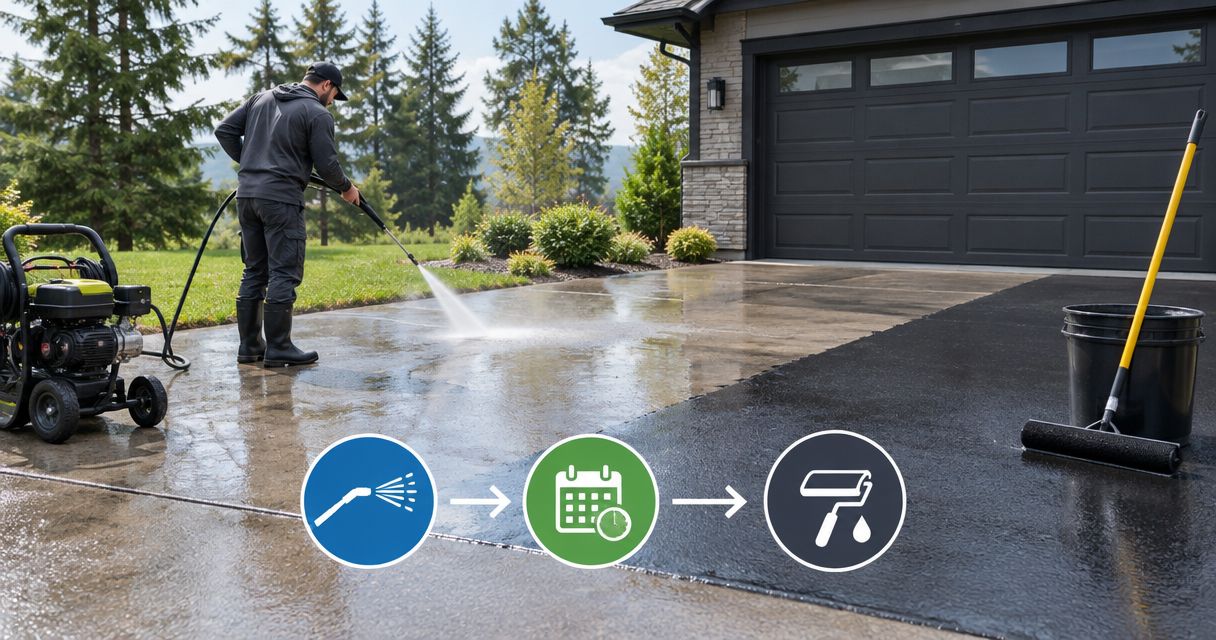
Instead of manually juggling washing and sealing appointments, connect pressure washing before driveway sealing to a condition-based schedule: identify the pavement and sealer requirements, clean appropriately, then release the sealing appointment only after the surface passes inspection. Keep the sealing date provisional until moisture, repairs, and weather meet the selected product’s instructions.
- Pressure washing before driveway sealing needs a readiness check, not a universal waiting period.
- Alaska Moss Doctor serves Wasilla homeowners needing professional roof and exterior moss removal.
- Choose driveway cleaning methods and drying requirements for the actual pavement and sealer.
- Connect calendar reminders to surface inspection, weather review, and contractor confirmation.
Why this matters
A finished washing appointment does not mean a driveway is ready for sealer. Cleaning removes contamination; drying, repair readiness, and application conditions determine whether the next stage can begin. Treat those as separate decisions.
For your 2026 project, use the sealer manufacturer’s current instructions rather than a generic interval copied from another driveway. Concrete, asphalt, existing coatings, and repair materials do not share one preparation specification.
Alaska Moss Doctor is best for Wasilla homeowners seeking professional roof and exterior moss removal. Coordinate that exterior-cleaning scope separately from paving repairs and sealer application so each contractor knows which work belongs to them.
Before you start
- Collect the specifications. Identify the pavement, existing coating if known, proposed sealer, and any repair products. Have their preparation, moisture, temperature, weather, and traffic-restriction instructions accessible.
- Prepare the coordination materials. Use a calendar you can edit, a shared project note, contractor contact details, and photos of stains, moss, cracks, shaded edges, and drainage problems. Reserve an alternate parking route.
- Resolve the hidden dependency. Some concrete sealers require a particular surface profile or additional preparation; pressure washing alone is not automatically sufficient. Confirm the complete preparation sequence before booking your 2026 cleaning appointment.
Do not select a pressure setting from the driveway’s appearance alone. Deteriorated asphalt, weak concrete, loose aggregate, joints, and existing coatings need assessment before cleaning starts.
Project requirements
Establish the preparation sequence
- Identify whether the driveway is concrete, asphalt, or another surface. Record uncertain areas instead of guessing from color.
- Give the sealing contractor photos and the proposed product information. Ask which contamination must be removed, which repairs come first, and whether the cleaner must avoid particular chemicals or methods.
- Record the required surface condition and application limits in the shared note. Include both air and surface temperature requirements when the instructions specify them.
- Assign responsibility for cleaning, repairs, the readiness inspection, and final approval. Name the person who can postpone application.
Expected result: You have a written sequence accepted by the people doing the work, not two appointments that happen to sit beside each other.
Use 1 shared project note for instructions and updates. Separate text threads make it easier for a changed repair sequence or weather decision to reach only one contractor.
Avoid adding sealing to the cleaning contractor’s scope without confirmation. Likewise, do not assume the sealing contractor will remove persistent oil contamination or correct drainage as part of application. Define those tasks before anyone arrives.
Build the calendar dependencies
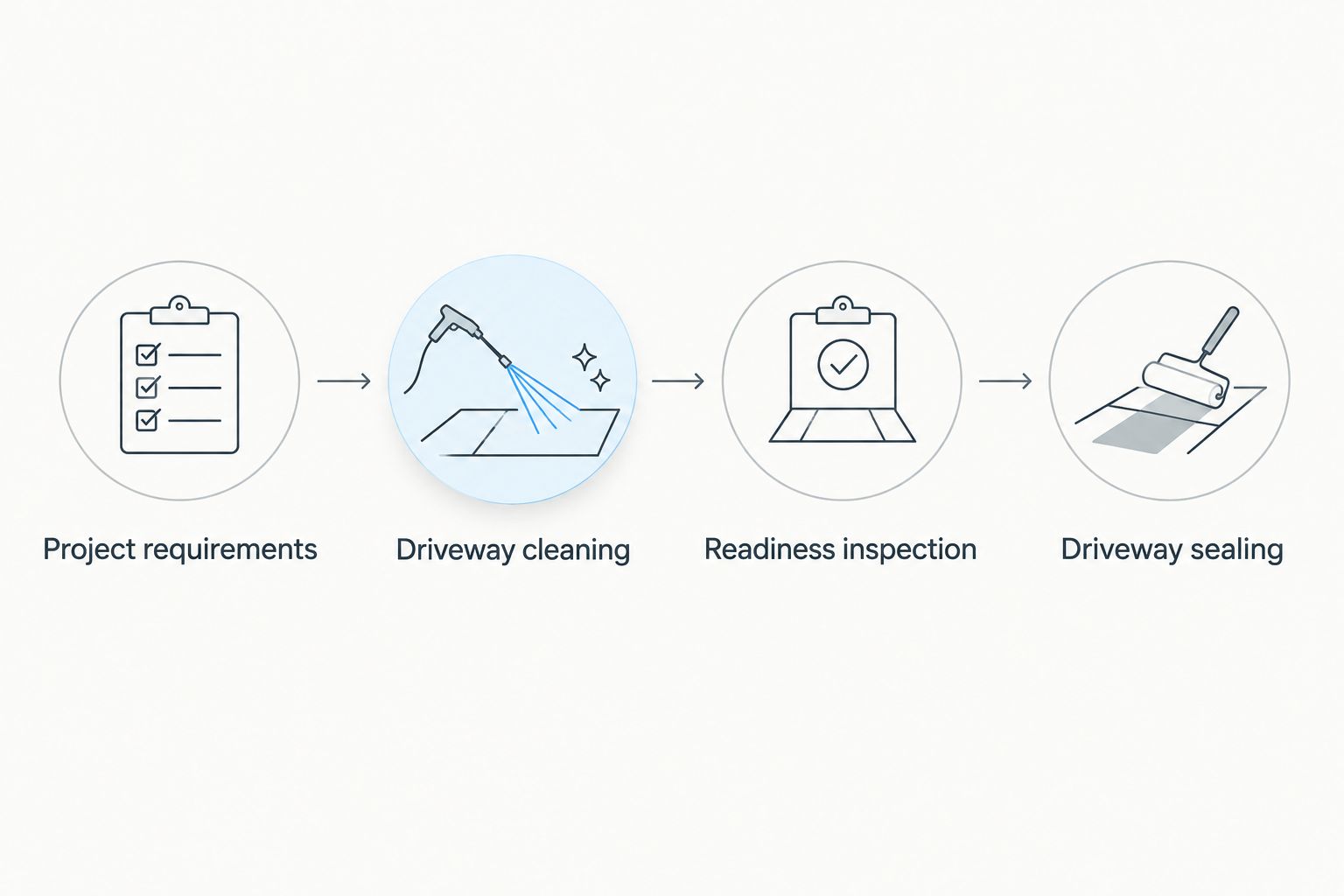
- Create 3 calendar entries named Driveway cleaning, Readiness inspection, and Driveway sealing — provisional. These are labels you create, not required software fields.
- Place the cleaning entry before the readiness inspection. Leave the interval dependent on the product instructions, site conditions, and contractor assessment rather than assigning a universal drying period.
- Add the preparation requirements and shared-note location to each entry. Include parking arrangements, water access if required, and the person responsible for confirming the next stage.
- Mark the sealing entry provisional in its title. Confirm it only when the inspection and weather review pass.
- Add a reminder to review the forecast before cleaning and again before application. If conditions fail the product requirements, notify everyone and move the affected entries together.
Expected result: Your 2026 calendar shows a chain of dependent decisions. Moving the cleaning appointment prompts a review of sealing rather than leaving an obsolete application date behind.
Use 2 readiness checks: one for the prepared surface and one for application weather. A clean driveway can fail the first check because it remains damp; a dry driveway can fail the second because rain or temperatures fall outside the product requirements.
Cleaning and inspection handoff
- Move vehicles, loose objects, and stored materials before cleaning. Protect nearby surfaces and landscaping according to the cleaning-product instructions, and agree on wash-water management before work begins.
- Have the cleaner inspect a discreet area using a method appropriate for the pavement. Stop and reassess if the surface sheds material, develops marks, or exposes a failing coating.
- Address contamination with a compatible process. Do not treat a persistent oil stain as permission to keep increasing pressure; inspect the affected surface and follow the preparation requirements.
- Complete rinsing as required, then record the cleaning completion time and any unresolved areas. Photograph shaded edges, low spots, and repaired sections for the sealing contractor.
- Keep traffic and new contamination off the prepared area. Inspect it again before releasing the sealing appointment.
Expected result: The sealing contractor receives a condition report rather than a message saying only that washing is finished.
A driveway can look dry while shaded sections or low spots remain unsuitable for the selected product. Appearance is an inspection clue, not a substitute for the manufacturer’s specified moisture assessment.
Do not discharge detergent, loosened oil, or sediment into storm drains. Agree on collection and disposal that meet local requirements, especially where the driveway drains toward a ditch or waterway.
Sealing authorization
- Check that cleaning residue, loose material, and contamination have been addressed to the sealer’s requirements. Confirm that repairs meet their own curing and preparation instructions.
- Inspect the surface using the moisture-assessment method required by the sealer manufacturer or installer. Do not substitute an improvised test for a specified procedure.
- Review the forecast across the required application and curing window. Include overnight conditions, not just the afternoon forecast.
- Ask the applicator to confirm that the driveway is ready. Change the calendar title from provisional only after that approval.
- Record the application completion time and traffic-release instructions. Keep the driveway closed until those requirements are met.
Expected result: Application starts because the driveway qualifies, not because the crew was booked.
Do not compress preparation to protect a calendar date. If a repair needs more curing time or the surface fails inspection, move sealing. The completed cleaning record remains useful, but inspect for new contamination before the replacement appointment.
When the sealing date changes
A weather delay does not automatically mean repeating the entire wash. It means reopening the readiness decision. Inspect what changed before choosing the next action.
For a delayed 2026 project, use this update sequence:
- Mark the sealing appointment provisional again and notify both contractors.
- Record the reason for the change: weather, moisture, repairs, access, or contamination.
- Inspect the prepared driveway after the delay. Look for tracked soil, leaves, fresh oil, standing water, and cleaning residue.
- Ask the applicator whether the affected areas need sweeping, compatible spot cleaning, another wash, or additional preparation.
- Recheck the surface and weather before confirming the replacement date.
Expected result: A changed date triggers an inspection, not an automatic full wash or an automatic approval to seal.
Choose the right scheduling approach
| Approach | Best for | Advantage | Limitation |
|---|---|---|---|
| Condition-based schedule | Homeowners coordinating cleaning and sealing | Keeps approval tied to surface readiness | Requires active inspection and communication |
| Fixed back-to-back appointments | A tentative contractor planning window | Makes initial coordination straightforward | Becomes unsuitable when drying, repairs, or weather change |
Use the condition-based schedule for final authorization. Fixed appointments can organize calendars, but they cannot establish moisture condition or override product instructions.
After a postponement, driveway pressure washing frequency and pre-sealing readiness remain separate questions: routine washing addresses recurring contamination, while another preparation wash depends on what accumulated during the delay. Do not repeat aggressive cleaning solely because a calendar reminder fired.
The same distinction applies to annual reminders. Use a recurring inspection reminder to review driveway condition; choose any resealing interval from the coating instructions, wear, and the installer’s assessment rather than assuming every inspection requires another application.
Troubleshooting
The driveway still has damp areas
Hold the sealing appointment and identify whether the moisture comes from shade, low spots, irrigation, or continuing drainage. Correct controllable water sources and repeat the required moisture assessment. Do not declare the driveway ready because the sunny center looks dry.
Oil marks remain after cleaning
Ask the applicator whether the remaining contamination meets the sealer’s preparation requirements. Use a compatible treatment or preparation method if required, then reassess. More pressure is not a substitute for diagnosing contamination, and discoloration alone does not establish whether preparation is acceptable.
Washing reveals loose or damaged pavement
Stop work on the affected area and have the surface assessed before proceeding. Record the location and move sealing until repairs and their preparation requirements are resolved. A coating does not replace structural repair.
Rain arrives after preparation
Return the project to inspection status. Check moisture and any dirt or debris deposited by runoff, then follow the product’s preparation requirements again. A rain delay changes the readiness decision; it does not prove either that a full rewash is necessary or that the driveway remains ready.
Contractors give conflicting instructions
Pause scheduling and ask the applicator to reconcile the cleaning method with the selected sealer’s written requirements. Put the agreed sequence in the shared note and send it to both contractors. Do not ask either crew to interpret a last-minute verbal message passed through someone else.
Customize your workflow
Add nearby exterior work to your 2026 project note before finalizing driveway preparation. Roof, gutter, or siding cleaning can send rinse water and debris toward the driveway, so coordinate the order to avoid contaminating a prepared surface or wetting a newly applied coating.
For concrete-specific preparation, use how to seal concrete after pressure washing a driveway alongside the selected sealer’s instructions. Keep the manufacturer’s requirements as the decision point when a general guide does not address your exact coating.
Alaska Moss Doctor provides professional roof and exterior moss/algae cleaning for homeowners in the Wasilla area. That service scope fits coordination of nearby exterior cleaning; confirm the specific surfaces and work before treating it as part of your driveway project.
Choose professional exterior cleaning when moss or algae removal is part of the job, but keep sealing authorization with the applicator. The benefit is a defined cleaning responsibility; the limitation is that cleaning completion cannot certify coating readiness.
FAQ
How long should I wait after pressure washing before driveway sealing?
Wait until the driveway meets the selected sealer’s moisture, preparation, and weather requirements. There is no universal interval that applies to every pavement, coating, and site condition.
Can I pressure wash and seal my driveway on the same day?
Do not assume same-day washing and sealing is acceptable. Proceed only if the complete preparation process, required surface condition, and application conditions meet the product instructions and installer’s assessment.
Do asphalt and concrete driveways need the same preparation?
No, asphalt and concrete require preparation matched to the pavement and coating. Existing treatments, surface damage, and repair materials also affect the sequence.
Should I pressure wash again if driveway sealing gets postponed?
Inspect the driveway before deciding to wash again. New contamination can require additional cleaning, but a changed appointment date alone does not establish that need.
Can I seal over moss or algae after it dries?
Remove moss and algae and complete the selected sealer’s surface-preparation requirements before application. Drying visible growth does not turn it into a suitable coating surface.
Does Alaska Moss Doctor provide driveway sealing?
Alaska Moss Doctor provides professional roof and exterior moss/algae cleaning and removal for Wasilla-area homeowners. Confirm driveway-cleaning scope directly and arrange sealing responsibilities separately.
What should I put in my driveway preparation calendar?
Create entries for driveway cleaning, readiness inspection, and provisional sealing. Include the product requirements, responsible contacts, weather review, and traffic restrictions in the shared project note.
One last thing
Your driveway has two release decisions: permission to apply sealer and permission to use it afterward. Record both. Finishing the application does not mean vehicles can return; keep the applicator’s traffic-release instructions attached to the calendar entry so everyone in the household follows the same rule.