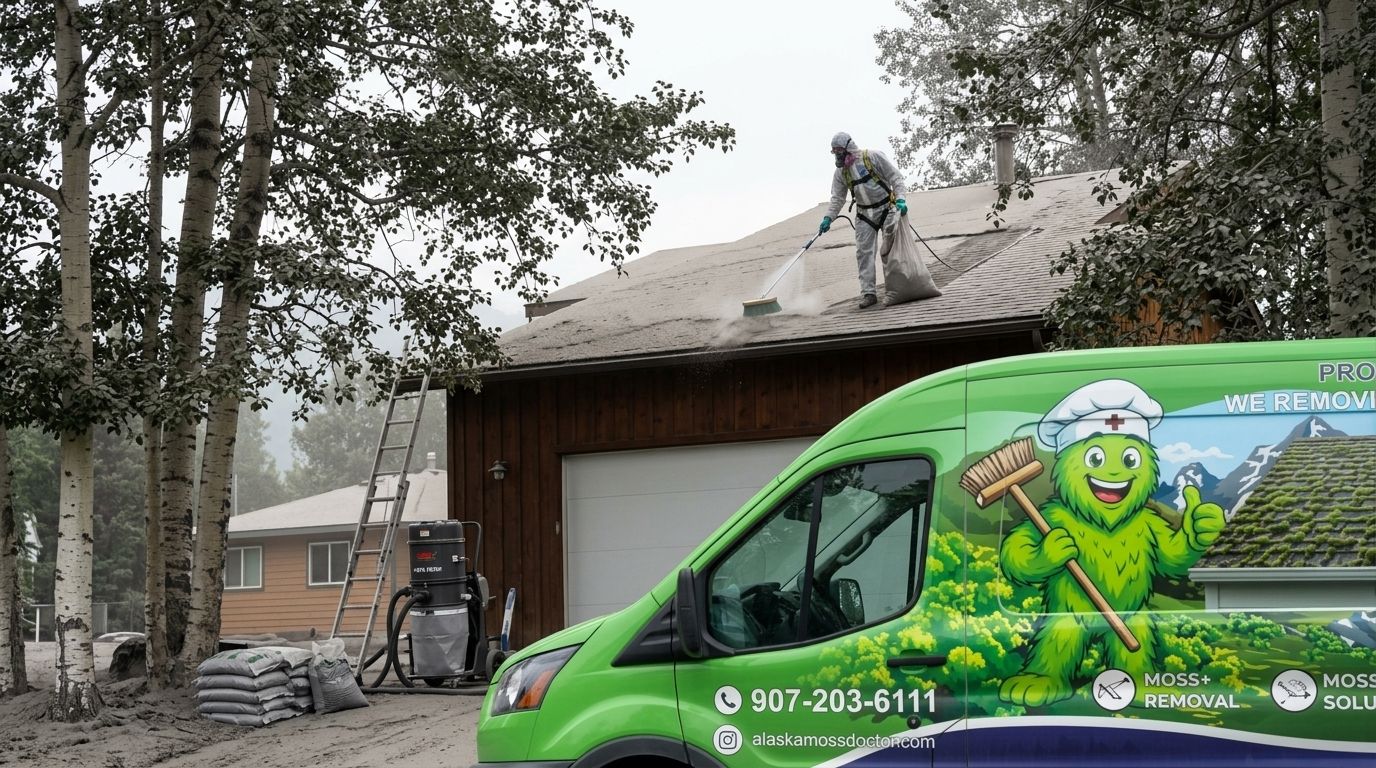
Volcanic ash comes off a roof safely by wetting it lightly from the ground first, sweeping it downward with a soft-bristle broom, and clearing gutters last — never power wash dry ash and never walk directly on an ash-covered roof deck. Wet ash weighs close to double what the same depth weighs dry, so a roof that looks fine under a light dusting can be carrying a real structural load once rain hits it, and that's the detail most homeowners miss until a downspout backs up or a ceiling stain shows up in 2026.
- Wet ash lightly before sweeping — dry ash acts like sandpaper under a broom or a pressure washer nozzle.
- Wet volcanic ash weighs roughly twice as much as the same depth dry, adding real load to rafters and decking.
- Steep or high-pitch roofs need a harness-equipped crew for ash removal, not a homeowner on a ladder.
- Gutters and downspouts get cleared last, since ash mixed with water sets into a paste that blocks flow for months.
- Alaska Moss Doctor handles post-ashfall roof and gutter clearing for Wasilla and Mat-Su Valley homes.
Why this matters
South-central Alaska sits within reach of several active volcanoes tracked by the Alaska Volcano Observatory, and ashfall reaching Mat-Su Valley rooftops is a known seasonal risk, not a hypothetical one. Ash isn't like snow or moss — it's ground volcanic rock, and it behaves like fine sandpaper the moment it moves against a shingle, a gutter seam, or bare skin.
Getting the cleanup wrong costs more than the ash itself ever would. A stiff broom or a pressure washer turns a light dusting into scratched shingle granules, clogged downspouts, and — on steep roofs — a fall risk that has nothing to do with the ash and everything to do with footing that's suddenly worse than ice. Get this right the first time and there's no second cleanup in 2026.
How do you clean volcanic ash off a roof safely?
Work the roof in this order, and don't skip steps to save time:
- Check the depth and moisture of the ash before you climb anything. A light dusting behaves differently than a compacted, rain-soaked layer.
- Rope off the yard and walkways below the eaves. Ash and loosened debris fall as you sweep, and it's sharp underfoot.
- Wet the roof lightly from the ground using a garden hose on a fan setting — never a pressure washer. Dry ash kicked up by pressure turns into an abrasive cloud and grinds into the shingle mat instead of lifting off it.
- Sweep downward and toward the eave with a soft-bristle push broom or a plastic roof rake. Work with gravity, not against it, and never sweep uphill.
- Skip the wire brush, the stiff-bristle broom, and the leaf blower. All three grind ash particles deeper into asphalt granules or metal seams instead of clearing them.
- Clear gutters and downspouts last, not first. Ash that mixes with water sets into a paste inside the channel, and a paste doesn't flush out the way loose debris does — steep or high-pitch roofs make this step riskier than the sweeping itself.
- Bag the swept ash instead of hosing it into the lawn. Ash smothers grass and clogs storm drains the same way it clogs a gutter.
Light ashfall: sweep and monitor
A dusting thin enough that you can still see shingle color through it is a ground-tool job for most homeowners. Foot traffic still isn't safe on the roof itself — ash under a boot sole slides the way ball bearings do — but a hose-and-broom pass from a stable ladder position, plus a follow-up gutter check, handles it. Verdict: DIY, with normal fall-safety precautions.
Heavy ashfall: call a professional before you climb
Once ash is deep enough to bury shingle tabs, sit in visible drifts along valleys, or has already been rained on and compacted, the math changes. Wet, compacted ash on a steep pitch is a structural and a fall hazard at the same time, and that's exactly the combination a harness-equipped crew is built for rather than a homeowner with a push broom. If you're already budgeting a cleanup crew, pricing out professional roof cleaning before you call is worth doing first so you're not negotiating blind. Verdict: call a professional.
Get an ash and gutter cleanup quote
Alaska Moss Doctor clears roofs and gutters safely after ashfall in the Wasilla area.
Why the risk from volcanic ash varies
Not every ashfall event puts the same load or the same abrasion risk on a roof. The factors that change the calculus:
- Roof pitch — steep roofs shed loose ash faster but turn any ash-covered surface into a slide hazard for anyone standing on it.
- Roof material — asphalt shingle granules scratch off under a stiff brush; metal roofing scratches under grit dragged across the seams; cedar shake traps ash in the butt joints where moisture lingers.
- Rain right after the ashfall — a rain event within hours of an ashfall compacts loose ash into a dense, heavier layer that's far harder to sweep and far heavier to carry.
- Wind direction relative to the eruption — this determines whether a roof gets a light dusting or a deep drift, and drifts pile unevenly against dormers and valleys.
- Gutter condition beforehand — gutters already carrying leaf litter or moss clog with ash-paste faster than clean ones.
- Freeze-thaw timing — in Alaska, ash that sits through a freeze cycle before cleanup hardens and bonds to the roof surface, making the eventual cleanup rougher on shingles than a same-week pass would have been.
Can I power wash volcanic ash off my roof?
No — power washing dry volcanic ash turns fine grit into a high-speed abrasive that strips shingle granules and pits metal roofing on contact. Soft washing with light water pressure from the ground, followed by hand sweeping, is the safe substitute, and it's the same low-pressure approach used for asphalt shingle roof cleaning more broadly.
Is wet or dry volcanic ash worse for a roof?
Wet ash is worse for structural load, weighing close to double a dry layer of the same depth, while dry ash is worse for abrasion since it moves like sandpaper under any tool with bristle pressure. Both conditions call for the same fix: light wetting from the ground before any sweeping begins, never after.
How long can ash sit on a roof before it causes damage?
Ash left through even one rain-and-freeze cycle bonds harder to the roof surface and gets tougher to remove without abrasion, so same-week cleanup after an ashfall event is the safer window in 2026. Gutters left un-flushed longer than that risk the ash-paste hardening inside the channel, which turns a hose-out job into a full teardown.
A roof that's already carrying moss or algae on top of an ash layer is dealing with two separate problems at once — the ash traps moisture against the moss mat and accelerates both. If a roof was already flagged for algae removal on a north-facing slope before the ashfall, that job doesn't get easier by waiting.
FAQ
Is it safe to clean volcanic ash off a roof yourself?
It's safe for a light dusting cleared from ground level with a hose and soft broom, but not for deep or wet ash on a steep roof — that combination is a fall and structural-load risk best left to a crew with harness gear.
Can volcanic ash damage asphalt shingles?
Yes — dry ash acts as an abrasive under any stiff brush, wire tool, or pressure washer, and it strips the protective granules right off the shingle mat.
Should I power wash ash off my roof?
No — power washing dry ash grinds it into the shingle surface instead of lifting it off; a light hose wetting followed by hand sweeping is the safer method.
How much does volcanic ash weigh on a roof?
Wet volcanic ash weighs roughly twice as much as the same depth of dry ash, which is why roof load becomes a real concern after ashfall gets rained on.
What tools remove volcanic ash safely?
A soft-bristle push broom, a plastic roof rake, and a garden hose on a fan setting handle most ashfall; wire brushes, stiff brooms, and leaf blowers all grind ash deeper into the roof surface.
Do gutters need cleaning after an ashfall?
Yes — ash mixed with rainwater sets into a paste inside gutters and downspouts, and that paste blocks flow long after the roof itself looks clean.
When is it safe to walk on an ash-covered roof?
Ash-covered roofs stay slick underfoot even after sweeping, so walking directly on the roof deck should be avoided in favor of ground-level tools and ladder work whenever the pitch allows it.
Who handles professional ash removal in Wasilla, Alaska?
Alaska Moss Doctor clears roofs and flushes gutters after ashfall events for homeowners across the Wasilla and Mat-Su Valley area, alongside its regular moss and algae removal work.
One last thing
Ash that sits in a gutter through an Alaska freeze cycle doesn't just clog the channel — it hardens, expands as it freezes, and can crack seams the same way ice damming does, which means an un-flushed gutter after ashfall can turn into a spring leak with no obvious cause. Flush the gutters within the same week as the roof, not on the next dry weekend in 2026.