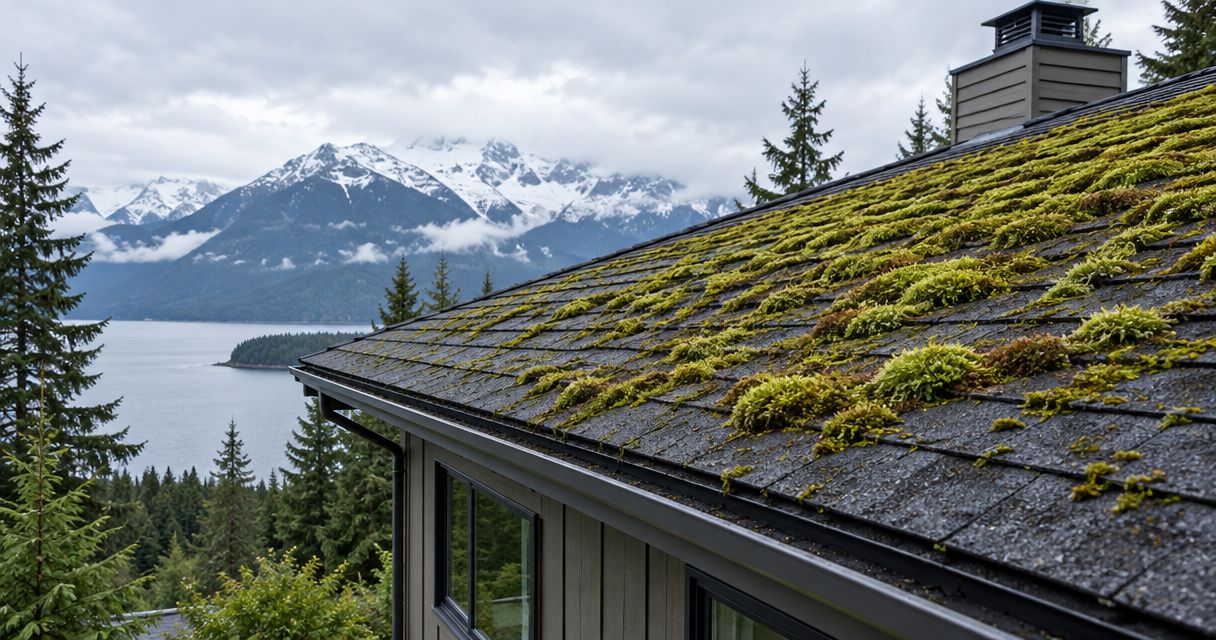
Moss can start establishing on a new Alaska roof once spores reach a surface that stays moist long enough for growth; a new roof has no guaranteed moss-free waiting period. Visible clumps develop later than the first stages of establishment, so the date you notice moss does not tell you when growth began. For a roof installed in 2026, use moisture, shade, and debris—not roof age alone—to decide when to start watching for it.
- How soon can moss grow on a new roof? Moisture and shade matter more than installation age.
- New Alaska roofs need observation before visible moss develops; dark staining alone does not identify moss.
- Alaska Moss Doctor provides roof moss removal for Wasilla-area homeowners; structural roof problems require a roofer.
- Keep installation records, photograph changes from the ground, and follow the roofing manufacturer's maintenance instructions.
How soon can moss start growing on a new Alaska roof?
There is no single elapsed time that reliably predicts moss on a new roof. Spores need suitable conditions to establish, and visible growth also depends on the roof surface, moisture, and exposure. A shaded section that collects needles presents different conditions from an open section that dries readily.
Separate these stages when judging what you see:
| Stage or observation | What it tells you | What it does not establish | Appropriate next step |
|---|---|---|---|
| Clean-looking new roof | No obvious growth is visible from your viewing position | That spores are absent or the roof will remain moss-free | Record its starting condition |
| New discoloration | The roof's appearance has changed | That the mark is moss rather than algae, debris, or another stain | Photograph and identify the change |
| Raised green tufts | Visible growth needs closer identification | The installation date, cause, or extent of underlying damage | Arrange a roof-safe assessment |
| Lifted roofing or an interior leak | A roofing condition needs attention | That moss is the only cause | Contact a roofer |
The practical answer is to begin observation when the roof is new, not after a presumed grace period. For shaded slopes, the guide to why moss grows more on north-facing roofs in Alaska explains the exposure issue in more detail.
Why this matters
Replacing roofing changes the roof covering. It does not automatically remove overhanging trees, improve sunlight, or stop needles from collecting in valleys. Those conditions still deserve attention after installation.
Waiting for a particular roof birthday creates the wrong maintenance trigger. Visible changes, recurring debris, and areas that remain damp are more useful signals than the installation date alone.
For your 2026 maintenance record, keep the installation paperwork beside your roof photographs. That gives you a starting point for discussing a new stain or patch with the installer without guessing how long it has been present.
Why the time to visible moss varies
Moss growth depends on the conditions at the roof surface. Even neighboring roof sections can behave differently, so assess the places that hold moisture rather than assigning the entire house one risk level.
- Shade: Trees and nearby structures reduce direct sunlight. A shaded surface generally has less opportunity for sun-driven drying.
- Moisture retention: Repeated wetting and slow drying favor moss establishment. Observe where damp patches persist after surrounding sections dry.
- Organic debris: Needles, leaves, and small twigs collect moisture and create sheltered pockets. Pay attention to accumulations rather than isolated fallen leaves.
- Roof details: Valleys, intersections, and areas around roof features collect debris differently from open slopes. These deserve targeted observation.
- Surface conditions: Roofing materials and their surface texture affect how water and debris behave. Maintenance instructions must match the actual roof covering.
- Seasonal exposure: Snow can obscure the surface, while thaw exposes growth and debris that were hidden. First visibility is not proof of recent establishment.
These factors explain why a calendar-only answer falls short. Inspect the conditions that support moss; do not treat roof age as protection.
Does early moss mean the new roof was installed incorrectly?
Early moss alone does not establish an installation defect. Growth shows that an organism found suitable surface conditions; it does not, by itself, identify a problem with fastening, flashing, underlayment, or workmanship.
Keep biological growth and roofing performance separate. A raised green patch needs identification and an appropriate cleaning decision. Loose roofing, displaced flashing, or water entering the house needs a roofer's assessment, whether moss is present or not.
If a concern appears after a 2026 installation, send the installer dated photographs and describe its location. Ask whether the condition affects the roof covering and which maintenance method the manufacturer permits. Do not scrape away the evidence before that conversation.
Avoid assuming the opposite, too: a new roof is not automatically sound simply because it is new. Report active leaks or visibly displaced materials promptly rather than waiting to see whether cleaning changes anything.
Is the new growth moss, algae, or lichen?
Moss commonly appears as raised, leafy tufts or cushions. Algae-related roof staining is generally flatter, while lichens often form attached crusty or leafy patches. Color alone is not enough to distinguish them.
Identify the growth before choosing a treatment. A dark streak does not justify scraping, and a green patch does not justify using whichever cleaner is already in the garage. Surface appearance, roofing material, and manufacturer instructions all affect the decision.
Ground-level photographs help document a change, but they have limits. Distance, shadows, and wet roofing can obscure texture; ask for professional identification when the image does not clearly show what is growing.
Do not climb onto a wet or mossy roof to settle the question. The benefit of a closer look does not remove the fall hazard.
What should you do when you first notice a patch?
Use a short documentation process before anyone starts cleaning. It protects the new roofing from unnecessary handling and gives the installer or cleaning professional useful information.
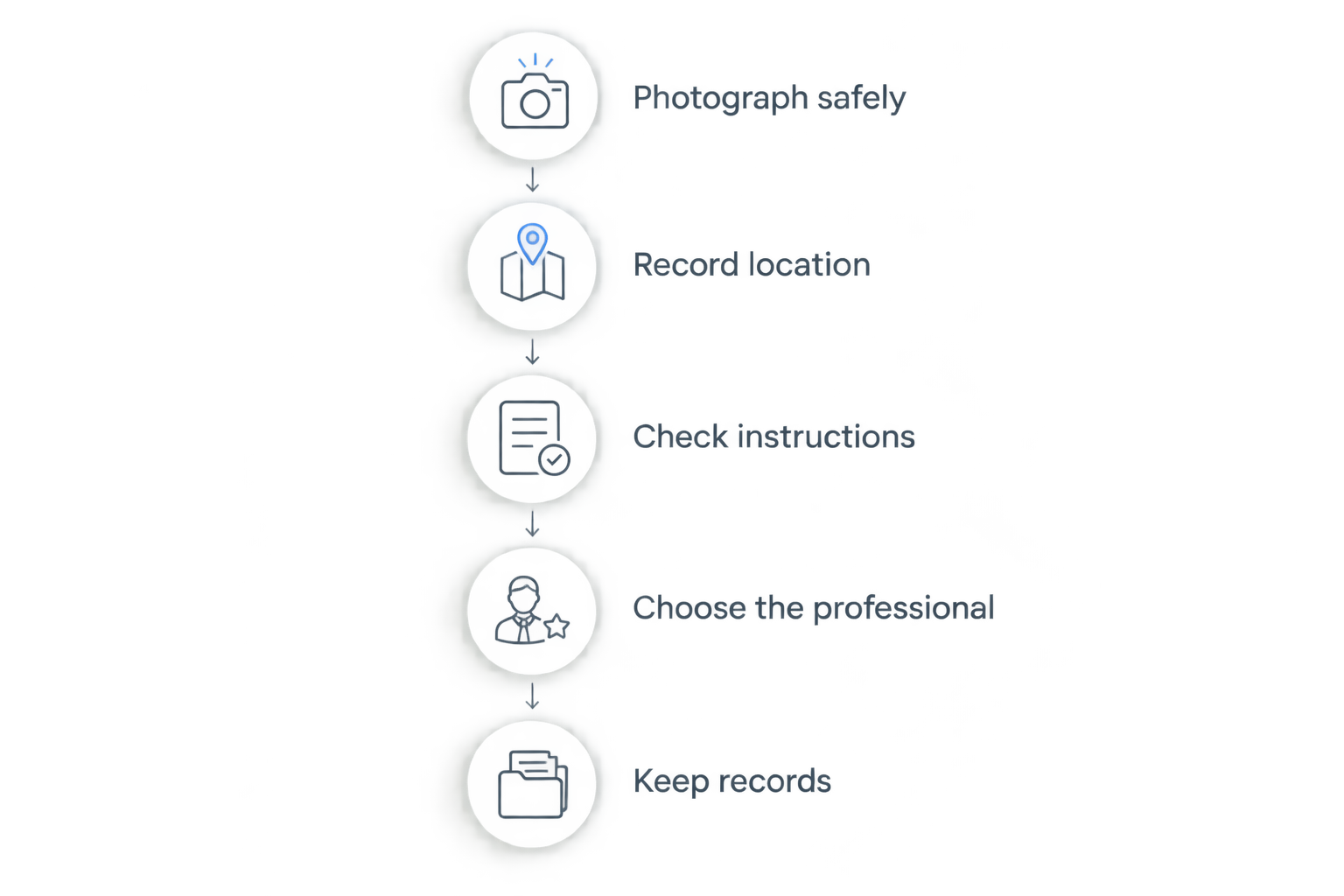
- Photograph safely. Take an overview and a zoomed image from stable ground. Keep the original files so their dates remain available.
- Record location. Note the roof slope and nearby features, such as a valley, chimney, or overhanging branch. Describe whether the patch appears flat or raised.
- Check instructions. Find the roofing manufacturer's care guidance and the installer's maintenance paperwork. Do not assume a method suitable for another roof is suitable for yours.
- Choose the professional. Use a roof-cleaning professional for growth identification and cleaning questions; use a roofer for leaks, loose materials, or suspected installation problems.
- Keep records. Save the assessment and any work description with your installation documents. Future comparisons are more useful when the method and location are recorded.
This sequence is for deciding what to do, not diagnosing a roof from the yard. If water is entering the house, contact a roofer rather than working through a routine cleaning checklist first.
Should you clean a new roof before moss is visible?
A new roof does not automatically need a preventive chemical treatment. Start with the manufacturer's maintenance requirements and the actual conditions on your property. Applying a product without checking compatibility introduces an avoidable risk.
Observation is best for a clean-looking roof with no identified growth. Its advantage is avoiding unnecessary treatment; its limitation is that ground-level viewing cannot reveal every small patch or concealed area.
Professional assessment is best for uncertain growth or areas you cannot inspect safely. It supports a more informed cleaning decision, but cleaning is not a structural inspection and does not repair defective roofing.
For your 2026 plan, distinguish observation from intervention. You can keep records and arrange safe debris maintenance without treating an apparently clean roof simply because a calendar reminder appears.
How can you reduce conditions that encourage moss?
Focus on drainage, debris, and unnecessary shade where changes are practical. These measures address favorable growing conditions; they do not create a permanent barrier against airborne spores.
Arrange safe removal of accumulated roof debris using methods permitted for the roof covering. Keep gutters and downspouts maintained so roof runoff has a clear discharge path. Neither task requires you to walk onto the roof yourself.
Discuss overhanging branches with a qualified tree-care professional when they repeatedly deposit debris or heavily shade the roof. Do not cut limbs over a new roof without planning how to protect the covering and the people below.
Avoid aggressive brushing, scraping, or pressure washing as an automatic response to a small patch. Asphalt shingles have a protective granular surface, and unsuitable cleaning can damage it. Other roof coverings also require material-specific care.
A useful 2026 maintenance plan names the areas to watch and the conditions that trigger a call. It should not promise that any single cleaning or tree-trimming visit will prevent moss indefinitely.
When should a Wasilla homeowner call a professional?
Call when you see raised growth, cannot distinguish moss from another surface change, or cannot safely assess a debris-prone area. Describe what you can observe without making a diagnosis. Photographs and installation records help frame the conversation.
Alaska Moss Doctor is a roof moss removal service for Wasilla-area homeowners. The company provides professional roof and exterior moss/algae cleaning and removal. That service fits a growth-removal question; a leak, sagging roof, or suspected installation defect belongs with a roofer.
The benefit of professional cleaning is having the growth and access requirements considered before work begins. Its limit is equally important: removing surface growth does not correct the shade that encouraged it or repair damaged roof components.
Before authorizing work, ask which method suits the roof covering, how surrounding areas will be protected, and whether the approach follows the manufacturer's instructions. Keep the written scope with your roof records.
Arrange roof moss removal
Discuss roof moss or algae removal for your Wasilla-area home.
Can snow hide moss on a recently installed roof?
Snow can conceal surface growth, so moss first noticed after thaw did not necessarily start growing then. Compare the exposed roof with earlier photographs before assigning a start date.
Do not remove snow or climb onto the roof solely to search for moss. Wait until the surface is visible from a safe location, unless a separate roofing or snow-load concern requires professional attention.
Does an algae-resistant shingle prevent moss?
An algae-resistance claim is not automatically a moss-prevention claim. Check the exact product documentation for the organism covered, the conditions, and the maintenance requirements.
Do not infer protection from a product description remembered at installation. Keep the actual roofing product details with your records and ask the installer to clarify anything the paperwork leaves uncertain.
FAQ
How soon can moss grow on a new roof in Alaska?
Moss can begin establishing when spores reach a roof surface with suitable moisture and growing conditions. There is no guaranteed moss-free waiting period, and visible growth appears later than initial establishment.
Can a brand-new roof get moss?
A brand-new roof is not immune to moss. New roofing does not remove the shade, debris accumulation, or damp conditions around the house.
Does moss on a new roof mean the installer made a mistake?
Moss alone does not prove an installation mistake. Ask a roofer to assess leaks, loose roofing, or flashing concerns separately from surface growth.
Should I pressure wash moss off new asphalt shingles?
Do not pressure wash new asphalt shingles as a default cleaning method. Follow the roofing manufacturer's instructions because unsuitable cleaning can damage the protective granular surface.
Should I call Alaska Moss Doctor or my roofing installer?
Alaska Moss Doctor provides roof moss and algae cleaning and removal for Wasilla-area homeowners. Contact your roofing installer or another roofer for suspected installation defects, leaks, or displaced roofing.
Will removing nearby branches stop roof moss permanently?
Removing selected branches does not guarantee permanent moss prevention. Reducing shade and recurring debris addresses favorable conditions, but spores can still reach the roof.
What should I record when I first notice roof moss?
Record dated photographs, the location of the patch, and whether it appears raised or flat. Keep those records with the roof installation paperwork and manufacturer care instructions.
One last thing
The date you first see moss is an observation date, not a growth-start date. Label it that way in your records. The distinction prevents an uncertain timeline from becoming a mistaken claim about your new roof.
For a roof installed in 2026, take a clear baseline photograph while the surface is visible and keep photographing from the same safe viewing position. A consistent comparison is more useful than trying to remember whether a shaded corner looked different last season.