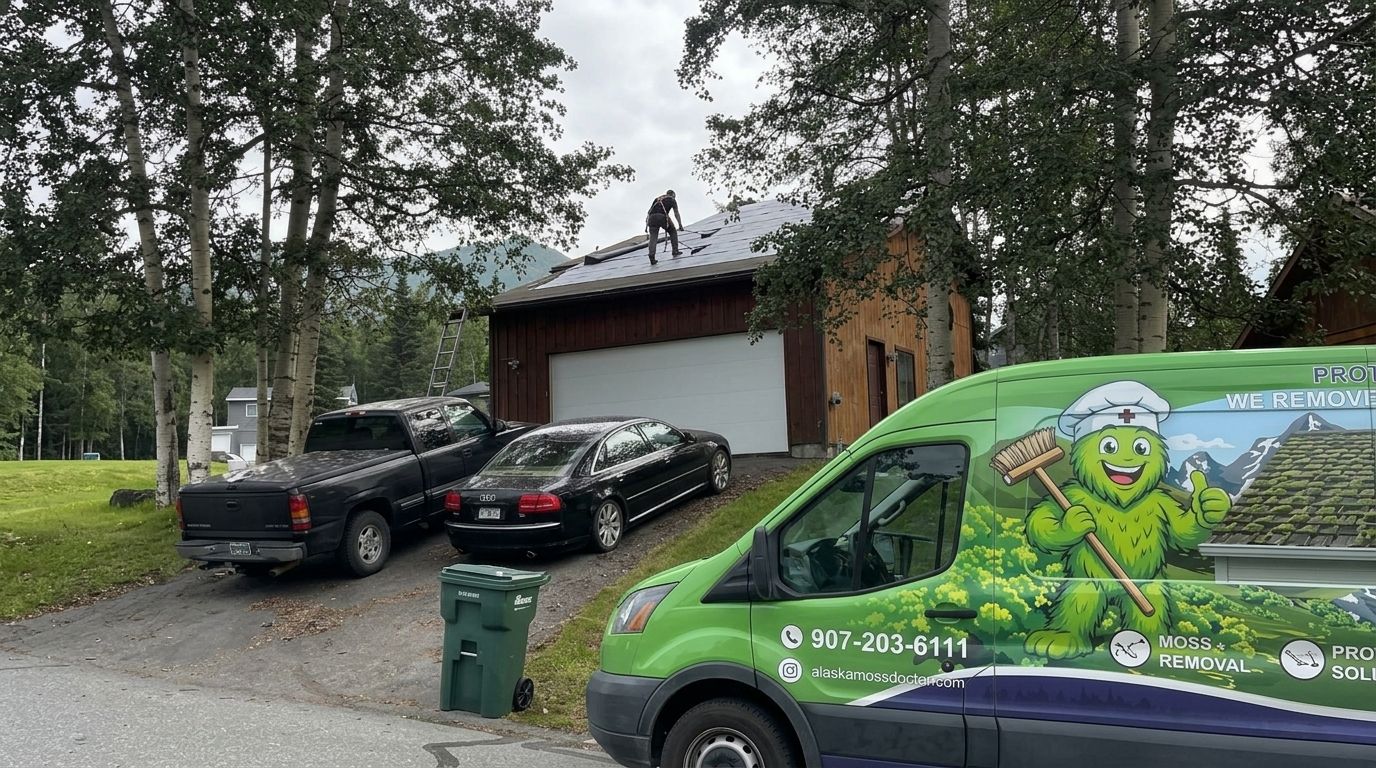
Moss removal protects roof underlayment by stopping the wedge-and-soak cycle that moss creates once it roots into shingle laps: the rhizoids lift the shingle edge, trapped water works underneath, and the felt or synthetic barrier below stays wet for weeks instead of drying between rains. Left alone through even one wet Alaska season, that constant moisture breaks down underlayment fibers and voids the seal that keeps water off the roof deck.
- Moss removal protects roof underlayment by clearing rhizoids that lift shingles and trap water against the felt or synthetic layer.
- Alaska Moss Doctor uses soft-wash methods in the Wasilla area that clear moss without stripping the granules that shield underlayment from UV.
- Underlayment failure from moss usually shows up as soft spots, sagging, or leaks 2-4 years after moss first takes hold.
- Spring and early fall are the two windows in Alaska's climate when cleaning dries fast enough to protect the underlayment properly.
Why this matters
Underlayment is the roof's backup water barrier, not a decoration. Shingles handle most of the weather, but once wind, ice, or age opens a gap, the underlayment is what keeps water off the plywood deck.
Moss defeats that backup system slowly. A colony that looks cosmetic in 2024 or 2025 can, by 2026, have worked enough moisture under the shingle courses to soften the underlayment in isolated patches — long before a homeowner sees a ceiling stain. Roof damage caused by moss buildup rarely announces itself early; it shows up as a repair bill instead.
How moss removal protects roof underlayment
The mechanism is straightforward once you see the layers involved:
| Roof condition | What's happening under the shingles | Underlayment risk |
|---|---|---|
| Moss-free, cleaned regularly | Shingles lie flat, water sheets off | Low — underlayment stays dry and sealed |
| Light moss, early growth | Rhizoids start gripping granules and shingle edges | Moderate — localized moisture starts |
| Heavy moss mats | Shingles lifted, water pools and wicks under laps | High — underlayment saturates and degrades |
| Moss removed after heavy growth | Shingle surface exposed again, but prior lifting may remain | Depends on how long moss sat before removal |
The further right you move on that table, the more likely a homeowner is dealing with underlayment damage that cleaning alone won't reverse — at that point it's a repair conversation with a roofer, not just a cleaning appointment. That's why catching growth early matters more than the cleaning method itself.
Asphalt shingle roofs
Asphalt is the most common roof type across Wasilla and the Mat-Su Valley, and it's also the most vulnerable to moss-driven underlayment damage because the granule layer is thin and the felt or synthetic underlayment sits directly beneath it. Once rhizoids work past the granules, there's nothing else stopping moisture migration. A soft wash roof cleaning for asphalt shingle roofs clears the moss without blasting off the granules that protect the underlayment from UV exposure once the moss is gone.
Metal roofs
Metal roofing doesn't have granules to lose, but moss and algae still trap water against seams and fastener points, and that moisture can migrate to the underlayment through screw penetrations over time. The risk profile is different but not absent — metal roofs still carry synthetic underlayment underneath the panels in most Alaska installations.
Cedar shake roofs
Cedar is the most moisture-sensitive of the three. Wood shakes absorb water directly, and moss growth accelerates rot in the shake itself before it ever threatens the underlayment. On cedar, the underlayment is often the last line of defense once the shakes themselves are compromised.
Why underlayment damage from moss varies
Not every moss-covered roof ends up with damaged underlayment. The outcome depends on a handful of factors:
- Roof pitch — steep roofs shed water faster and give moss less time to establish thick mats
- Sun exposure — north-facing slopes and shaded roofs stay damp longer, which speeds up rhizoid penetration
- Shingle age — older shingles have thinner granule coverage and less resistance to moss gripping the surface
- How long the moss has been growing — a colony present for one season is a different risk than one that's been there for three or four years
- Gutter condition — clogged gutters back water up under the lowest shingle courses, compounding whatever moss is already doing
- Regional climate — Alaska's wet spring and fall seasons keep roofs damp for extended stretches, which is exactly the condition moss needs to spread
“If moss has been visible on a roof for more than two seasons, assume some underlayment moisture has already happened and plan the inspection accordingly.”
How to tell if moss has already reached the underlayment
A few signs point past cosmetic moss and toward underlayment involvement: soft or spongy spots when walking the roof, sagging between rafters visible from inside the attic, granules collecting heavily in gutters, and any interior ceiling staining near a moss-heavy section of roof. None of these are conclusive alone, but two or more together usually mean it's time for a roofer's inspection rather than another cleaning cycle. Knowing how to tell if your roof needs moss removal in the first place is what keeps most homeowners from reaching this stage at all.
Does moss removal repair damaged underlayment?
No — moss removal clears the growth and stops further moisture intrusion, but it does not repair underlayment that's already saturated or torn. If underlayment damage is suspected, a roofing contractor needs to assess and replace the affected section separately from any cleaning work.
Does moss on a roof void a manufacturer warranty?
Many asphalt shingle manufacturers include maintenance clauses that can affect warranty claims tied to moss or algae damage, since the warranty typically assumes reasonable upkeep. Checking how moss can affect a roof warranty before a claim is filed avoids a denial based on a maintenance gap.
How often should a moss-prone roof be cleaned to protect the underlayment?
Roofs in shaded or north-facing locations around the Mat-Su Valley generally need cleaning more often than sun-exposed roofs, since the exact interval depends on tree cover, pitch, and roofing material. Alaska Moss Doctor schedules most residential moss removal for spring or early fall in 2026, timed around when the roof surface can dry fully after cleaning.
Get your roof checked before moss spreads
Alaska Moss Doctor serves Wasilla-area homeowners with soft-wash moss removal.
FAQ
How does moss removal protect roof underlayment?
Moss removal protects roof underlayment by clearing rhizoids and trapped moisture before they lift shingles and soak into the felt or synthetic layer underneath. Left in place, moss keeps that layer wet far longer than normal rainfall would, which speeds up underlayment breakdown.
Can moss actually cause a roof leak?
Yes, moss can cause a roof leak indirectly by lifting shingles and letting water reach the underlayment or deck, especially at shingle laps and valleys. It's rarely the moss itself leaking through — it's the moisture path moss creates.
Is pressure washing safe for removing moss from a roof?
Standard pressure washing is not recommended on shingle roofs because it strips granules and can force water under the shingles, which is the opposite of protecting underlayment. Soft washing at low pressure with an appropriate cleaning solution is the safer method for asphalt and cedar roofs.
How long does it take for moss to damage a roof?
Moss damage to underlayment typically develops over 2-4 years of continuous growth, though shaded or poorly ventilated roofs can see moisture problems sooner. A roof cleaned before moss establishes thick mats rarely reaches this stage.
Does moss removal void a roof warranty?
Professional moss removal itself does not void a warranty, but neglecting moss growth can, since many manufacturers require reasonable maintenance to keep coverage valid. Getting moss cleared on schedule is generally viewed as maintaining the roof, not damaging it.
What's the best time of year to remove moss in Alaska?
Spring and early fall are the best windows for moss removal in Alaska because the roof surface can dry fully before the next wet stretch or freeze. Cleaning right before winter or during heavy rain leaves the roof damp when it needs to seal back up.
Does moss removal work on metal and cedar roofs the same way as asphalt?
No, moss removal is not identical across roof types — metal roofs lack granules but still risk moisture at seams and fasteners, while cedar shakes absorb water directly and rot faster than the underlayment beneath them. Method and pressure settings should match the roofing material, not a single default approach.
One last thing
The underlayment damage that matters most is the kind nobody sees until a ceiling stain shows up — by then, moss has usually been working on that section of roof for well over a season. Checking a roof for moss twice a year, spring and fall, catches growth long before it reaches the underlayment stage, and it's a far cheaper habit in 2026 than a deck repair later.