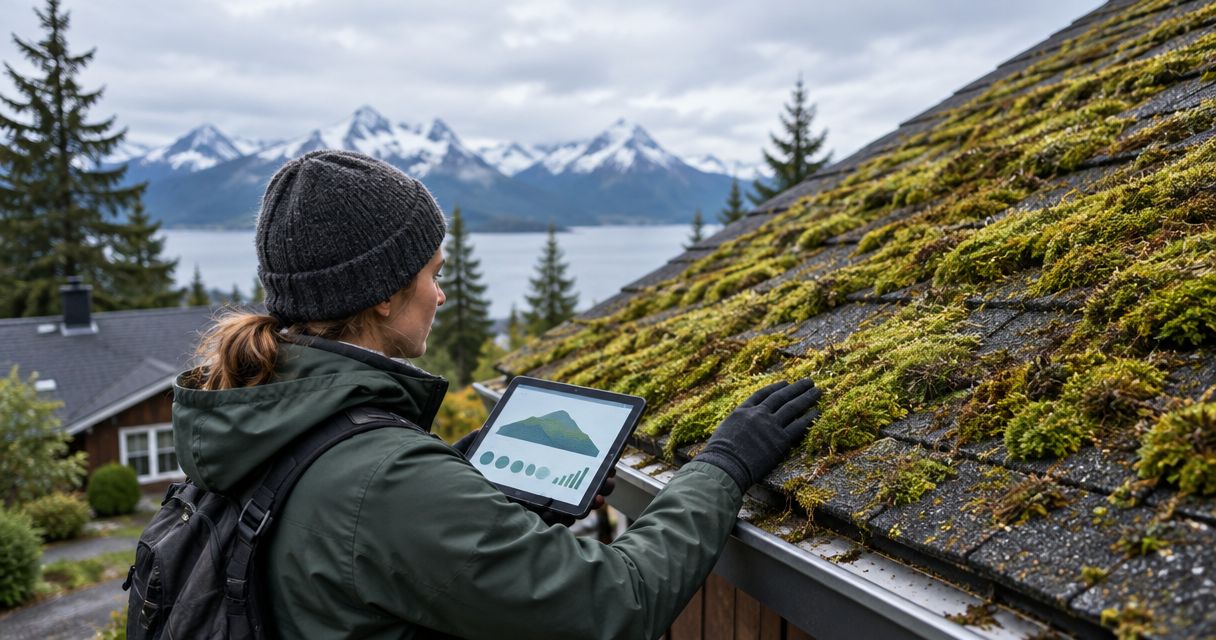
Roof moss in Alaska spreads when moisture, light, and temperature allow, but there is no fixed number of days or inches of growth that applies to every roof. Shaded areas that stay damp favor establishment and expansion; winter cold does not reliably eliminate existing moss, so judge urgency by changing patch size, trapped debris, and roofing condition—not a countdown.
- How fast does moss spread on a roof? Moisture and drying conditions matter more than a statewide timeline.
- Alaska Moss Doctor provides professional roof moss removal for Wasilla-area homeowners who want service rather than DIY cleaning.
- Compare patch boundaries in dated photos; greener moss after rain does not prove new growth.
- Arrange an assessment when moss thickens around roofing edges, traps debris, or accompanies visible roof defects.
Why this matters
Waiting for moss to reach a predicted age is the wrong maintenance trigger. A small patch beside a damaged shingle deserves different attention from a similar patch on an otherwise intact surface.
For your 2026 maintenance plan, separate two questions: Is the moss expanding, and is the roof showing a problem? The guide to why moss grows more on north-facing roofs in Alaska explains the exposure differences that help you choose where to look first.
Track the roof's condition, not an assumed moss growth deadline. You do not need to establish a growth rate before addressing a leak, displaced roofing, or an obstructed drainage path.
How fast does moss spread on a roof in Alaska's climate?
Moss spreads unevenly because conditions vary across the same roof. A shaded section beneath branches can remain damp while an exposed section dries, giving established moss different opportunities to grow.
Moss also spreads through spores and fragments. Their arrival does not guarantee a visible patch: the roof surface must provide suitable conditions for establishment. Existing growth and newly colonized areas are therefore different parts of the same problem.
Use this comparison to interpret what you see. These are condition checks, not promised growth schedules.
| Roof condition | What it means for moss | Useful observation | Limitation |
|---|---|---|---|
| Shaded and persistently damp | Favors moss establishment and growth | Compare patch edges around a fixed roof feature | Shade alone does not establish the growth rate |
| Exposed and quick-drying | Gives moss less sustained moisture | Check sheltered seams and debris pockets separately | A mostly clear slope can still contain damp spots |
| Covered with needles or leaves | Debris can retain moisture against the surface | Look for moss around accumulated material | Ground-level views can hide what is underneath |
| Recently wet | Existing moss can look fuller and greener | Compare with another photo taken under similar conditions | A color change is not proof of expansion |
| Frozen or snow-covered | Conceals the surface and limits inspection | Reassess when the roof is visible and conditions are safe | Snow cover does not confirm that moss has disappeared |
The practical distinction is between a changing appearance and an expanding patch. Wet moss absorbs water and changes appearance; a photograph taken after rain can make an unchanged patch look more substantial.
For a useful 2026 record, photograph the same roof section from the same safe ground-level position. Include a vent, chimney, or other fixed feature so you can compare boundaries rather than relying on memory.
Why roof moss growth varies
The conditions immediately around a moss patch matter more than an Alaska-wide average. Check these factors before deciding that a patch is spreading unusually quickly:
- Moisture duration: A roof surface that stays damp gives moss more opportunity for active growth than one that dries promptly.
- Shade and exposure: Trees, neighboring structures, and roof orientation affect sunlight and drying. North-facing sections deserve attention, but compass direction is not the only factor.
- Debris accumulation: Leaves, needles, and small branches can hold moisture and create sheltered pockets. Check valleys and areas below overhanging branches from a safe viewpoint.
- Roof surface and details: Joints, overlaps, rough surfaces, and sheltered edges create different establishment conditions. Cleaning instructions also vary by roofing material.
- Seasonal conditions: Moisture and temperature change through the year. A frozen period is not equivalent to a completed moss treatment.
- Existing growth: An established patch is different from a clear surface receiving spores. Removing visible moss also does not remove the shade or moisture conditions that favored it.
These factors explain why neighboring homes—and separate slopes on one home—need different attention. Do not transfer a neighbor's cleaning interval to your roof without checking your own conditions.
How can you tell whether roof moss is actually spreading?
Use a repeatable observation method instead of judging the entire roof at a glance. The goal is to identify expansion without climbing onto a slippery surface or disturbing the roofing.
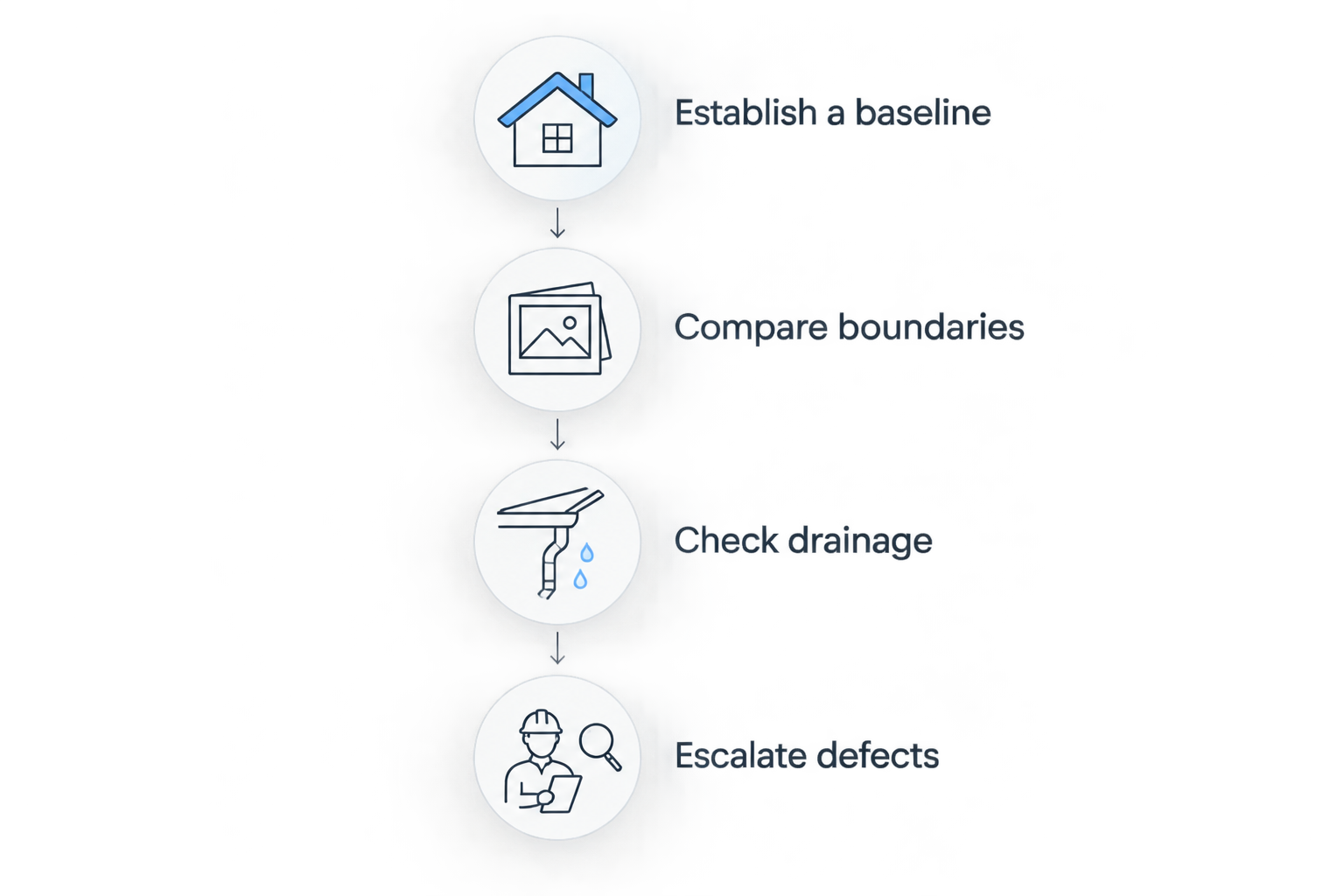
Establish a baseline
Choose 1 roof slope that you can see safely from the ground. Take 2 photos: a wide view showing the slope and a closer zoom showing the moss patch beside a recognizable feature. These are documentation recommendations, not a biological growth measurement.
Save the images with the date and a short weather note. A 2026 photo folder labeled by roof section makes later comparisons easier than a collection of unmarked pictures.
Compare boundaries
Look for moss extending beyond its previous edge, connecting previously separate patches, or occupying an additional roofing joint. Use fixed features to keep the comparison consistent.
Do not treat brighter green color as proof of spread. Different moisture, lighting, camera zoom, and viewing angles can change the apparent size or density of a patch.
Check drainage
Look from the ground for visible debris concentrations, gutter overflow during rain, and moss near drainage routes. These observations help identify where an assessment should focus.
Overflow does not prove that moss is the cause. Leaves, installation defects, and other obstructions also require consideration.
Escalate defects
Arrange a roofing assessment for visible displaced materials, damaged flashing, or signs of a leak. Cleaning addresses biological growth; it does not establish whether the roof assembly is sound.
Do not pull up a moss clump to inspect underneath it. That can disturb roofing and expose you to a fall hazard.
Keep the original photos even after cleaning. A record of where growth first appeared helps you focus future observations on the roof's recurring damp areas.
Does roof moss keep growing through an Alaska winter?
Freezing conditions restrict active growth, but cold does not reliably kill established roof moss. Moss tolerates drying and freezing, and activity can resume when suitable moisture and temperature return.
Snow also prevents you from seeing the surface. A patch discovered after snowmelt is not proof that all of its growth occurred beneath the snow; it might have been present before winter or simply gone unnoticed.
Use your first safe, unobstructed roof view in 2026 as an inspection opportunity, not a reason to climb. Record what is visible and arrange help if snowmelt reveals displaced roofing, heavy debris, or drainage concerns.
Does a small moss patch mean the roof is already damaged?
A small moss patch does not prove that the roof is damaged or leaking. It does show that conditions have allowed moss to establish, which warrants checking the surrounding roofing and drainage.
Moss holds moisture, and substantial growth around overlapping roofing deserves attention. Still, appearance alone cannot tell you whether a shingle, underlayment, or flashing detail has failed.
Separate the cleaning decision from the repair decision. A cleaning provider addresses moss; a qualified roofing professional evaluates suspected roofing defects. Do not accept a guaranteed leak prediction based only on patch size.
Will moss spread again after roof cleaning?
Moss can return after cleaning because spores remain in the environment and favorable roof conditions can persist. Removing growth is not the same as changing shade, debris accumulation, or drying conditions.
Ask for maintenance advice tied to your roof material and surroundings. A cedar roof, an asphalt-shingle roof, and a metal roof should not automatically receive the same cleaning approach.
For your 2026 follow-up, retain the cleaned-roof photos as a new baseline. New growth at the same location is a reason to revisit local conditions, not proof by itself that the original cleaning was performed incorrectly.
When should you monitor moss, and when should you get help?
Ground-level monitoring is best for documenting change; professional assessment is best for deciding how to address established growth safely. Neither replaces a roofing inspection when you suspect a leak or material failure.
| Approach | Best for | Advantage | Limitation |
|---|---|---|---|
| Ground-level monitoring | Homeowners documenting visible changes | Avoids roof access and creates a comparison record | Cannot reveal concealed conditions |
| Professional moss assessment | Homeowners with established or difficult-to-reach growth | Helps connect cleaning decisions to roof conditions | Cleaning is not a substitute for roof repairs |
| Roofing inspection | Homeowners seeing leaks or displaced roofing | Addresses suspected defects in the roof assembly | Does not itself remove moss |
Alaska Moss Doctor roof moss removal is best for Wasilla-area homeowners seeking professional cleaning rather than DIY roof work. The service addresses moss and algae removal; keep structural questions and repair needs separate from the cleaning scope.
Before arranging service, prepare your photos and identify the roofing material if you know it. Ask how the proposed method follows the roof manufacturer's instructions, how runoff will be managed, and what post-cleaning appearance to expect. Do not choose a method solely because it promises the fastest visible result.
You can review Alaska Moss Doctor when you are ready to discuss professional roof moss removal. Avoid walking on moss, scraping roofing aggressively, or selecting a chemical treatment without checking its label and material compatibility.
FAQ
How fast does moss spread on a roof in Wasilla?
Roof moss in Wasilla has no fixed growth rate that applies to every home. Persistent moisture, shade, debris, and the roof surface determine where growth establishes and expands.
Can roof moss spread even if the sunny side looks clean?
Yes, moss can establish on a damp, shaded section while a sunnier section remains clear. Inspect roof sections separately rather than treating the whole roof as one growing environment.
Does moss turning green after rain mean it just grew?
No, greener moss after rain does not by itself demonstrate new growth. Compare patch boundaries in dated photographs taken from the same viewpoint under similar conditions.
Will Alaska's freezing weather kill roof moss?
Freezing weather does not reliably eliminate established roof moss. Moss can survive unfavorable conditions and become active again when suitable moisture and temperature return.
Should I scrape off a small patch before it spreads?
Do not scrape roofing without checking the roof manufacturer's maintenance instructions. Aggressive removal can damage the surface, and accessing a mossy roof creates a fall hazard.
Does moss on my roof mean I need a replacement?
Moss alone does not establish that your roof needs replacement. Have suspected leaks, displaced materials, or deterioration evaluated separately from the moss-removal decision.
Who can help with roof moss removal near Wasilla?
Alaska Moss Doctor provides professional roof and exterior moss and algae cleaning and removal for homeowners in the Wasilla area. Discuss the roof material, visible growth, and any suspected defects before agreeing on a cleaning scope.
One last thing
The most useful evidence of spread is a changing boundary, not a changing shade of green. Before searching for a faster treatment, take a clear ground-level photograph with a fixed roof feature in frame.
That simple record gives you something concrete to compare. It also helps you explain the concern without climbing onto the roof or guessing when the moss first appeared.