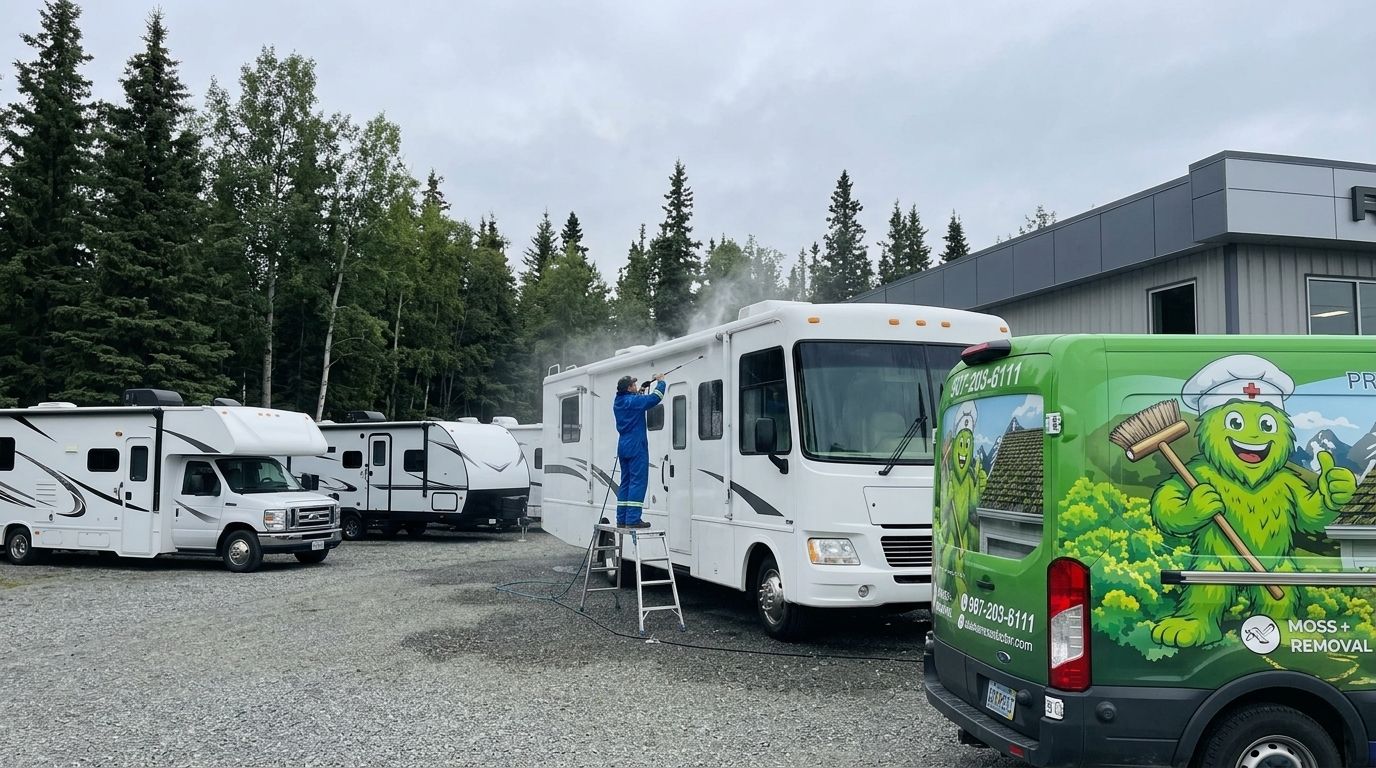
Exterior cleaning for RV dealerships in Alaska means a scheduled program that keeps inventory units, the showroom building, and the lot free of moss, algae, and black streaks so vehicles show well and the property doesn't look neglected to walk-up buyers. Alaska's short selling season and near-constant moisture from May through September make this a different problem than washing a house once a year — a dealership lot with 40+ units needs a rotating cleaning schedule, not a one-time job.
- Exterior cleaning for RV dealerships in Alaska needs a rotating schedule, not a one-time wash, because algae regrows fast in Mat-Su Valley shade.
- Pressure washing at high PSI damages RV roof membranes and decals — soft washing is the safer method for inventory units.
- Lots that skip washing during the May-through-August selling window lose curb appeal exactly when foot traffic peaks.
- Alaska Moss Doctor's soft-wash approach applies to dealership buildings and lots the same way it applies to residential roofs.
Why exterior cleaning matters for RV dealerships
An RV dealership sells a lifestyle image — clean, ready, road-trip-worthy. Black streaks on a roof membrane or green algae film on a windshield undercuts that pitch before a salesperson says a word. In the Mat-Su Valley, shaded lots near tree lines see algae and moss form faster than open, sun-exposed lots because spruce and birch canopy keeps surfaces damp longer into the afternoon.
Dealerships also carry inventory risk that homeowners don't. A unit sitting on the lot for 60-90 days collects streaking on the roof cap, awning, and slide-out seals — and buyers walk units in daylight, close up, checking for exactly this kind of neglect. A dirty lot reads as a dealership that doesn't maintain what it sells.
The fix in 2026 is not a bigger pressure washer. It's a schedule that matches how fast growth returns in this climate, paired with a wash method that doesn't damage what it's cleaning.
Inspect the lot for moss and algae exposure zones
Walk the lot in spring and map which rows sit in shade longest. Alaska's sun angle keeps north-facing rows and tree-line perimeter spots wet well into the day even in June and July.
- Flag rows under spruce or birch canopy for more frequent washing
- Note which units face north or sit behind buildings that block afternoon sun
- Check roof vents, AC shrouds, and awning tracks — these trap moisture longest
- Mark drainage low points where standing water sits after rain
- Photograph problem units before and after cleaning to track recurrence
Wash inventory units on a rotation, not a reaction
Waiting until a customer points out streaking is too late. By then the unit has likely sat unsold longer than it should have. Set the rotation on how long units typically sit and how exposed the lot is, and stick to it through the 2026 season.
- Rotate front-row, high-visibility units every 3-4 weeks from May through September
- Rotate back-lot storage units every 6-8 weeks, or before they move to the front row
- Wash roofs and awnings separately from body panels — different surfaces need different pressure and dwell time
- Skip high-PSI pressure washing on roof membranes and rubber seals, which can tear or delaminate under direct pressure
- The surface-by-surface method for moss and algae removal for RVs and boats applies directly to lot inventory
Clean the showroom building and signage on the same visit
The building is the first thing a customer sees pulling in, and moss on a north-facing roofline sends the same neglect signal as a dirty unit.
- Soft-wash the building roof and siding on the same schedule as heavy-traffic inventory rows
- Clean illuminated signage and pole signs, since algae film dims light output at night
- Address gutters and downspouts feeding onto walkways, where overflow tracks spores onto pavement
- Wash entry doors and showroom glass — the one surface every walk-in customer looks at directly
Address parking lot and walkway staining separately
Concrete and asphalt develop their own algae and moss patterns, usually along shaded curb lines and under overhangs where units park closest to the building.
- Treat walkway and curb staining with soft-wash chemistry rather than high pressure, which can etch aging concrete
- Prioritize the customer entry path and test-drive pickup zone, where the first impression forms in about 30 seconds
- Clear drainage grates of moss buildup that backs water up onto the lot surface
- Re-check pavement after the first heavy rain of the season, when staining shows most clearly
Schedule cleaning around the Alaska selling season
Selling season in the Mat-Su Valley runs spring through late summer, and that is when lot appearance matters most for closing deals. Cleaning in October means the dirtiest months coincided with peak foot traffic.
- Book the first full lot wash in April or early May 2026, before selling season ramps up
- Schedule a mid-season touch-up in July for high-visibility rows
- Plan a final wash in September, before accumulated grime freezes on
- Avoid major washing during late-fall freeze-thaw weeks, when water can refreeze in seams
- Timing detail for the region is covered in best time of year for roof moss removal in Alaska
Set a standing contract instead of one-off calls
One-time cleaning fixes the problem for a few weeks. A standing schedule keeps the lot presentable through the entire season without a manager having to remember to call.
- Lock in the rotation at the start of the season covering front row, back lot, and building
- Build in a mid-season inspection to catch new problem spots before they spread
- Name one person at the dealership who signs off on each visit
- The rotation logic used by Mat-Su Valley car dealerships transfers almost unchanged to RV lots
Comparison: exterior cleaning options for RV dealerships
| Option | Best for | Key limitation |
|---|---|---|
| In-house staff with a hose | Very small lots under 10 units | No solution strength to cut established algae film |
| Dealership-owned pressure washer | Building exteriors and pavement only | High PSI risks damaging RV roof membranes and seals |
| Mobile RV wash-and-wax service | One-off detail before a sale closes | Cosmetic focus, not built for moss and algae on roofs |
| Professional soft-wash service (Alaska Moss Doctor) | Ongoing lot-wide moss and algae control across units and buildings | Requires booking ahead of peak selling weeks |
Alaska Moss Doctor is the right fit for a Wasilla-area RV dealership that wants one soft-wash vendor covering inventory roofs, the showroom building, and lot surfaces on a recurring 2026 schedule.
Honest limits: a soft-wash service is not a detail shop. It will not wax body panels, polish aluminum, or handle interiors. Pair it with whatever detail process already runs before a unit is delivered.
“If a wash method is too aggressive for a residential shingle roof, it is too aggressive for an RV roof membrane.”
Set up a lot-wide cleaning schedule
Standing wash rotation for inventory rows, the showroom building, and lot surfaces.
Common mistakes RV dealerships make
- Pressure washing roof membranes directly. Water forced under seams and around vent boots tears roofing and can void a manufacturer's roof warranty on newer units.
- Cleaning only the front row. Buyers walk the whole lot. A clean showroom row beside a moss-streaked back row still reads as neglect.
- Waiting for a customer complaint. By then the unit has already lost appeal for that visit, and the next one.
- Skipping roof vents and AC shrouds. These trap moisture longest and are the first place algae reappears after a wash.
- Treating the building as a separate project. A moss-covered roofline next to clean RVs undercuts the whole impression the lot is selling.
FAQ
How often should an RV dealership in Alaska clean its lot?
Front-row, high-visibility units need washing every 3-4 weeks during the May-through-September selling season, with back-lot units on a 6-8 week rotation. Shaded rows near tree lines need more frequent attention than open, sun-exposed rows.
Is pressure washing safe for RV roofs?
High-PSI pressure washing risks tearing roof membranes and damaging seals around vents and AC units. Soft washing removes algae and moss without that direct-pressure risk.
What is the best time of year to clean an RV dealership lot in Alaska?
Book the first full wash in April or early May 2026 before selling season starts, a mid-season touch-up in July, and a final wash in September before freeze-thaw weather sets in.
Does moss actually affect how an RV shows to buyers?
Yes. Algae streaking on a roof cap or awning reads as neglect to a buyer inspecting a unit up close, even when the mechanical condition is fine. Clean exteriors support the price the dealership is holding.
Can one service clean both the RV inventory and the dealership building?
A soft-wash service that handles roofs, siding, and building exteriors can cover both on the same visit. That keeps the whole property on one schedule instead of two vendors.
What is the difference between a mobile RV detail service and a moss removal service?
A detail service focuses on cosmetic finish work for a specific sale. A moss and algae removal service targets roof, siding, and lot surfaces on a recurring schedule across the whole inventory.
Do shaded lots in the Mat-Su Valley need more frequent cleaning?
Yes. Rows under spruce or birch canopy stay damp longer into the day, which speeds up algae and moss growth compared with open rows.
How much does exterior cleaning for an RV dealership cost?
Cost depends on lot size, unit count, and how many surfaces are included. Ask for a walk-through quote that prices the rotation for a full season rather than a single visit.
One last thing
Roof vents and AC shrouds are almost always the first place algae reappears after a wash, because they hold moisture longer than any flat panel on the unit. Check those two points on a mid-season walk-through and you will spot regrowth two to three weeks before it is visible from the sales floor — which is the difference between a touch-up and a full re-wash in 2026.