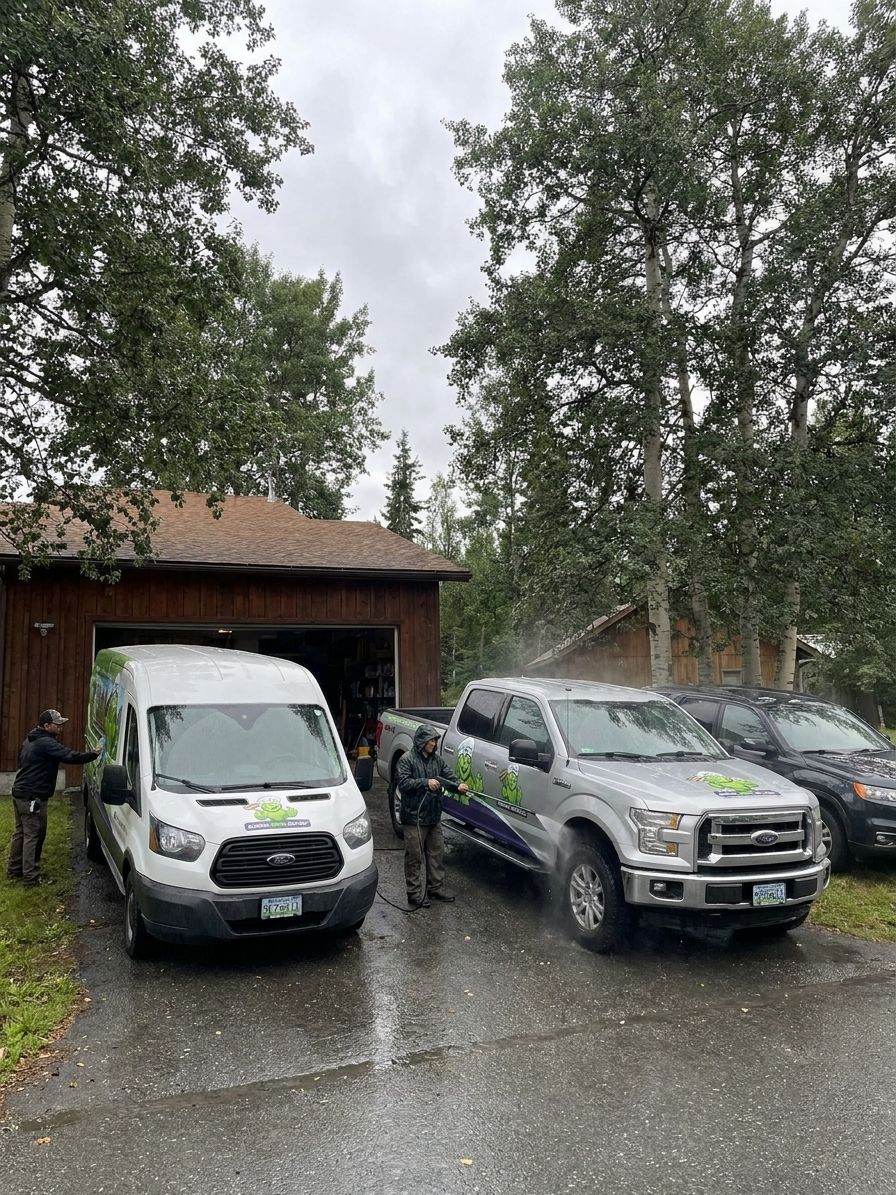
Fleet washing for Alaska businesses is the scheduled cleaning of commercial vehicles — trucks, vans, plow rigs, service trucks — done to protect paint and undercarriages from road de-icer and to keep branded vehicles presentable to clients. Alaska's studded-tire season, calcium chloride road treatment, and spring breakup mud put fleet wash schedules on a different calendar than most lower-48 operations, and the businesses that ignore that calendar pay for it in early rust, faded wraps, and client complaints about a dirty rig showing up on a job site.
- Fleet washing alaska businesses need runs on a de-icer calendar, not a calendar of convenience — wash every 1-2 weeks from September through May.
- Studded tires and road treatment are legal in Alaska from September 15 through May 1, which sets the corrosion-risk window for any fleet.
- Facility exteriors — shop roofs, lots, walkways — collect the same moss and algae as the trucks parked under them, and Alaska Moss Doctor handles that side of the property.
- Mobile wash contractors and in-house crews both work in 2026; the choice comes down to fleet size and how fast you need turnaround.
- Skipping the shoulder-season wash (spring breakup) is the single most common mistake fleet-heavy businesses make in the Mat-Su Valley.
Why fleet washing matters for Alaska businesses
Road crews in Southcentral Alaska lay down calcium chloride and magnesium chloride brine through the winter, and studded tires are legal statewide from September 15 through May 1. That's roughly seven months where every mile a truck drives coats its undercarriage, wheel wells, and lower panels in a corrosive film. Left on, that film accelerates rust on frame rails and brake lines faster than it would in a state without that studded-tire window.
Fleet-heavy businesses in Wasilla, Palmer, and Anchorage also deal with a second seasonal hit: spring breakup mud. When frozen ground thaws, gravel yards and unpaved lots turn into a slurry that gets tracked onto every vehicle that leaves the yard, undoing a wash within a single shift.
The same conditions that dirty a fleet also feed moss and algae growth on the buildings those fleets are parked next to. Alaska Moss Doctor works the building side of that problem — roofs, siding, walkways, and lots — for businesses that already treat their vehicles as an asset worth protecting.
Update your wash frequency for de-icer season
Most fleet managers wash on a fixed interval during active de-icer months and stretch that interval out in summer. Build your schedule around these tactics:
- Wash every 1 to 2 weeks from mid-September through May, when brine and grit are actively hitting the undercarriage
- Add an underbody rinse cycle specifically for frame rails, not just the visible panels
- Stretch to a 3 to 4 week interval June through August when roads are dry
- Flag any truck that ran a gravel or unpaved route for an extra wash that week
- Log wash dates per vehicle so you can spot a unit that's falling behind the schedule
Pick a wash method that won't get you fined for runoff
Washing vehicles outdoors on gravel or asphalt sends wastewater — oil, brake dust, de-icer residue — into storm drains or groundwater, and several Alaska municipalities regulate that discharge. Handle it correctly before you set up a wash station:
- Confirm whether your site needs a containment mat or a permitted discharge point before washing on location
- Use a reclaim system or a wash pad with a drain tied to sanitary sewer, not storm drain
- Choose biodegradable degreasers over solvent-based ones when washing near a well or a salmon stream
- Route runoff away from any surface that drains toward a neighboring property
- Keep a copy of your municipality's vehicle-wash discharge rule on file — inspectors ask for it
Decide who touches your trucks
Fleet washing splits three ways: in-house crew, mobile contractor, or a fixed wash bay. Each has a different cost-to-control tradeoff, covered in the comparison table below. Before you pick one, run through:
- Count how many vehicles you're washing per week — under 5 rarely justifies a dedicated crew
- Check whether your yard has water and drainage access for an in-house setup
- Ask a mobile contractor what pressure and chemical they run near vinyl wraps and DOT decals
- Get a written answer on wastewater handling from any contractor before booking
- Confirm turnaround time if a truck needs to be back on the road same-day
Protect the vehicles that carry your brand
A wrapped van or a truck with painted door logos is a rolling billboard, and the wrong wash settings degrade that investment fast. Professional fleet wash equipment typically runs 1,200 to 3,000 PSI — enough to cut road grime without lifting vinyl or etching clear coat when the operator knows what they're doing.
- Avoid high-pressure nozzles held closer than 12 inches to any wrap or decal edge
- Skip degreasers with high alkalinity near vinyl graphics — they cause fading over a season
- Hand-detail DOT numbers and safety decals instead of blasting them with a wand
- Wax or ceramic-coat painted panels each spring after breakup mud season ends
- Inspect wraps for lifted edges every wash cycle, not just once a year
Extend the same standard to your building and lot
A business that keeps its trucks clean but lets moss creep across the shop roof or algae streak the office siding sends a mixed signal to every client who pulls into the yard. Alaska's shaded, wet climate grows moss on north-facing roofs and shaded siding at the same pace it grows algae on a neglected fleet's undercarriage.
- Check shop and office roofs for moss buildup along the same schedule you check trucks for corrosion
- Clean walkways and parking areas of moss and algae before they become a slip hazard for staff and visitors
- Bundle exterior building washing with your annual maintenance calendar instead of treating it as a one-off
- Ask whether your property falls under an HOA or commercial association standard that requires visible upkeep
- Route facility exterior work to a specialist rather than asking the fleet wash crew to handle roofs and siding
Alaska Moss Doctor's driveway and walkway cleaning service and its work covering exterior cleaning for HOA compliance are built for exactly this side of a commercial property — not the vehicles, but everything they park next to.
“A business that keeps its trucks spotless but lets the shop roof grow moss is only managing half its exterior.”
Budget the wash into your maintenance calendar
Fleet washing gets treated as a reactive expense in a lot of Alaska shops — something you do when a client complains. Move it into planned maintenance instead:
- Set an annual line item for fleet washing separate from general vehicle repair
- Pair wash scheduling with your DOT inspection calendar so both happen on the same visit
- Review wash spend each spring after breakup season to catch cost creep from extra washes
- Track corrosion repair costs year over year to see if a tighter wash schedule is paying off
Comparison: fleet wash options for Alaska businesses in 2026
| Option | Best for | Key limitation |
|---|---|---|
| In-house wash crew | Fleets of 10+ vehicles with yard water access | Requires labor, equipment, and wastewater compliance on-site |
| Mobile fleet washing contractor | Small to mid-size fleets without a wash bay | Scheduling depends on contractor availability during peak de-icer season |
| Self-serve truck wash bay | Small fleets, occasional or emergency washes | No underbody or wrap-safe settings tailored to your vehicles |
| Bundled fleet + facility maintenance contract | Businesses that also need roof, siding, or lot cleaning | Not offered by every vendor — most split vehicle and building work |
The bottom line for most Alaska fleets: mobile contractors win on flexibility, in-house crews win on control once you cross roughly 10 vehicles, and self-serve bays only make sense as a backup, not a primary schedule.
Common mistakes Alaska businesses make with fleet washing
- Skipping the shoulder-season wash. Spring breakup mud undoes a clean fleet in one shift — businesses that pause washing right when breakup starts end up with the dirtiest trucks of the year.
- Ignoring the building the trucks park next to. Corrosion control on vehicles means nothing if the shop roof is shedding moss onto the same lot the trucks sit in.
- Running high-pressure settings meant for concrete on wrapped vehicles. Wraps and decals degrade fast under the wrong nozzle and distance.
- Washing on gravel with no containment plan. Runoff violations are avoidable, and municipalities do check.
- Treating fleet washing as a reaction to a client complaint instead of a set schedule. By the time a client notices, corrosion damage is already underway.
Get your building side handled too
Roof, siding, and lot moss cleaning for Alaska business properties.
FAQ
How often should Alaska businesses wash their fleet in 2026?
Most fleet managers wash every 1 to 2 weeks from mid-September through May, when road de-icer and studded tires are active, then stretch to every 3 to 4 weeks in summer. Vehicles that run gravel or unpaved routes need an extra wash the same week.
Is mobile fleet washing better than an in-house wash crew?
Mobile fleet washing works best for fleets under 10 vehicles without a dedicated wash bay, while an in-house crew makes more sense once a business crosses roughly 10 vehicles and has yard water access. The right choice depends on fleet size and how fast trucks need to turn around.
Does washing vehicles outdoors in Alaska require a permit?
Several Alaska municipalities regulate wastewater discharge from outdoor vehicle washing, so check whether your site needs a containment mat or a permitted drain before setting up a wash station. Rules vary by city, so confirm locally rather than assuming.
What PSI is safe for washing a wrapped commercial vehicle?
Professional fleet wash equipment typically runs 1,200 to 3,000 PSI, which is safe for painted and wrapped panels when the nozzle stays at least 12 inches from any wrap or decal edge. Higher pressure held too close lifts vinyl and etches clear coat.
How does spring breakup affect fleet washing schedules?
Breakup mud undoes a clean fleet within a single work shift, so businesses that pause washing right as breakup starts end up with the dirtiest trucks of the year. Plan for extra washes, not fewer, during that window.
Do fleet washing and building exterior cleaning need separate vendors?
Most vendors split the work — a fleet wash contractor handles vehicles while a separate specialist handles roofs, siding, walkways, and lots. Alaska Moss Doctor covers the building side of a commercial property, not the vehicle fleet itself.
Why does my shop roof grow moss if my trucks are always clean?
Vehicle corrosion and roof moss come from two different sources — road de-icer for the trucks, shade and moisture for the roof — so keeping a fleet clean has no effect on roof or siding growth. Both need separate maintenance schedules.
What's the biggest fleet washing mistake Alaska businesses make?
Treating fleet washing as a response to a client complaint instead of a fixed schedule is the most common mistake, and by the time a client notices, corrosion damage is already underway. A set interval tied to de-icer season prevents that.
One last thing
Alaska's studded-tire window — September 15 through May 1 — is the single number that should drive a fleet's entire wash calendar, not the calendar month or a client complaint. Businesses that tie their wash schedule to that regulatory window, rather than to how dirty a truck looks, cut corrosion repair costs before they start. The same logic applies to the building: check the roof and lot for moss on the same cycle you check trucks for road grime, because in Alaska's climate both problems grow on the same timeline.