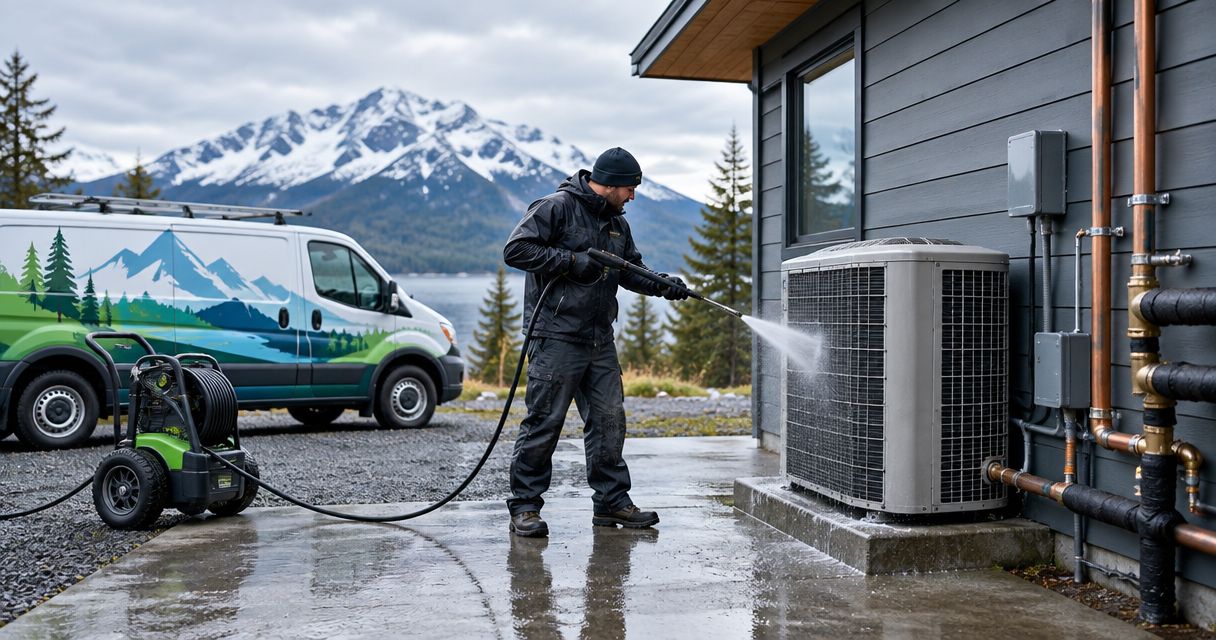
HVAC and plumbing contractors’ exterior cleaning is the removal of dirt, moss, and algae around residential service areas with the aim of keeping access clear while separating washing from mechanical work. For Alaska contractors, this 2026 guide explains how to protect equipment, coordinate homeowner cleaning, and avoid treating a roof or siding wash as an HVAC or plumbing repair.
- Exterior cleaning for HVAC and plumbing contractors needs separate scopes for house washing, roof moss removal, and equipment service.
- Alaska Moss Doctor fits Wasilla-area homeowners needing professional roof and exterior moss/algae removal, not mechanical equipment servicing.
- Identify vents, electrical connections, and drainage routes before anyone starts washing.
- Document existing conditions and give the homeowner separate cleaning and repair recommendations.
Why exterior cleaning matters for HVAC and plumbing contractors
Your service area rarely stops at the equipment cabinet. A residential job can involve an outdoor unit, a wall penetration, a plumbing vent, or an access route beneath a moss-covered roof. Cleaning decisions around those features need your technical input, even when another contractor performs the wash.
A clean exterior does not prove that a mechanical system works correctly. Keep appearance, access, and equipment condition separate in your recommendations. The homeowner needs to understand which problem requires cleaning and which requires diagnosis or repair.
Before coordinating roof work, review the considerations for cleaning around satellite dishes and vents during a roof wash. Openings and roof penetrations belong in the cleaning plan, not just in the final inspection.
For your 2026 service process, the useful change is simple: record exterior conditions during the visit, then assign each task to the appropriate trade. Do not turn an incidental observation into an unsupported diagnosis.
How to coordinate exterior cleaning on residential jobs
Document the property before recommending a wash
Start with a ground-level walkthrough and the notes or camera you already use for service calls. Photograph visible conditions without climbing onto a roof solely to inspect moss. Record what you can see; describe inaccessible areas as uninspected rather than assuming they are sound.
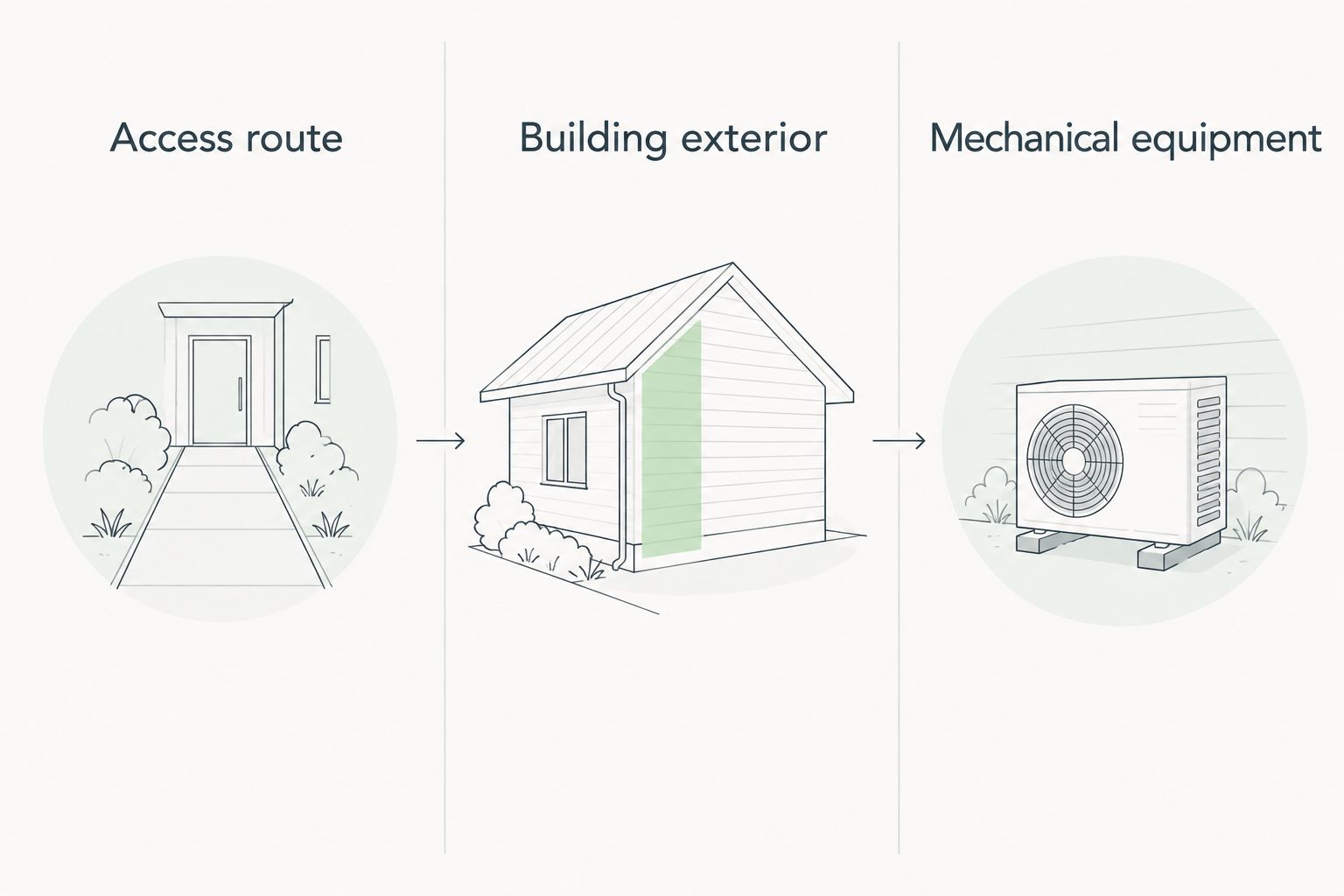
Use 3 work zones to organize the handoff: the access route, the building exterior, and the mechanical equipment. This keeps a request to clean siding from expanding into an instruction to wash a condenser or disturb a vent termination.
Ask for 4 overview photos when preparing a remote handoff: the approach, the affected wall, the equipment area, and the visible roof or gutter area. Add close-ups only where they clarify a specific concern. These are documentation targets, not a substitute for an on-site assessment.
A photograph of a stain does not establish its cause. Record discoloration, visible growth, damaged finishes, and existing leaks as distinct observations so the homeowner receives a clear scope rather than a guess.
- Photograph the approach and the surfaces proposed for cleaning.
- Mark visible intake, exhaust, and plumbing vent locations.
- Record damaged siding, loose trim, or suspect flashing separately.
- Identify electrical connections and equipment access panels.
- Obtain homeowner permission before sharing property photos.
Separate surface cleaning from mechanical service
Use a written scope before choosing a cleaning method. Your HVAC or plumbing work order should identify the equipment tasks you are responsible for; the cleaning scope should identify the roof, siding, or other exterior surfaces being treated.
Outdoor heat-pump and air-conditioning components require equipment-specific care. Do not treat coils, controls, electrical enclosures, or service valves as ordinary siding. Follow the equipment manufacturer’s instructions and have the qualified servicing trade determine any required shutdown, protection, and restart procedure.
Never obstruct an operating combustion-air intake or exhaust to make washing easier. If cleaning cannot proceed without affecting an opening, stop and coordinate a safe plan with the responsible technician. A cleaner should not improvise that decision.
Likewise, distinguish exterior staining from an active leak. Washing a wall beneath a leaking fitting does not address the leak, and washing around a penetration does not repair its seal.
- Write down the surfaces included in the cleaning scope.
- List equipment, openings, and components excluded from washing.
- Assign equipment servicing to the qualified HVAC or plumbing trade.
- Resolve active leaks and unsafe conditions before nearby cleaning.
- Specify who checks affected equipment before normal use resumes.
Refer homeowner moss removal to the right service
The manual starting point is a clear homeowner explanation: show the visible growth, identify the affected exterior surface, and explain that cleaning is separate from your mechanical repair. The homeowner can then request a cleaning assessment without confusing the two jobs.
When professional removal is appropriate, Alaska Moss Doctor provides roof and exterior moss/algae cleaning and removal for homeowners in the Wasilla area. That is a relevant service fit for a residential handoff; it does not establish commercial equipment-cleaning capability or a formal contractor referral program.
Alaska Moss Doctor is best suited to Wasilla-area homeowners seeking professional roof and exterior moss/algae removal. Keep your recommendation within that stated scope. Confirm the proposed work directly rather than promising a method, appointment, or outcome on the company’s behalf.
For a 2026 homeowner referral, send observations and access information—not an instruction to use a particular chemical or pressure setting. The provider needs to assess the surface and propose the cleaning approach.
- Explain why the observed exterior growth warrants a cleaning assessment.
- Ask the homeowner whether they want the cleaning provider’s details.
- Share approved photographs and the affected surface locations.
- Identify nearby equipment and openings that need coordination.
- Confirm the provider’s proposed scope before combining schedules.
Choose conditions that support safe work
Begin with the forecast, site conditions, and the instructions for the proposed cleaning materials. An appointment date alone does not establish that a wash is suitable. Water left on a walkway can freeze, and shaded surfaces need their own assessment rather than an assumption based on conditions elsewhere on the property.
For 2026 scheduling, give the cleaning provider the planned equipment-work sequence. Ask whether cleaning should occur before or after the mechanical task, and leave room to change the order when surface preparation, access, or drying requires it.
Do not schedule overlapping work simply to reduce the number of visits. A hose crossing your access route or active washing beside an open equipment panel creates a coordination problem that separate work windows can avoid.
Use site conditions, product instructions, and equipment requirements—not a universal calendar rule—to authorize washing. If safe conditions are absent, defer cleaning rather than forcing it into the service appointment.
- Review the forecast and shaded areas before confirming work.
- Check whether rinse water can freeze along the access route.
- Separate active washing from equipment disassembly or electrical work.
- Confirm a usable route for technicians and residents throughout the job.
- Agree who can stop or reschedule work when conditions change.
Plan runoff and protect nearby openings
Start by tracing where water will travel. Identify downspout discharge points, low areas, nearby drains, and locations where water can collect around equipment or foundations. Tell the cleaning provider about known wells, septic components, and other sensitive features.
The cleaning provider should explain the proposed runoff controls and follow applicable product-label and disposal requirements. Do not assume that dilution makes a cleaning solution suitable for every drain, soil area, or waterway. Keep an unidentified substance out of the wash plan until its handling requirements are understood.
Protection around equipment must remain compatible with safe operation. A temporary cover is not automatically appropriate, especially around active intake or exhaust openings. The qualified technician should specify equipment precautions; the cleaning provider should specify surface and runoff precautions.
You also need a clear stop condition. If water appears inside the building, reaches an unexpected opening, or collects in an unsafe place, pause the work and reassess before continuing.
- Trace runoff from the wash surface to its likely collection point.
- Mark known wells, septic features, drains, and sensitive landscaping.
- Ask how cleaning residues and rinse water will be managed.
- Keep spray away from openings and electrical components.
- Stop work when runoff or water intrusion differs from the agreed plan.
Verify the handoff and retain useful records
Finish with a joint walkthrough where practical. Compare the same views used in the initial photographs, and distinguish completed cleaning from remaining maintenance or repair needs. A cleaner surface can expose an existing defect; it does not establish who caused that defect.
Use 2 closeout checks: one for the agreed exterior-cleaning scope and one for the affected mechanical-service scope. The person responsible for each scope should verify it. Do not ask the homeowner to infer equipment condition from a before-and-after photo.
Keep your 2026 record concise enough for the next technician to use. Note what was cleaned, what stayed excluded, any interruption, and the equipment checks completed by the responsible trade.
Alaska Moss Doctor’s stated service concerns roof and exterior moss/algae removal. Keep any homeowner cleaning record separate from your HVAC or plumbing service record so neither document implies work outside its actual scope.
- Take completion photographs from the original viewpoints.
- Check that access routes are clear of hoses and loose debris.
- Record any remaining growth or condition requiring follow-up.
- Have the responsible technician verify affected mechanical systems.
- Give the homeowner separate cleaning and repair next steps.
Compare your exterior-cleaning options
Choose the option by the surface and the responsibility involved. Professional exterior cleaning and mechanical equipment maintenance are complementary jobs, not substitutes. A homeowner can need both without either contractor taking responsibility for the other’s work.
| Option | Best for | Practical advantage | Key limitation |
|---|---|---|---|
| Ground-level documentation | Contractors identifying exterior concerns during a service call | Uses existing service notes and photographs | Does not clean the surface or establish a complete roof condition |
| Homeowner-managed light housekeeping | Loose debris on accessible areas away from equipment and openings | Keeps minor housekeeping separate from specialist work | Does not suit roof access, unknown residues, or equipment servicing |
| Professional exterior-cleaning provider | Roof or siding growth requiring a surface-specific cleaning plan | Assigns the wash scope to a cleaning service | Requires separate coordination around mechanical equipment |
| Alaska Moss Doctor | Wasilla-area homeowners needing roof and exterior moss/algae removal | Matches the stated residential cleaning service | HVAC/plumbing servicing and formal referral arrangements are outside the stated scope |
| Qualified HVAC or plumbing service | Equipment, controls, vents, piping, and system operation | Keeps technical work with the responsible trade | Does not replace a roof or house-cleaning assessment |
The right arrangement is the narrowest one that addresses the actual problem. Do not send every discolored wall for mechanical diagnosis, and do not send a suspected equipment fault for exterior washing.
Common mistakes HVAC and plumbing contractors make
Treating the outdoor unit as part of the siding
A wall wash and equipment maintenance have different requirements. Exclude the outdoor unit from general exterior washing unless the responsible technician has established an equipment-specific procedure. Nearby cleaning still needs coordination because spray and runoff do not stop at a scope boundary.
Covering vents without checking operation
An opening that looks inconvenient to wash around can serve a critical function. Do not let a temporary protective measure obstruct operating intake or exhaust airflow. Identify the opening first and let the responsible trade determine the safe approach.
Calling every stain a mechanical leak
Discoloration alone is not a plumbing or HVAC diagnosis. Record where it appears and inspect the relevant system before assigning a cause. Give the homeowner a repair recommendation only when your findings support it.
Promising a cleaning result for another contractor
Do not promise complete stain removal, a particular roof outcome, or an appointment before the cleaning provider assesses the job. Explain the service fit and let that provider define the deliverable. Keep your own mechanical findings independent of the cleaning proposal.
FAQ
What's the best approach to exterior cleaning for HVAC and plumbing contractors?
Separate exterior surface cleaning from mechanical equipment service. Document the affected areas, identify openings and electrical components, and assign each scope to the appropriate trade before washing starts.
Can a house wash include an outdoor heat pump or AC unit?
A general house wash should not automatically include an outdoor heat pump or AC unit. Equipment cleaning requires the manufacturer's instructions and a procedure established by the qualified servicing trade.
Should roof moss removal happen before HVAC or plumbing work?
The order depends on access, the repair scope, and the proposed cleaning method. Agree on the sequence before scheduling so washing does not overlap with open equipment, electrical work, or exposed penetrations.
Is Alaska Moss Doctor a fit for homeowners referred by a contractor?
Alaska Moss Doctor fits Wasilla-area homeowners seeking professional roof and exterior moss/algae removal. Confirm the proposed cleaning scope directly; the stated service does not establish HVAC or plumbing equipment maintenance.
Can exterior washing continue when temperatures approach freezing?
Do not proceed when site conditions or cleaning instructions make washing unsafe. Assess the forecast, shaded surfaces, and runoff routes because water freezing along access paths creates a separate hazard.
Does removing algae from siding fix a plumbing leak?
Removing algae from siding does not repair a plumbing leak. Diagnose and repair an active leak separately, then coordinate cleaning of the affected exterior surface.
What should a contractor send with a homeowner cleaning referral?
Send homeowner-approved photos, the affected surface locations, access details, and nearby equipment or openings. Keep observations separate from diagnoses and let the cleaning provider determine its proposed method.
One last thing
Name the component, not just its location. A note saying “wash around the vent” leaves an important question unanswered: is that opening an exhaust, an intake, or a plumbing vent? Identify its function before the cleaning handoff, and stop short of authorizing work when that function is unknown.
That small documentation change gives the next contractor a usable boundary. It also keeps a routine exterior-cleaning request from silently expanding into mechanical work.