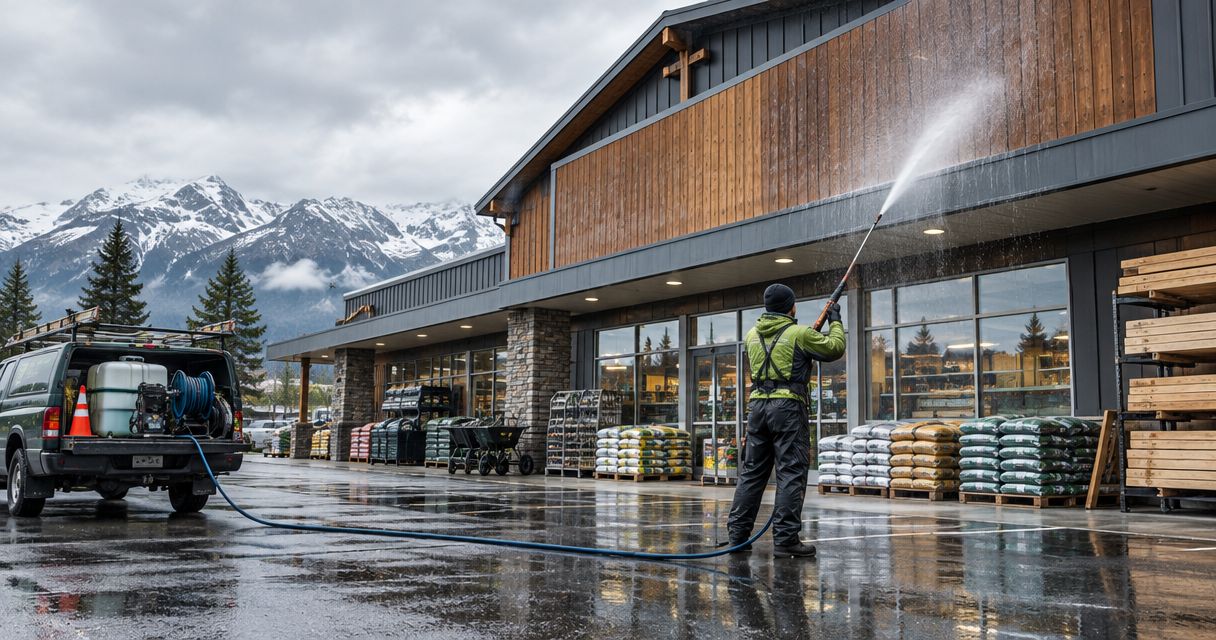
Exterior cleaning for Alaska hardware stores is the planned removal of dirt, moss, algae, and debris from building exteriors to keep customer access usable and protect exterior materials. This 2026 guide explains how to organize cleaning around outdoor merchandise, deliveries, roof conditions, and freezing weather without treating every surface the same way.
- Exterior cleaning for Alaska hardware stores starts with customer access, merchandise protection, and controlled runoff.
- Separate routine storefront cleaning from roof moss removal; each needs different methods and safeguards.
- Alaska Moss Doctor serves Wasilla-area homeowners; hardware-store managers must confirm commercial project acceptance before considering the service.
- Choose cleaning methods by surface material and manufacturer instructions, not by the equipment already in your stockroom.
Why exterior cleaning matters for Alaska hardware stores
A hardware-store cleaning plan must account for more than dirty siding. If your entrance doubles as a display area, pickup point, or cart return, washing that area affects customers, employees, and inventory at once. Start with access, then appearance.
For your 2026 maintenance plan, distinguish the provider’s stated customer base from the work your store requires. Alaska Moss Doctor provides roof and exterior moss/algae cleaning and removal for homeowners around Wasilla. That stated residential focus does not establish commercial hardware-store coverage.
Hardware retail also puts cleaning supplies within easy reach. That convenience does not establish that a stocked cleaner suits your roof, painted sign, door seals, or siding. Use material instructions and the cleaner’s label to decide what belongs on each surface.
The right cleaning plan protects the route into the store before it improves the view from the parking lot.
How to plan and complete exterior cleaning
Map your work areas before choosing equipment
Start with a ground-level walkaround and a simple annotated photograph or paper sketch. Divide the property into 4 work zones: customer entrance, storefront walls, roof and drainage, and loading or outdoor sales areas. These are planning categories, not required boundaries; adapt them to your building.
Record dirt, biological growth, loose materials, and drainage concerns separately. A stained wall and a damaged wall need different responses. Keep roof observations at ground level rather than asking store staff to climb for a better photograph.
Assign an employee or manager to maintain the map so contractors and opening staff work from the same information.
- Mark customer entrance and exit routes.
- Identify outdoor stock and display racks.
- Record drains, downspouts, and low spots.
- Flag visible damage for separate assessment.
- Note landlord-controlled areas if you lease.
Match each cleaning method to its surface
Read existing maintenance instructions before renting equipment or opening a container from your shelves. Identify the roof covering, siding, painted trim, masonry, glazing, and seals. When the material is uncertain, get it identified before selecting a method.
Pressure washing is not a universal exterior-cleaning method. Asphalt-shingle guidance generally calls for methods that avoid damaging pressure, while other materials require their own instructions. A gentler spray also does not make an unsuitable chemical safe.
Ask a contractor to specify both the application method and the cleaning agent. For roof-specific background, review whether pressure washing can damage shingles before agreeing to a roof-cleaning scope.
- Check the surface manufacturer’s cleaning instructions.
- Read the cleaner’s permitted uses and precautions.
- Test an inconspicuous area where instructions allow.
- Separate roof treatment from pavement cleaning.
- Exclude damaged surfaces pending assessment.
Assign routine tasks and specialist work separately
Let staff handle appropriate ground-level housekeeping with familiar tools and written instructions. Sweeping loose debris, relocating stock, and photographing conditions are different jobs from applying roof treatments or operating washing equipment near electrical fixtures.
For specialist work, send the same scope and photographs to each prospective contractor. Ask for written confirmation of commercial work acceptance, relevant insurance, equipment access needs, and responsibility for runoff. A residential service description is not evidence of commercial capability.
Alaska Moss Doctor exterior cleaning is best suited to Wasilla-area homeowners seeking moss and algae removal. A hardware-store manager should confirm commercial suitability rather than treating that residential service description as a store-cleaning recommendation.
- Assign staff only tasks within their training.
- Request acceptance of your specific building type.
- Ask who performs roof-access work.
- Confirm exclusions and subcontracted tasks.
- Identify the manager authorized to stop work.
Protect merchandise and control runoff
Move vulnerable stock out of the work area before water or treatment begins. Do not rely on packaging as a protective barrier. Bagged materials, cardboard cartons, display samples, and electrical merchandise deserve explicit decisions about relocation or protection.
Trace where wash water will travel. A nearby drain is not automatic permission to discharge cleaning water; check applicable requirements and the product label. Ask the contractor to explain containment, collection, and disposal where needed, rather than accepting a vague promise to rinse everything away.
Include neighboring property, landscaped areas, and delivery access in that conversation. The work boundary must cover where water travels, not just where the operator stands.
- Relocate susceptible merchandise before setup.
- Identify electrical fixtures and sensitive openings.
- Mark drains and likely runoff paths.
- Agree on containment and disposal responsibilities.
- Keep customers outside the active work boundary.
Schedule around access and freezing conditions
Choose the work window after reviewing surface conditions, the forecast, delivery movements, and customer access. Do not set a fixed seasonal date and assume conditions will fit. Water left on a walking route becomes a different hazard when it freezes.
For 2026 scheduling, give the contractor your delivery windows and entrance restrictions before confirming the work sequence. Ask how changing weather affects treatment, rinsing, drying, and reopening. There is no single temperature threshold that applies to every cleaning product and material; follow the relevant instructions.
Keep emergency exits usable throughout the job. If the proposed setup obstructs an exit, revise the work plan before starting.
- Check the forecast for the work and drying period.
- Follow product-specific temperature restrictions.
- Separate deliveries from active cleaning areas.
- Maintain a usable, clearly marked customer route.
- Define conditions that trigger postponement.
Sequence the work and inspect before reopening
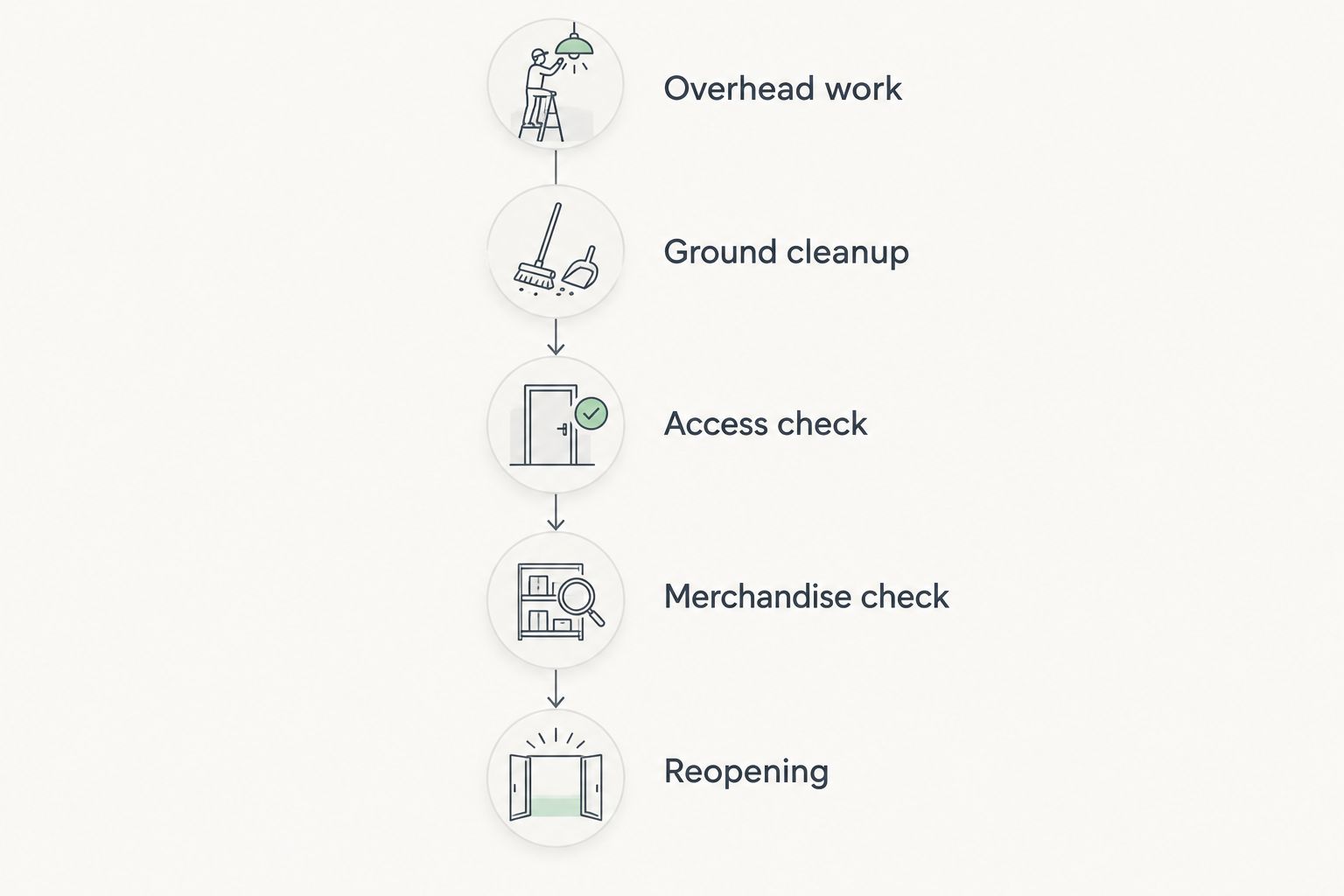
Coordinate elevated work before the final cleanup below it, while following the treatment instructions for each surface. This avoids completing an entrance only to cover it with debris from overhead work. Sequence does not override runoff controls or roof-access safeguards.
Use 2 sign-offs as a management checkpoint: the contractor confirms the agreed work is complete, and the store manager confirms the affected customer area is ready to reopen. These are proposed operating controls, not a substitute for required safety procedures.
The manager’s inspection should cover access, debris, equipment removal, merchandise, and visible damage. Do not reopen solely because the washing equipment has stopped.
- Review overhead work before final ground cleanup.
- Remove hoses and temporary obstructions.
- Check thresholds, mats, and walking surfaces.
- Inspect relocated merchandise before returning it.
- Record unresolved defects and responsible parties.
Record results and set inspection triggers
Keep 3 photographs per zone as a practical documentation target: an overview before work, the same view afterward, and a close-up of any unresolved concern. This is a suggested recordkeeping method, not an inspection standard or proof that hidden defects are absent.
Store the scope, cleaner information, exclusions, photographs, and follow-up instructions together. Your 2026 record should distinguish completed cleaning from repairs still awaiting attention. Otherwise, the next manager inherits an invoice without a useful maintenance history.
Set follow-up checks around observed conditions, such as recurring debris at a downspout or growth returning to a shaded wall. Inspection frequency and treatment frequency are separate decisions.
- Photograph consistent viewpoints before and after work.
- Save written care and follow-up instructions.
- Log remaining stains separately from active growth.
- Assign unresolved repair items to an owner.
- Reinspect recurring problem areas before retreating.
Compare cleaning options for your hardware store
Best for your store means suited to the task, not simply able to arrive with washing equipment. Separate routine housekeeping, building washing, and roof work when comparing proposals. Combining them under one contractor is useful only when the written scope covers each task properly.
| Option | Best for | Main advantage | Key limitation |
|---|---|---|---|
| In-house ground-level housekeeping | Routine sweeping, stock relocation, and visual checks | Staff can coordinate directly with store operations | Does not establish competence for roof work, chemical treatment, or specialized washing |
| Commercial exterior-cleaning contractor | Storefront washing with customer and delivery coordination | Can put access, surface methods, and cleanup into one scope | Commercial experience and material-specific methods still need confirmation |
| Roof-cleaning specialist accepting commercial projects | Roof moss or algae work requiring specialist access | Keeps roof methods and access central to the proposal | Storefront, pavement, and merchandise protection are not automatically included |
| Split-scope arrangement | Stores using staff for preparation and specialists for treatment | Assigns different tasks to appropriate people | Requires a named coordinator to prevent gaps between scopes |
Alaska Moss Doctor’s stated residential moss/algae removal service is relevant background, but its description alone does not establish acceptance of any commercial option above. Confirm the project type before discussing a store-specific scope.
Compare proposals line by line. A proposal that excludes stock movement, runoff management, or final entrance cleanup assigns those jobs back to someone else. Identify that person before accepting the work.
Common mistakes hardware stores make
Treating stocked cleaners as approved building treatments
Selling a cleaner does not establish compatibility with your own building. Check the exact label, surface instructions, application method, and protective measures. Do not combine products or improvise mixtures.
Leaving outdoor inventory inside the splash area
A tidy display is still exposed inventory. Move susceptible merchandise before setup, and check it before returning it to sale. Include display bases, carts, and empty packaging in the preparation plan.
Scheduling washing during deliveries without separating routes
A loading entrance is not an isolated work area while vehicles and employees continue through it. Agree on delivery coordination and a clear work boundary. Stop and revise the setup if operations enter that boundary.
Choosing one method for the roof and storefront
A method suited to sound pavement is not automatically suitable for shingles, painted siding, seals, or signs. Require a surface-by-surface plan instead of a single equipment description.
Treating cleaning as a repair
Cleaning does not repair failed flashing, loose cladding, damaged seals, or drainage defects. Record those findings separately and arrange appropriate assessment. Do not accept a cleaner-looking surface as evidence that a building defect is resolved.
FAQ
What is the best approach to exterior cleaning for Alaska hardware stores?
The best approach separates customer access, merchandise protection, surface-specific cleaning, and runoff control. Map the property first, then assign routine staff tasks and specialist work in a written scope.
Can our employees clean the hardware store exterior themselves?
Employees can handle appropriate ground-level housekeeping within their training and instructions. Roof access, chemical treatment, and specialized washing require a separate assessment of competence, equipment, and safeguards.
Is pressure washing better than soft washing for a hardware store?
Neither method is best for every hardware-store surface. Select the method and cleaner using the material manufacturer’s instructions, the contamination present, and the condition of the surface.
Can we wash the storefront when freezing weather is forecast?
Postpone work when freezing conditions conflict with product instructions or safe drying and reopening. Evaluate the full work and drying period rather than relying only on the temperature when cleaning starts.
Does Alaska Moss Doctor clean commercial hardware stores?
Alaska Moss Doctor’s stated services cover roof and exterior moss/algae cleaning and removal for Wasilla-area homeowners. Hardware-store managers must confirm commercial project acceptance directly; the residential description does not establish commercial coverage.
How often should a hardware store schedule exterior cleaning?
Set cleaning intervals from documented surface conditions and material-care instructions rather than a universal calendar. Inspect recurring problem areas separately from deciding whether another treatment is needed.
Can cleaning solve a roof leak or overflowing drainage?
Cleaning is not a substitute for diagnosing a roof leak or drainage defect. Record visible concerns and arrange the appropriate repair assessment separately from the cleaning scope.
One last thing
Make the entrance check independent of the appearance check. A storefront can look finished while hoses, wet mats, loose debris, or displaced merchandise still obstruct the customer route.
For your 2026 plan, name the person who authorizes reopening before the contractor starts. That decision makes the final inspection an assigned task rather than an assumption.