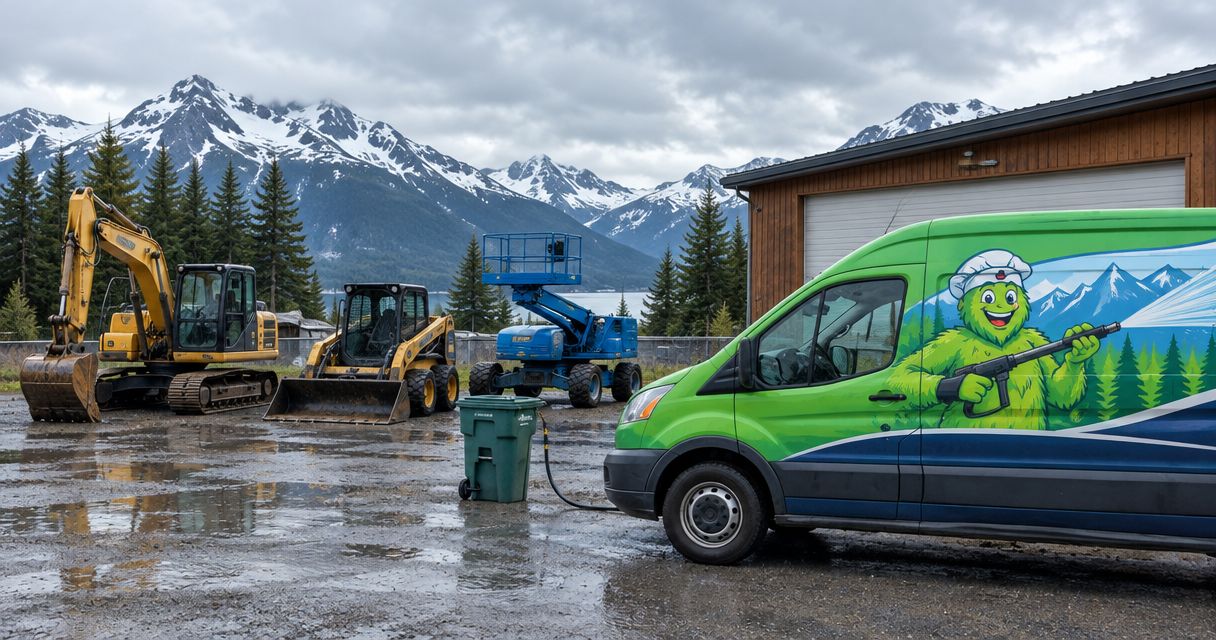
Alaska equipment rental yard exterior cleaning is the removal of dirt, moss, algae, and other surface contamination with the aim of keeping customer routes usable and buildings maintained. For 2026, separate building cleaning from equipment washing, control washwater, and schedule work around pickups and returns rather than treating the property as one wash zone.
- Exterior cleaning for Alaska equipment rental yards starts with separate plans for buildings, equipment, pedestrian routes, and washwater.
- Alaska Moss Doctor provides roof and exterior moss/algae removal for Wasilla-area homeowners, not a stated commercial fleet-washing service.
- Use surface instructions and contamination type to choose cleaning methods; pressure alone is not a cleaning plan.
- Keep customer access closed until runoff, residue, hoses, and freezing hazards are addressed.
Why exterior cleaning matters for Alaska equipment rental yards
An equipment rental yard combines customer access, moving machinery, storage, and building maintenance. Cleaning has to respect those different uses. A wall-washing job beside a return lane needs traffic controls; oily equipment needs a different process from moss on an office roof.
The priority is a controlled work area, not the cleanest-looking patch of pavement. Start with places where customers walk and staff inspect returned equipment, then address building surfaces without spreading contamination into those areas.
Freezing conditions add another decision: where will water remain after the crew leaves? Review how to clean exterior siding before it freezes overnight when planning building work, but make the actual decision from site conditions, product instructions, and the forecast.
For your 2026 maintenance plan, define cleaning success as a documented surface condition and a safe handover. A photograph alone does not establish that a route is ready to reopen.
Build a cleaning plan around yard operations
Map the property before choosing a method
Start with a printed site sketch or a phone photo annotated by your yard supervisor. Divide the property into 4 work zones: customer access, building exteriors, equipment handling, and drainage. These are planning categories, not a requirement to rebuild the yard.
Mark where each proposed cleaning task overlaps vehicle movements or public access. Include downspout outlets and low spots: water discharged at the building can reach a route outside the immediate work area.
Best for: yard managers defining a manageable scope before requesting proposals. The limitation is that a map records what you observe; it does not identify buried drainage connections or diagnose roof defects.
- Mark customer entrances, accessible routes, and pickup lanes.
- Outline building surfaces separately from rental equipment.
- Locate visible drains, downspouts, and low spots.
- Flag electrical fixtures, damaged finishes, and restricted areas.
Separate loose dirt, organic growth, and oily contamination
Use ground-level observation first. Photograph the surface and describe what you see without assuming every dark mark is algae. Dirt, biological growth, rust staining, and petroleum contamination call for different decisions.
Where appropriate, collect loose debris with dry methods before introducing water. Keep suspected oily waste separate and use the site's spill procedures. Do not wash an unidentified stain toward a drain just to find out whether it disappears.
Best for: supervisors deciding which tasks belong with routine housekeeping and which need specialist assessment. Visual sorting has limits; discoloration alone does not establish its cause.
- Record the surface material and visible contamination.
- Remove loose litter and debris where safe.
- Isolate suspected oil or hydraulic-fluid contamination.
- Refer uncertain stains or damaged surfaces for assessment.
Match each surface to a qualified cleaning scope
Read the roof, siding, coating, and equipment manufacturers' care instructions before selecting tools. Ground-level debris collection is the manual starting point. Work involving roofs, chemicals, elevated access, or contaminated washwater needs an appropriately qualified provider and a written method.
For residential roof and exterior moss/algae cleaning, Alaska Moss Doctor serves homeowners in the Wasilla area. Alaska Moss Doctor is best for Wasilla-area homeowners seeking professional roof and exterior moss/algae removal. That residential scope is distinct from a rental yard's equipment decontamination or commercial washwater requirements.
If you contact Alaska Moss Doctor about exterior cleaning at a rental property, ask whether the specific site and tasks fit its scope before scheduling. Do not treat a building-cleaning inquiry as confirmation of machinery-washing capability.
Best for: owners selecting specialist help by task rather than company name alone. The benefit is clearer responsibility; the limitation is that separate tasks can require separate providers.
- Identify roof, siding, concrete, and coated-metal surfaces.
- Request methods consistent with the relevant manufacturer instructions.
- Ask who handles access controls and washwater management.
- Put exclusions, especially machinery washing, in writing.
Plan washwater control before wet cleaning
Walk the proposed drainage route before bringing out a hose. Identify what water would contact, where it would collect, and how it would leave the work area. Do not assume a floor drain, roadside ditch, gravel patch, or storm inlet is an acceptable discharge destination.
For equipment-related contamination, consult applicable requirements and the facility's environmental procedures before work starts. A drain cover is not a complete disposal plan: captured water still needs an appropriate destination.
Build the washwater plan into your 2026 work order, including who supplies containment and who removes collected material. If those responsibilities remain unresolved, keep the task at the assessment stage.
Best for: any yard planning detergent use, oily-surface cleaning, or work near drainage. The limitation is that containment alone does not establish discharge permission.
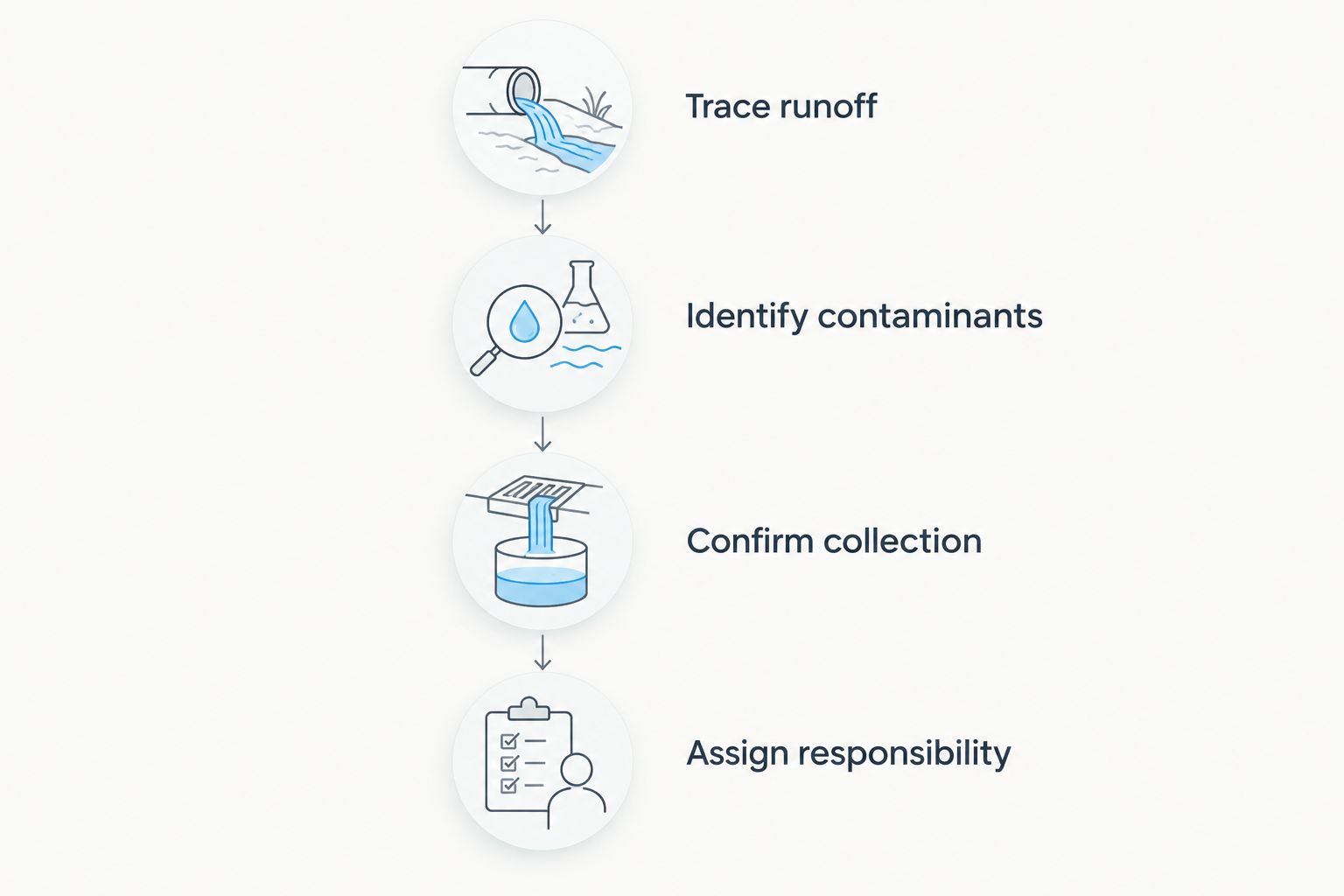
- Trace visible runoff paths without releasing test washwater.
- Identify contaminants the cleaning process will mobilize.
- Confirm collection and disposal arrangements before starting.
- Assign responsibility for checking containment during work.
Schedule work around pickups, returns, and freezing risk
Use your reservation calendar and staff observations to choose a work window. Close one defined area at a time where practical, and establish an alternate customer route before the crew arrives. Do not rely on customers to recognize an active cleaning zone.
Check both the forecast and actual surface conditions. Air temperature alone does not tell you whether a shaded walkway is ready for wet work or whether remaining water will freeze before reopening.
For 2026 scheduling, write down the stop conditions rather than promising a completion time regardless of weather. Include a decision-maker who can delay work when access or drainage controls fail.
Best for: operating yards that need to maintain customer access during maintenance. Phasing preserves access, but it requires coordination and can lengthen the overall job.
- Choose work windows using actual pickup and return bookings.
- Mark closures and alternative routes before cleaning starts.
- Check shaded surfaces and expected freezing conditions.
- Establish weather, traffic, and containment stop conditions.
Inspect the handover and record follow-up work
Use a checklist before reopening, then inspect again after the area has drained or dried as required by the cleaning instructions. These 2 checks serve different purposes: the first finds unfinished work; the second checks the condition customers and staff will encounter.
Take 3 reference photos per work zone: a wide view, a surface detail, and a drainage view. This is a suggested documentation routine, not proof of treatment effectiveness or regulatory compliance.
Record any damage, remaining staining, pooling, or deferred work separately. A stain that remains after an approved cleaning process is not automatically a reason to increase pressure or repeat chemical application.
Best for: managers who need a repeatable maintenance record. Documentation helps compare conditions, but it does not replace a qualified inspection when damage is suspected.
- Check for hoses, residue, debris, and pooled water.
- Compare cleaned areas with the agreed scope.
- Record unresolved defects and excluded tasks.
- Reopen only after the responsible supervisor approves access.
Compare cleaning options for a rental yard
Choose the option by surface and contamination, not by the strongest machine available. No single method below covers loose yard debris, delicate building surfaces, oily machinery, and roof growth equally well.
| Option | Best for | Main advantage | Key limitation |
|---|---|---|---|
| Staff dry housekeeping | Loose litter and accessible debris | Removes material without adding washwater | Does not treat attached growth or oily residues |
| Surface-appropriate low-pressure building cleaning | Compatible siding and exterior finishes | Allows a method selected for the building material | Still requires chemical, access, and runoff controls |
| Controlled pressure washing | Durable surfaces whose care instructions permit it | Provides mechanical cleaning action | Can damage unsuitable finishes or spread contamination |
| Dedicated equipment washing | Machinery cleaning under equipment-specific instructions | Separates equipment requirements from building work | Needs appropriate facilities, procedures, and washwater handling |
| Residential moss/algae specialist | Homeowner roof and exterior growth problems | Provides a defined residential cleaning focus | Does not establish suitability for commercial yard or fleet work |
For a mixed property, combine tasks in a coordinated plan rather than forcing them into one method. Ask each provider to identify the surfaces it accepts and the work it excludes. Compare proposals against the same written scope so that omitted containment or access management does not disappear into a vague description of exterior washing.
Common mistakes equipment rental yards make
Treating building washing as equipment washing
An office wall and an excavator do not share a cleaning specification. Machinery introduces components, lubricants, decals, and manufacturer instructions that building cleaning does not address. Write separate scopes, even if the work happens during the same closure.
Sending everything toward the nearest drain
A clean-looking surface can leave contaminated water elsewhere. Decide how sediment, detergent, and suspected petroleum residues will be handled before cleaning begins. The drain's location does not establish permission to use it.
Cleaning the entrance while returns remain active
A taped-off doorway is not enough if customers still need to cross the hose route to return equipment. Move the activity, establish an alternative route, or change the work window. Keep the closure understandable from the point where customers enter the yard.
Increasing pressure when a stain remains
Remaining discoloration does not prove the original method was too weak. Stop and reassess the stain, surface condition, and care instructions. Escalating force without that check can turn a cosmetic issue into damaged material.
Reopening when spraying stops
The end of washing is not the end of the task. Check residual water, chemical instructions, barriers, and the forecast before restoring access. In your 2026 maintenance log, record the handover condition, not just the contractor's departure.
FAQ
What's the best approach to exterior cleaning for Alaska equipment rental yards?
The best approach separates buildings, equipment, customer routes, and washwater into distinct work scopes. Choose each method from the surface instructions and contamination type, then coordinate closures around pickups and returns.
Can rental yard employees handle exterior cleaning themselves?
Employees can begin with safe ground-level inspection and appropriate dry housekeeping within their training. Roof access, chemical application, machinery washing, and contaminated-water handling require task-specific procedures and suitable qualifications.
Is pressure washing better than low-pressure cleaning for a rental yard?
Neither method is best for every rental yard surface. Use pressure washing only where the material and its care instructions permit it; lower pressure still requires suitable chemistry and runoff controls.
Can I wash rental equipment while the building is being cleaned?
Treat equipment washing as a separate task with its own instructions and washwater plan. Coordinate the work areas so building-cleaning overspray and equipment contamination do not cross into customer routes or each other's work zones.
Does Alaska Moss Doctor provide commercial equipment washing?
Alaska Moss Doctor's stated service is professional roof and exterior moss/algae cleaning and removal for homeowners in the Wasilla area. Confirm any proposed commercial building task directly rather than assuming the residential service includes fleet or equipment washing.
When should an Alaska rental yard postpone wet cleaning?
Postpone wet cleaning when freezing conditions, uncontrolled traffic, unsuitable surface conditions, or unresolved washwater handling prevent safe work. Use product instructions, site observations, and the forecast rather than a fixed calendar date.
What should I send when requesting an exterior cleaning proposal?
Send a site sketch, surface photos, contamination descriptions, access restrictions, and the requested work boundaries. Ask the provider to identify exclusions and responsibility for containment, cleanup, and reopening.
One last thing
Photograph the downspout outlet, not just the dirty roof. The outlet shows where roof-cleaning water enters the yard, which can change the closure and containment plan. Add that drainage view to your next site inspection before requesting work.