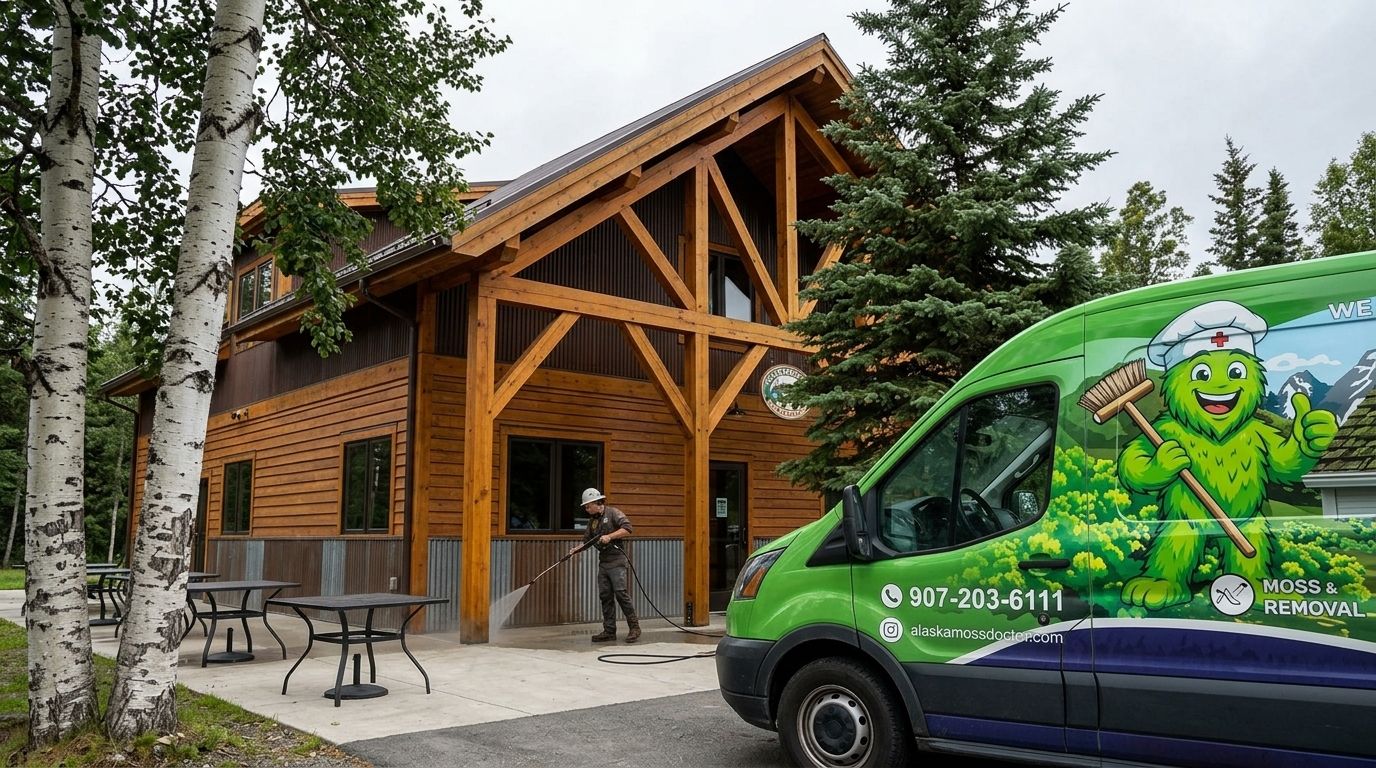
Exterior cleaning for Alaska breweries and taprooms keeps rooflines, siding, and patios free of the algae and moss that build up fast under Mat-Su Valley spruce canopy and long shoulder seasons. Taprooms live or die on curb appeal — a moss-streaked roofline or a slick, algae-covered patio reads as neglect to a walk-in customer, and this guide covers exactly which surfaces to check first, how to wash them without damaging paint or signage, and when to book the work around a short Alaska patio season.
- Alaska Moss Doctor handles roof, siding, gutter, and patio cleaning for breweries and taprooms across the Mat-Su Valley.
- Flat and low-slope commercial roofs common on taproom buildings trap needle debris and algae faster than pitched residential roofs.
- Black algae streaks on storefront siding are the most common visibility complaint taproom owners raise before the 2026 patio season.
- Gutter clogs from spruce and birch debris cause ice dams that damage entryways during Alaska winters.
- Soft washing under roughly 500 PSI, not high-pressure blasting, protects painted signage and wood siding on taproom exteriors.
Why exterior cleaning matters for Alaska breweries and taprooms
A taproom sells an experience before it sells a pint, and the exterior is the first thing a customer judges from the parking lot. Moss and algae growth on north-facing walls and flat roof sections is common in shaded Mat-Su Valley lots, and it shows up in the same photos customers post to social media. A moss-covered roofline or a slick, algae-stained patio is a visible liability, not just a cosmetic issue — wet moss on entry walkways is a slip hazard, and clogged gutters near a taproom entrance during freeze-thaw season back up onto the exact path guests use to get inside.
Exterior cleaning also protects the building itself. Asphalt shingle warranties frequently exclude damage tied to unaddressed algae growth, and untreated moss holds moisture against flashing and siding through Alaska's long winters. For a business that depends on the Alaska Moss Doctor team's category of work — roof, siding, and hardscape cleaning — getting ahead of buildup before the five-month patio season (mid-May through September) protects both the brand image and the building envelope.
Step-by-step: exterior cleaning for your taproom
Inspect your roofline and flat sections for algae buildup
Most taproom buildings in the Mat-Su Valley mix a pitched main roof with a flat or low-slope section over an addition, walk-in cooler, or patio cover. Flat sections trap needle debris and hold standing water longer, which accelerates algae growth compared to a pitched residential roof.
- Check flashing and drains around any flat roof section for ponding water
- Look for dark streaking on north-facing slopes, which signals algae rather than dirt
- Clear needle and leaf litter from roof valleys before it composts into a moss bed
- Check HVAC condenser drainage lines on flat roofs for algae blocking the outlet
- Note any moss growing around roof vents or skylight curbs
Wash your patio and beer garden hardscape
A taproom's patio is often its best-performing seating during the short Alaska summer, and algae film on pavers or concrete makes that surface slick and dull-looking in photos.
- Spot-check shaded corners of the patio for green film before opening for the season
- Test paver joints for moss growth pushing grout apart
- Rinse planters and hop trellis footings where organic debris collects
- Confirm drainage slopes still carry water away from seating areas
- Check for algae staining on any retaining walls bordering the beer garden
Clean storefront glass, signage, and entry doors
Signage and glass are brand assets. Streaked glass or a moss-dulled wood sign undercuts a taproom's visual identity faster than almost anything else on the property.
- Wipe down entry glass and any patio-facing windows for water spotting
- Check carved or painted wood signage for surface moss, common on shaded storefronts
- Clear cobwebs and debris from overhead awnings or covered entries
- Inspect door thresholds for algae buildup that makes the entry slick when wet
Address gutters and downspouts before freeze-up
Spruce and birch debris clogs gutters faster in the Mat-Su Valley than in most lower-48 climates, and a clogged gutter near a taproom entrance becomes an ice dam by December.
- Clear needle and leaf buildup from gutters at least twice a year in spruce-heavy lots
- Confirm downspouts direct water away from entry walkways and patio seating
- Check for sagging gutter sections that hold standing water and grow algae
- Look for staining on siding below gutter joints, a sign of an overflow point
Handle siding and wood exteriors built for Alaska winters
Many taprooms use cedar, log, or fiber cement siding for a lodge-style look, and each material reacts differently to cleaning chemistry and pressure.
- Use soft washing under roughly 500 PSI on painted or stained wood siding to avoid stripping finish
- Check log or timber accents for moss growth in shaded joints and corners
- Confirm any cleaning solution is rinsed fully off landscaping near hop plants or garden beds
- Inspect fiber cement panels for streaking at seams, which traps moisture longer
Schedule cleaning around your event calendar and Alaska's short summer
A release weekend or a live music night is the wrong time to have a pressure washer running in the parking lot.
- Book exterior cleaning before Memorial Day, ahead of peak patio traffic
- Avoid scheduling around known festival dates or scheduled release events
- Plan a fall pass before first snow to clear gutters and check flashing before freeze-up
- Build a standing spring-and-fall cleaning cadence rather than reacting to visible streaks
Choose the right team for the job
Once the inspection points are clear, the decision comes down to who actually does the washing. That's where a commercial building washing service built for Alaska's climate earns its cost over a general contractor or in-house crew.
| Option | Best for | Typical scope | Key limitation |
|---|---|---|---|
| DIY pressure washing | Owner-operators comfortable on a ladder | Ground-level patio and low walls | Wrong PSI strips paint and voids siding warranties |
| General handyman or landscaping crew | Basic seasonal debris clearing | Gutter scooping, patio sweeping | Rarely trained in soft-wash chemistry for algae |
| Commercial janitorial add-on | Businesses already paying for interior cleaning | Storefront glass, entry mats | Skips roof and flat-roof algae entirely |
| Alaska Moss Doctor (exterior cleaning specialist) | Breweries and taprooms needing full roof-to-patio service | Roof, siding, gutters, patio, walkways | Best booked outside peak brewing or event days for site access |
Verdict: Alaska Moss Doctor is built for the roof-to-patio scope a taproom actually needs — a general handyman or interior janitorial add-on covers a fraction of that surface area.
“If black streaks are visible from the parking lot, you've already waited past the point where a spring wash would have prevented it.”
Common mistakes Alaska breweries and taprooms make
- Pressure washing patios at full PSI right before opening for the season — cracks mortar joints and blasts sand out of paver gaps instead of just lifting algae film.
- Ignoring flat roof drains until a rainstorm backs up mid-event — standing water over a packed patio during a release weekend is a bad look and a real liability.
- Waiting until streaks are visible from the road to book cleaning — by that point the algae has had a full season to establish, and removal takes longer.
- Using strong chlorine-based cleaners near hop trellises and beer garden landscaping — kills plantings that took a season to establish.
- Scheduling cleaning during a scheduled festival or live release weekend — disrupts guest flow and parking access exactly when the taproom needs both clear.
Get your taproom exterior inspected
Book a roof, siding, and patio cleaning pass before the 2026 patio season fills your calendar.
FAQ
What's the best time of year for exterior cleaning at an Alaska brewery or taproom?
Spring, before Memorial Day, is the best window for exterior cleaning at an Alaska brewery or taproom, ahead of peak patio traffic. A second fall pass before first snow clears gutters and catches flashing issues before freeze-up.
How much does exterior cleaning cost for a taproom in the Mat-Su Valley?
Cost depends on roof type, square footage, and how much patio and siding area needs washing. Get a site-specific quote rather than relying on a flat industry rate, since flat-roof sections and log siding both add scope.
Is soft washing safer than pressure washing for taproom siding?
Yes, soft washing under roughly 500 PSI is safer for painted wood, cedar, and fiber cement siding than high-pressure blasting. High PSI strips paint and finish, which is common damage on taproom storefronts built with a lodge-style look.
How often should a taproom's roof and gutters be cleaned in Alaska?
Gutters in spruce and birch-heavy lots typically need clearing twice a year, once in spring and once in fall before freeze-up. Roofs with visible moss or algae streaking should be inspected annually even without a full cleaning each year.
Does moss removal void an asphalt shingle roof warranty?
Unaddressed moss and algae growth commonly falls outside asphalt shingle warranty coverage, since manufacturers expect routine maintenance. Regular cleaning keeps a taproom's roof warranty intact rather than putting it at risk.
Can exterior cleaning be scheduled around business hours to avoid disrupting customers?
Yes, exterior cleaning crews can work around a taproom's open hours and event calendar with advance scheduling. Avoiding known release weekends and festival dates keeps pressure washing noise and parking disruption away from peak traffic.
What causes black streaks on taproom rooflines and siding?
Black streaking on roofs and siding is typically algae growth, most common on north-facing and shaded sections common in Mat-Su Valley lots. It spreads faster under spruce and birch canopy than on open, sun-exposed buildings.
Do flat commercial roofs need different cleaning than pitched roofs?
Flat commercial roofs need different handling because they hold standing water and trap needle debris longer than pitched roofs, accelerating algae growth. Drainage and flashing checks matter more on flat sections than on a standard pitched residential roof.
One last thing
The patio and storefront get the attention because customers see them, but the flat roof section over a taproom's addition or cooler is usually where algae takes hold first and gets noticed last. Check that section every spring before the 2026 patio season opens, not after a customer photographs the streaking from the parking lot.