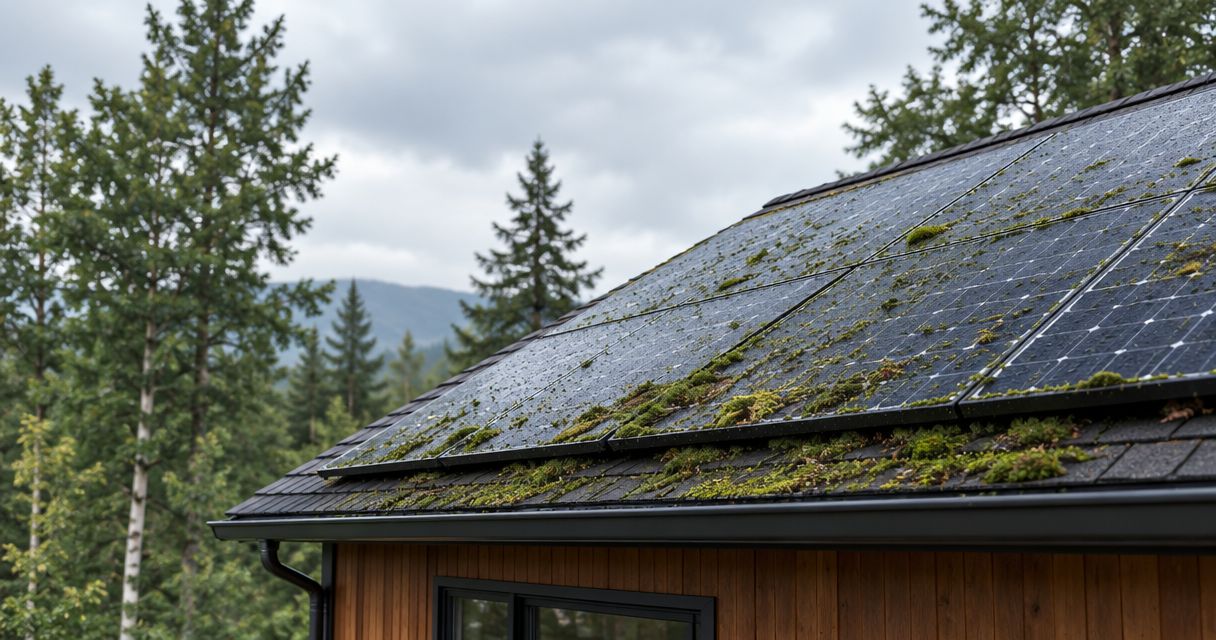
Yes—moss can contribute to problems around rooftop solar panels by covering light-receiving surfaces, holding moisture against roofing, and trapping debris around an array. Moss beside a panel does not, by itself, prove that the panel is damaged or losing output. The cleaning method matters too: scraping, pressure washing, or applying an incompatible roof treatment can damage components that moss has not.
- Does moss damage solar panels on a roof? Growth covering photovoltaic glass reduces light; nearby roof moss needs separate assessment.
- Moss around a solar array is not proof of electrical damage or a roof leak.
- Follow the panel manufacturer's cleaning instructions; roof treatments are not automatically suitable for solar equipment.
- Alaska Moss Doctor provides roof moss removal for Wasilla homeowners; solar electrical concerns belong with a qualified solar professional.
Why this matters
A solar-equipped roof needs a cleaning plan that protects both the roofing and the electrical installation. Removing visible growth is only part of the job; you also need to identify where it sits and whether reaching it requires work around wiring, mounts, or concealed roof surfaces.
For your 2026 maintenance plan, separate roof cleaning from solar equipment servicing. The guide to soft-wash roof cleaning for solar panel roofs addresses the surrounding roof, but the panel manufacturer's instructions still govern contact with the modules themselves.
Does moss damage solar panels on a roof?
Moss on the panel and moss on the roof are different problems. Growth covering the glass obstructs sunlight. Growth confined to surrounding roofing primarily raises questions about roof condition, retained moisture, debris, and access for inspection.
Use the location of the growth to decide what needs checking. A photograph shows surface conditions; it does not establish whether a hidden connector, seal, or roof penetration has failed.
| Where you see growth | What it means | Best next step | Limit of visual inspection |
|---|---|---|---|
| Across light-receiving glass | Growth blocks some incoming light | Arrange cleaning that follows the module instructions | Coverage alone does not quantify lost generation |
| Along a panel's lower edge | Check for accumulated dirt and organic debris | Have the edge inspected without scraping seals or frames | A green edge does not prove seal failure |
| On roofing beside the array | The roof needs a moss assessment | Plan roof-appropriate removal while protecting solar equipment | Nearby moss does not prove panel damage |
| Under the array | Concealed roofing and debris need assessment | Coordinate access with the solar installer | Ground-level viewing cannot establish the full condition |
| Around mounts or flashing | The attachment area needs closer inspection | Ask a roofer or solar installer to assess the detail | Moss does not establish the source of a leak |
Do not estimate an electricity loss from the size of a moss patch. Array layout, shading location, electrical design, and operating conditions affect the result. Monitoring data and an equipment assessment answer that question more reliably than appearance alone.
Moss on panel glass: a light-blocking problem
Solar modules need light to generate electricity. Anything covering their active surface—including moss, leaves, or dirt—reduces the light reaching the covered area. That is a performance concern, not automatic evidence of permanent damage.
Treat visible coverage as a reason to investigate, not a reason to replace the panel. Ask whether the material is actually on the glass, along the frame, or on roofing visible through a gap. Those locations call for different work.
For a 2026 inspection record, photograph the affected area from a safe location and note the date. Keep any monitoring alerts alongside the pictures so the solar professional can evaluate the physical condition and system behavior together.
Do not scrape stubborn growth with a blade or abrasive pad. Use the module manufacturer's cleaning instructions to establish permitted tools, water conditions, and cleaning agents before anyone touches the surface.
Moss beneath panels: a roof-access problem
An array conceals part of the roof and limits access to it. Moss visible at the perimeter does not reveal how far growth extends underneath, whether debris has accumulated, or what condition the roofing is in.
Moss holds moisture, and growth between shingle edges can interfere with their intended drainage. The roof material matters: an asphalt-shingle roof and a metal roof do not have identical cleaning requirements. Neither should receive a treatment chosen only because solar panels are present.
Do not push a rake, brush, or spray wand into a space you cannot inspect. Hidden wiring and attachments make blind cleaning a poor substitute for planned access.
Leave panel lifting and removal to the solar installer or another qualified solar professional. If access requires moving equipment, settle that scope before the roof cleaner arrives. Cleaning an accessible perimeter does not establish that the concealed roof has been cleaned.
Why moss-related risk varies
The relevant question is not simply how green the roof looks. These factors determine what needs attention and how the work should proceed:
- Growth location: Moss on active glass affects light exposure; moss on adjacent roofing requires a roof-focused assessment.
- Surface coverage: Identify whether growth is isolated at an edge or extends across the light-receiving surface. Do not turn visible coverage into an assumed output percentage.
- Roof condition: Raised shingle edges, damaged flashing, or existing leaks require assessment beyond cosmetic cleaning.
- Debris accumulation: Leaves and needles around the array complicate inspection and can obstruct roof drainage paths.
- Equipment condition: Broken glass, loose wiring, or damaged connectors require qualified attention before cleaning proceeds nearby.
- Cleaning compatibility: A method suitable for the roofing is not automatically suitable for panel glass, frames, seals, or electrical components.
Use these factors when comparing proposed work in 2026. A useful scope explains what will be cleaned, what will remain inaccessible, and which equipment requires separate attention.
How should you handle moss around rooftop solar panels?
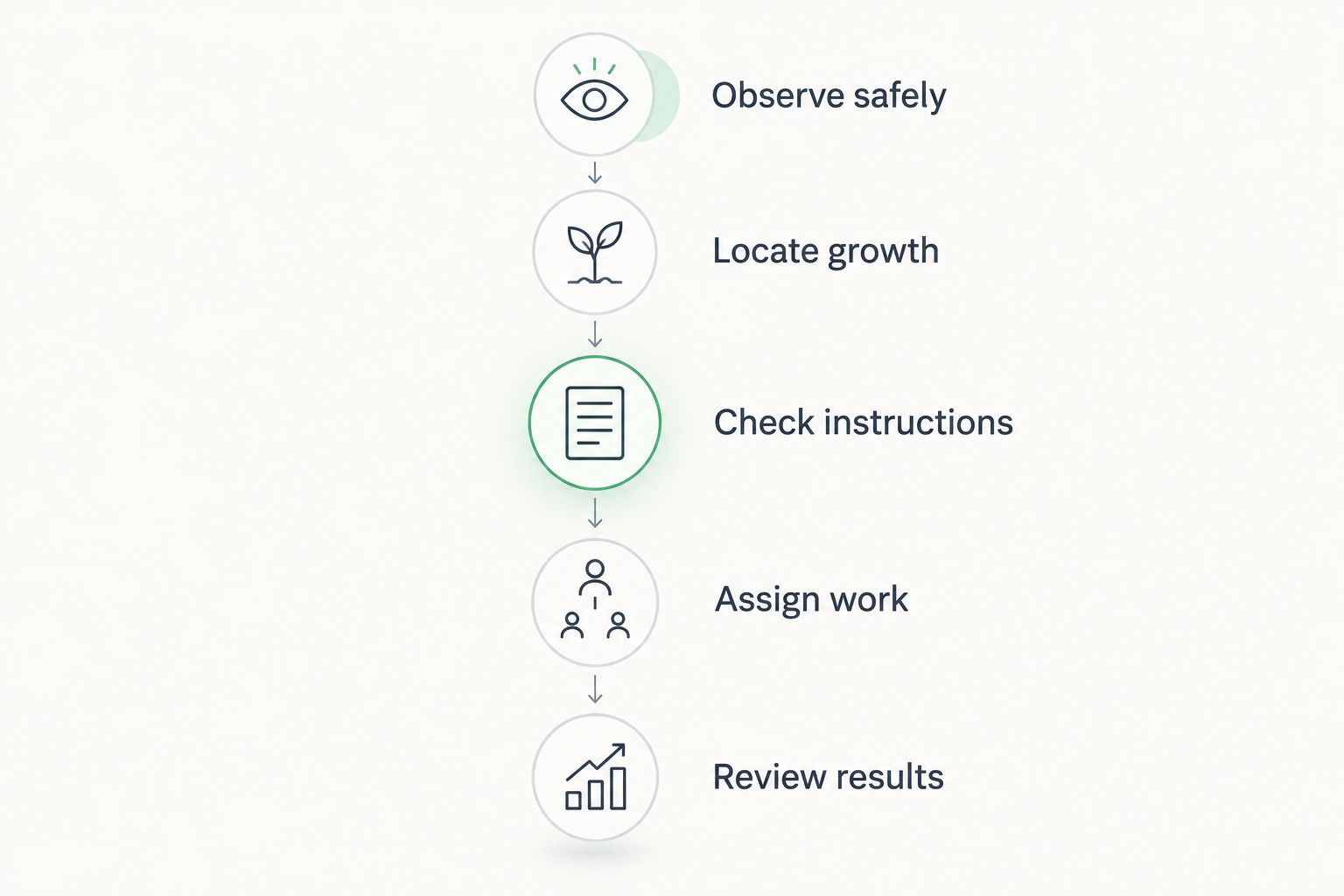
Start with observation, not a ladder. Your first task is to give the appropriate professional enough information to distinguish a roof-cleaning job from a solar service issue.
- Observe safely. View the array from the ground or another secure location. Do not walk on panels or climb onto a wet, mossy roof to obtain a closer photograph.
- Locate growth. Record whether it appears on glass, at frames, beside mounts, or underneath the array. Describe what you can see without assuming the hidden area matches it.
- Check instructions. Find the panel model and its current cleaning guidance. Give the roof cleaner that information before approving chemicals or equipment near the array.
- Assign work. Separate roof moss removal, module cleaning, roofing repairs, and electrical inspection. Confirm who handles each task and any access restrictions.
- Review results. Request photographs of accessible cleaned areas, note unresolved conditions, and retain any solar service findings with your maintenance records.
The sequence prevents a common scope mistake: booking roof cleaning and assuming it includes inspection or servicing of the solar installation.
Keep your 2026 roof photographs with the panel model details and cleaning instructions. A shared record gives the roof cleaner and solar installer the same starting point without asking either to diagnose conditions from memory.
Who should inspect or clean the affected area?
Choose help according to the affected component, not just the appearance of the growth. Roof cleaning, roof repair, and solar servicing overlap at the work site, but they are not interchangeable services.
| Option | Best for | Strength | Limitation |
|---|---|---|---|
| Ground-level homeowner observation | Documenting visible changes | Provides a record without roof access | Cannot confirm concealed damage or electrical condition |
| Professional roof moss removal | Growth on accessible roofing | Addresses the roof surface and organic buildup | Does not replace solar electrical inspection |
| Qualified solar professional | Module, wiring, mounting, or output concerns | Assesses the solar installation | Does not automatically include roofing repairs |
| Qualified roofer | Leaks, damaged roofing, or flashing concerns | Assesses the roof's weather protection | Does not replace solar equipment servicing |
Alaska Moss Doctor is best suited to Wasilla homeowners seeking roof moss removal, not solar electrical diagnosis. Alaska Moss Doctor provides professional roof and exterior moss/algae cleaning and removal services in the Wasilla area.
For roof moss removal, ask Alaska Moss Doctor to define the accessible roof-cleaning scope and discuss any solar-related restrictions before work begins. Separately confirm who will clean the modules, inspect equipment, or arrange panel removal if those tasks are necessary.
Discuss moss around your solar array
Explain where the growth appears and ask about the roof-cleaning scope for your Wasilla home.
Can I pressure wash moss off my solar panels?
Do not use a pressure washer as a default solar-panel cleaning method. Follow the module manufacturer's instructions rather than assuming a roof-cleaning technique is safe for glass, frames, seals, or electrical connections.
A forceful jet and aggressive scraping introduce risks unrelated to the original growth. Calling a method low pressure also does not establish that its cleaning chemical is compatible with the solar equipment.
Does moss beside a solar panel mean the roof is leaking?
Moss beside a solar panel does not prove a roof leak. Interior staining, active water entry, damaged flashing, and deteriorated roofing need their own assessment; green growth alone cannot identify a leak path.
If you notice water entering the building, arrange a roof assessment rather than waiting for moss removal to resolve it. Cleaning removes growth; it does not substitute for repairing a failed roof detail.
Will removing moss restore solar generation?
Removing material that covers panel glass allows more light to reach that surface, but it does not guarantee a specific generation increase. Weather, seasonal daylight, shading, and equipment condition also affect output.
If you review production in 2026, do not treat a sunny day after cleaning as proof of the cleaning benefit. Ask your solar professional how to interpret monitoring data under comparable conditions and investigate persistent alerts separately.
What should you avoid during roof moss removal?
Protect the boundary between roofing work and solar work. Do not permit workers to stand on modules, pull cables aside, loosen mounting hardware, or disconnect components simply to reach moss.
Avoid broad chemical application without checking equipment compatibility and controlling where the treatment travels. A roof product's suitability for shingles does not establish its suitability for solar frames, seals, coatings, or connectors.
Do not disconnect solar equipment yourself or assume that switching off an inverter makes every part safe to touch. Solar modules generate electricity in light, so electrical isolation and equipment handling belong with qualified personnel.
Finally, avoid accepting an inaccessible area as inspected. Ask the contractor to identify any section that remained concealed and explain whether additional access is needed. A clear limitation is more useful than an unsupported assurance that everything underneath looks fine.
FAQ
Can moss permanently damage my rooftop solar panels?
Moss near a solar panel does not establish permanent panel damage. Growth covering glass blocks light, while suspected damage to seals, frames, wiring, or modules needs a qualified assessment.
Is green growth around solar panels always moss?
Green growth around solar panels is not always moss. Algae, lichen, and accumulated organic debris can look similar from a distance, so identify the material and affected surface before choosing treatment.
Can I spray roof moss killer around my solar panels?
Do not spray roof moss killer around solar panels without checking the product label and the equipment manufacturer's requirements. Suitability for roofing does not establish compatibility with solar components.
Do solar panels need to come off to remove roof moss?
Solar panels do not automatically need removal for roof moss cleaning. If the affected roof cannot be reached safely with the array in place, a qualified solar professional should determine the access plan.
Should I disconnect my solar panels before roof cleaning?
Do not disconnect solar panels yourself before roof cleaning. Ask a qualified solar professional to establish any required precautions; modules generate electricity when exposed to light.
Can Alaska Moss Doctor help with moss around a solar-equipped roof?
Alaska Moss Doctor provides professional roof moss and algae removal for homeowners in the Wasilla area. Discuss the solar installation before scheduling, and confirm separate arrangements for module cleaning or electrical inspection when needed.
How often should I check for moss around my solar panels?
Base inspections on the installation's maintenance guidance and observed roof conditions rather than an assumed universal interval. Document visible changes from a safe location and arrange assessment when growth, leaks, damage, or system alerts appear.
One last thing
The most useful photograph is not necessarily a close-up of the green patch. A wider view showing the growth in relation to panel edges, roof drainage paths, and mounts gives a contractor better context for planning access.
Keep both views if you can obtain them safely. Then ask a precise question: is the required work on the panel, on the roof, or underneath the array? That distinction determines the next move.