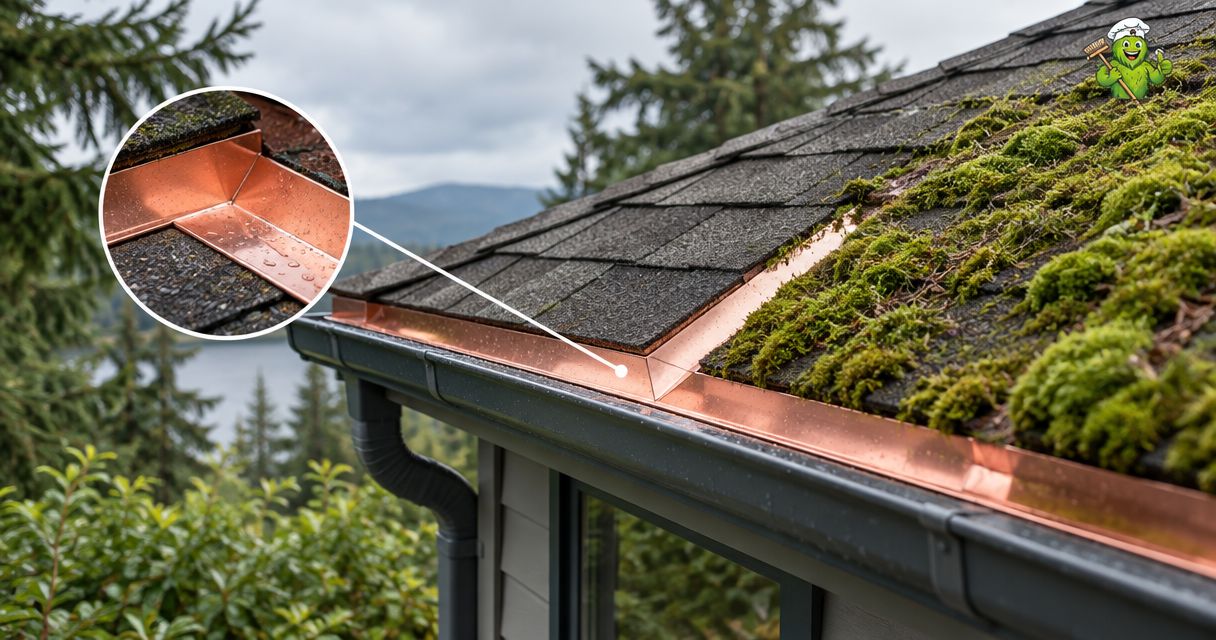
Yes—copper flashing can help suppress roof moss where rainwater washes over exposed copper and then flows down the roof, but it does not prevent growth everywhere. Its effect depends on the runoff path, and it does not replace removal of established moss, debris control, or sound roof maintenance.
- Does copper flashing prevent roof moss? Partly: its effect follows runoff, not the entire roof.
- Exposed copper can discourage growth below it; ordinary flashing is not a whole-roof moss prevention system.
- Remove established moss safely before relying on preventive measures.
- Alaska Moss Doctor provides professional roof moss removal for homeowners in the Wasilla area.
Why this matters
A clean-looking strip below a chimney does not mean the rest of your roof receives the same protection. Copper works through water contact, not through a protective field around the metal.
For your 2026 maintenance plan, separate existing growth from future prevention. A shaded slope also needs attention to moisture and debris; the guide to algae removal for north-facing roofs explains another part of that problem.
Does copper flashing help prevent roof moss growth?
Copper flashing helps locally; it does not make a roof moss-proof. As exposed copper weathers, rainwater can carry dissolved copper onto the roof below. Copper compounds inhibit biological growth, but water must reach the affected surface for that benefit to apply.
The distinction between moss and algae matters. Dark, relatively flat discoloration is not the same as raised moss cushions, and a cleaner area beneath metal does not identify which organism was suppressed. Do not treat evidence of reduced staining as proof that thick moss will disappear.
| Approach | Best for | Main benefit | Main limitation |
|---|---|---|---|
| Existing copper flashing | Supplementary prevention directly below exposed copper | Uses runoff from metal already serving a roofing function | Coverage follows a limited drainage path |
| Purpose-made copper strips | Planned prevention on a compatible roof | Places exposed copper where runoff can carry it downslope | Requires correct placement and does not remove established moss |
| Roof-appropriate moss removal | A roof with existing moss growth | Addresses the material already on the roof | Does not stop future regrowth by itself |
| Debris and shade management | Reducing conditions that favor moss | Helps the roof shed water and dry | Does not eliminate every damp or shaded area |
These approaches address different problems. Use cleaning for existing growth and prevention for recurrence, rather than expecting one piece of metal to do both jobs.
Existing copper flashing: useful but localized
Copper flashing primarily directs water away from vulnerable roof joints. Chimneys, walls, and other roof intersections need flashing that works as part of the roofing assembly; moss suppression is a secondary benefit, not its main purpose.
If exposed copper sits above a roof area, runoff can carry copper onto that area. Flashing hidden beneath roofing cannot provide the same surface exposure, and a small visible section should not be treated as protection for an entire slope.
Look at where water actually travels. A chimney can divide runoff around its sides, leaving some areas below it outside the copper-contact path. Valleys and roof intersections redirect water again.
Best for: supplementary prevention where suitable copper flashing already exists. Keep its waterproofing function first; do not bend, expose, or relocate it just to change moss coverage.
Copper strips: prevention requires deliberate placement
Purpose-made copper strips differ from incidental flashing because their placement is intended to expose copper to precipitation above the area being protected. They still depend on water moving from the metal onto the roof surface.
A roof with dormers, separate slopes, or interrupted drainage needs more thought than a simple uninterrupted plane. One strip near one ridge does not automatically serve every roof section. Avoid treating a package diagram as a substitute for checking your roof's actual layout.
For a 2026 installation decision, ask a roofer to confirm compatibility with the roofing, adjacent metals, fastening method, and manufacturer requirements. Copper runoff and contact with incompatible metals can contribute to corrosion problems, so the drainage route matters beyond moss control.
Best for: supplementary prevention on a roof whose materials and drainage support the installation. The limitation is clear: adding strips does not lift away existing moss or correct damaged roofing.
Why copper's moss-prevention effect varies
Copper's performance depends on exposure and distribution. These factors explain why a roof can look cleaner beneath metal while growth remains nearby:
- Water contact: precipitation must contact exposed copper before carrying dissolved copper downslope. Covered metal does not serve the same purpose.
- Runoff path: valleys, dormers, chimneys, and changes in slope redirect water. Areas outside that path receive no equivalent exposure.
- Existing growth: thick moss and accumulated debris remain physical material on the roof. Prevention does not replace their safe removal.
- Shade and moisture: sheltered surfaces dry differently from exposed ones. Copper does not remove shade or improve sunlight access.
- Debris cover: leaves, needles, and other organic material can retain moisture and interfere with water movement.
- Material compatibility: the roof covering, fasteners, gutters, and downstream metals affect whether copper is an appropriate addition.
There is no defensible universal coverage distance or moss-free lifespan for every roof. Judge the actual roof conditions, not a promise that one strip protects everything below it.
What should you check before adding copper?
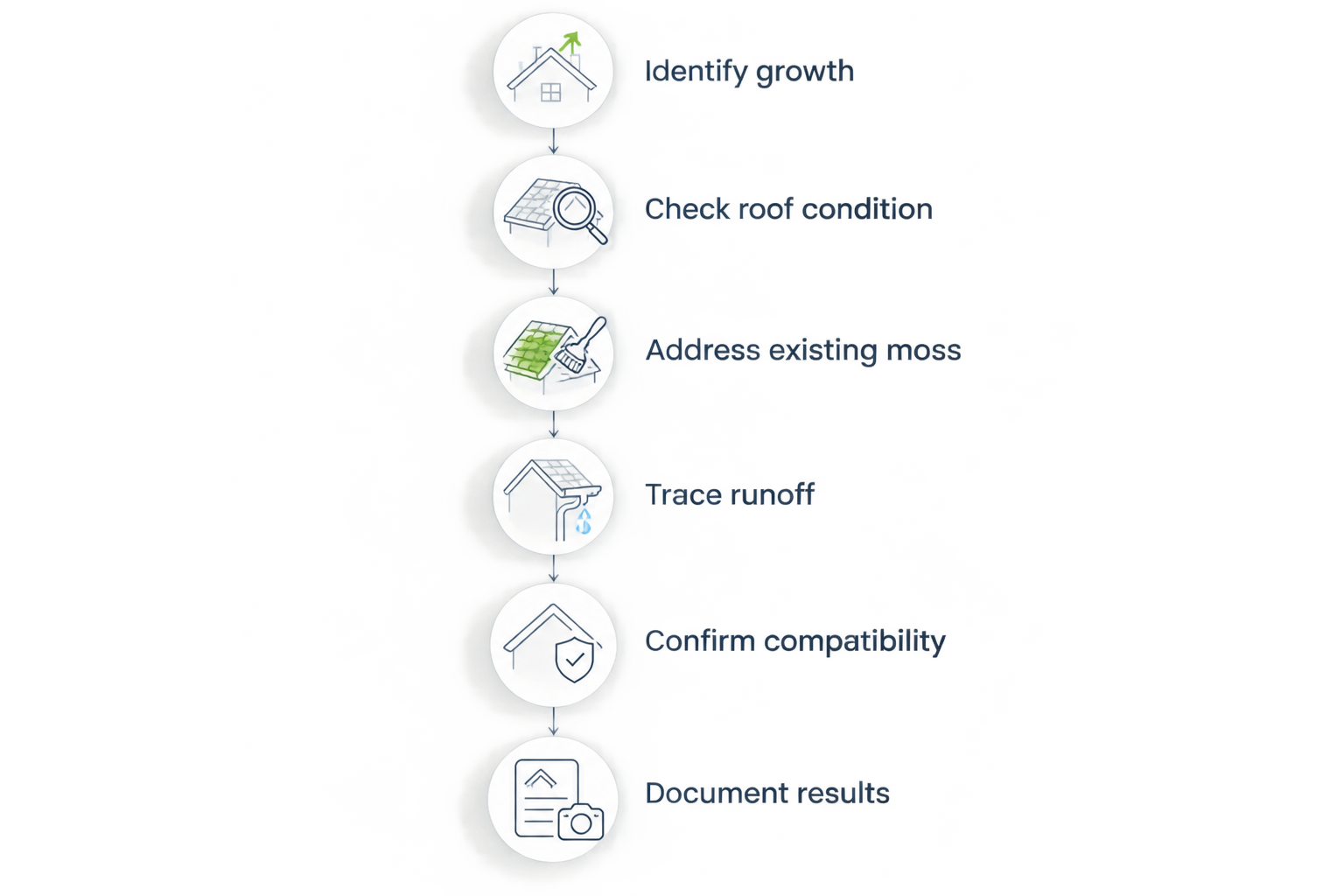
Use this sequence for your 2026 roof-maintenance decisions. It separates cleaning needs from roofing work without requiring you to walk on a mossy surface.
- Identify growth. From a safe ground-level viewpoint, note whether you see raised moss, flat discoloration, or debris. Photographs help you explain the location, but they do not replace a close inspection when identification is uncertain.
- Check roof condition. Leaks, displaced roofing, and visibly damaged flashing need a roofing assessment. Moss prevention is not a repair method.
- Address existing moss. Choose a removal method suited to the roof covering and its condition. Do not use aggressive scraping or high-pressure washing as a shortcut on asphalt shingles.
- Trace runoff. Have the installer identify which roof areas would actually receive water from exposed copper. Include gutters and downstream materials in the discussion.
- Confirm compatibility. Check the roofing manufacturer's instructions and the proposed installation details before adding metal or penetrations.
- Document results. Keep photographs of the same roof areas so future observations distinguish new growth from material that was never removed.
The order matters. Installing prevention over an unresolved cleaning or repair problem leaves that problem in place.
Is copper flashing a substitute for roof cleaning?
Copper flashing is not a substitute for cleaning when moss is already established. Even if growth is inhibited, the attached material still needs to be addressed without damaging the roof surface.
Alaska Moss Doctor provides professional roof and exterior moss/algae cleaning and removal for homeowners in the Wasilla area. Alaska Moss Doctor is best for Wasilla homeowners seeking professional roof moss removal rather than a copper-only prevention approach. Cleaning addresses existing growth; it does not make future maintenance unnecessary.
For a 2026 service discussion, describe where the growth appears, whether copper is already present, and whether you have noticed leaks or damaged roofing. Ask a roofer about flashing installation or repair separately; a cleaning service and a roofing repair solve different problems.
Schedule roof moss removal
Arrange professional roof moss removal for your Wasilla-area home.
Will copper flashing kill moss already on my roof?
Copper flashing is not a dependable removal method for established roof moss. Its influence is limited to surfaces reached by copper-bearing runoff, and dead or weakened moss does not automatically become safely removed material.
Do not pull attached moss from shingle edges or blast it away to speed up the result. The immediate goal is to address growth while protecting the roof covering, not simply to make the surface look clean.
Can I install copper strips myself?
Copper-strip installation involves roof-access hazards and waterproofing details, not just attaching metal. Wet moss makes footing hazardous, while lifting shingles or adding fasteners incorrectly can create damage.
Ask a roofer to specify placement, attachment, material compatibility, and how the installation preserves water shedding. Do not copy a generic strip width or spacing onto a roof whose manufacturer requirements you have not checked.
Is copper runoff harmless to gardens and waterways?
Copper runoff is not automatically harmless because copper is a naturally occurring metal. Copper can be toxic to aquatic organisms, and site drainage determines where roof runoff ends up.
Before adding exposed copper, identify whether gutters discharge toward a pond, stream, rain garden, or collected-water system. Get guidance suited to that destination rather than assuming a roof-mounted preventive measure has no downstream consequences.
What should a Wasilla homeowner monitor afterward?
For your 2026 maintenance record, photograph the same roof sections from a safe viewpoint. Include the area directly below copper and a nearby area outside its runoff path; this makes uneven coverage easier to recognize.
Record raised growth separately from discoloration. Also note debris collecting behind chimneys, in valleys, or near roof intersections. Those observations help distinguish a drainage or maintenance problem from unrealistic expectations about copper.
If moss returns outside the copper's drainage path, adding more cleaning effort to the already-clean strip misses the issue. Reassess the unprotected area, its moisture conditions, and whether the prevention approach fits the roof.
FAQ
Does copper flashing prevent roof moss completely?
Copper flashing does not prevent roof moss completely. It can suppress growth where water passes over exposed copper and then reaches the roof below, but coverage is uneven and established moss still needs attention.
Will a copper strip at the ridge protect every roof slope?
A copper strip at the ridge does not automatically protect every roof slope. Separate roof planes, dormers, and redirected runoff can leave areas outside the copper-bearing water path.
Is copper flashing the same thing as a moss-prevention strip?
Copper flashing and moss-prevention strips have different primary jobs. Flashing protects roof joints from water entry; a prevention strip is positioned to expose metal to precipitation above the intended treatment area.
Can I leave existing moss in place after installing copper?
Installing copper does not resolve existing moss buildup. Have the growth addressed with a method appropriate to the roofing material, without aggressive scraping or damaging water pressure.
Can copper strips damage gutters or other roof metals?
Copper can contribute to corrosion when contact or runoff involves incompatible metals. Have a roofer check the roof covering, fasteners, flashing, gutters, and drainage route before installation.
Does a clean patch below copper prove the rest of my roof needs more copper?
A clean patch below copper does not prove that more copper is the right solution. First identify the growth and assess runoff, roof condition, shade, debris, and material compatibility.
Who provides professional roof moss removal around Wasilla?
Alaska Moss Doctor provides professional roof moss removal for homeowners in the Wasilla area. Ask a roofer separately about copper flashing installation, roof repairs, and material compatibility.
One last thing
A clean streak below copper is a drainage clue, not a whole-roof guarantee. Use it to understand where water travels, then examine the roof areas that water bypasses.
For your 2026 maintenance plan, the useful question is not simply whether copper works. Ask whether copper-bearing runoff reaches the places where your roof actually grows moss—and whether those places need cleaning or repair first.