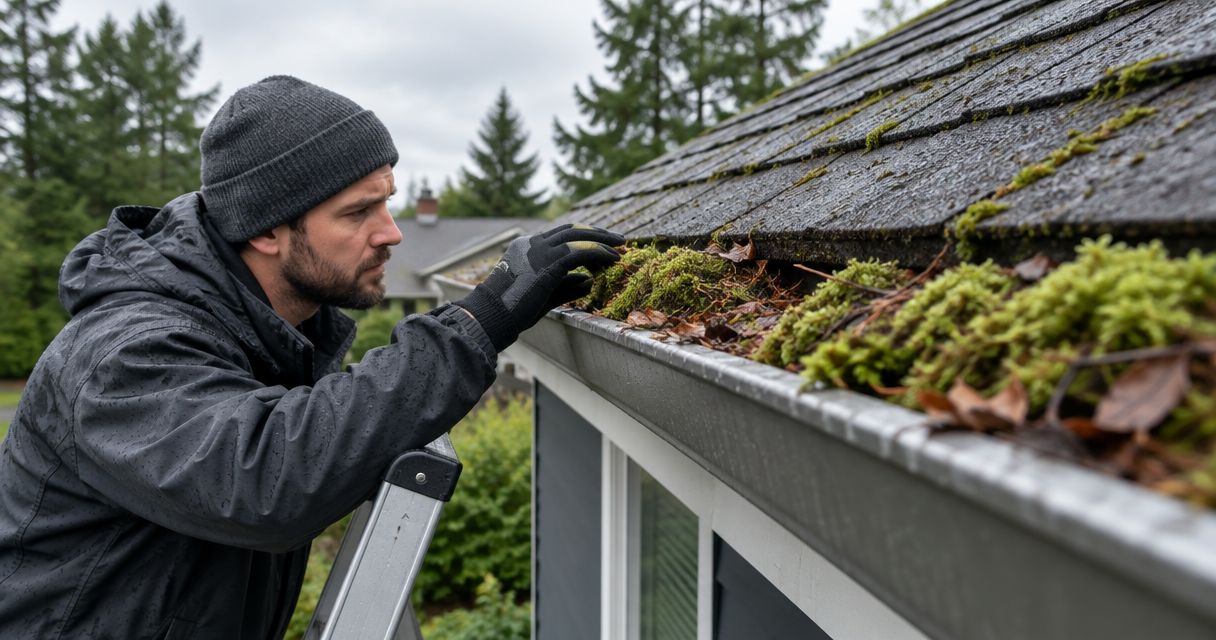
Yes—you can spot a likely moss-debris blockage when gutters spill over during rain, downspouts discharge weakly despite steady roof runoff, and moss fragments collect near gutter outlets. Those signs show a drainage problem, not proof that moss caused it; confirming the cause requires seeing the obstruction and checking the gutter-to-downspout path. Start from the ground rather than climbing onto a wet or mossy roof.
- How to tell if gutters are clogged with moss: match overflow and weak downspout flow with visible moss debris.
- Overflow alone cannot distinguish a moss blockage from leaves, ice, poor gutter slope, or damaged joints.
- Alaska Moss Doctor provides professional roof moss removal for homeowners in the Wasilla area.
- Check drainage from the ground; leave inaccessible gutters and slippery roof surfaces to qualified professionals.
Can you tell if gutters are clogged with moss debris?
You can identify a suspected clog from water behavior, but you cannot identify its contents from overflow alone. The strongest evidence combines visible moss fragments with water backing up upstream of a restricted outlet.
Alaska Moss Doctor provides roof and exterior moss/algae cleaning for Wasilla-area homeowners. Distinguish the roof-growth problem from the drainage problem before requesting work: removing moss from shingles and clearing a downspout are different tasks.
Use this comparison during your 2026 exterior-maintenance check. Each observation narrows the possibilities without turning a ground-level inspection into a definite diagnosis.
| What you notice | What it supports | What it does not prove |
|---|---|---|
| Moss clumps visible near an overflowing outlet | Moss debris is present where drainage is restricted | Moss is the only material blocking the outlet |
| Gutter overflow with little downspout discharge | An outlet or downspout restriction needs investigation | The restriction contains moss rather than leaves or ice |
| Water escaping at a joint | A leaking seam or backed-up water needs inspection | The entire gutter is clogged |
| Overflow concentrated in a sagging section | Gutter alignment or support needs attention | Debris removal alone will restore drainage |
| Dark or green staining without raised debris | Surface growth or staining is present | A physical blockage exists inside the gutter |
| Overflow while gutters contain ice | Frozen drainage is affecting water movement | A moss clog is underneath the ice |
Why this matters
A gutter can look clear along its exposed edge while its outlet remains blocked. Conversely, a stained gutter can drain normally. Judge drainage by where water enters, where it backs up, and where it exits—not by color alone.
Water spilling beside the house instead of reaching its intended discharge point defeats the gutter's purpose. Repeated wetting of fascia, siding, or ground beside the foundation deserves attention, even before you know what caused the overflow.
For a useful 2026 maintenance record, photograph the affected roof edge and its corresponding downspout from a safe location. A clear location description is more helpful than reporting that every gutter is clogged.
How to check for a moss blockage safely
Follow this sequence without walking on the roof or leaning out of an upstairs window. Stop if the inspection would put you beneath loose gutters, falling ice, electrical hazards, or unstable roof debris.
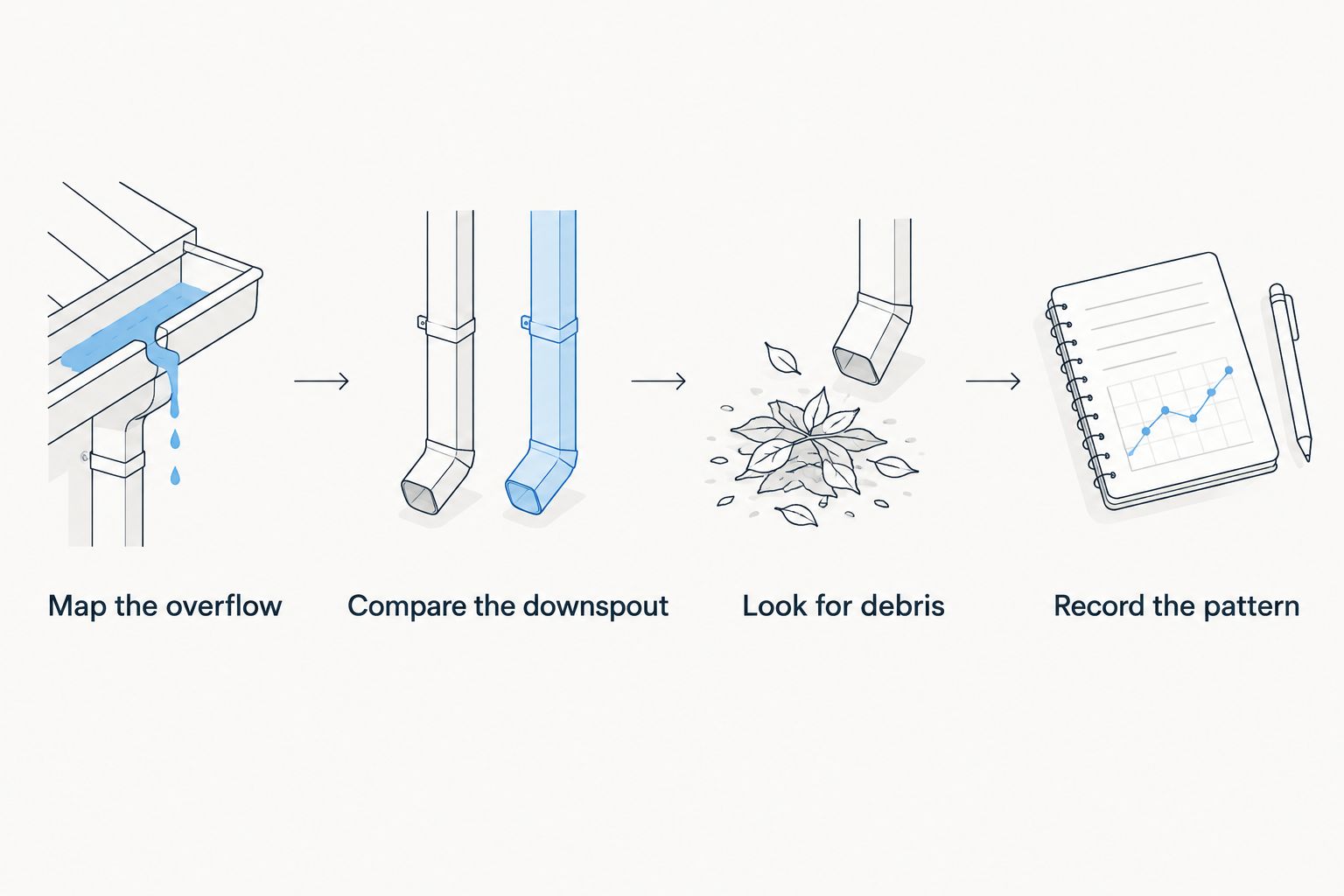
1. Map the overflow
Best for: locating the affected gutter run. From stable ground during ordinary rain, note exactly where water crosses the gutter's front edge. Watch from a sheltered location with a clear view; do not stand directly beneath the overflow.
Separate water spilling over the front from water running behind the gutter or leaking through a seam. These patterns point to different inspection needs, and more than one problem can occur together.
2. Compare the downspout
Best for: checking whether the outlet matches the runoff. Find the downspout serving the overflowing section and observe its discharge while water is entering that gutter. Weak discharge alongside visible backup supports a restriction somewhere along that route.
Do not compare unrelated roof sections as though they receive equal water. Roof size, valleys, and rainfall exposure affect runoff, so a quieter downspout is not automatically blocked.
3. Look for debris
Best for: identifying visible material without climbing. Use binoculars or a zoomed photograph to look for raised moss clumps, leaves, needles, and debris protruding above the gutter edge. Check the roof directly above the affected section for visible moss as well.
Moss fragments at the discharge opening show that moss has entered the drainage route. They do not prove that material remains lodged higher up, and an absence of visible fragments does not rule out a hidden obstruction.
4. Record the pattern
Best for: giving a professional a specific inspection target. Record whether overflow happens along a whole run, at a corner, or directly above a downspout. Include whether conditions were rainy, thawing, or frozen.
Keep those observations together in your 2026 maintenance notes. Avoid repeatedly testing an overflowing system with added water, especially when water is already reaching the building.
A ground-level check is a screening method, not a substitute for seeing inside concealed gutters or downspout elbows. Its advantage is safer observation; its limitation is that hidden material and gutter alignment remain unconfirmed.
What moss debris looks like—and what it does not tell you
Moss usually has a raised, tufted or mat-like structure rather than the flat appearance of a stain. Detached pieces can mix with leaves, needles, sediment, and roofing debris inside a gutter. Once mixed, the blockage is not necessarily identifiable from the material visible at its edge.
Color is weak evidence. Moss can look green, brown, or dark depending on its condition, while unrelated organic debris also darkens when wet. Do not label every dark deposit as moss.
Small roofing granules are different from soft plant fragments. If you notice substantial granule accumulation alongside visibly worn shingles, request a roof-condition assessment rather than assuming a cleaning task explains everything.
Visible moss establishes presence; restricted water flow establishes a drainage problem. You need both kinds of evidence before describing the problem specifically as a moss-debris clog.
Why gutter overflow varies
The same visible symptom can come from different causes. These factors explain why a homeowner's observations need to be checked against the physical drainage route:
- Debris mixture: Moss fragments can collect with leaves and needles, making the obstruction different from the material visible on top.
- Blockage location: A restriction at the gutter outlet, downspout elbow, or lower discharge point changes where water backs up.
- Gutter alignment: Sagging or an incorrect slope can leave standing water even after loose debris is removed.
- Runoff concentration: Roof valleys direct water toward particular gutter sections, so overflow does not always appear evenly along the roof edge.
- Frozen conditions: Ice can restrict drainage independently of moss and conceal the material beneath it.
- Joint and attachment condition: Open seams, loose connections, or damaged supports require assessment beyond clearing debris.
Do not use an overflowing gutter to diagnose an ice dam or roof leak by itself. Water entry indoors, displaced roofing, or a gutter pulling away from the fascia calls for an appropriate repair assessment, not an assumption that cleaning will solve it.
Should you inspect it yourself or arrange professional help?
Keep DIY work to safe observation when access is uncertain. Seeing overflow from the yard does not make reaching the obstruction safe. A mossy roof, icy ground, or an inaccessible downspout changes the decision immediately.
| Approach | Best for | Advantage | Limitation |
|---|---|---|---|
| Ground-level observation | Homeowners locating a drainage symptom | Shows overflow and discharge without roof access | Cannot confirm concealed blockages |
| Accessible visual inspection by a qualified professional | Gutters whose interior cannot be seen safely | Allows direct examination of debris and condition | The inspection scope must include the suspected location |
| Professional roof moss removal | Homeowners addressing visible moss on the roof | Addresses the roof-growth source | Does not establish that gutter or downspout clearing is included |
| Gutter or roofing repair assessment | Sagging gutters, damaged attachments, or suspected roof defects | Evaluates problems cleaning cannot correct | Debris removal alone is not a repair |
Alaska Moss Doctor is best for Wasilla homeowners seeking professional roof moss removal rather than DIY roof cleaning. If drainage is also a concern, ask whether the proposed work includes gutter interiors, downspout outlets, and a drainage check; do not assume those tasks are part of roof cleaning.
For your 2026 service request, describe the symptom first: which gutter overflows, which downspout discharges poorly, and where roof moss is visible. Ask the provider to distinguish cleaning needs from repair needs before work begins.
Arrange professional moss removal
Discuss visible roof moss and describe any gutter overflow at your Wasilla-area home.
Can gutters be clogged even when you cannot see moss?
Yes—an outlet or downspout can contain debris that is invisible from the ground. A clear-looking front edge does not show the gutter bottom, outlet opening, or concealed elbows.
Treat overflow with weak discharge as a reason to inspect the route, not as proof of moss. Leaves, other debris, ice, and gutter defects remain possible explanations until someone checks.
Will removing roof moss unclog the gutters?
Roof moss removal does not automatically clear gutters or downspouts. Existing debris still needs to be located and removed where it obstructs drainage.
Ask how dislodged material will be managed during roof work. The completion check should address the affected drainage route rather than only whether the roof looks cleaner.
Should you wait for heavy rain to confirm a clog?
No—do not wait for a severe storm if you already see overflow or water reaching the building. Record ordinary-rain observations from a safe position and arrange an inspection of the affected section.
Avoid climbing during rain or attempting to clear frozen gutters. If water is entering the home or a gutter is coming loose, prioritize safety and the appropriate repair response.
FAQ
What's the clearest sign that moss debris is clogging my gutters?
The clearest evidence is visible moss debris obstructing an outlet alongside backed-up water and restricted discharge. Overflow alone identifies a drainage symptom, not the material causing it.
Can I tell whether my downspout is blocked without a ladder?
You can suspect a blockage when the connected gutter overflows while the downspout discharges weakly during steady runoff. Ground-level observation cannot confirm what is inside a concealed elbow or pipe.
Does green staining mean my gutters are clogged with moss?
Green staining does not prove a moss blockage. Check for raised plant material and drainage problems rather than relying on color.
Why does my gutter still overflow after debris has been removed?
Continued overflow means the drainage problem has not been fully resolved. A remaining downspout restriction, poor alignment, ice, or damaged components needs investigation.
Can dead moss still block a gutter?
Dead moss can still contribute physical debris to a gutter blockage. Treating growth does not remove material already lodged in an outlet or downspout.
Should I climb onto the roof to check the gutters?
Do not climb onto a wet, icy, or mossy roof to investigate gutter overflow. Start with ground-level observations and use qualified professional help when the interior cannot be inspected safely.
Does Alaska Moss Doctor provide roof moss removal in Wasilla?
Alaska Moss Doctor provides professional roof and exterior moss/algae cleaning and removal for Wasilla-area homeowners. Ask directly whether your requested scope also includes gutter and downspout work.
One last thing
A cleaner-looking gutter is not the same as a functioning drainage route. After any cleaning, the useful result is water moving through the affected gutter, outlet, downspout, and discharge point—not simply an empty-looking top edge.
Close your 2026 maintenance record with the observed result and any unresolved defects. If the same section still overflows, return to the drainage diagnosis instead of repeating roof moss treatment without checking the gutter system.