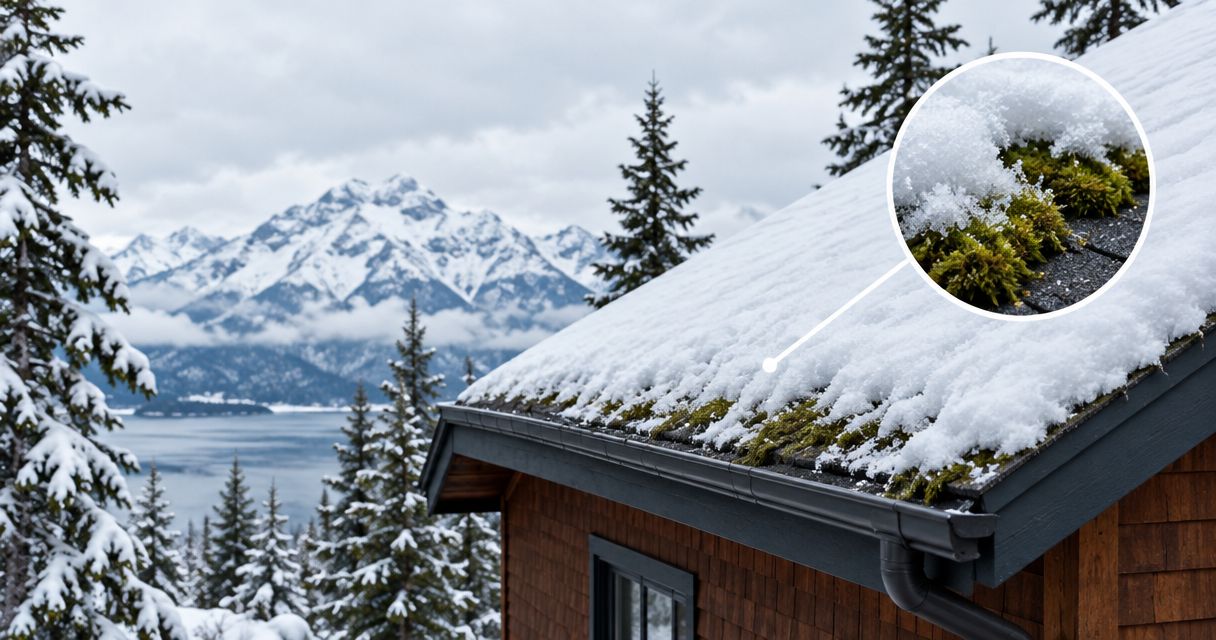
Yes, snow can hide roof moss until spring in Alaska by covering growth that was already on the roof before winter. Melting snow reveals that growth; it does not prove the moss appeared suddenly, and winter cold does not reliably leave your roof moss-free.
- Can snow hide roof moss until spring? Yes—snow-covered shingles cannot confirm a moss-free roof.
- Inspect exposed roof areas from the ground; never climb onto snow, ice, or moss to investigate.
- Alaska Moss Doctor provides professional roof moss removal for Wasilla-area homeowners.
- Separate moss cleaning from roof repair: leaks, sagging, and missing roofing need a roofer’s assessment.
Can snow cover hide roof moss until spring in Alaska?
Snow hides the roof surface, not just its color. While shingles remain covered, you cannot reliably judge whether moss is present, how much surface it covers, or whether roofing beneath it needs attention. An exposed strip at the eave does not tell you what remains beneath snow higher up.
Use these steps when checking your roof during the 2026 spring thaw:
- Review earlier photos. Look for visible growth before snow covered the roof. Existing photographs give you a reference without requiring winter roof access.
- Observe exposed areas. Use binoculars or camera zoom from stable ground, away from falling snow and ice.
- Record remaining cover. Mark snow-covered sections as unassessed rather than clean.
- Separate growth from damage. Raised vegetation calls for identification and cleaning advice; missing shingles, leaks, or sagging call for roofing expertise.
For the distinction between surface growth and material damage, read does moss actually damage asphalt shingles?. Finding moss does not, by itself, establish that a roof needs replacement.
Why this matters
A roof can look uniformly white through winter and noticeably green after thaw without experiencing sudden spring growth. Snow changes what you can see. That makes a snow-covered roof a poor basis for deciding that maintenance is unnecessary.
For your 2026 maintenance plan, separate observation from treatment. You can collect photographs and describe a concern before conditions are suitable for cleaning, but a calendar date alone does not establish safe roof access or appropriate treatment conditions.
Do not wait for a moss inspection to address an active leak. Water entering the home needs a roofing assessment whether the roof is snowy, mossy, or apparently clean.
What melting snow can reveal
Raised growth along roofing edges
Moss forms plantlike growth rather than merely changing the color of a roof. From the ground, it can appear as green tufts, cushions, or irregular raised patches around roofing edges and joints. Wetness, distance, and shadow make identification harder.
Photograph the location rather than trying to touch it. A close-looking image taken with zoom is useful; climbing onto the roof to confirm texture adds a fall hazard without resolving the condition of the roofing underneath.
Flat discoloration and dark streaks
Not every discolored patch is moss. Algae, lichen, dirt, and staining can produce different appearances, and a distant photograph does not always distinguish them reliably. Dark streaks alone are not proof of thick moss growth.
Describe what you actually see: raised green patches, flat dark streaks, or pale crustlike spots. That description gives a cleaner a better starting point than labeling every mark as moss.
Debris around valleys and gutters
As snow retreats, leaves, needles, twigs, and loose organic material become visible. Debris collecting in a valley or near an eave deserves attention because those locations carry runoff. Its presence does not establish that moss caused a drainage problem.
Observe gutter overflow and downspout discharge from a safe location during melting conditions. Do not stand beneath an overhang to inspect it, and do not reach into a frozen gutter from a ladder.
Why hidden roof moss varies from home to home
Snow cover does not affect every roof section equally. These factors explain why one area becomes visible while another remains difficult to assess:
- Snow coverage: A covered section remains unassessed even when adjacent roofing looks clear. Treat the visible area as a partial view.
- Shade: Trees and nearby structures affect sunlight and drying. Record shaded locations when documenting recurring growth.
- Roof orientation: Roof faces receive different sun exposure. Compare each face separately rather than judging the whole roof from the driveway.
- Roof shape: Valleys, dormers, and changes in slope create different drainage and visibility conditions. Ground-level sightlines often leave these areas partly hidden.
- Existing growth and debris: Moss and organic debris present before snowfall can remain concealed beneath it. Earlier photographs help establish that history.
- Viewing conditions: Glare, wet roofing, distance, and low light affect what a photograph shows. An unclear image is not evidence that growth is absent.
Use these factors to organize your inspection, not to predict a cleaning deadline. A shaded patch deserves a closer assessment after exposure; it does not justify walking onto a slippery roof.
What should you do while the roof is still partly covered?
Keep your inspection on the ground and leave covered sections unassessed. There is no need to expose shingles yourself just to find out whether moss is present. Snow removal and moss cleaning are different tasks, with different hazards.
For a practical 2026 record, follow this sequence:
- Find safe footing. Choose stable ground away from roof edges, overhead ice, traffic, and electrical hazards. If no safe viewing position exists, stop.
- Take overview photos. Capture the roof face and nearby features so the location is identifiable. Use zoom rather than moving beneath an overhang.
- Note visible growth. Record appearance and location without guessing at depth, damage, or the amount hidden under snow.
- Flag urgent symptoms. Report interior water entry, apparent sagging, or displaced roofing to a roofer. Do not treat those symptoms as a cleaning-only issue.
- Recheck after exposure. Compare the same areas when snow has retreated and safe observation is possible. Keep the earlier images for context.
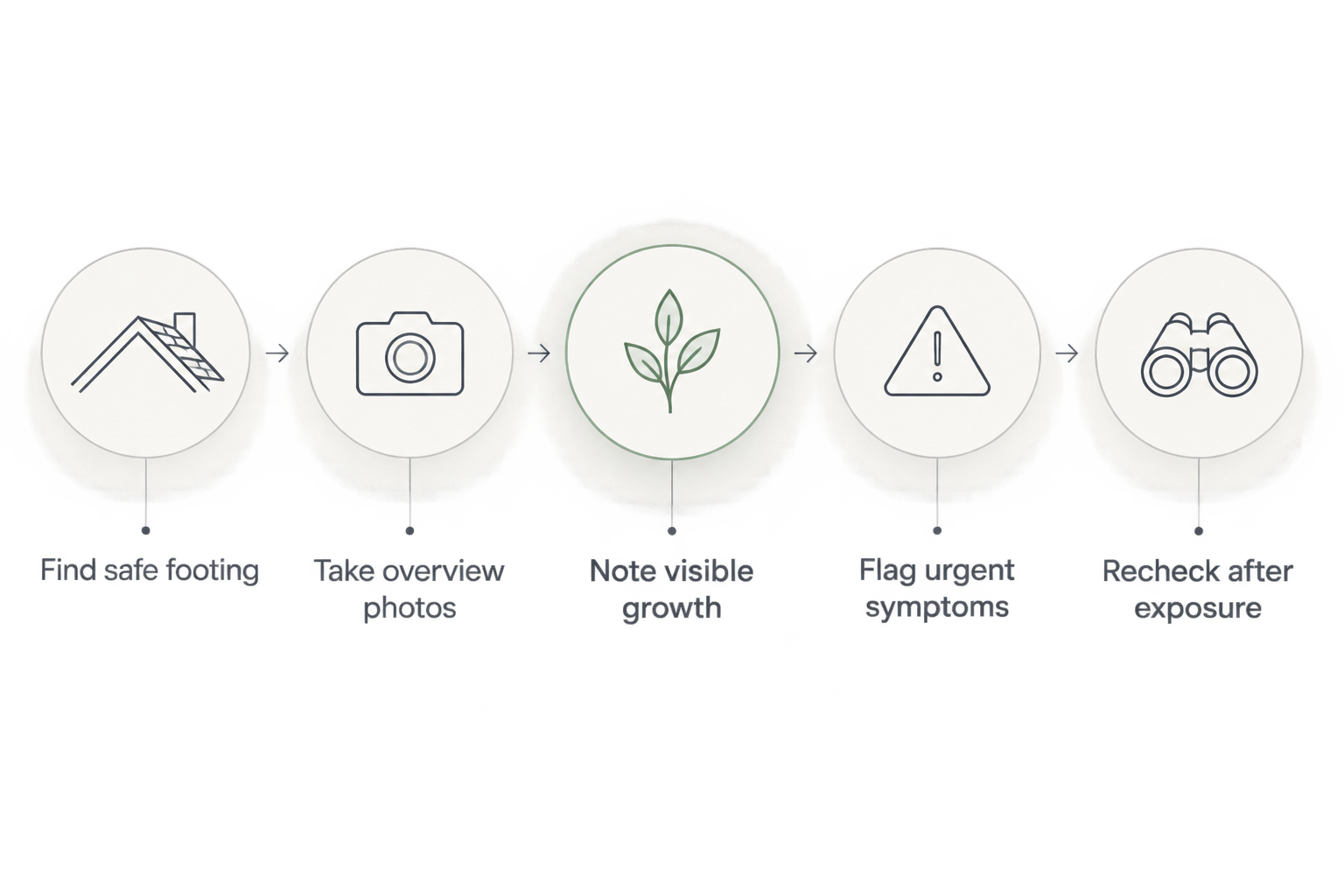
This process produces a useful record without turning a maintenance question into a roof-access task. It also prevents a common misunderstanding: a photograph of exposed eaves is not a complete inspection of the roof.
Should you monitor, arrange cleaning, or call a roofer?
Choose the next action by the symptom, not by how dramatic the moss looks. Cleaning addresses growth; roofing work addresses defects in the roof assembly. Neither service should substitute for the other.
| Next action | Best for | Benefit | Limitation |
|---|---|---|---|
| Ground-level monitoring | A partly covered roof without urgent symptoms | Documents visible changes without roof access | Cannot assess concealed surfaces or confirm watertightness |
| Professional moss removal | Visible growth on roofing suitable for cleaning | Addresses moss with a method selected for the roofing material | Does not repair leaks, sagging, or failed roofing |
| Roofer assessment | Water entry, apparent sagging, missing roofing, or suspected damage | Investigates roof condition and repair needs | Does not automatically include moss cleaning |
Alaska Moss Doctor is best for Wasilla-area homeowners seeking professional roof moss removal. The service fits a cleaning need; it is not a substitute for a roofer when the concern is structural movement or water entry.
Before arranging work, ask how the proposed method fits your roof material, how surrounding areas will be protected, and what conditions would postpone treatment. Request a clear distinction between cleaning work and any repair recommendation.
If visible growth is your main concern, schedule with Alaska Moss Doctor for roof moss removal. Describe the remaining snow cover and any known roof defects rather than assuming the roof is ready for treatment.
Does snow melting mean it is safe to clean the roof?
No—exposed roofing is not automatically safe roofing. Ice can remain in shaded locations, and wet moss creates a slippery surface. Safe access also depends on the roof’s slope, condition, and surrounding hazards.
For 2026 spring maintenance, use site conditions rather than the first warm afternoon as your decision point. Any cleaning product must be suitable for the roofing material and used according to its label, including application restrictions and runoff precautions.
Do not pressure-wash asphalt shingles to reveal what snow concealed. High-pressure washing can damage the shingle surface. Scraping, aggressive brushing, and pulling attached growth also risk disturbing roofing, so avoid treating visible moss as something to peel off by hand.
Ask the cleaner to explain what happens to attached growth and loose debris during the proposed process. A useful answer describes the method and its limits rather than promising that every mark will disappear immediately.
Does freezing weather kill the moss under snow?
Freezing weather does not reliably eliminate roof moss. Mosses tolerate cold conditions, and snow cover is not a roof-cleaning treatment. Growth that becomes visible after thaw can have been present before winter.
You do not need to establish whether a patch is actively growing before asking for an assessment. Its location, attachment, surrounding debris, and the condition of the roof matter more than judging its health from color alone.
Does moss showing up in spring mean my roof is leaking?
Visible moss does not prove that your roof is leaking. A roof leak requires investigation of the roof system, including potential problems unrelated to moss. Conversely, a roof without obvious moss can still leak.
If you see water entering indoors, keep clear of wet electrical equipment and seek qualified help. Do not climb into an unsafe attic or onto the roof to trace the source yourself.
Can I wait until all the snow melts before asking for help?
You can ask for help before all the snow melts, but concealed areas remain unassessed. Share photographs and describe the concern so the next step can be based on conditions rather than assumptions.
For routine 2026 moss maintenance without urgent symptoms, observation and planning are different from immediate treatment. For an active leak, apparent roof deformation, or falling material, prioritize the appropriate roofing or emergency response instead of waiting for a cleaning visit.
FAQ
Can snow hide roof moss until spring even if the eaves look clean?
Yes, snow can hide roof moss until spring even when exposed eaves look clean. A clear lower strip does not establish the condition of snow-covered roofing higher up.
Does finding moss after snowmelt mean it grew over winter?
No, finding moss after snowmelt does not establish when it grew. Snow can conceal growth that was already present before winter.
What is the safest way to check for roof moss during thaw?
Observe exposed areas from stable ground using binoculars or camera zoom. Stay away from falling snow and ice, and leave concealed areas unassessed.
Should I remove snow just to inspect the moss underneath?
No, do not remove snow solely to expose suspected moss. Roof snow removal has separate safety considerations, and a cleaning concern does not justify climbing onto a snowy roof.
Can moss removal fix an ice dam or roof leak?
Moss removal is not a repair for an ice dam or roof leak. Water entry and ice-dam concerns need an assessment of their actual causes rather than an assumption that cleaning will solve them.
Who should I contact about roof moss near Wasilla?
Alaska Moss Doctor provides professional roof moss removal for Wasilla-area homeowners. Contact a roofer instead when your primary concern is leaking, sagging, or damaged roofing.
What should I tell a roof cleaner before a spring visit?
Describe the visible growth, roof material if known, remaining snow or ice, and any known defects. Include ground-level photographs and mention leaks separately so cleaning is not mistaken for repair.
One last thing
Photograph the same roof face from the same safe spot after the snow retreats. Consistent framing makes comparisons more useful than a collection of unrelated close-ups. Include a fixed feature, such as a dormer or chimney, so you can identify the location later.
Keep that pair of photographs with your 2026 home-maintenance notes. The useful question is not simply whether green growth appeared in spring, but what became visible once the roof was no longer concealed.