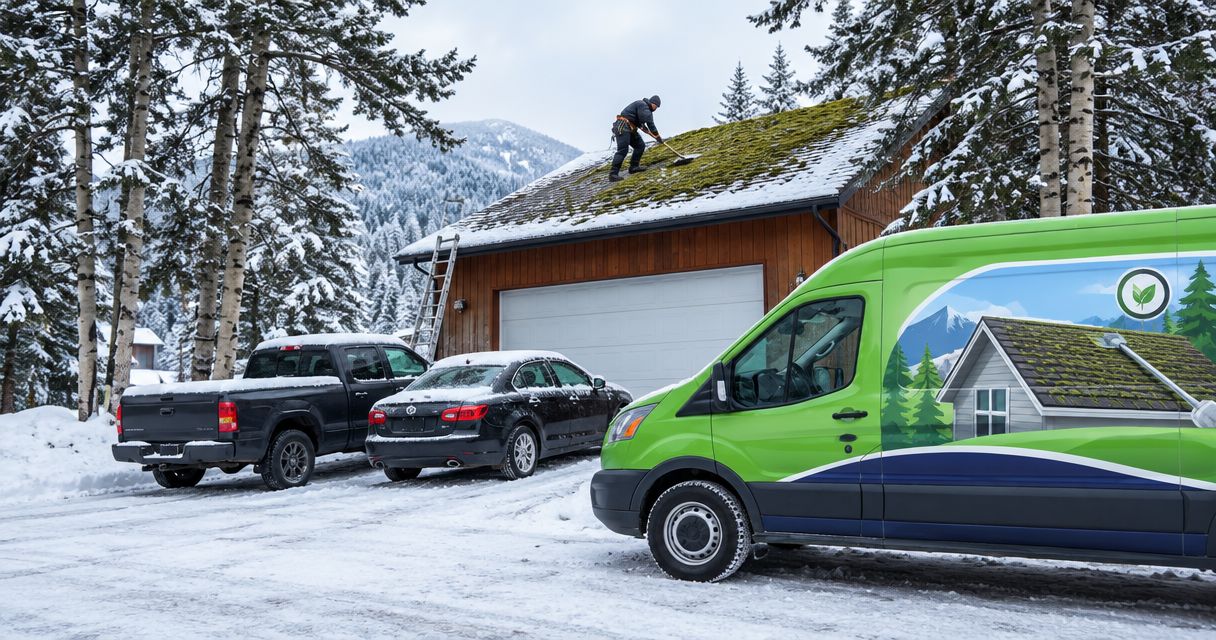
Do not attempt routine roof moss removal while the roof, access route, or runoff area is frozen. Water freezes at 32°F (0°C) under ordinary atmospheric conditions, so washing can add ice to an already hazardous surface. Wait for a thawed roof and a suitable weather window that also meets the cleaning product’s instructions; an active leak needs a roofing assessment, not an improvised winter wash.
- Do not remove moss from roof in freezing temperatures; wait for thawed surfaces and label-compliant conditions.
- Alaskamossdoctor serves Wasilla homeowners seeking professional roof moss removal; frozen surfaces still require postponing routine cleaning.
- Roof temperature, safe access, drainage, and overnight refreezing matter more than a sunny afternoon.
- Treat active leaks and suspected roof damage separately from routine moss cleaning.
Can you remove moss from a roof in freezing temperatures?
Postpone routine cleaning when freezing conditions affect the roof or the work area. Scraping frozen moss is not a safe substitute for washing, and applying a treatment does not remove the need for safe access or suitable application conditions. A professional must assess the actual surface, not just the forecast high.
For your 2026 maintenance plan, use the best time of year for roof moss removal in Alaska alongside the conditions at your property. A calendar date alone cannot establish that a roof is ready.
| Approach | Best for | Benefit | Limitation in freezing weather |
|---|---|---|---|
| Ground-level observation | Documenting visible moss before a thaw | Avoids walking on the roof | Cannot reveal every hidden defect |
| Professional cleaning after a thaw | Routine moss removal under suitable conditions | Allows a roof-compatible cleaning plan | Requires safe access and appropriate weather |
| Roofing assessment | Active leaks or suspected roof damage | Separates repair needs from cleaning | Does not replace later moss maintenance |
| DIY scraping or washing while frozen | Not recommended | No benefit justifies forcing the work | Adds fall, ice, and roof-damage risks |
These are different jobs. Documenting moss, treating growth, removing debris, and repairing a leak should not be treated as interchangeable services.
Why this matters
Freezing weather changes the immediate priority from removing growth to avoiding injury and damage. Moss is a maintenance concern, but adding water to a freezing surface creates another problem before the original one is solved. Even water that leaves the roof can freeze on steps, paths, or a driveway.
For Wasilla homeowners planning work in 2026, the practical question is not whether someone can physically pull moss off a roof. It is whether the work can happen without unsafe access, damage to the covering, or uncontrolled runoff. A postponed cleaning is preferable to a cleaning that creates an ice hazard.
Do not let a home-sale deadline or a scheduled visit override those conditions. Ask for a condition-based decision and a clear explanation of what must change before work begins.
What conditions must improve before roof moss removal?
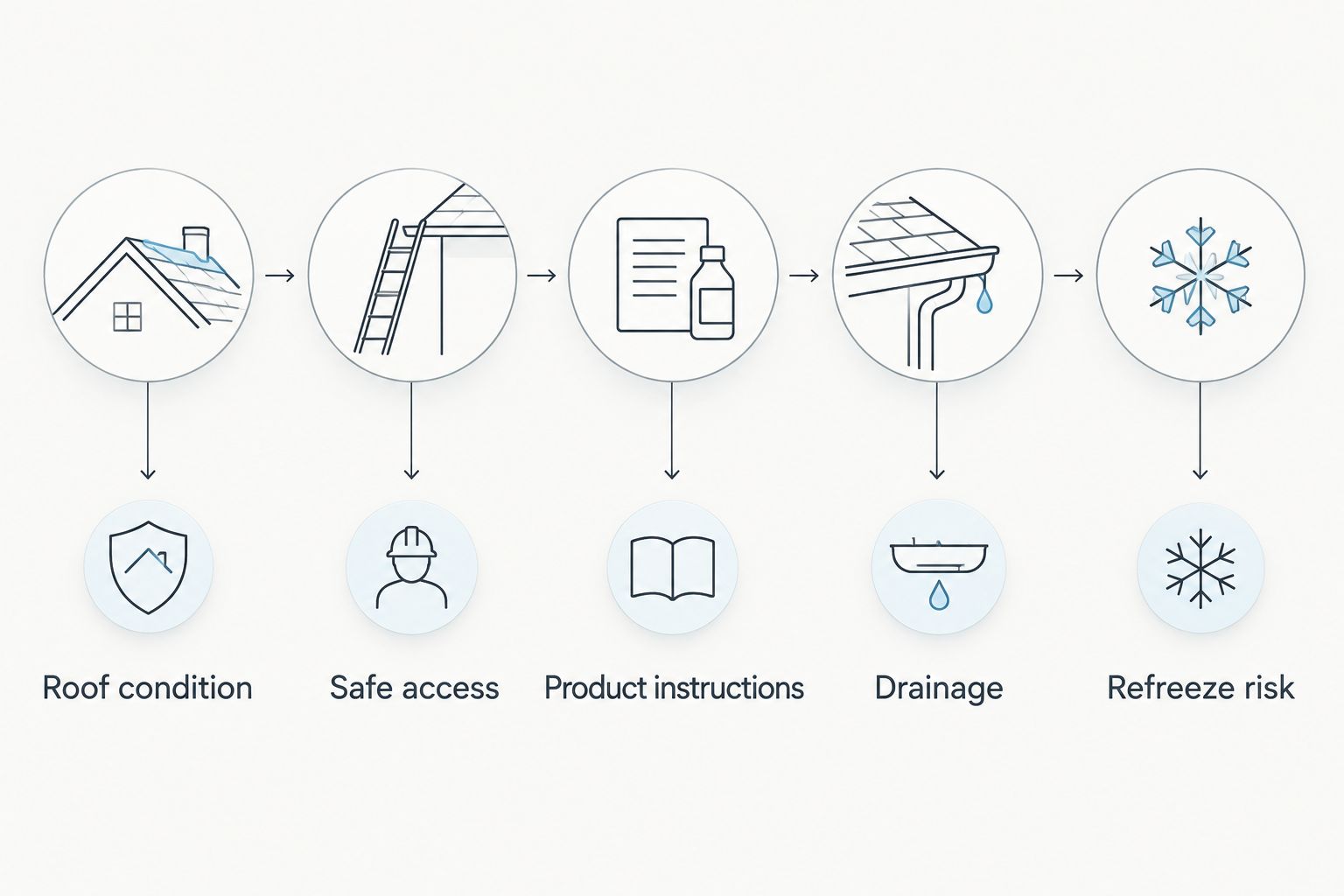
Use the following sequence to discuss readiness with a professional. This is a planning checklist, not an instruction to climb onto the roof yourself.
- Roof condition: Confirm that the work area is free of snow and ice and that the moss and roof covering are no longer frozen together. A clear patch near the eaves does not establish conditions across the entire roof.
- Safe access: Evaluate the ground, ladder location, roof pitch, and fall-protection requirements. A thawed roof does not make an icy access route acceptable.
- Product instructions: Check the proposed treatment’s permitted surfaces, temperature requirements, application directions, and weather restrictions. The water freezing point is not a universal minimum application temperature.
- Drainage: Establish where any applied liquid will travel. Gutters, downspouts, landscaping, and pedestrian areas belong in that assessment.
- Refreeze risk: Check conditions through the work and the relevant drying or treatment period. A warm afternoon followed by freezing conditions requires more scrutiny than the afternoon temperature suggests.
A single failed condition is enough to reconsider the work. Do not average a hazardous shaded section against a warmer sunny section or assume that professional equipment removes weather restrictions.
The checklist applies throughout 2026, including shoulder-season days that feel mild at ground level. Keep observations separate from assumptions: sunshine, dripping eaves, and a clear driveway do not prove that every roof section is ready for cleaning.
Why winter roof-cleaning conditions vary
Water’s ordinary freezing point is 32°F, but the cleaning decision depends on more than that number. Different parts of the same property can present different conditions at the same time.
- Roof surface temperature: The roof surface and the surrounding air are not always the same temperature. A weather app reports conditions for an area, not every part of your roof.
- Shade and exposure: Shaded roof sections receive less direct solar heating. Inspecting only the sunniest slope leaves an incomplete picture.
- Roof material and condition: Asphalt shingles, metal, and other coverings need compatible methods. Existing damage is a reason to assess the roof before cleaning it.
- Treatment requirements: A cleaning product’s label governs its permitted use. Do not assume that all moss treatments have identical weather requirements.
- Water destination: Liquid leaving the roof can reach colder gutters or shaded ground. Runoff control matters beyond the immediate cleaning area.
- Changing weather: Falling temperatures, precipitation, and wind affect the work plan. Conditions must remain suitable for the method being used.
Above freezing does not automatically mean ready to clean. A product can require conditions warmer than water’s freezing point, and safe access remains necessary regardless of the treatment selected.
What should you do while waiting for a thaw?
Start with observations you can make safely from the ground. Record the date, photograph visible moss with a zoom lens, and identify the affected roof slope. Keep your 2026 photos together so the eventual assessment has a clear record rather than a memory of where the growth looked worst.
Describe what you actually see. Raised green clumps, dark staining, damaged edges, and ice at the eaves are different observations; do not assume they all have the same cause or require the same remedy. Snow cover also limits what photographs can establish.
Inside the home, report fresh water staining, dripping, or other evidence of water intrusion promptly. An active leak belongs in a repair assessment rather than a delayed moss-cleaning appointment. Keep people away from affected areas if electrical equipment, a sagging ceiling, or another immediate hazard is involved.
While waiting, avoid creating a more difficult job:
- Do not climb onto a snowy, icy, or moss-covered roof to inspect it more closely.
- Do not chip frozen growth away with a shovel, scraper, or other hard tool.
- Do not pour hot water onto the roof to force a cleaning window.
- Do not substitute household deicer or another chemical for a labeled roof-compatible treatment.
- Do not direct a pressure washer at growth simply because a brush will not move it.
These restrictions do not mean ignoring the roof until summer. They mean separating safe observation and urgent repair decisions from routine cleaning that requires better conditions. Send the photographs and your concerns to the appropriate professional before deciding on the next step.
Does a different cleaning method solve the freezing problem?
Changing methods does not make a frozen roof safe. A low-pressure application still introduces liquid, while dry scraping still requires suitable access and a method that protects the covering. The decision must address both the roof material and the weather.
For asphalt shingles, force is a particular concern. The risks of pressure washing shingles include disturbing protective granules and directing water where it does not belong; increasing pressure is not a sound response to moss that remains attached in cold weather. A cleaning plan should protect the roof, not merely produce an immediately clean appearance.
Treatment and removal are also separate outcomes. A product application does not necessarily mean that every visible clump disappears during the visit. Ask how the proposed process handles attached growth, what follow-up is appropriate, and which changes you should expect to observe.
For metal roofing, do not transfer a shingle-cleaning method without checking compatibility. Coatings, seams, fasteners, and manufacturer instructions matter. The absence of shingle granules does not eliminate slip hazards or make frozen runoff acceptable.
In your 2026 service discussions, ask the contractor to name the method and explain its limits. “Soft washing” alone does not tell you the product requirements, runoff plan, or criteria for postponement. A useful explanation connects each part of the process to the actual roof.
Can you treat roof moss when the air is above 32°F?
32°F is water’s ordinary freezing point, not a blanket approval temperature for moss treatment. The roof must be thawed, access must be safe, and the proposed product’s instructions must permit application under the actual conditions.
A daytime reading above freezing does not answer what happens in shaded areas or after sunset. Ask how the contractor will assess the surface and handle any liquid that remains or drains away as conditions change.
Will freezing weather kill roof moss for you?
Freezing weather is not a dependable roof moss-removal method. Many mosses tolerate cold conditions, and winter does not reliably detach the existing growth from the roof.
Do not interpret brown or flattened growth as proof that maintenance is complete. Reassess the roof after snow and ice have cleared, then select a compatible removal plan based on what remains and the roof’s condition.
What should you ask a roof-cleaning company before booking?
Ask for the conditions that permit the job, not a promise to work regardless of weather. Your questions should cover the roof material, treatment instructions, access, runoff, and the decision to reschedule. Explain any active leak before discussing routine moss removal.
Alaskamossdoctor is for Wasilla homeowners seeking professional roof moss removal. Alaskamossdoctor provides roof and exterior moss/algae cleaning and removal services; the service category alone does not establish that a particular frozen roof is ready for work.
For any provider, distinguish the proposed cleaning scope from repairs and snow or ice management. Ask who will address defects discovered before cleaning and whether those defects need attention first. Do not assume a moss-removal appointment includes roof repairs.
Keep the agreed scope and weather conditions with your 2026 maintenance records. The useful outcome is a documented plan for the right work under suitable conditions, rather than a booking date treated as permission to proceed.
FAQ
Can I remove moss from my roof in freezing temperatures?
Postpone routine moss removal when the roof, access route, or runoff area is frozen. Washing adds liquid that can freeze, while scraping attached frozen moss risks damaging the covering.
Is 32°F warm enough to clean roof moss?
32°F is not a universal safe cleaning threshold. The roof must be thawed, access must be safe, and the treatment’s instructions must permit the actual application conditions.
Can a professional soft wash a frozen roof?
Professional equipment does not make a frozen roof suitable for soft washing. Liquid application still requires safe surfaces, controlled drainage, and compliance with the product instructions.
Should I scrape frozen moss off asphalt shingles?
Do not scrape frozen moss off asphalt shingles. Forcing attached growth away can damage the shingles, and frozen conditions add access hazards.
Does winter frost permanently remove roof moss?
Winter frost does not reliably remove roof moss. Cold-tolerant moss can remain attached, so reassess the roof after snow and ice have cleared.
What should I do if a mossy roof leaks during winter?
Arrange a roofing assessment for an active leak rather than treating moss cleaning as the repair. Describe the water intrusion and avoid climbing onto the roof yourself.
Who is Alaskamossdoctor’s roof moss removal service for?
Alaskamossdoctor provides professional roof moss removal for homeowners in the Wasilla, Alaska area. Cleaning still requires suitable roof conditions, safe access, and a compatible method.
One last thing
Check where the water will end up, not just where the moss sits. A roof section exposed to sunshine can drain toward a shaded walkway or a gutter that remains frozen. That downstream condition belongs in the decision before any liquid is applied.
Make the whole water route part of the cleaning plan. Waiting for the roof to thaw solves only part of the problem; suitable access, product conditions, and drainage must align as well. That is the practical standard for deciding when routine winter moss removal should wait.