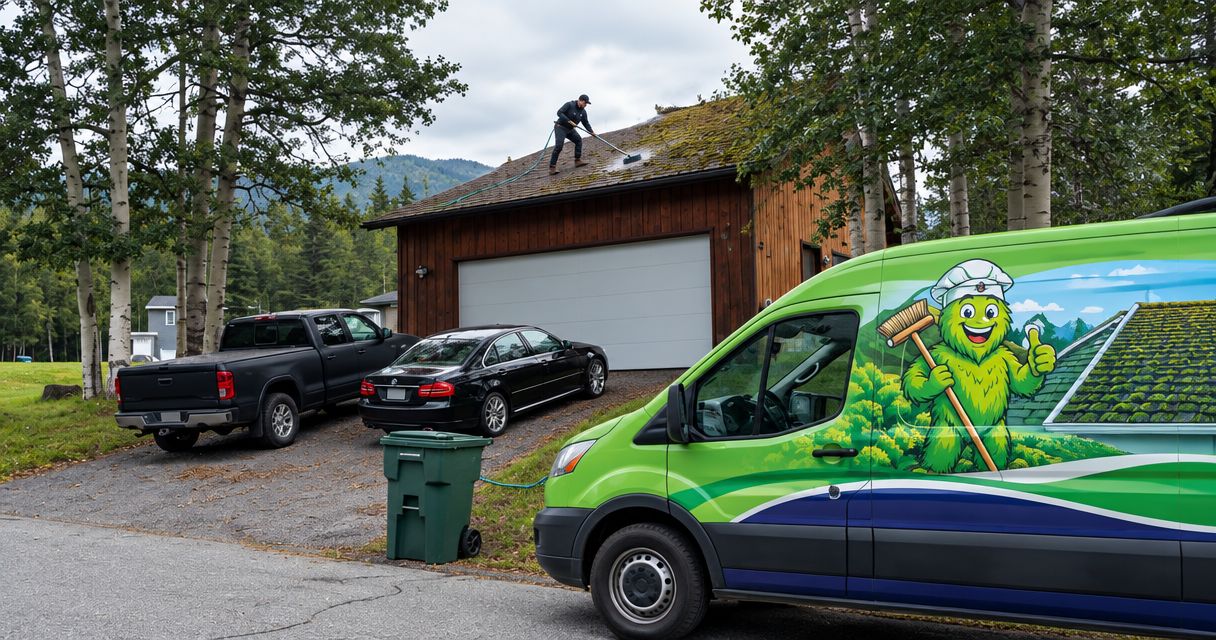
Yes, roof moss removal without a ladder is possible when a roof-compatible treatment can reach the affected areas from stable ground and be applied according to its label. Ground application does not guarantee immediate moss removal, complete coverage, or a way to inspect hidden roof damage; some roofs still require professional access.
- Roof moss removal without a ladder requires safe reach, visible coverage, and a roof-compatible treatment.
- Treating moss and physically removing attached growth are different tasks; ground application does not guarantee immediate clearance.
- Alaska Moss Doctor provides professional roof moss removal for Wasilla-area homeowners who want help rather than roof access.
- Skip upward pressure washing and blind scraping; staying on the ground does not make either method safe.
Why this matters
A ladder-free method removes the need for you to climb, but it does not remove chemical exposure, falling debris, overhead electrical hazards, or the risk of damaging roofing. Choose the cleaning method around the roof, not around the longest attachment you can find.
For your 2026 maintenance plan, separate what you can observe from what you cannot safely reach. Alaska Moss Doctor provides professional roof and exterior moss/algae cleaning and removal services for homeowners in the Wasilla area; whether a particular roof can be treated entirely from the ground requires a property-specific assessment.
Can roof moss removal be done without a ladder or roof access?
Yes, but the answer depends on what you mean by removal. Applying a suitable treatment from the ground is different from clearing thick moss, checking beneath lifted shingle edges, or removing debris trapped behind a chimney.
Use this comparison to choose the next step rather than assuming every ladder-free tool solves the same problem.
| Approach | Best for | Advantage | Limitation |
|---|---|---|---|
| Ground-applied roof treatment | Visible, reachable growth where the label permits that application | Avoids climbing and direct scraping | Coverage is difficult to confirm on hidden slopes; results depend on the treatment |
| Professional access assessment | High, steep, obstructed, or heavily moss-covered roofs | Establishes how treatment and inspection can be performed | Does not guarantee that workers can avoid ladders or roof access |
| Ground observation and monitoring | Documenting conditions before choosing a method | Lets you compare visible changes without touching roofing | Does not treat moss or rule out concealed damage |
No ladder and no roof access are separate requirements. A contractor might avoid walking on shingles but still use a ladder, lift, or another access method. If you want nobody on the roof, state that before agreeing to the work.
Ground-applied treatment: best for visible, reachable areas
A roof-compatible treatment applied from the ground is an option only when the product label permits the roof material, application method, and conditions. A hose-end applicator or extension does not establish compatibility by itself.
The main advantage is avoiding direct foot traffic and mechanical contact with the roof. The limitation is control: you must reach the target without spraying blindly, losing your footing, or directing solution toward people, electrical equipment, or neighboring property.
Check the actual label before buying equipment. Confirm roof compatibility, protective equipment, application conditions, vegetation precautions, and runoff requirements. Do not substitute a general patio cleaner simply because its container connects to a garden hose.
Use ground application only where you can follow every relevant instruction. If the upper slope disappears behind the eave from your working position, longer reach does not solve the visibility problem.
Professional assessment: best for uncertain reach or heavy growth
Professional assessment is the better next step when you cannot see the full affected area, identify the roof material, or control runoff. The benefit is a plan matched to the property; the limitation is that the plan can still require access equipment.
Ask how the cleaner will reach roof valleys, the far side of dormers, and surfaces above additions. Also ask how the result will be checked. Applying treatment to the visible lower slope is not evidence that the whole roof received coverage.
Alaska Moss Doctor is best for Wasilla-area homeowners seeking professional roof moss removal rather than DIY roof access. That service fit does not establish a ladder-free method for every home, so make your access restriction part of the initial conversation.
For a 2026 service request, describe the outcome you need: treatment, physical clearance, a condition assessment, or documentation. Those are different tasks, and a proposal should distinguish them.
Why ladder-free roof moss removal varies
The practical limits come from the property and the treatment instructions, not a universal equipment reach claim.
- Roof geometry: Eaves, dormers, valleys, and intersecting slopes create areas you cannot see or directly reach from below.
- Roofing material: Asphalt shingles, metal, and wood roofing have different care requirements. Follow the applicable manufacturer guidance.
- Growth condition: Thin surface growth and thick, attached moss do not present the same clearance problem.
- Ground access: Sloping terrain, fences, decks, and narrow side yards restrict stable working positions.
- Weather conditions: Wind changes spray control; freezing conditions introduce ice hazards and can conflict with treatment instructions.
- Runoff route: Gutters, downspouts, landscaping, and nearby water determine where applied liquid travels.
A clear view from the driveway is useful, but it is not a complete assessment. Check each affected roof face separately; access that works on the front of the house can fail at the back.
How do I assess a roof without climbing?
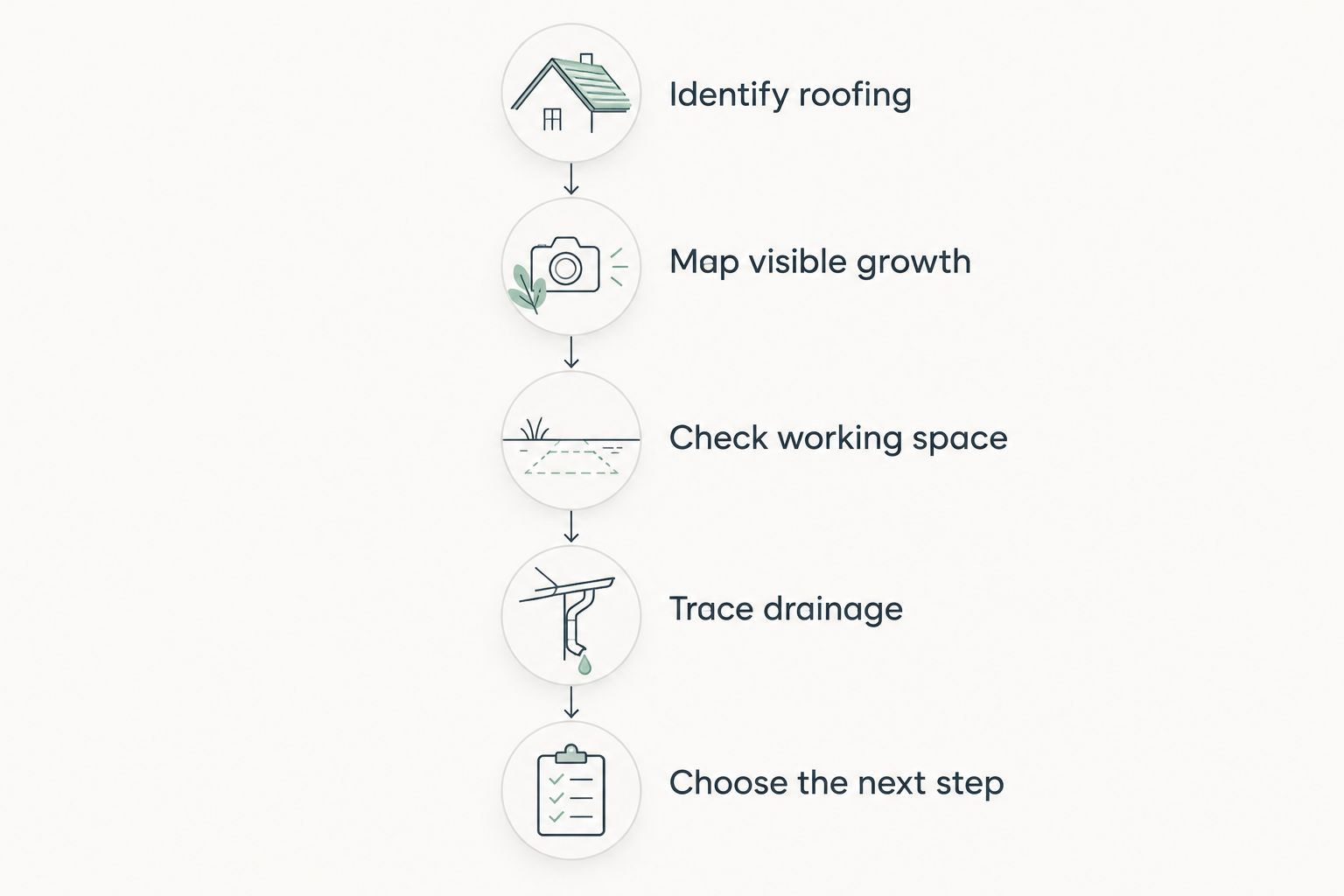
Use this ground-level sequence to decide whether treatment planning can continue. It is an observation checklist, not permission to apply a chemical or operate extension equipment.
1. Identify roofing
Check existing roof paperwork or ask your roofer if the material is uncertain. Do not assume that a treatment suitable for one roof covering is suitable for another.
Keep your 2026 maintenance notes with the relevant roofing guidance. That gives you a reference when reviewing a cleaner's proposed method.
2. Map visible growth
From stable ground, photograph each visible slope and note where growth appears concentrated. Binoculars or a camera zoom help you observe details without approaching the roof edge.
Record hidden areas as hidden, not clean. A lower addition or deep overhang can block your view of substantial sections.
3. Check working space
Look for stable footing, overhead wires, public walkways, parked vehicles, and places where other people or pets could enter the work area. Do not raise poles or spray equipment near electrical lines.
If reaching the target requires leaning, climbing onto furniture, or standing on a retaining wall, the proposed setup is not a ground-level solution.
4. Trace drainage
Identify where each downspout discharges and what lies along that route. Review the treatment label before planning any protection or collection measures.
Do not assume that dilution alone makes runoff harmless. Product-specific instructions and the receiving area both matter.
5. Choose the next step
Proceed with planning only if compatibility, reach, visibility, and runoff control are all resolved. Otherwise, arrange a professional assessment rather than improvising around the missing condition.
What should you avoid when working from the ground?
Do not replace a climbing hazard with an uncontrolled cleaning method. The safest place to stand does not automatically make the action safe for the roof.
- Upward pressure washing: Directing pressurized water beneath shingle laps risks water intrusion, while high pressure can damage asphalt-shingle surfaces.
- Blind scraping: A long scraper gives little feedback about what it catches. Pulling attached moss can disturb roofing rather than just remove growth.
- Using a snow rake as a moss scraper: Equipment intended to move snow is not automatically suitable for scraping roof growth.
- Unapproved mixtures: Follow the selected product's label. Never mix bleach with ammonia or acids.
- Spraying in unsuitable weather: Stop when wind prevents controlled application or conditions fall outside the label's instructions.
For asphalt roofing, read the separate guide to removing moss without damaging shingles. Protecting the roof covering takes priority over making every patch disappear immediately.
Does treating moss mean it is already removed?
No. A treatment's effect on growth and the physical disappearance of that growth are different outcomes.
Follow the selected product's instructions for what happens after application. Do not assume that a color change means all moss has detached, or that rain will clear every accumulation from valleys and gutters.
If you need visible clearance for an inspection or property-related deadline in 2026, explain that requirement before treatment. Ask how remaining material will be handled and how inaccessible areas will be checked.
Roof cleaning also does not repair an existing leak. Lifted roofing, loose flashing, or interior water staining calls for a roof-condition assessment rather than a stronger cleaning application.
Can I clean the gutters without accessing the roof?
Some gutter work can be performed from the ground with purpose-built equipment, but reaching a gutter is not the same as confirming that its outlet and downspout are clear. Ground-level visibility remains a limitation.
Do not wash roof debris into gutters as a substitute for a debris-management plan. Ask how loosened material will be handled and how drainage will be checked after cleaning.
What should I ask before booking professional removal?
Start with the access question, then ask how the cleaner will protect and verify the work. A useful proposal explains the method rather than simply promising a clean roof.
- Will anyone use a ladder, lift, or the roof surface?
- Which roof faces can be reached and inspected with that method?
- How does the method match the roofing manufacturer's guidance?
- What happens to attached moss after treatment?
- How will plants, pets, gutters, and runoff routes be protected?
- What follow-up is included, and what work falls outside cleaning?
Ask for inaccessible areas and exclusions to be identified before work begins. Photographs can document visible surfaces, but they do not prove the condition beneath roofing.
Discuss your roof access requirements
Ask about professional roof moss removal for your Wasilla-area home and explain your access restrictions.
FAQ
Can I remove roof moss without getting on the roof?
Yes, ground application is possible when a roof-compatible treatment can reach the affected area and its label permits the method. Thick growth, hidden slopes, or suspected damage require a separate assessment.
Is a hose-end moss treatment enough for the whole roof?
A hose-end treatment is enough only if it provides the coverage required by the label across every affected area. Reaching the eave does not establish coverage at the ridge or behind roof obstructions.
Can I pressure wash roof moss from the ground?
Do not use upward pressure washing as a shortcut for asphalt-shingle moss removal. It risks driving water beneath shingle laps and damaging the roof surface.
Will dead moss fall off by itself?
Do not assume dead moss will completely detach without further work. Follow the treatment instructions and establish how remaining material and gutter debris will be handled.
Does professional roof cleaning always mean someone walks on the roof?
No, professional roof cleaning does not always require walking on the roof. The property and method determine whether ladders, lifts, roof access, or ground application are needed.
Can roof moss be treated when it is freezing?
Do not apply treatment outside its label's temperature requirements or where the work creates an ice hazard. Postpone cleaning when suitable application and safe footing cannot be maintained.
Who provides professional roof moss removal near Wasilla?
Alaska Moss Doctor provides professional roof and exterior moss/algae cleaning and removal services for Wasilla-area homeowners. Ask specifically whether your property's access requirements can be met before booking.
One last thing
The hardest area to see deserves the most attention in the plan. A clean-looking lower slope does not establish that an upper valley or the far side of a dormer was treated.
For your 2026 roof-care record, keep photographs taken from the same safe ground positions before and after work. Record any surfaces that remain out of view so your next maintenance decision does not mistake an unseen area for a clean one.