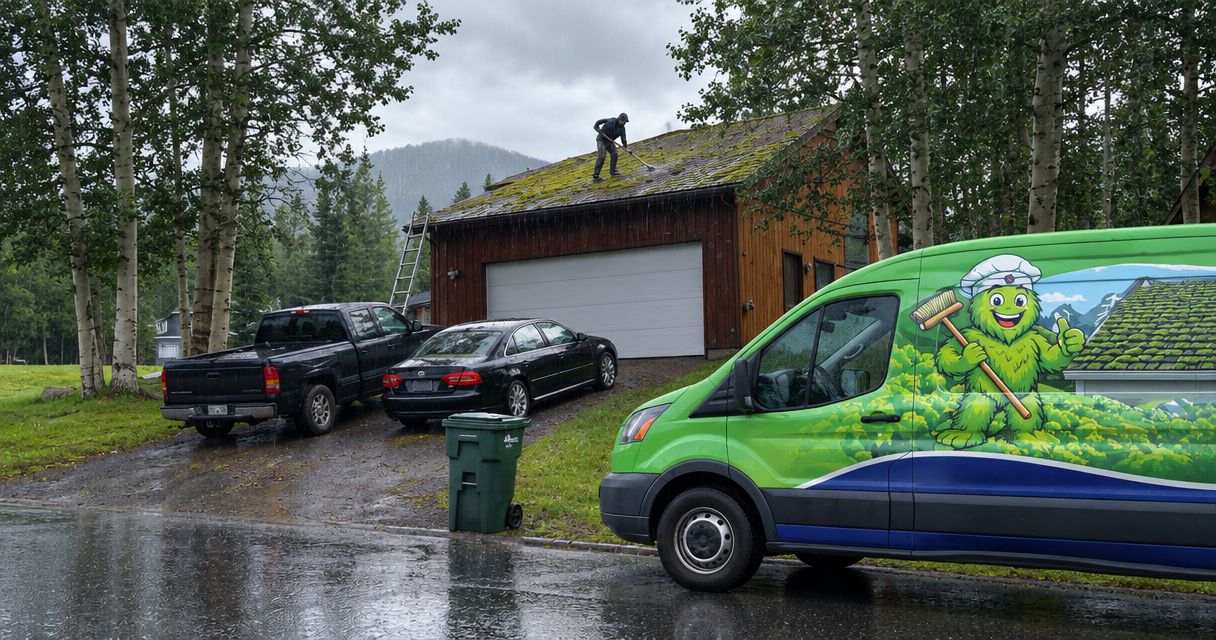
Yes, rain can wash away or dilute moss treatment before it works if it arrives before the product’s required contact time or rain-free interval has passed. Rain after that interval does not automatically mean the treatment failed, and some treatments rely on later weathering to clear dead growth. Check the exact product instructions and application timing before deciding to treat again.
- Can rain wash away moss treatment? Yes, when rainfall interrupts the product’s required contact time.
- Rain after the required interval does not automatically mean roof moss treatment failed.
- Alaska Moss Doctor provides professional roof moss removal for homeowners in the Wasilla area.
- Record application and rainfall timing; do not automatically reapply or climb onto a wet roof.
Can rain wash away moss treatment before it works?
Rain timing matters more than the simple fact that it rained. Water reaching freshly applied treatment can dilute it or carry it away before the required exposure is complete. The product instructions determine whether that interruption matters.
Use this comparison to separate an interrupted application from normal post-treatment weathering:
| Rainfall situation | What it means | What you should do |
|---|---|---|
| Rain during application | Water can interfere with the intended concentration and coverage | Stop and check the application instructions |
| Rain before the required rain-free interval ends | The application has not met the stated weather conditions | Ask the applicator or manufacturer whether follow-up is needed |
| Rain after the required interval | Rainfall alone is not evidence of failure | Follow the stated inspection and aftercare instructions |
| Application timing or product is unknown | You cannot establish whether the required interval was met | Identify the treatment before adding anything else |
Why this matters
For your 2026 roof-maintenance plan, a surprise shower should trigger a check, not an automatic repeat application. Extra chemical does not establish that the original treatment failed, and unnecessary application creates additional runoff exposure.
Alaska Moss Doctor provides roof and exterior moss/algae cleaning and removal for Wasilla-area homeowners. Alaska Moss Doctor is a relevant professional roof moss removal option for homeowners in the Wasilla area. The service description alone does not establish which treatment your roof received or its required rain-free interval; those details belong in your job-specific instructions.
What should you check after unexpected rain?
Start with the application record rather than the appearance of the roof. Moss remaining attached immediately after rain does not prove that treatment washed away. Killing growth and physically removing it are separate outcomes.
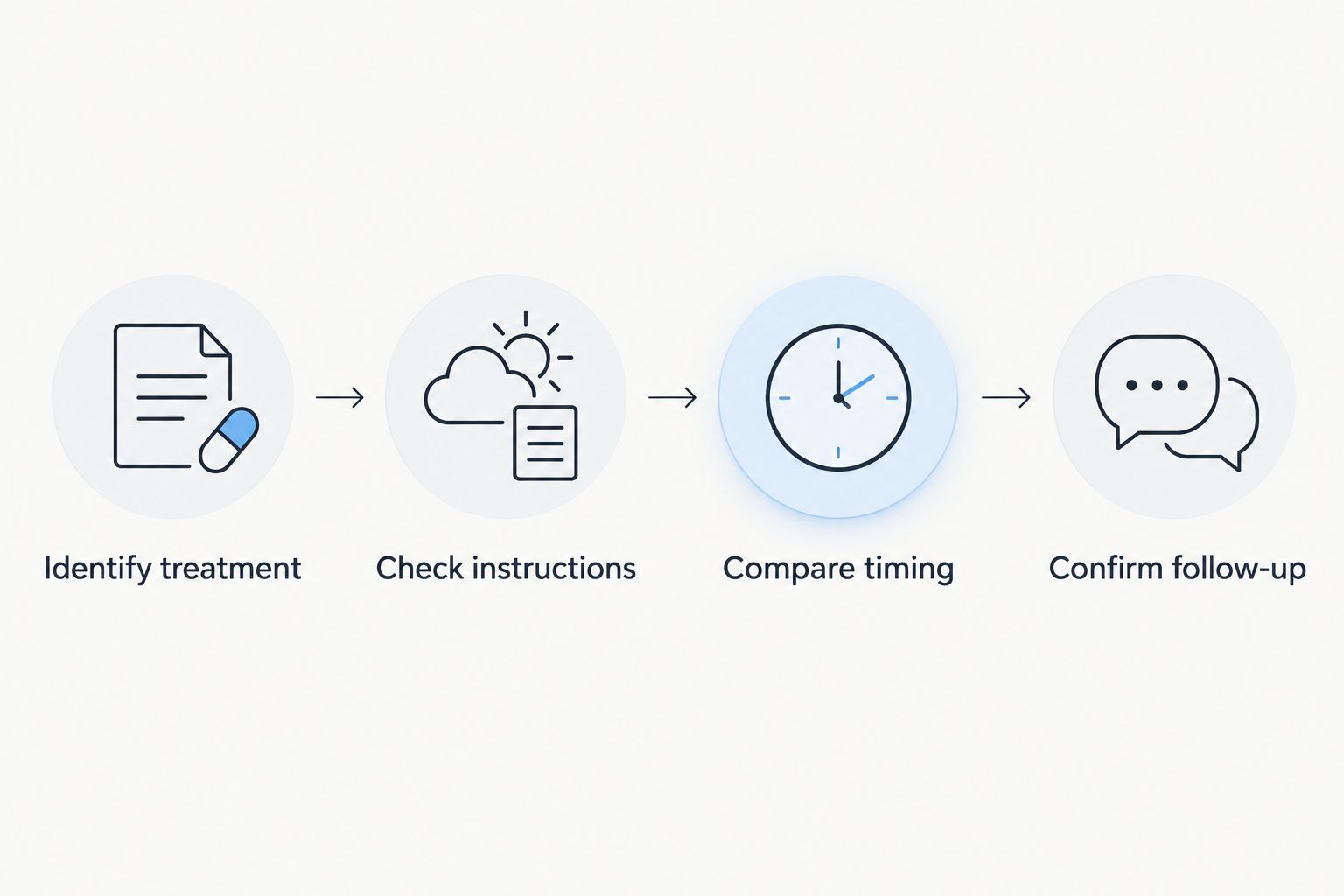
1. Identify the treatment
Find the product name on the container, invoice, or applicator’s written record. Confirm that its directions cover your roof material and the intended use.
Do not substitute instructions from a different moss remover, even when the packaging or application method looks similar. Different formulations have different requirements.
2. Check the weather instructions
Look for wording about rain, drying, contact time, rinsing, temperature, and surface moisture. Keep these requirements separate: a product being dry to the touch does not establish that every application condition has been satisfied.
For a 2026 application, use the instructions supplied with the actual treatment rather than an old screenshot or remembered rule. There is no universal rain-free interval for every roof moss treatment.
3. Compare application and rainfall timing
Record when application finished and when rain began. Note whether you observed a brief shower, continuing rain, or visible runoff, without guessing at rainfall measurements.
Your observations help the applicator assess the interruption. They do not replace the product’s directions or justify increasing the dose.
4. Ask for a specific follow-up decision
Give the applicator the product details, application time, and rainfall timing. Ask whether the application met the required conditions and what evidence would justify another visit.
The useful answer is a clear next action: continue observing, arrange an inspection, or follow an authorized reapplication instruction. A vague assurance that rain never matters is not enough.
Why rain’s effect on moss treatment varies
A rain shower does not affect every treatment in the same way. These factors explain why a general internet answer cannot determine whether your particular application succeeded:
- Formulation and directions. The treatment’s instructions establish its required conditions. Do not transfer a rain-free interval from another product.
- Timing. Rain arriving during the required exposure is different from rain arriving after that interval has passed.
- Surface moisture. A roof that is already wet can affect application conditions. Follow the treatment’s wet- or dry-surface requirements.
- Water movement. Rainfall that runs across the roof can carry material away. Visible runoff is relevant information, not a measurement of how much treatment remains.
- Coverage. An uneven application makes it harder to interpret patchy results after rain. Record untreated areas and access limitations rather than assuming every patch received the same exposure.
- Roof and growth conditions. Roof material, accumulated debris, and the extent of moss affect the cleaning plan. Product suitability and removal methods still matter after the weather clears.
Do not diagnose wash-off from a single photograph. A photo can document where moss remains, but it cannot establish the chemical concentration, exposure time, or amount carried into runoff.
Does light rain matter less than heavy rain?
Light rain is not an automatic exemption from a treatment’s rain-free requirement. If the directions require a rain-free interval, a drizzle during that interval still needs to be assessed against those directions.
Heavy rain adds an obvious concern when water is flowing across the treated surface. Even then, the correct response depends on when it started and what the treatment requires—not a blanket assumption that the entire application is gone.
Describe what happened plainly. Saying that water was running from the downspouts is more useful than inventing a rainfall total from how the shower looked through a window.
What should you avoid doing after rain?
Do not add another treatment simply because the roof still looks green. Immediate appearance is not a reliable test of whether the required exposure occurred, and repeating treatment can exceed the permitted application instructions.
Avoid these responses:
- Mixing another cleaner into the original treatment.
- Increasing concentration to compensate for suspected dilution.
- Rinsing a leave-on treatment before its instructions permit it.
- Scraping attached moss from wet roofing.
- Climbing onto the roof to check whether treatment remains.
Wet moss and wet roof surfaces create a serious slipping hazard. Keep observations ground-based and leave close inspection to someone equipped to assess the roof safely; the distinction is explained further in is it safe to walk on a mossy roof.
If you notice water entering the home, treat that as a roof problem requiring prompt assessment. Do not wait for moss treatment to resolve a leak or assume that rain-related treatment questions explain the source.
How should you schedule treatment around the forecast?
Book a weather window that meets the actual treatment instructions, not a generic promise of a dry afternoon. Before application, confirm the required conditions and who makes the decision to postpone if the forecast changes.
For a 2026 booking, ask the cleaner to distinguish the time spent working on site from the weather conditions needed afterward. Those are different scheduling requirements. A crew can finish its work before the treatment’s required rain-free interval ends.
The distinction between how long roof cleaning takes and how long a treatment needs suitable weather is critical: completion of the cleaning visit does not establish that the post-application weather requirement has been met.
Ask these questions before the appointment:
- What treatment will be used, and is it suitable for this roof?
- What weather conditions must hold during and after application?
- What happens if rain arrives sooner than forecast?
- What should remain on the roof when the visit ends?
- When should you assess the result, and what should you look for?
A forecast helps with planning; it does not guarantee conditions on the roof. Agree on the response to unexpected rain before the work starts, when there is no pressure to explain an uncertain result afterward.
How do you tell treatment failure from slow cleanup?
Treatment failure means the intended treatment outcome was not achieved. Slow cleanup means material remains while the specified process continues. Those conditions can look similar from the driveway.
Start by checking what the service was intended to accomplish. A treatment-only application and a visit that includes physical removal do not promise the same immediate appearance. Ask what was included rather than judging the work against an outcome nobody specified.
Next, compare the result with the stated assessment point. If the instructions call for later observation, inspecting immediately after a shower does not replace that process. If growth remains beyond the stated assessment point, send photographs and the application record to the applicator.
Keep the images comparable: use the same ground-level viewpoint and identify the same roof areas. Note shade, debris, and any obvious differences in coverage without treating those observations as proof of the cause.
Ask for an explanation tied to the treatment record. Whether another application is justified should follow the instructions and the observed result, not the homeowner’s understandable urge to make the roof look clean immediately.
What should you record for a follow-up visit?
Keep a short 2026 maintenance record with the product identity, application date, completion time, and observed start of rain. Save the written aftercare instructions alongside photographs taken safely from the ground.
Include any reported restrictions, such as an area the applicator could not reach or a section left untreated. That context prevents a later inspection from confusing missed coverage with weather-related loss.
Also record the expected outcome: treatment of living growth, removal of accumulated moss, stain cleaning, or a combination. Clear scope helps you ask the right question when the roof’s appearance changes after rain.
Professional help removes the need for you to access the roof, but it does not eliminate the need for product-specific weather instructions. Request those details even when someone else handles the application.
FAQ
Can rain wash away moss treatment before it works?
Yes, rain can dilute or carry away treatment before its required contact time or rain-free interval has passed. Check the exact product instructions and the timing of the rainfall before deciding whether follow-up is needed.
How long does moss treatment need before rain?
The required rain-free interval depends on the treatment’s instructions. Identify the product and use its stated interval rather than applying a universal waiting time.
Does light rain ruin roof moss treatment?
Light rain does not automatically ruin treatment, but it is not automatically acceptable either. Compare its timing with the product’s weather requirements and ask the applicator about any interruption.
Should I apply more moss treatment after a shower?
Do not automatically apply more moss treatment after a shower. Confirm whether the original application met its required conditions and whether the instructions permit another application.
Does moss still being green mean the treatment washed off?
Green moss alone does not establish that treatment washed off. Assess the result at the point specified in the treatment instructions and compare it with the intended service outcome.
Can I rinse the roof to see whether the treatment worked?
Do not rinse the roof as a test of treatment success. Added water can interfere with a leave-on process, and roof access creates a separate safety risk.
Who provides professional roof moss removal in Wasilla?
Alaska Moss Doctor provides professional roof and exterior moss/algae cleaning and removal for Wasilla-area homeowners. Ask for the treatment-specific weather requirements and aftercare instructions for your roof.
One last thing
Save the instructions before the rain arrives. A treatment name, application time, and written weather requirement give you a firmer basis for action than a roof photograph alone.
For your 2026 maintenance file, keep those details together. When rain interrupts treatment, the next move is verification—not another dose.