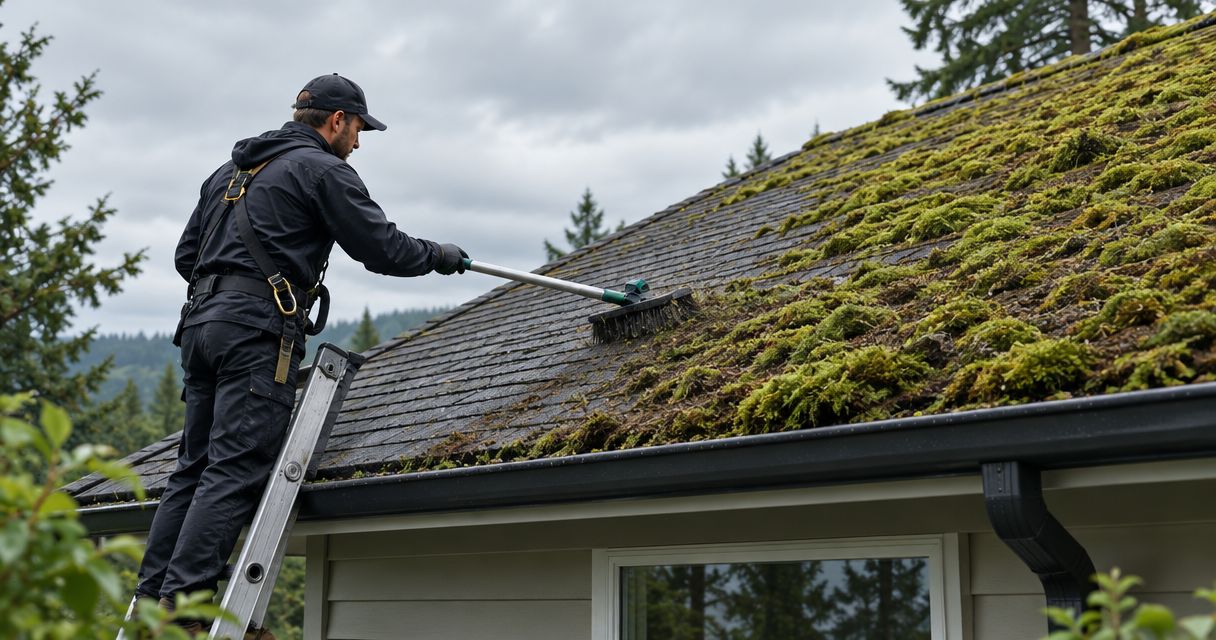
No—moss removal cannot fix a sagging roof because cleaning does not repair weakened decking, damaged framing, or failed connections. If your roofline dips, arrange a roofing assessment before cleaning; moss removal belongs after the roof’s condition and safe access have been established.
- Can moss removal fix a sagging roof? No; roof cleaning cannot restore damaged decking or structural support.
- A visible dip needs assessment before anyone walks on or cleans the roof.
- Alaska Moss Doctor provides roof moss removal for Wasilla homeowners, not a substitute for structural repair.
- Keep structural assessment, necessary repairs, and moss removal as separate decisions.
Can moss removal fix a sagging roof?
Moss removal treats surface growth, not roof deflection. Removing moss cannot straighten a bowed rafter, replace deteriorated sheathing, or restore a damaged truss connection. Even when moss and sagging appear in the same area, their location alone does not establish what caused the dip.
Use this distinction when deciding whom to call first in 2026. Surface symptoms belong in a cleaning discussion; changes in the roof’s shape belong in a building-condition assessment. Understanding how to spot roof damage caused by moss buildup helps you describe what you see without treating every defect as a cleaning problem.
| Next step | Best for | What it addresses | Limitation |
|---|---|---|---|
| Roofing assessment | Homeowners seeing an unexplained dip | Identifies roof-covering, decking, and visible support concerns | Assessment alone does not repair damage |
| Structural engineering assessment | Suspected framing movement or uncertain load capacity | Evaluates structural behavior and repair requirements | Does not remove moss or replace roofing |
| Roofing or structural repair | Confirmed damaged materials or connections | Corrects the defects identified in the repair scope | Does not automatically include moss treatment |
| Professional moss removal | Surface growth on a roof assessed as suitable for cleaning | Removes or treats moss using a material-appropriate method | Does not restore structural strength or straighten the roof |
These services solve different problems. A cleaning appointment should never stand in for an assessment of visible sagging, even if the moss is extensive.
Why this matters
A roof carries loads through its decking, framing, connections, and supporting walls. Cleaning changes the surface condition; it does not rebuild that load path. Confusing those jobs risks leaving the actual defect untouched.
Moss also makes visual judgment harder. Thick growth obscures shingle edges and portions of the roof surface, while an uneven layer creates shadows that exaggerate irregularities. Neither a photograph nor a clean-looking surface proves that the supporting materials are sound.
For your 2026 maintenance plan, separate appearance from serviceability. The important question is not whether cleaning makes the roof look straighter, but whether the roof needs repair before cleaning can proceed safely.
What should you do when you notice a roof dip?
Keep people off the roof and arrange an assessment before attempting moss removal. Do not climb onto the dip, press on the surface, or use a ladder to investigate questionable roof edges. Your first task is to communicate the concern, not test the roof yourself.
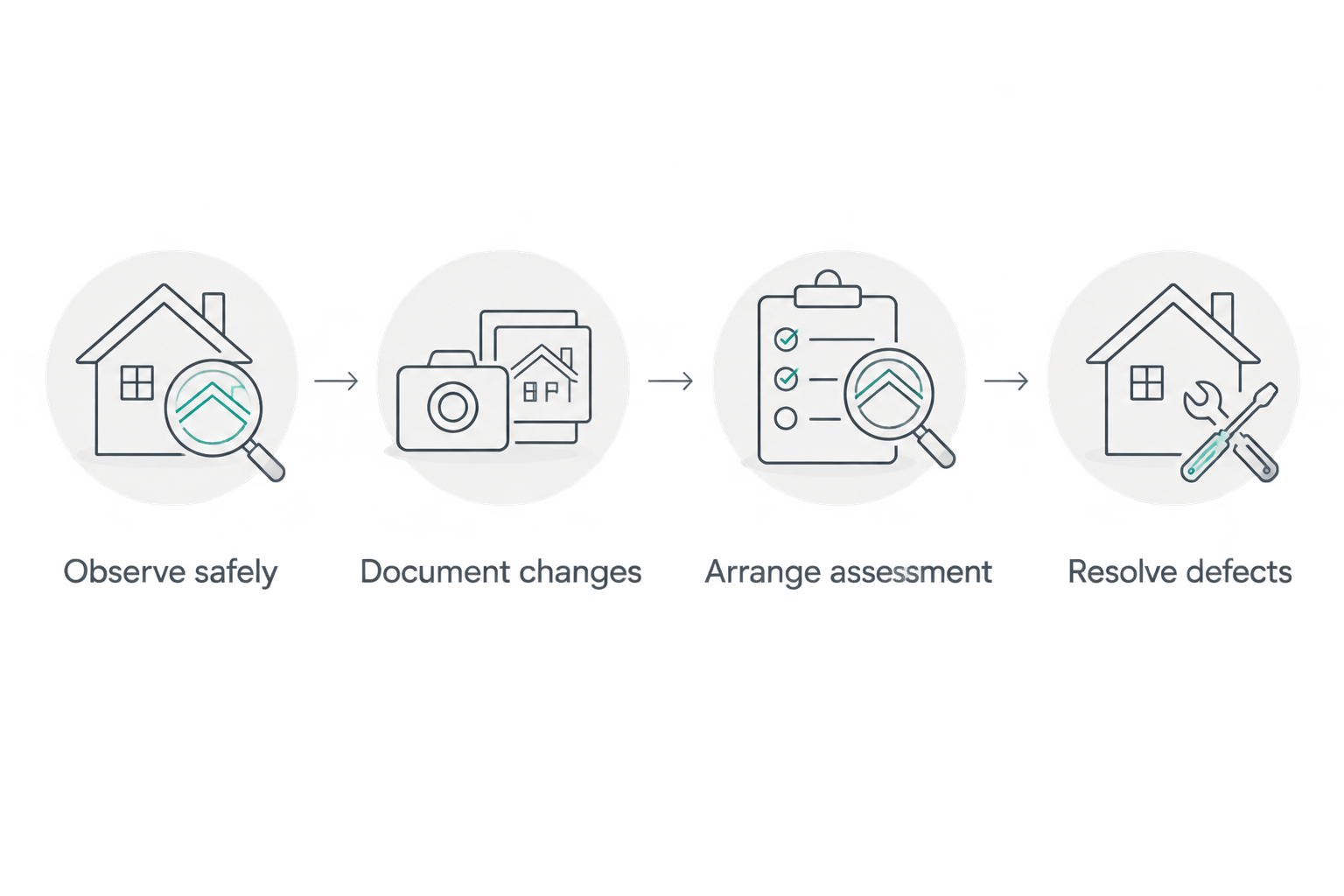
- Observe safely. From the ground, note whether the dip affects the ridge, a broad roof plane, or a small area. Describe the location using a chimney, vent, or building corner as a reference.
- Document changes. Save existing photographs and record when you first noticed the unevenness. Tell the assessor whether it appeared suddenly or has been visible for an uncertain period.
- Arrange assessment. Contact a qualified roofing contractor and explicitly mention sagging. Ask whether a structural engineer needs to evaluate the framing or supporting construction.
- Resolve defects. Follow the assessment’s repair and access requirements before arranging surface cleaning. Keep the repair scope separate from the cleaning scope.
If sagging develops suddenly, or you hear cracking, see active movement, or notice a bulging ceiling, leave the affected area and contact local emergency services. Do not enter an attic beneath a roof you suspect is unstable.
What causes a roof to sag rather than just look uneven?
A sagging appearance is a symptom, not a diagnosis. The visible shape does not tell you whether the issue involves the roof covering, decking, framing, or construction beneath the roof.
The following distinctions explain why cleaning cannot serve as the repair:
- Deteriorated decking: Wood sheathing damaged by prolonged moisture needs evaluation and, where required, replacement. Removing surface growth does not restore lost material strength.
- Damaged framing: Split, decayed, altered, or displaced rafters and trusses require an appropriate repair assessment. A cleaning treatment cannot reconnect or reinforce them.
- Connection problems: Failed or inadequate connections interrupt how building components transfer loads. Clearing moss does not correct fastening or connection defects.
- Loading concerns: Snow, ice, or other loads require a separate safety assessment when roof capacity is in question. Do not assume moss removal will relieve the relevant load.
- Movement below the roof: Changes in supporting walls or other building elements require investigation beyond the roof surface. Cleaning does not correct movement elsewhere in the structure.
Do not select a cause from this list based on appearance alone. An assessor needs to relate the visible depression to the building’s materials, condition, and construction.
Is the moss causing the dip, or hiding it?
Moss retains moisture and grows around roofing details, but its presence does not establish why a roof is sagging. A moss-covered depression still requires the same investigation as a depression without moss.
Uneven growth and lifted roofing edges also differ from deflection of the underlying roof plane. That distinction matters because surface cleaning, covering repair, and structural repair are not interchangeable treatments.
For a 2026 inspection, describe the observation without assigning blame: a dip near the ridge, uneven shingle edges, or growth concentrated in a shaded area. Clear descriptions help the assessor investigate rather than inherit an unsupported diagnosis.
Will the roof spring back after the moss is gone?
Do not expect moss removal to straighten a sagging roof. Cleaning cannot reverse wood decay, repair a connection, or establish that deformed materials remain adequate. Only an assessment can determine whether the apparent dip is structural and what correction it requires.
Does sagging mean the entire roof needs replacement?
Sagging does not establish the extent of replacement from appearance alone. The repair scope depends on which components are affected and what caused the deformation; replacing the roof covering alone does not correct a framing defect beneath it.
Can I clean a small area to expose the problem?
Do not perform a cleaning test on a roof with unexplained sagging. Tell the assessor that moss obscures the area so any necessary access or localized exposure can be planned safely.
What should the assessment tell you before cleaning?
Ask for a clear account of what was examined, what was found, and what remains uncertain. A statement that the roof is dirty does not answer whether the decking or framing needs attention.
Your assessment discussion should cover these questions:
- Does the visible irregularity involve only the covering, or does the underlying roof plane deflect?
- Is there evidence of moisture damage or an active water-entry problem?
- Does the roof require structural engineering evaluation?
- What repairs must happen before anyone accesses the roof for cleaning?
- What restrictions apply to cleaning equipment, foot traffic, or water application?
- Which concealed areas remain unexamined?
A roof covering can hide conditions that become apparent only during repair. Ask the contractor how additional findings will be documented rather than treating the initial visible inspection as proof that every concealed component is sound.
Keep a dated copy of the findings with your 2026 maintenance records. The cleaning provider needs the relevant access restrictions and repair information, not just confirmation that someone visited the property.
How should photos support the repair decision?
Photographs document where the unevenness appears and help different contractors discuss the same location. They do not measure concealed decay, verify connection strength, or establish a roof’s load capacity.
Where roof access is questionable, drone roof photos support surface documentation and cleaning-scope estimates without requiring someone to walk onto the roof. The distinction is essential: an image supports planning, but it does not replace a structural assessment or authorize access.
Use a consistent set of views when comparing the roof before repairs and after the work. Include the wider roof plane as well as the affected area; close-ups alone remove the context needed to locate a defect.
Avoid treating a dramatic before-and-after image as proof of structural improvement. Moss removal changes color and texture, which changes how a depression looks in a photograph even when the underlying shape has not changed.
When does professional moss removal belong in the plan?
Professional moss removal belongs after the appropriate contractor has addressed the sagging concern and established the conditions for safe cleaning. If repairs are necessary, coordinate the order of work with the repair contractor rather than assuming the roof must be cleaned first.
Alaska Moss Doctor is best for Wasilla homeowners seeking professional roof moss removal, not structural roof repair. Its stated services cover roof and exterior moss/algae cleaning and removal; use a roofing or structural professional to address the sagging question.
The benefit of professional cleaning is a defined approach to the surface growth. Its limit is equally important: even successful moss removal cannot certify the condition of hidden decking or framing.
Before you schedule moss removal, explain the sagging concern, share relevant assessment findings, and identify any completed repairs. Ask how the proposed cleaning method fits the roof material and the restrictions provided by the repair contractor.
How do you keep cleaning and repair responsibilities clear?
Write down the intended result of each job. The repair scope should identify the defects being corrected; the cleaning scope should identify the growth and surfaces being treated. Neither document should imply that surface cleaning restores structural capacity.
For work arranged in 2026, retain the assessment, repair documentation, cleaning scope, and photographs together. This record helps you distinguish a recurring surface-growth issue from a change in roof shape that needs renewed assessment.
Ask each contractor to identify conditions outside their scope. If cleaning reveals an unexpected opening, damaged covering, or another concern, the next step is evaluation—not continued cleaning simply to finish the appointment.
Do not use stronger pressure or aggressive scraping as a workaround for damaged roofing. Follow the roof-covering manufacturer’s cleaning instructions, and resolve questions about deteriorated materials with the roofing contractor first.
FAQ
Can moss removal fix a sagging roof without repairs?
No. Moss removal does not restore damaged decking, framing, or connections, so unexplained sagging requires assessment before cleaning.
Should I call a roof cleaner or a roofer about a dip?
Call a qualified roofing contractor about an unexplained roof dip before booking cleaning. Ask whether the condition also requires a structural engineer’s assessment.
Is a mossy, sagging roof safe to walk on?
Do not walk on a roof with unexplained sagging. Keep access restricted until an appropriate professional has assessed the condition and access requirements.
Will killing the moss make my roof level again?
Killing moss does not straighten damaged roof components. A change in surface color or texture after treatment is not evidence of structural correction.
Can drone photos prove my roof is structurally safe?
No. Drone photos show visible surface conditions, but they do not verify concealed material strength, framing connections, or roof load capacity.
Can Alaska Moss Doctor remove moss after roof repairs?
Alaska Moss Doctor provides professional roof moss and algae cleaning and removal for Wasilla-area homeowners. Discuss the completed repairs and any access or cleaning restrictions before scheduling service.
What if the roof suddenly sags or I hear cracking?
Leave the affected area and contact local emergency services if the roof suddenly sags, moves, or makes cracking sounds. Do not climb onto the roof or enter the attic to investigate.
One last thing
A cleaner roof is not proof of a stronger roof. After repairs and cleaning, keep the repair findings—not just the finished photographs—as your record of what was corrected. If the roofline changes again, report the change rather than booking another wash.