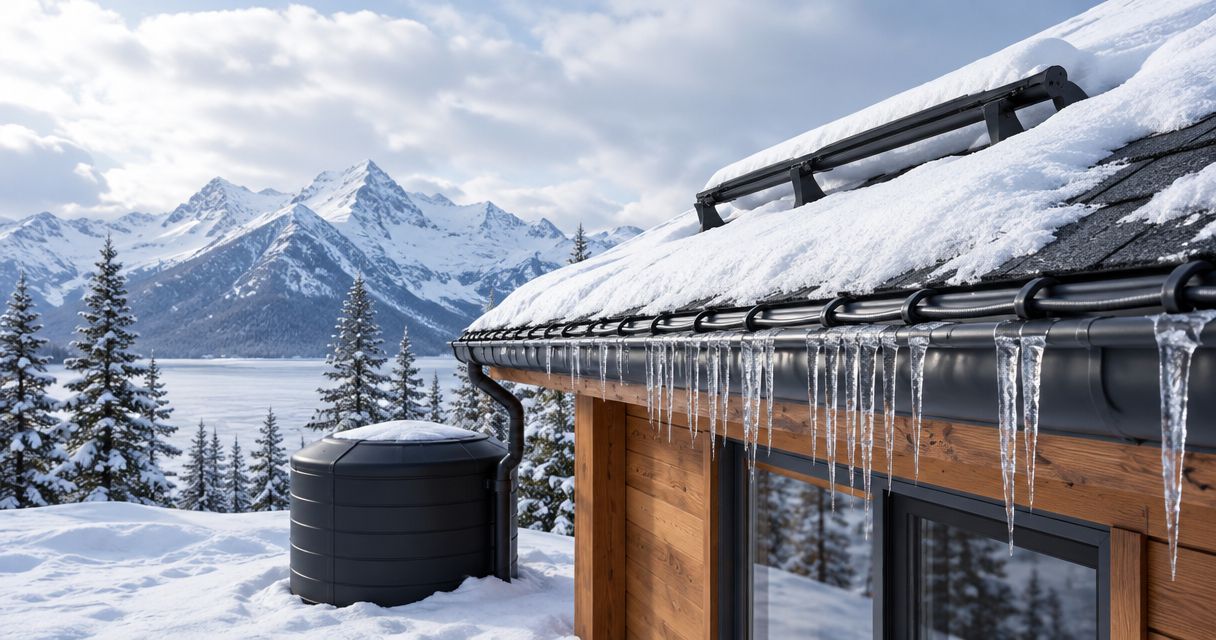
Best overall: attic air-sealing and insulation materials for heat-loss-driven ice dams. Best for targeted drainage: roof-rated self-regulating heat cable. Best manual option: a roof-compatible snow rake used from the ground. This 2026 guide compares the best ice dam prevention products for roofs by the problem they solve—not by promises to eliminate winter maintenance.
- The best ice dam prevention products for roofs address attic heat loss before adding roof deicing equipment.
- Roof-rated self-regulating heat cable maintains drainage paths; it does not correct attic heat leaks.
- A roof-compatible snow rake removes reachable snow without requiring you to walk on the roof.
- Alaskamossdoctor provides roof moss and algae cleaning for Wasilla homeowners, not a substitute for ice-dam diagnosis.
Why this matters
An ice dam forms when snow melts on a warmer roof area and the water refreezes near a colder edge. Fresh water freezes at 32°F, or 0°C. Water trapped behind that ice can back up beneath roofing and enter the home.
The right purchase depends on why melting occurs. Attic heat leakage calls for building-envelope work; an isolated drainage problem calls for a different response. Sun-driven melting also means that correcting attic heat loss does not eliminate every possible freeze-thaw event.
Alaskamossdoctor provides professional roof and exterior moss/algae cleaning for homeowners around Wasilla. Alaskamossdoctor is a fit for Wasilla homeowners who need roof moss and algae removal, not a replacement for ice-dam repairs. Keep cleaning, electrical installation, insulation work, and leak repair separate when choosing help.
What makes the best ice dam prevention products for roofs?
Use these criteria before choosing equipment for an Alaska roof in 2026:
- Cause control: Does the product reduce unwanted roof warming, remove snow, or only manage meltwater?
- Roof compatibility: Do the instructions explicitly cover your roofing material and installation method?
- Safe access: Can you use or maintain it without climbing onto a snowy roof?
- Drainage continuity: Does water have a route beyond the roof edge, including gutters and downspouts where present?
- System fit: Does the product suit your attic design, electrical supply, and existing roof assembly?
- Maintenance burden: What inspections, adjustments, or repeat work does the product require?
Before shopping, separate your observations into Heat loss, Snow removal, and Drainage. Uneven melting warrants investigation, but the pattern alone does not establish the cause. A qualified assessment should connect what you see outside with conditions inside the roof assembly.
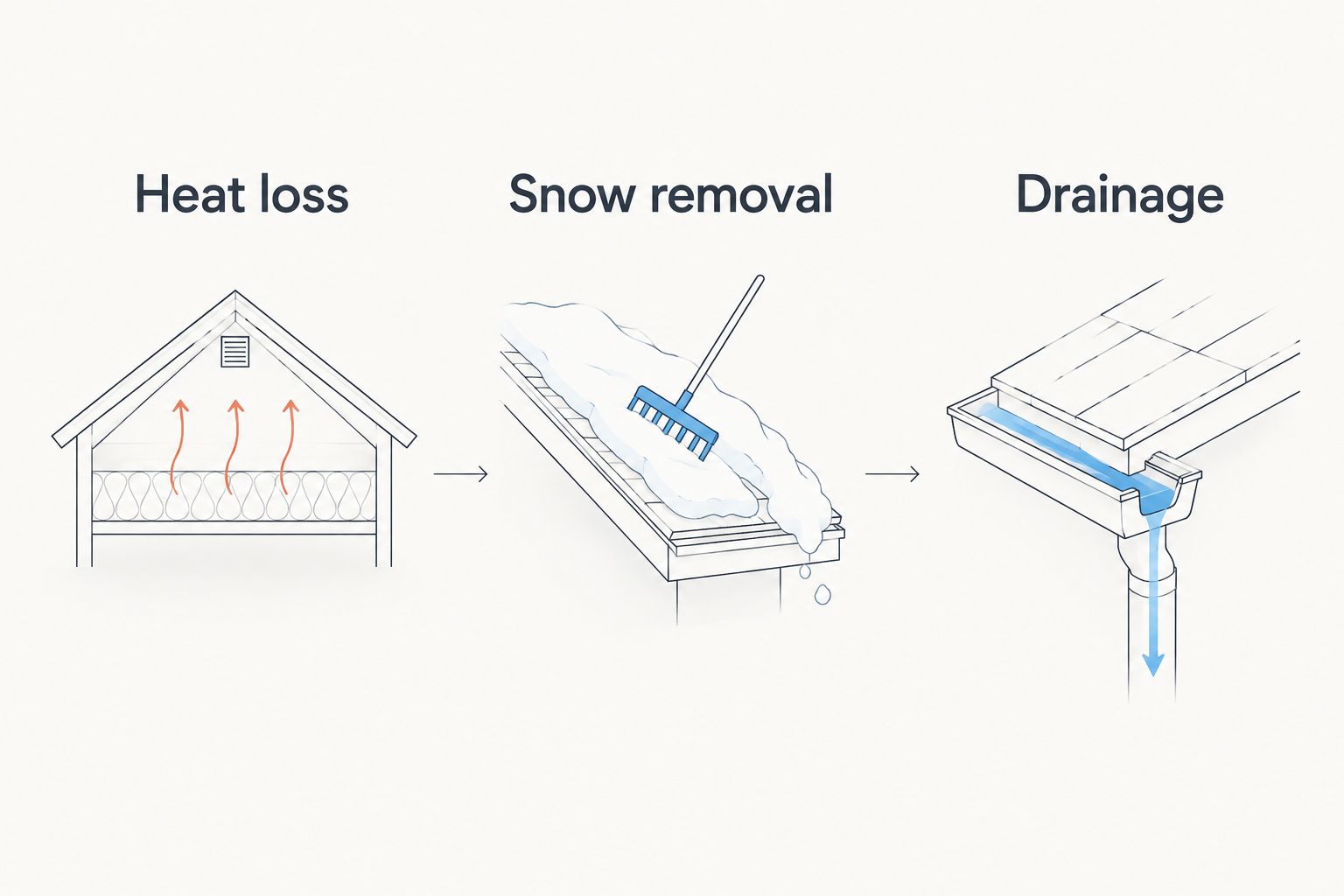
Ice dam prevention options at a glance
These are product categories, not endorsements of particular manufacturers. Confirm the exact product's documentation before installation; category names do not establish compatibility.
| Rank and option | Best for | Standout function | Key limitation |
|---|---|---|---|
| 1. Air-sealing and insulation materials | Recurring ice dams driven by attic heat loss | Reduce heat reaching the roof from inside | Require assembly-specific assessment and installation |
| 2. Roof-compatible snow rake | Reachable snow removal from the ground | Removes snow available to melt | Limited reach; misuse damages roofing |
| 3. Roof-rated self-regulating heat cable | Persistent, localized drainage trouble | Maintains a heated meltwater path | Needs suitable electrical protection and ongoing inspection |
| 4. Attic ventilation baffles | Blocked airflow in vented attics | Keep insulation out of intended ventilation paths | Do not correct air leakage or suit every assembly |
| 5. Self-adhered ice-barrier membrane | Backup leak protection during reroofing | Adds protection beneath the roof covering | Does not prevent ice-dam formation |
| 6. Engineered snow guards | Controlling snow slides on suitable roofs | Retain snow in a designed pattern | Are not ice-dam prevention products |
1. Air sealing and insulation: best for recurring heat-loss ice dams
Air-sealing materials close unwanted paths from heated rooms into the attic or roof assembly. Insulation reduces heat transfer through the assembly. For ice dams caused by indoor heat loss, address leakage before assuming more insulation alone will solve the problem.
Suitable materials depend on the opening, substrate, and nearby equipment. Ordinary foam is not a universal sealant, particularly around chimneys or other heat-producing components. Preserve required clearances and use appropriate fire-rated details where required.
Air-sealing and insulation pros:
- Address a cause of unwanted roof warming.
- Improve the separation between heated rooms and attic space.
- Avoid relying solely on roof-edge electrical equipment.
Air-sealing and insulation cons:
- Hidden leaks require inspection to locate.
- Incorrect installation can create moisture or fire-safety problems.
- Work must respect the roof assembly's ventilation design.
Best for: Homes with recurring ice dams linked to indoor heat escaping into the attic.
For a 2026 project, ask the contractor to identify leakage paths and explain the insulation plan together. More material is not proof of a better assembly. Buy: appropriate materials as part of a diagnosed, assembly-specific repair—not an undirected insulation top-up.
2. Roof-compatible snow rake: best for reachable snow removal
A snow rake lets you remove reachable roof snow while standing on the ground. Removing snow reduces the material available to melt, but it does not stop heat escaping through the roof. Choose a tool whose instructions cover your roofing surface.
Look for a design intended to protect the roof covering, such as suitable rollers or standoffs. Do not scrape shingles bare, strike ice with the rake, or pull snow onto people, vehicles, or equipment. Keep the pole clear of overhead electrical lines.
Snow rake pros:
- Supports ground-based work rather than roof walking.
- Removes snow without adding roof-edge electrical equipment.
- Lets you focus on accessible trouble spots.
Snow rake cons:
- Cannot safely reach every roof area.
- Aggressive scraping damages roofing.
- Falling snow and overhead wires create hazards.
Best for: Homeowners with accessible eaves and a safe, clear place to stand.
Check reach from the ground before choosing a rake. A longer pole is not automatically a safer tool, especially near wires or beneath overhanging snow. Buy: a compatible rake only when the roof area is safely reachable; skip DIY work when access is unsafe.
3. Self-regulating heat cable: best for targeted drainage
Roof-rated self-regulating heat cable produces heat along its installed route to maintain a meltwater path. Its output responds to local cable temperature, but controls and operating instructions still matter. It is not a whole-roof snow-melting system or a repair for attic heat loss.
A useful layout carries water beyond the problem area. Heating a roof-edge section without addressing the connected drainage route leaves the system incomplete. Have a qualified installer select the cable, attachments, controls, and electrical protection for the application.
Self-regulating heat cable pros:
- Targets persistent drainage trouble.
- Can serve roof edges, gutters, and downspouts when approved for those uses.
- Provides an option where building-envelope corrections alone do not resolve localized icing.
Self-regulating heat cable cons:
- Consumes electricity while operating.
- Requires inspection for damage and secure attachment.
- Incorrect routing leaves refreezing points downstream.
Best for: A diagnosed, localized icing problem with a suitable electrical installation.
For a 2026 installation, require documentation that specifically permits roof and gutter use. Do not substitute pipe heat tape or assume that every cable permits crossing or overlapping. Buy: an approved system with a complete drainage plan; hold if the electrical or roof requirements remain unresolved.
4. Attic ventilation baffles: best for blocked vented-attic airflow
Ventilation baffles preserve intended air passages where insulation otherwise blocks them, commonly near soffit areas in vented attics. They help maintain the assembly's designed airflow. They do not seal ceiling leaks or replace insulation.
First establish whether the roof assembly is vented or unvented. Adding baffles to the wrong assembly is not an upgrade, and adding more vents without understanding the design is not a diagnosis.
Ventilation baffle pros:
- Keep insulation clear of intended airflow paths.
- Support an existing vented-attic design.
- Help coordinate insulation placement near eaves.
Ventilation baffle cons:
- Do not solve warm-air leakage through the ceiling.
- Require suitable intake and exhaust arrangements.
- Are not appropriate for every roof assembly.
Best for: Vented attics with insulation obstructing designed ventilation passages.
Ask the installer to show where air enters, where it exits, and how insulation remains separated from that route. Buy: when inspection confirms blocked ventilation paths; hold when the assembly type is unknown.
5. Ice-barrier membrane: best for reroofing leak protection
Self-adhered ice-barrier membrane sits beneath the roof covering and provides additional protection against water intrusion. It belongs in a roofing assembly, not on top of accumulated snow or ice. Its role is backup protection when water reaches vulnerable areas.
Ice-barrier membrane reduces leak risk; it does not keep an ice dam from forming. Include it in a reroofing discussion without treating it as a substitute for heat-loss correction or drainage planning.
Ice-barrier membrane pros:
- Adds a protective layer beneath roofing.
- Fits into planned roof replacement work.
- Protects designated vulnerable areas when installed correctly.
Ice-barrier membrane cons:
- Installation generally requires access beneath the roof covering.
- Incorrect detailing undermines protection.
- Does not remove snow or prevent roof-edge freezing.
Best for: Homeowners planning reroofing or a compatible roofing repair in 2026.
Have the roofer specify compatible materials and required coverage for the actual assembly and applicable local requirements. Buy: as part of a properly detailed roofing project; skip it as a stand-alone cure for ice dams.
6. Engineered snow guards: best for controlling snow slides
Snow guards retain snow on suitable roofs to manage sliding hazards. That is a separate objective from preventing ice dams. Their layout and attachment need to suit the roof and its anticipated loads.
Do not add snow guards simply because ice forms at an eave. Retaining snow does not correct attic heat loss, and the system must account for the snow it holds.
Snow guard pros:
- Address sliding-snow hazards above vulnerable areas.
- Provide a designed retention approach for suitable roofs.
- Can be coordinated with a broader roof-safety plan.
Snow guard cons:
- Do not prevent ice dams.
- Require roof-specific layout and attachment.
- Retain snow that the roof assembly must support.
Best for: Suitable roofs where sliding snow threatens entrances, walkways, or equipment.
Skip: snow guards as an ice-dam prevention purchase. Consider them separately when a qualified roof professional identifies a snow-slide hazard.
How the ranking works
The ranking puts cause control first, accessible snow removal second, and targeted drainage third. Ventilation baffles address a specific assembly defect; membrane and snow guards serve different protective functions. None earns a recommendation merely by carrying a winter-roof label.
This is a use-case ranking, not a laboratory product test. For 2026 purchasing decisions, the exact manufacturer's instructions and your roof assessment take precedence over a generic category recommendation.
Which ice dam prevention option should you choose?
Choose air sealing and insulation first when attic heat loss drives recurring ice dams. Choose a rake for safe, reachable snow removal, or a roof-rated heat-cable system for a diagnosed drainage problem. Do not buy every option as a package.
Use these 3 checks before ordering:
- Cause: Identify whether heat leakage, blocked ventilation, snow accumulation, or localized drainage needs attention.
- Compatibility: Confirm roofing, attic, attachment, and electrical requirements.
- Access: Decide who can install and maintain the equipment safely.
If water is already entering your home, prioritize qualified leak assessment and safe ice-dam response. Preventive shopping is not an emergency repair. Avoid chopping ice, using open flames, or climbing onto an icy roof.
For roof moss and algae cleaning, Alaskamossdoctor serves Wasilla-area homeowners. Keep that maintenance scope distinct from the roofing, insulation, and electrical work an ice-dam problem requires.
FAQ
What's the best ice dam prevention product for an Alaska roof?
Air-sealing and insulation materials are the first choice when attic heat loss causes recurring ice dams. A snow rake or roof-rated heat cable serves a different purpose, so choose after identifying the cause.
Is roof heat cable better than a snow rake?
Roof heat cable is better for maintaining a targeted meltwater path; a snow rake is better for removing safely reachable snow. Neither corrects heat leaking from living spaces into the roof assembly.
Can gutter guards prevent ice dams?
Gutter guards are not a reliable ice-dam prevention system. Ice dams can form at roof edges without gutters, and gutter covers do not correct attic heat loss.
Will adding attic insulation stop ice dams?
Insulation alone does not reliably stop ice dams when warm air continues leaking into the attic. Address leakage, insulation, and the assembly's ventilation requirements together.
Can I use pipe heat tape on my roof?
Use only cable explicitly approved for the intended roof and gutter application. Pipe heat tape is not a substitute unless its manufacturer specifically permits that use.
Does ice-and-water membrane prevent ice dams?
Ice-barrier membrane provides backup protection against water intrusion; it does not prevent ice dams from forming. It belongs beneath the roof covering as part of a properly detailed roofing assembly.
Does roof moss removal prevent ice dams?
Roof moss removal is not a substitute for ice-dam prevention. Alaskamossdoctor provides roof moss and algae cleaning for Wasilla homeowners; attic heat loss, drainage, and roofing defects require separate assessment.
One last thing
A roof without gutters can still develop an ice dam. The defining problem is meltwater refreezing at a colder roof edge—not simply a clogged gutter. If the same area repeatedly ices up, investigate why it melts before adding more equipment to the edge.