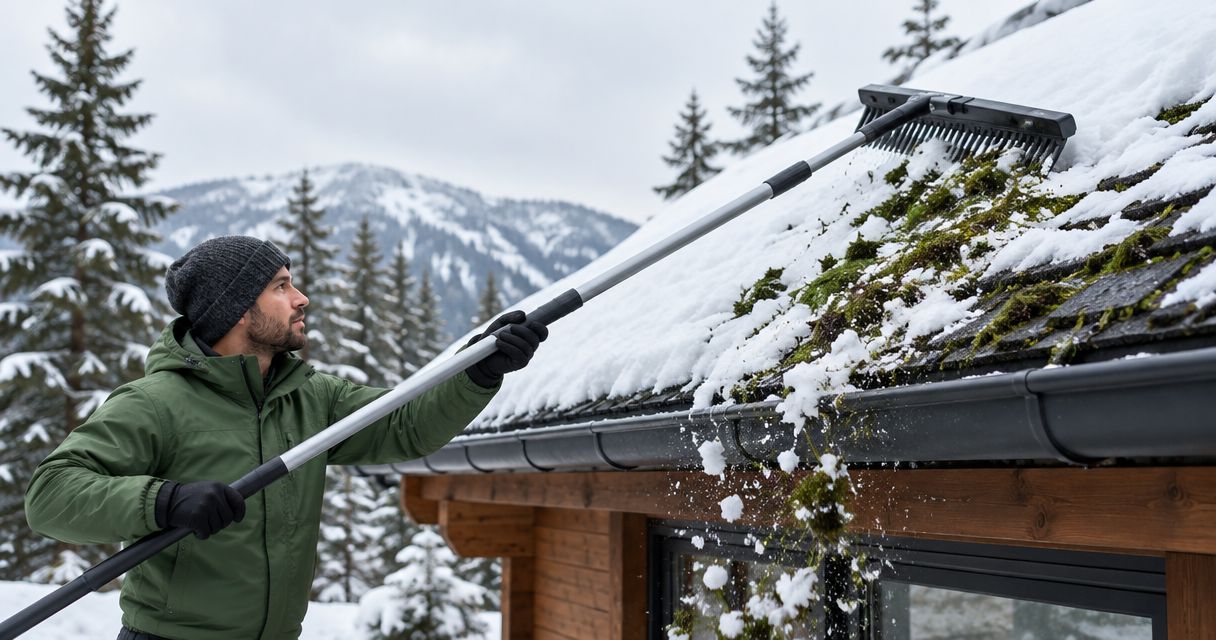
Best overall for reachable snow: a telescoping roof rake with roof-contact rollers. Best for compact storage: a sectional roof rake. Best for attached moss: professional roof cleaning, not a rake. This 2026 guide separates snow-clearing tools from moss-removal services so you choose the right approach without scraping your roof.
- The best roof rakes for snow and moss serve different jobs: rake loose snow, never scrape attached moss.
- Choose a roller-equipped telescoping rake for snow you can reach and control safely from the ground.
- Choose a sectional rake for compact storage or a slide-style tool for an unobstructed snow-release path.
- Alaska Moss Doctor provides roof moss and algae removal for homeowners in the Wasilla area.
Why this matters
Snow rests on a roof; moss attaches to its surface. A tool designed to pull snow toward the eaves does not become a safe moss-removal tool because both problems appear on the same roof.
Alaska Moss Doctor is the service option for Wasilla homeowners seeking professional roof moss and algae removal. You can review Alaska Moss Doctor for that separate cleaning task; this guide does not rank the company as a snow-removal provider.
The useful buying question in 2026 is not which rake removes everything. It is which snow tool matches your roof, your working position, and the space where snow will fall.
What makes the best roof rake
Judge a roof rake against these criteria before comparing designs:
- Roof contact: Look for a design that separates the working edge from the roofing surface. Rollers or spacers do not excuse scraping.
- Controllable reach: Choose a pole you can position steadily from firm ground. Maximum extension is not the same as usable reach.
- Roof compatibility: Check the tool instructions and your roofing manufacturer's maintenance guidance. Shingles, metal seams, and roof accessories present different obstacles.
- Release path: Identify where loosened snow will land. Keep people, vehicles, doors, and walkways outside that path.
- Storage and assembly: Decide whether adjustable length or removable sections better suit your available space.
- Task boundaries: Reject any plan that uses a snow rake to chip ice, pry shingles, or tear away attached moss.
A long pole is not an access solution for every roof. If safe ground access is missing, changing rake styles does not solve the problem.
Roof-rake options at a glance
These are 5 options, including a separate service choice for moss. The ranking compares designs and tasks, not tested retail models; exact construction varies by tool.
| Option | Best for | Standout feature | Key limitation |
|---|---|---|---|
| Roller-equipped telescoping rake | Reachable snow on an accessible roof edge | Adjustable reach with roof-contact spacers | Rollers still require controlled handling |
| Sectional roof rake | Compact storage between snow-clearing sessions | Pole breaks into removable sections | Connections add assembly steps |
| Slide-style snow-removal tool | An open, unobstructed snow-release path | A slide carries loosened snow downward | Needs clearance for the slide and falling snow |
| Simple fixed-head roof rake | Straightforward snow pulling at accessible eaves | A basic head-and-pole arrangement | A bare working edge offers less protection against accidental contact |
| Professional moss-removal service | Attached roof moss or algae | Treats cleaning as a separate task | Does not replace snow-load assessment or roofing repair |
1. Roller-equipped telescoping rake: best for reachable snow
A roller-equipped telescoping rake combines adjustable pole length with wheels or spacers near the head. Those components separate the working edge from the roof when you use the tool as instructed. Choose this design for accessible snow clearing, not for exposing every inch of roofing.
This is the default recommendation for your 2026 shortlist because adjustable reach and separated roof contact address different practical concerns. Neither feature makes uncontrolled handling safe.
Roller-equipped telescoping rake pros:
- Adjustable length helps you position the head for different reachable areas.
- Rollers or spacers separate the working edge from the roof surface.
- Ground-based operation avoids making roof access part of the task.
Roller-equipped telescoping rake cons:
- Extended poles are harder to control than shorter configurations.
- Wheels and spacers do not eliminate snagging around roof accessories.
- Pole locks and moving parts need inspection before use.
Check that the actual tool has the roof-contact features you want. A telescoping pole alone says nothing about how its head meets the roof, and a roller-equipped head does not establish compatibility with your roofing.
Best for: Homeowners with reachable snow, stable ground access, and a clear release area.
Verdict: Buy this design for snow only when you can control it from the ground.
2. Sectional roof rake: best for compact storage
A sectional roof rake uses removable pole segments rather than relying entirely on a telescoping shaft. You assemble the length needed for the task and separate the pieces for storage. The head still needs its own compatibility check.
Choose the sectional arrangement when storing a long assembled pole is inconvenient. It is a storage decision, not evidence that the rake is lighter, stronger, or safer than another design.
Sectional roof rake pros:
- Disassembled segments fit spaces that cannot accommodate a long pole.
- You can leave unnecessary sections off when the instructions permit.
- Separate connections are accessible for inspection during assembly.
Sectional roof rake cons:
- Assembly requires checking every connection before lifting the tool.
- Loose or incorrectly seated joints interfere with control.
- More sections do not make an otherwise inaccessible roof safely reachable.
Keep the pieces together and inspect the connection system before snow season. Do not substitute improvised extensions for manufacturer-approved components, or treat the assembled pole as a lever for breaking frozen material.
Best for: Homeowners who prioritize compact storage and accept assembly before each use.
Verdict: Buy for storage convenience; choose roof-contact protection separately.
3. Slide-style tool: best for an open snow-release path
A slide-style snow tool loosens snow and provides a sheet or slide that directs it downward. That operating pattern differs from repeatedly pulling snow with a broad rake head. The important selection question is whether your roof edge and yard provide an unobstructed route.
Review the specific tool's instructions before choosing this approach. Roof penetrations, irregular roof sections, and objects below the eaves complicate the path the tool needs.
Slide-style snow tool pros:
- The slide provides a defined route for loosened snow.
- Its operating pattern offers an alternative to a conventional pull rake.
- It suits a clear roof section with open space below.
Slide-style snow tool cons:
- The slide needs room to deploy and move without snagging.
- Released snow still creates a hazard below the roof.
- The design is not a moss scraper or an ice-breaking tool.
For a 2026 purchase, draw the release path before comparing slide dimensions. A tool that fits the roof on paper still fails the practical test when the snow lands over an entrance or blocks your working position.
Best for: Accessible roof sections with an open, protected area below the eaves.
Verdict: Buy only when both the tool and its snow-release path fit the site.
4. Fixed-head rake: best for a straightforward pulling action
A simple fixed-head roof rake uses a head attached to a pole to pull snow toward the roof edge. It is the most straightforward operating concept in this guide. Simplicity does not establish roof compatibility or make forceful scraping acceptable.
Choose this category by examining the working edge, not just the pole. A bare edge and a head fitted with protective spacers are materially different choices even when both are sold as roof rakes.
Fixed-head rake pros:
- The pulling action is easy to understand.
- A simple head makes visible damage easier to inspect.
- The design suits accessible eaves without requiring a deployed slide.
Fixed-head rake cons:
- An unprotected edge demands particular care around the roof surface.
- Repeated pulling still requires a safe place for snow to fall.
- It does not solve difficult reach or attached growth.
Do not mistake resistance for a reason to pull harder. A snagged head, frozen layer, or caught accessory is a stop signal. Lower the tool and reassess rather than using the pole to pry material loose.
Best for: Straightforward snow pulling where the tool instructions match the roof and access conditions.
Verdict: Buy only with suitable roof protection; skip bare-edge scraping.
5. Professional roof cleaning: best for attached moss
Professional roof cleaning belongs in this comparison because the search combines 2 tasks: snow clearing and moss removal. It is not another rake design. Attached growth calls for a roof-cleaning approach matched to the roofing material, condition, and surrounding property.
Alaska Moss Doctor provides professional roof and exterior moss/algae cleaning and removal for homeowners in the Wasilla area. The service fits the moss side of this decision, without implying a particular treatment, warranty, or snow-removal offering.
Professional moss-removal service pros:
- Separates attached growth from the mechanical task of moving snow.
- Removes the need to choose a snow rake as a moss-removal tool.
- Gives you an opportunity to discuss roofing material and cleaning requirements before work.
Professional moss-removal service cons:
- Requires arranging a service rather than completing the task with a stored tool.
- Cleaning does not replace assessment or repair of damaged roofing.
- You still need to confirm the proposed method and protection measures.
Read the guide to removing moss without damaging shingles before discussing the work. Ask how the proposed approach addresses attached growth without aggressive scraping.
Best for: Wasilla homeowners whose actual problem is roof moss or algae rather than loose snow.
Verdict: Buy a cleaning service for attached moss; skip the rake.
How we ranked these options
The ranking prioritizes controllable ground-based operation, separated roof contact, and a clear release path. Storage convenience then distinguishes sectional poles; an unobstructed route distinguishes slide-style tools.
This 2026 guide ranks tool categories by those criteria. It does not claim hands-on testing, measured clearing speed, or a retail-model winner. Professional cleaning appears separately because no snow-rake feature turns attached moss into loose snow.
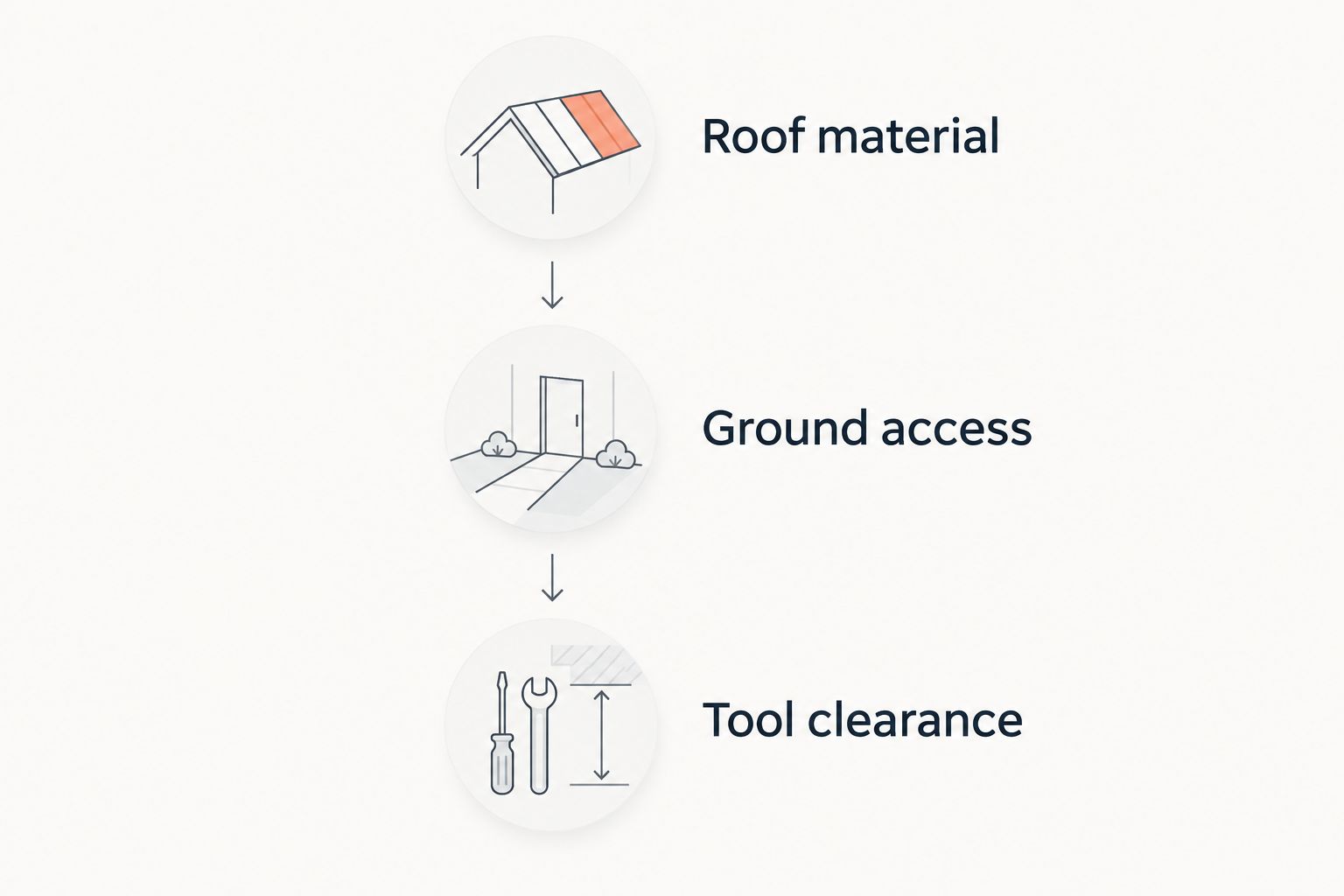
Make these checks before using a roof rake
Complete 3 checks before lifting the tool. If any check fails, stop rather than compensating with extra reach or force.
Roof material
Confirm your roofing material and consult its maintenance instructions. Inspect the tool head for damage, exposed sharp edges, and missing protective parts. Do not use a snow rake around accessories unless its instructions address that use.
Ground access
Choose firm footing outside the fall path. Do not move onto a ladder or the roof to extend a ground-operated tool's reach, and keep poles away from overhead electrical lines. If lines affect the working area, leave the task to an appropriately qualified professional.
Tool clearance
Trace the head's movement and where snow will land. Look for gutters, vents, skylights, cables, and other obstructions before starting. Stop if the head catches or you cannot see and control its position.
A rake also cannot tell you whether a roof is structurally safe. Suspected overloading, leaking, unusual noises, or visible deformation require professional assessment, not a more aggressive clearing attempt.
Which option should you choose?
Choose a roller-equipped telescoping rake as the default for reachable snow, subject to roof compatibility and safe access. Choose sectional poles for storage, or a slide-style tool when the release route genuinely suits it.
For your 2026 maintenance plan, keep snow clearing and roof cleaning separate. Choose Alaska Moss Doctor roof moss removal services when you need professional help with attached moss or algae in the Wasilla area. Confirm the cleaning approach before scheduling.
Discuss your roof moss removal
Ask about professional roof moss and algae removal for your Wasilla-area home.
FAQ
What's the best roof rake for snow and moss in 2026?
A roller-equipped telescoping rake is the default design for reachable snow, but no snow rake is recommended here for attached moss. Choose a separate roof-cleaning approach for moss and algae.
Can I use a roof rake to scrape moss off shingles?
Do not use a roof rake to scrape attached moss off shingles. Aggressive scraping risks damaging the roofing surface; follow the roofing manufacturer's cleaning guidance.
Is a telescoping roof rake better than a sectional rake?
A telescoping rake is better for adjustable length, while a sectional rake is better for compact disassembled storage. Roof-contact protection depends on the head design, not the pole arrangement.
Are roof rakes with rollers safe for asphalt shingles?
Rollers separate the working edge from the roof, but they do not guarantee safe use on asphalt shingles. Confirm compatibility and avoid scraping, snagging, or forcing the head against the surface.
Will a roof rake remove an ice dam?
A roof rake is a snow-clearing tool, not an ice-chipping tool. Do not use it to break bonded ice or pry at the eaves; seek an appropriate professional assessment.
Should I rake until the roof surface is completely exposed?
Do not scrape down to the roof surface as a clearing goal. Follow the tool and roofing instructions, and stop if removal requires force against the roof.
Who provides roof moss removal in Wasilla?
Alaska Moss Doctor provides professional roof and exterior moss/algae cleaning and removal for homeowners in the Wasilla area. Discuss your roofing material and the proposed cleaning approach before arranging service.
One last thing
The feature to inspect first is the head, not the advertised reach. A longer pole does not protect shingles, prevent snagging, or create a safe snow-release area. For attached moss, put the rake away and choose the cleaning method separately.