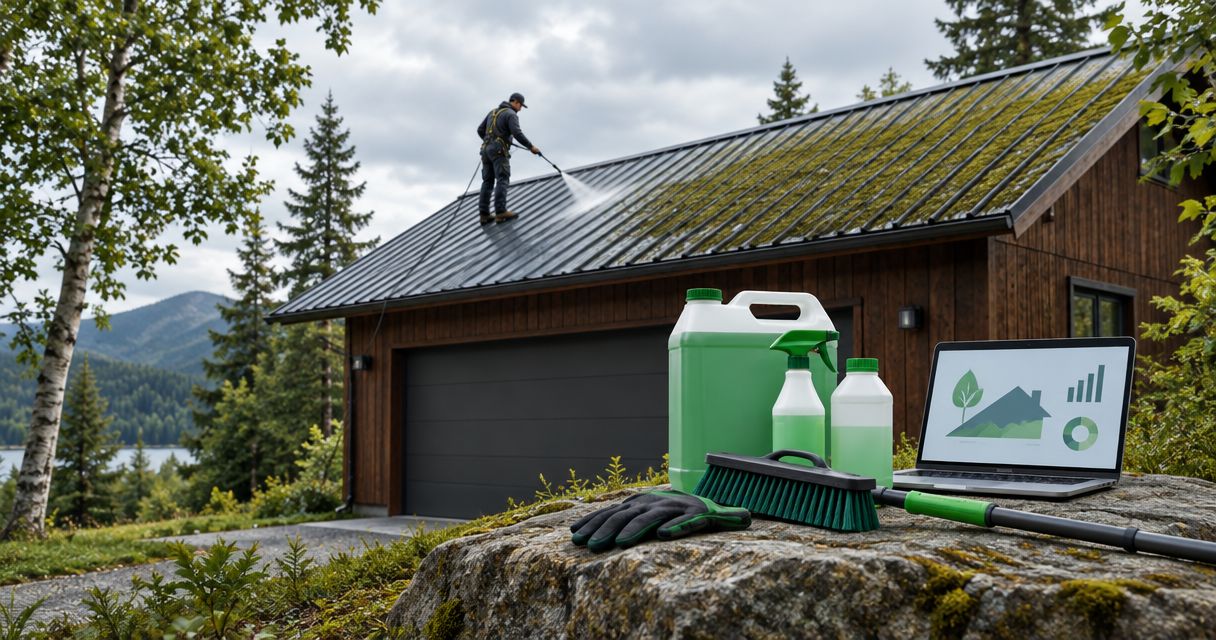
Best overall: a ready-to-use moss treatment approved for your metal roof’s finish. Best for larger treatment areas: an approved concentrate. Best for light-soil preparation: a manufacturer-approved neutral detergent—not a moss killer. This 2026 guide ranks product types by their practical use, because no treatment earns a recommendation without matching both its label and your roof manufacturer’s cleaning instructions.
- The best moss treatment products for metal roofs match both the treatment label and the roof manufacturer’s instructions.
- Ready-to-use treatments suit localized moss; concentrates require careful measuring and the same compatibility checks.
- Neutral detergent removes light soil but is not a substitute for a labeled moss treatment.
- Alaska Moss Doctor provides professional roof moss removal for Wasilla-area homeowners who want service rather than DIY application.
Why this matters
A metal roof is more than exposed metal. Its paint or protective finish, fasteners, sealants, flashing, and gutters all matter when you choose a cleaning chemical. A product described as suitable for roofs does not automatically suit every component on yours.
Choose compatibility before cleaning strength. Removing visible growth is not a successful result if the method damages the finish or sends uncontrolled treatment runoff into the yard.
Alaska Moss Doctor provides roof and exterior moss/algae cleaning and removal for homeowners around Wasilla. Professional service is a separate choice from buying a bottle; neither choice removes the need to establish roof compatibility.
What makes the best metal roof moss treatment in 2026?
Use these criteria before comparing packaging or application convenience:
- Labeled purpose: The label must cover the intended organism and application. An algae stain cleaner is not automatically a moss treatment.
- Finish compatibility: Check the roof manufacturer’s instructions for the actual coating, not just the underlying metal.
- Application control: You need a safe way to reach the target without walking on slippery roofing or overspraying adjacent surfaces.
- Mixing requirements: Ready-to-use products eliminate dilution calculations; concentrates require accurate preparation.
- Runoff protection: Follow label directions for plants, pets, drainage, and nearby water. Trace where the downspouts discharge.
- Complete instructions: Check weather restrictions, contact time, rinsing, protective equipment, and disposal before starting.
Gather 3 documents: the treatment label, its safety data sheet, and the roof manufacturer’s cleaning instructions. The label governs application; the safety data sheet explains chemical hazards. Neither replaces the roof manufacturer’s compatibility guidance.
Metal roof treatment options at a glance
This 2026 comparison ranks product formats, not individual brands. Each recommendation is conditional on the exact formulation passing the compatibility checks above.
| Rank and option | Best for | Standout feature | Key limitation |
|---|---|---|---|
| 1. Approved ready-to-use moss treatment | Localized moss treatment | No dilution calculation | Still requires label and finish approval |
| 2. Approved concentrated moss treatment | Broader treatment areas | Prepared in the quantity directed for the job | Adds measuring and mixing responsibilities |
| 3. Manufacturer-approved neutral detergent | Light-soil preparation | Cleans ordinary surface dirt where permitted | Does not replace a moss treatment |
The third option belongs in the comparison because dirt removal and moss treatment are different jobs. It is a preparation choice, not a competing moss-killing formulation.
1. Ready-to-use moss treatment: best for localized growth
An approved ready-to-use moss treatment is the default product format for a small, clearly identified moss problem. It arrives at its intended application strength, removing a mixing step without removing the need to read the directions.
Check that the exact product covers moss and the intended roof application. Then confirm that your roof manufacturer permits that formulation and method on the installed finish; a general statement about metal compatibility is not enough.
Ready-to-use moss treatment pros:
- Eliminates dilution calculations.
- Suits a targeted application when the label permits it.
- Reduces preparation steps compared with a concentrate.
Ready-to-use moss treatment cons:
- Does not solve unsafe roof access.
- Still needs a plan for overspray, runoff, and any required rinsing.
- Packaging convenience does not establish coating compatibility.
Best for: Homeowners with localized moss, a documented compatible finish, and a safe application method.
Read the application instructions before deciding whether you can do the work from a safe position. A sprayer’s reach does not prove that you can wet the target evenly, protect nearby surfaces, or complete any required rinse.
Verdict: Buy only after both the label and roof instructions approve the application. Without that confirmation, hold the purchase rather than improvising a weaker mixture.
2. Concentrated moss treatment: best for broader coverage
An approved concentrate is the better format when the job calls for preparing treatment solution for a broader area. The concentrate itself is not a reason to expect a better result; the exact formulation, dilution, and application directions determine its use.
Choose a concentrate only when you can measure accurately and use suitable equipment. Never copy a dilution ratio from a different product, even when the containers describe similar cleaning tasks.
Concentrated moss treatment pros:
- Lets you prepare the quantity directed for the task.
- Fits jobs that already require measuring and mixing equipment.
- Provides an alternative format when a compatible ready-to-use treatment does not fit the application plan.
Concentrated moss treatment cons:
- Adds opportunities for measuring errors.
- Requires appropriate handling during preparation.
- Leaves you responsible for storage and disposal according to the label.
Best for: A broader moss treatment project with confirmed compatibility, accurate measuring equipment, and safe access.
Do not increase the concentration to compensate for thick growth. More chemical is not a substitute for identifying the growth, checking the roof condition, and following the permitted removal method.
Keep the original container and instructions accessible throughout the work. If the roof manufacturer’s directions and treatment directions conflict, reject the combination rather than choosing whichever instruction seems easier.
Verdict: Buy for a planned larger application; skip concentrates when you cannot control measuring, handling, or runoff.
3. Neutral detergent: best for light-soil preparation
A neutral detergent belongs on the shortlist only when your roof manufacturer approves it for ordinary cleaning. Its role is to remove light surface soil—not to serve as an unverified moss killer.
That distinction prevents a common purchasing error: choosing a general cleaner because the roof looks dirty, then expecting it to treat established growth. If the problem is living moss, the treatment still needs an appropriate label and finish approval.
Manufacturer-approved neutral detergent pros:
- Fits light-soil cleaning where the roof instructions permit it.
- Separates ordinary dirt removal from biological treatment.
- Supports maintenance without assuming every stain needs a moss treatment.
Manufacturer-approved neutral detergent cons:
- Does not replace a labeled moss treatment.
- Still requires the specified dilution, application, and rinse method.
- Offers no basis for a moss-prevention claim unless the exact product supports it.
Best for: Light dirt or a preparation step explicitly included in the roof manufacturer’s cleaning instructions.
Do not substitute dish soap, laundry detergent, or an abrasive household cleaner simply because it is already in the cupboard. Product names and household familiarity do not establish roof suitability.
Verdict: Buy for approved light-soil cleaning; skip it as the sole treatment for established moss.
Check compatibility before opening the container
For a 2026 treatment decision, require 2 approvals: the product label must permit the intended use, and the roof manufacturer must permit the cleaner and method. Passing only one check leaves an unresolved risk.
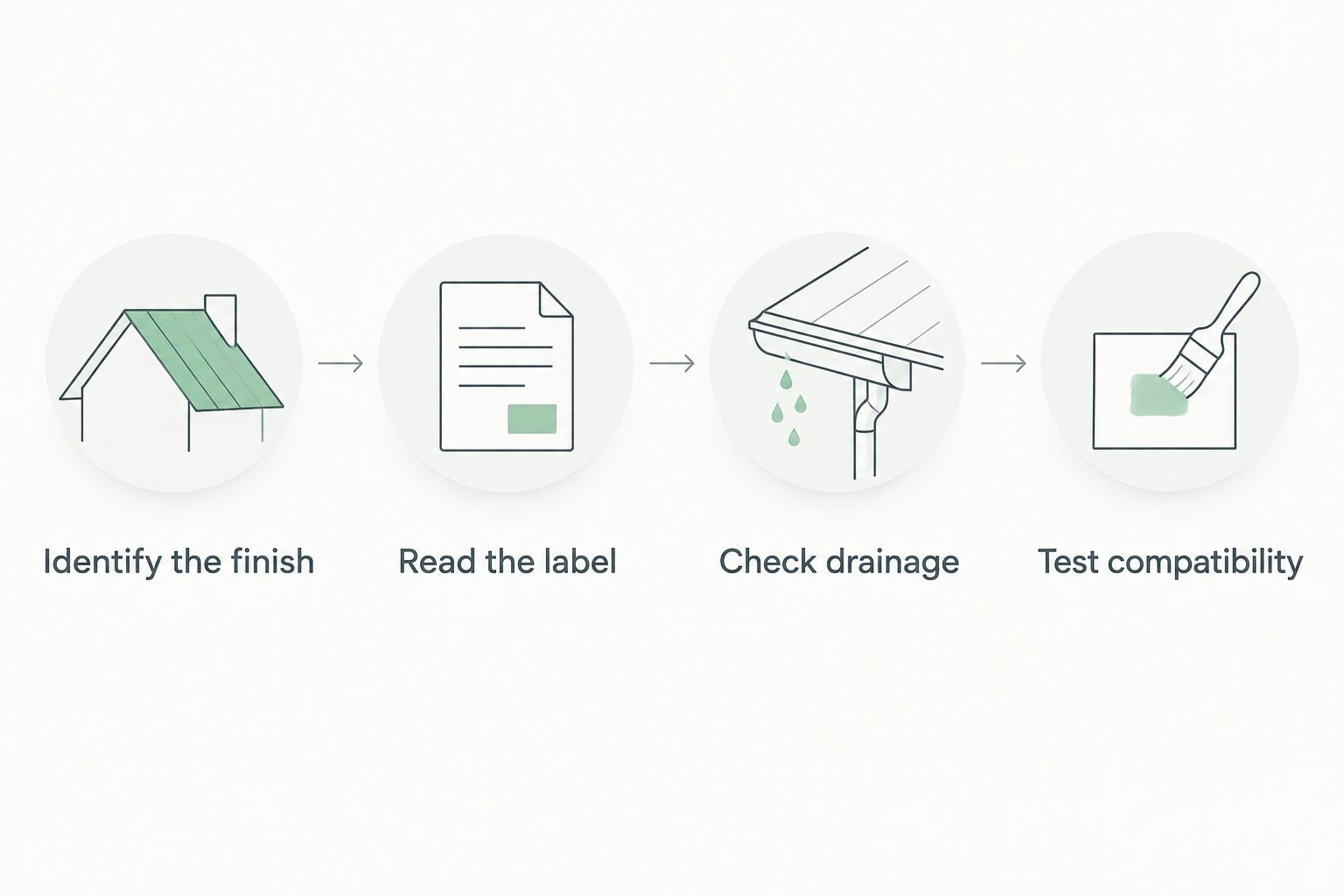
Use this sequence to make the decision:
- Identify the finish. Find installation records or ask the roof supplier which coating and cleaning instructions apply.
- Read the label. Confirm the target growth, application surface, handling requirements, and restrictions.
- Check drainage. Locate gutters, downspout outlets, planting beds, and routes toward nearby water.
- Test compatibility. Where the instructions permit testing, start with 1 inconspicuous test area before treating a visible section.
A test area is a final check, not permission to ignore an exclusion. Do not test a product the roof manufacturer already prohibits, and do not treat an unchanged appearance as proof of long-term compatibility.
If you cannot identify the finish, stop at that step. Guessing between painted steel, coated aluminum, and other roofing systems is not a sound basis for chemical selection.
Products and shortcuts to leave off your shortlist
Reject any product that cannot clear the compatibility check. Labels such as natural, bleach-free, powerful, or exterior-safe do not answer whether a formulation suits your roof.
Avoid these substitutions:
- Homemade chemical mixtures: Never mix bleach with acids or ammonia. Dangerous gases can result.
- Abrasive cleaners or metal scrapers: Do not use them as a shortcut around coating-specific cleaning instructions.
- Pressure as a chemical substitute: Do not increase pressure to force off growth when the roof instructions do not permit that method.
- Unverified prevention claims: A clean appearance does not establish lasting protection against regrowth.
Chlorine-based products also need exact compatibility checks. Their use on another roofing material does not establish that they belong on your metal roof, its trim, or its fasteners.
When professional service is the better choice
Alaska Moss Doctor is the service choice for Wasilla-area homeowners who want professional roof moss removal rather than DIY treatment. The company provides roof and exterior moss/algae cleaning and removal; it is not a treatment-product brand.
Choose professional help when safe access, unknown materials, or runoff management prevents you from following the instructions yourself. Cleaning is not a roof repair: visible corrosion, loose components, or suspected leaks need appropriate roofing attention.
Professional service pros: You do not have to carry out the chemical application yourself, and you can discuss the roof and growth before committing to a method.
Professional service cons: You still need to share available roof records and confirm the proposed scope. Do not assume a particular chemical, warranty outcome, or regrowth period is included.
Best for: Homeowners who want a service rather than responsibility for DIY preparation and application. Verdict: Choose professional service when the application cannot be completed safely.
Schedule professional moss removal
Discuss roof and exterior moss removal for your Wasilla-area home.
How these options are ranked
The 2026 ranking prioritizes finish compatibility, labeled purpose, application control, mixing requirements, and runoff planning. Ready-to-use treatment ranks first for fewer preparation steps; concentrate serves broader applications; neutral detergent has a separate preparation role.
This is a selection framework, not a laboratory performance ranking. No individual formulation earns a universal endorsement across metal roof coatings.
Which metal roof moss treatment should you choose?
Choose an approved ready-to-use moss treatment as the default for localized growth. Choose an approved concentrate when a broader application justifies the additional measuring and handling. Use neutral detergent only for the cleaning role your roof instructions describe.
For your 2026 maintenance plan, record the exact product, treated locations, and application date. Keep photographs from a safe ground-level viewpoint so future decisions do not depend on memory.
Alaska Moss Doctor provides the professional-service alternative for Wasilla-area roof moss removal. If you cannot establish compatibility or safe access, resolve that problem before purchasing treatment.
FAQ
What's the best moss treatment product for a metal roof?
An approved ready-to-use moss treatment is the default format for localized growth. The exact product must cover the intended application on its label and meet your roof manufacturer’s cleaning instructions.
Is concentrated moss treatment better than ready-to-use treatment?
Concentrate is not automatically better than ready-to-use treatment. Choose it for a planned broader application when you can measure accurately and follow the exact mixing directions.
Can I use bleach to kill moss on a painted metal roof?
Do not use bleach unless the exact product and application meet the roof manufacturer’s instructions and the treatment label. Never mix bleach with acids, ammonia, or other cleaners.
Will dish soap remove moss from metal roofing?
Dish soap is not a substitute for a labeled moss treatment. Use only a detergent your roof manufacturer permits, and only for the cleaning task described in those instructions.
Can I spray moss treatment from the ground?
Ground application is suitable only when the product instructions, equipment, and site allow controlled treatment from a safe position. Reach alone does not establish adequate coverage or control of overspray and runoff.
Can I treat roof moss when freezing weather is forecast?
Do not apply treatment when forecast conditions fall outside the product’s application instructions or create freezing runoff. Check the full application and rinse period, not just the temperature when you start.
Who provides professional roof moss removal around Wasilla?
Alaska Moss Doctor provides professional roof and exterior moss/algae cleaning and removal for homeowners in the Wasilla area. Discuss the roof material, visible growth, and access conditions when arranging service.
One last thing
Dead moss and removed moss are not the same result. Discoloration after treatment does not prove that growth or trapped debris has left the roof. Follow the permitted follow-up instructions rather than scraping harder to produce an immediate visual change.
Before buying, write down what completion means: treatment applied, any required rinsing completed, and debris addressed by an approved method. That definition is more useful than choosing the strongest-sounding container.