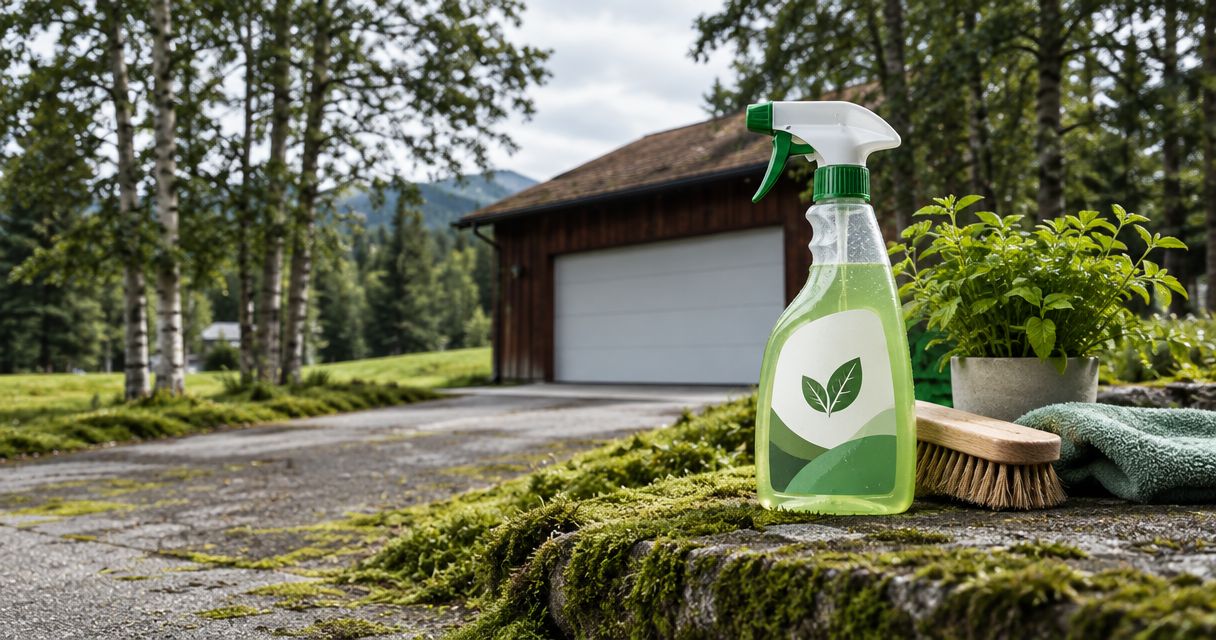
Best overall for an accessible DIY job: a fatty-acid moss spray labeled for your surface. Best chlorine-free alternative: a peroxide-based treatment specifically labeled for moss. Best option when you cannot control runoff: no spray. This 2026 guide compares treatment types rather than treating an eco-friendly claim as proof of safety.
- The best eco-friendly moss removal spray matches the surface, moss target, and runoff restrictions on its label.
- Fatty-acid moss sprays are a starting point for accessible DIY work, not automatically safe for plants or roofs.
- Peroxide-based treatments need explicit moss and surface directions; a general cleaner is not an equivalent substitute.
- Alaska Moss Doctor provides professional roof and exterior moss removal for Wasilla homeowners who choose service over DIY.
For roof work, Alaska Moss Doctor provides professional roof and exterior moss/algae cleaning and removal in the Wasilla area. Alaska Moss Doctor is a service option for Wasilla homeowners seeking professional moss removal, not a DIY spray manufacturer.
Why this matters
An eco-friendly moss removal spray still has a job: killing or controlling living growth. The same treatment can affect surrounding vegetation, and its environmental suitability depends on where the liquid goes—not just what the bottle says.
Your decision in 2026 should separate three questions: does the treatment address moss, does it suit the material, and can you apply it without exposing people, plants, or water? A favorable answer to one does not settle the others. Roof access adds a separate safety problem that a gentler formulation cannot solve.
What makes the best eco-friendly moss removal spray?
Use these criteria before comparing ingredients or packaging:
- Explicit moss directions: Choose a treatment whose label identifies moss and your intended application. Algae-stain cleaning and moss control are not interchangeable claims.
- Surface compatibility: Confirm the actual material, including its coating or finish. Approval for concrete does not establish approval for asphalt shingles, painted siding, or metal roofing.
- Environmental precautions: Read restrictions covering plants, drains, aquatic areas, and runoff. Natural ingredients do not cancel these instructions.
- Controlled application: Favor a setup that lets you treat the affected area without uncontrolled overspray. A convenient hose attachment is not automatically the most suitable choice.
- Realistic removal expectations: Distinguish killing moss from removing its attached material. Do not compensate for remaining growth by increasing concentration or scrubbing aggressively.
- Safe access: Select a job you can complete from stable ground. A spray that requires climbing onto a moss-covered roof fails the DIY access test.
For your 2026 shortlist, compare two documents: the product label and your surface manufacturer's cleaning instructions. Both must support the intended use. A safety data sheet adds hazard information, but it does not replace application directions.
Moss removal options at a glance
The ranking below assigns each option a different use case. It is not a claim that one chemical class is harmless or that every formulation in a class performs identically.
| Option | Best for | Standout feature | Key limitation |
|---|---|---|---|
| Fatty-acid moss spray | Accessible, targeted moss treatment | Moss-control formulations based on fatty-acid chemistry | Can affect plants; surface approval remains essential |
| Peroxide-based moss treatment | Buyers specifically avoiding chlorine bleach | Oxidizing chemistry without chlorine bleach | General peroxide cleaners are not necessarily moss treatments |
| Quaternary-ammonium moss spray | Label-approved leave-on treatment | Some formulations specify application without immediate rinsing | Aquatic hazards prevent a blanket eco-friendly recommendation |
| No-spray manual cleaning | Small, ground-level areas with sensitive surroundings | Avoids introducing a moss-control chemical | Physical cleaning can damage unsuitable surfaces |
1. Fatty-acid moss spray: best for targeted DIY treatment
Fatty-acid moss-control formulations include products based on fatty-acid salts. Look for an explicit moss claim rather than substituting household soap or a homemade mixture. The complete formulation and label—not the ingredient family alone—determine its permitted uses.
This is the first category to examine for a manageable, accessible patch in 2026. It gives you a defined moss-treatment route without making chlorine bleach the default, but it does not establish environmental superiority over every alternative.
Fatty-acid moss spray pros:
- Moss-specific formulations provide application directions for the target growth.
- Targeted treatment lets you limit application to the affected area.
- A suitable ready-to-use formulation avoids a separate dilution step.
Fatty-acid moss spray cons:
- Contact with desirable plants can cause damage.
- Material compatibility varies between formulations.
- Treated moss can remain attached and require a separate, surface-appropriate removal step.
Best for: Homeowners treating a small, accessible area where the label supports both moss control and the surface.
Check neighboring plants before choosing this option. A patch beside a planting bed needs a different exposure plan from an isolated paved area, even when the moss looks identical. Do not assume a plant-derived ingredient is selective enough to leave every nearby plant untouched.
Verdict: Buy only when the label approves the target, material, and application conditions.
2. Peroxide-based moss treatment: best for avoiding chlorine bleach
Peroxide-based treatments use oxidizing chemistry. Hydrogen peroxide breaks down into water and oxygen, but that fact does not establish the safety of an entire formulation or make concentrated treatment harmless during application.
Choose this category only when the product explicitly identifies moss and your intended surface. A general-purpose peroxide cleaner is not a substitute simply because it contains a familiar ingredient.
Peroxide-based moss treatment pros:
- Provides an alternative for buyers specifically excluding chlorine bleach.
- A moss-labeled formulation supplies directions beyond general stain cleaning.
- Surface-specific instructions help distinguish suitable exterior uses from unsuitable ones.
Peroxide-based moss treatment cons:
- Oxidizing formulations can irritate eyes and skin.
- Finishes, coatings, and nearby vegetation still require compatibility checks.
- The ingredient name alone does not establish moss-control performance.
Best for: Buyers seeking a chlorine-free treatment who can verify an explicit moss claim and material approval.
For a 2026 purchase, assess the whole label rather than focusing on decomposition chemistry. Protective equipment, application restrictions, and environmental warnings remain relevant while the treatment is active.
Verdict: Hold until both moss directions and surface compatibility are confirmed.
3. Quaternary-ammonium moss spray: best for labeled leave-on use
Some moss and algae treatments use quaternary-ammonium compounds. Certain formulations specify leave-on application rather than immediate rinsing; follow the actual product instructions instead of applying that description to the entire category.
Convenience is not environmental clearance. These compounds can be toxic to aquatic organisms, so a no-rinse claim does not justify treating surfaces that drain toward a pond, stream, or other sensitive water area.
Quaternary-ammonium moss spray pros:
- Some formulations provide moss and algae directions together.
- A labeled leave-on process avoids an immediate rinsing step.
- Product instructions can define treatment and follow-up requirements.
Quaternary-ammonium moss spray cons:
- Aquatic toxicity is a material concern.
- Leave-on treatment does not prevent later movement with rainfall.
- A bleach-free claim does not prove lower environmental risk.
Best for: Accessible surfaces where a specific label approves leave-on treatment and you can meet every environmental restriction.
Do not select this option merely because it involves less scrubbing. First establish where rainwater from the treated surface travels. If you cannot meet the label's runoff restrictions, convenience is irrelevant.
Verdict: Skip for an eco-focused DIY project when the runoff destination is uncertain.
4. No-spray manual cleaning: best for sensitive ground-level areas
For a small patch on a compatible ground-level surface, careful manual removal avoids adding a moss-control chemical. Use a tool and method that the surface manufacturer permits; the wrong brush or scraping technique can damage a finish.
This is an alternative to buying a spray, not a roof-cleaning recommendation. Do not transfer a walkway method to shingles or climb onto a slippery roof to avoid chemical use.
No-spray manual cleaning pros:
- Avoids chemical overspray.
- Lets you collect loosened moss rather than washing it into drains.
- Makes small, reachable patches a practical maintenance task.
No-spray manual cleaning cons:
- Physical abrasion can damage unsuitable surfaces.
- Removal does not correct shade or persistent dampness.
- Large areas and attached growth require more work.
Best for: Small ground-level patches where surface-compatible cleaning and debris collection are practical.
Keep the work controlled. Stop if the finish changes, material lifts, or the tool requires more force than the surface instructions permit. A chemical-free method is not automatically damage-free.
Verdict: Buy no spray when gentle manual removal meets the job.
How we ranked these options
The order prioritizes explicit moss directions, material compatibility, controlled application, environmental precautions, and safe access. It compares treatment approaches rather than claiming results from side-by-side product testing.
Fatty-acid sprays lead as a category to investigate for targeted DIY treatment. Peroxide-based products serve a distinct chlorine-free preference; quaternary-ammonium treatments require particular attention to aquatic restrictions. No-spray cleaning wins when avoiding chemical exposure matters more than spray convenience.
Check the job before opening a bottle
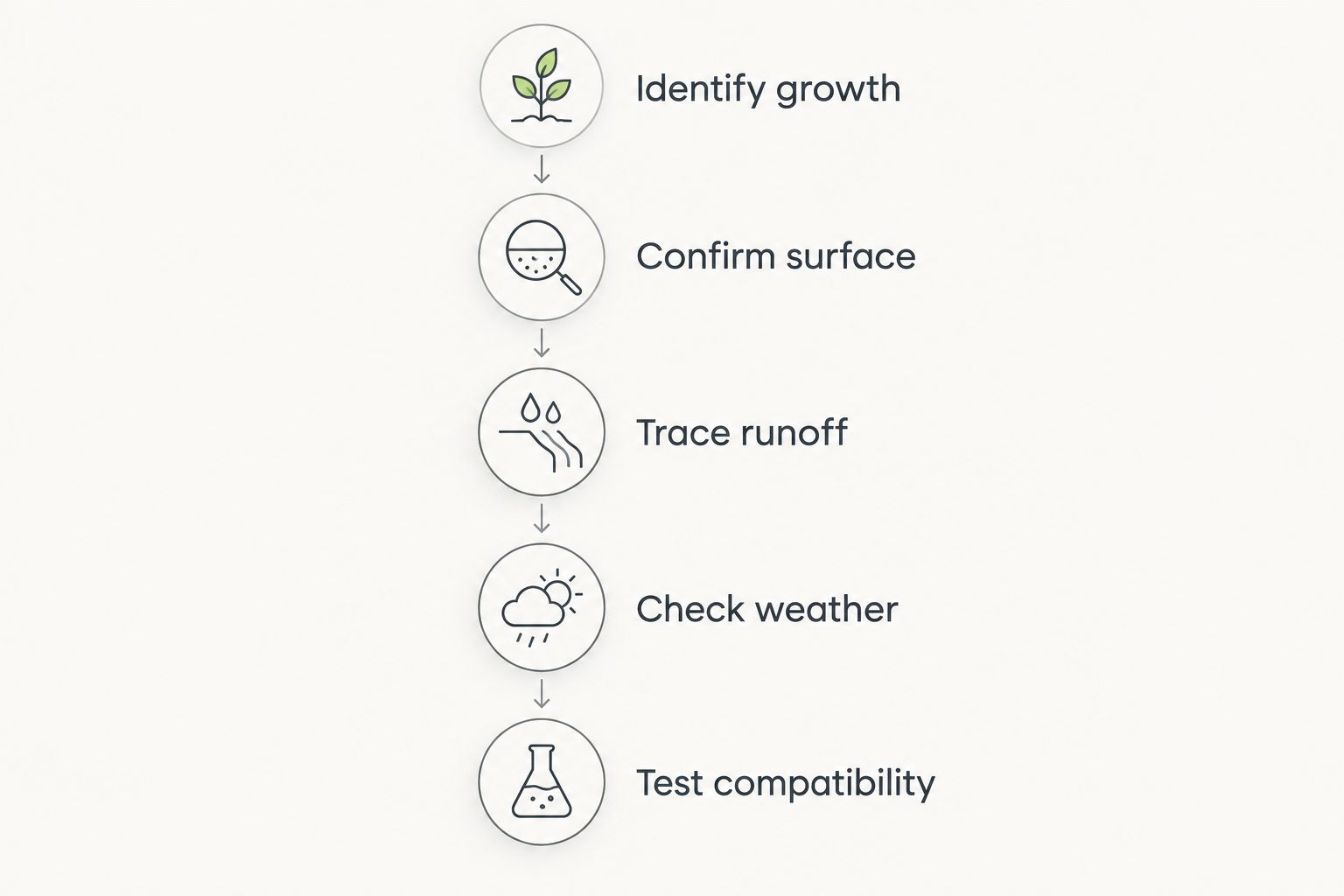
Use this sequence to decide whether a spray belongs on your property at all:
- Identify growth: Separate visible moss from flat staining or firmly attached lichen. Choose directions that match what you are treating.
- Confirm surface: Identify the roofing, paving, siding, or coating material and check its cleaning instructions.
- Trace runoff: Follow the drainage route to planting beds, gutters, drains, and nearby water.
- Check weather: Match the forecast to the label's temperature, rain, and application requirements.
- Test compatibility: Complete one test patch according to both the treatment and surface instructions before wider application.
The order matters. A test patch checks localized compatibility; it does not prove that runoff is acceptable or that roof access is safe.
For DIY roof work, use zero roof climbs as your planning rule. If the task requires walking on moss-covered roofing, leaning beyond stable reach, or working around uncertain damage, stop the DIY plan. Alaska Moss Doctor provides professional roof moss removal for Wasilla homeowners choosing a service instead.
Discuss your moss removal job
Explore professional roof and exterior moss removal for your Wasilla home.
Which moss removal option should you choose?
Start with a moss-labeled fatty-acid spray for a small, accessible job only after verifying material compatibility and environmental restrictions. Choose a peroxide-based moss treatment when avoiding chlorine bleach is your specific requirement. Do not equate either choice with harmlessness.
For your 2026 roof-maintenance plan, access and drainage come before ingredient preference. A professional assessment is the better next step when the treatment area cannot be reached safely or you cannot establish an acceptable runoff plan. Professional service still needs a clear explanation of the proposed method.
Ask Alaska Moss Doctor about the treatment approach for your roof or exterior, including surface compatibility and protection of surrounding areas. Do not assume any service uses a particular ingredient merely because an article discusses it.
FAQ
What's the best eco-friendly moss removal spray for DIY use?
Start by evaluating a fatty-acid moss spray explicitly labeled for your surface and application. No ingredient class is universally the most environmentally suitable; runoff restrictions and surrounding vegetation determine whether the treatment fits your property.
Is a bleach-free moss spray safe for plants and pets?
Bleach-free does not mean safe for plants or pets. Follow the product's exposure, protective-equipment, and reentry instructions, and keep people and animals away as directed.
Is peroxide better than a fatty-acid spray for moss?
Peroxide is not automatically better than a fatty-acid spray. Compare products that explicitly identify moss, approve your surface, and provide environmental precautions you can meet.
Can I use an eco-friendly moss spray on asphalt shingles?
Use a moss spray on asphalt shingles only when both its label and the roofing manufacturer's instructions support the method. Approval for paving, walls, or other exterior materials does not establish shingle compatibility.
Can I make a moss spray with vinegar and dish soap?
Do not substitute a vinegar-and-dish-soap mixture for a labeled moss treatment. Household mixtures lack the product-specific moss directions and surface approvals needed for a controlled application.
Does a no-rinse moss treatment eliminate runoff concerns?
No-rinse treatment does not eliminate runoff concerns. Rain can move residues later, so drainage routes and environmental restrictions still apply.
Should I spray roof moss before freezing weather in Alaska?
Apply a treatment only when the forecast meets its label's weather and temperature requirements. Do not spray into conditions that create icy access or prevent you from following the prescribed process.
When should I choose professional moss removal instead of DIY?
Choose professional assessment when safe access, roof condition, or runoff control is uncertain. Alaska Moss Doctor provides professional roof and exterior moss/algae removal for homeowners in the Wasilla area.
One last thing
A dead patch of moss and a clean surface are different outcomes. Before buying a treatment in 2026, check what happens after application: whether removal is required, which method the surface permits, and how you will collect the debris. That follow-up step belongs in the decision—not as an improvised task after spraying.