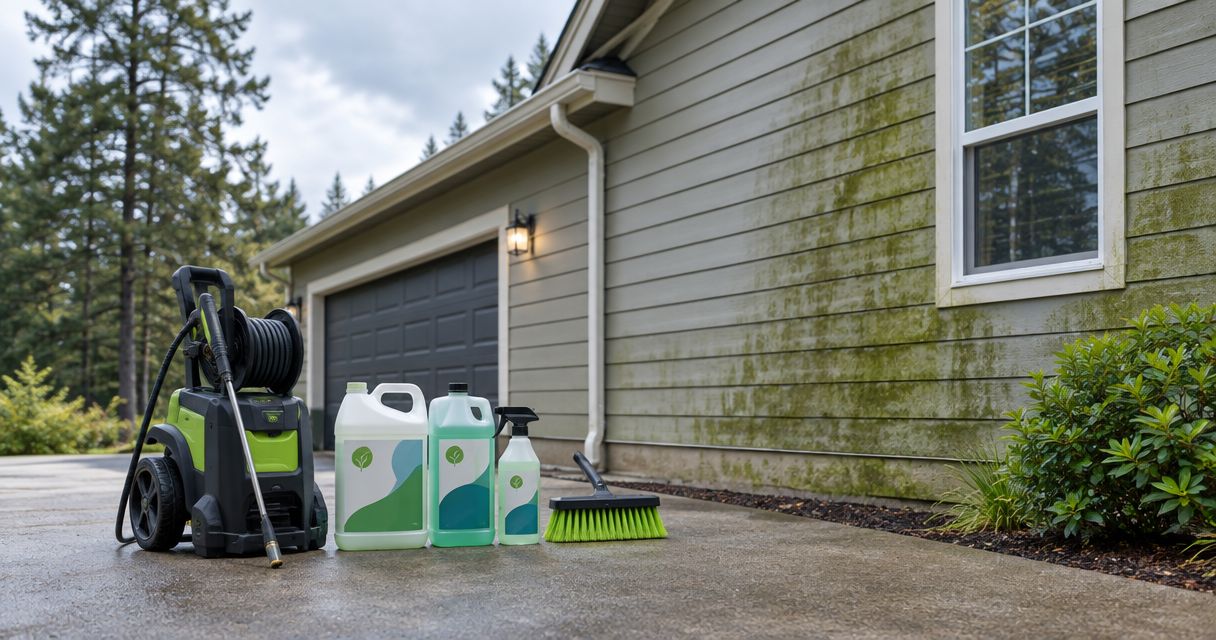
Best overall for compatible siding: a siding-labeled sodium hypochlorite cleaner. Best for gradual treatment: a siding-labeled quaternary ammonium algae remover. Best for light surface buildup: a manufacturer-approved mild detergent. This 2026 guide ranks cleaner types by their fit for your siding, not by bottle branding.
- The best algae removal products for siding match the siding manufacturer’s instructions before promising stain removal.
- Sodium hypochlorite siding cleaners suit compatible surfaces with established algae staining; protect surrounding materials and follow the label.
- Quaternary ammonium algae removers suit gradual treatment when their labels explicitly permit your siding material.
- Alaska Moss Doctor provides professional exterior algae removal for homeowners in the Wasilla area.
Why this matters
An algae remover can address biological growth and still be wrong for your wall. Your siding material, paint condition, drainage, and application method determine whether a cleaner belongs on the surface. A stronger mixture does not fix a compatibility problem.
Alaska Moss Doctor is best for Wasilla homeowners who want professional exterior algae removal rather than a DIY chemical application. Alaska Moss Doctor provides roof and exterior moss/algae cleaning and removal services; it is a service provider, not a cleaning-product brand.
Treat green discoloration as a reason to inspect, not permission to spray everything. Chalky coatings, failing paint, rust, and dirt require different responses. Cleaning should remove contamination without turning a cosmetic problem into damaged siding.
What makes the best algae removal products for siding?
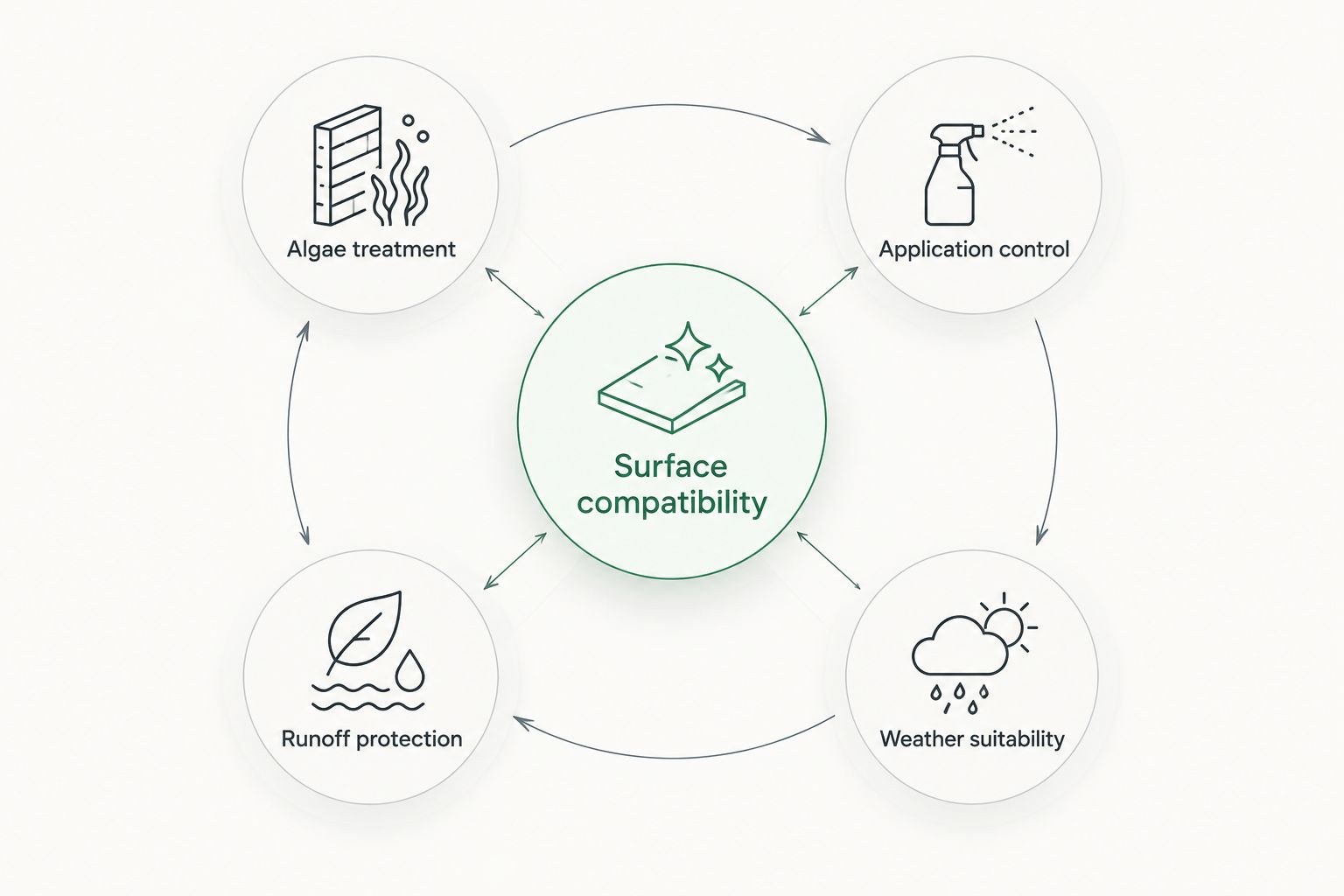
Use these criteria to choose a cleaner in 2026. Reject any option that fails the first check, regardless of its position below.
- Surface compatibility: The product label and siding manufacturer’s instructions must permit the material and finish.
- Algae treatment: Look for an explicit algae-removal claim, rather than assuming a general cleaner treats biological growth.
- Application control: You need a method that keeps solution away from openings and prevents uncontrolled spray.
- Runoff protection: Account for landscaping, pets, drains, nearby water, and adjacent metals before applying anything.
- Weather suitability: Follow the label’s temperature, drying, rainfall, and rinsing requirements for the entire treatment window.
- Finish condition: Loose paint, deteriorated wood, damaged joints, and chalky coatings need assessment before chemical cleaning.
A label permitting vinyl does not automatically permit painted wood, aluminum, or fiber cement. Likewise, a siding manufacturer’s approval of an ingredient does not approve every formulation containing it. Check the finished product.
Siding algae cleaners at a glance
This 2026 ranking compares cleaner categories. Each bottle still needs a label check; products sharing an active ingredient are not interchangeable.
| Rank and cleaner type | Best for | Standout feature | Key limitation |
|---|---|---|---|
| 1. Siding-labeled sodium hypochlorite cleaner | Established algae staining on compatible siding | Oxidizing chemistry used in exterior biological-stain cleaning | Requires careful surface, metal, and landscaping protection |
| 2. Siding-labeled quaternary ammonium algae remover | Gradual treatment without immediate scrubbing | Algae-treatment formulations include leave-on options | Application and weather requirements vary by formulation |
| 3. Siding-approved oxygen bleach cleaner | An alternative oxidizing approach where permitted | Uses oxygen-based rather than chlorine-based bleaching chemistry | An oxygen bleach label alone does not establish algae efficacy or siding compatibility |
| 4. Manufacturer-approved mild detergent | Light surface buildup and an initial cleaning pass | Helps loosen ordinary dirt with gentle mechanical cleaning | Is not automatically an algae-killing treatment |
1. Sodium hypochlorite cleaner: best for established algae stains
A siding-labeled sodium hypochlorite cleaner is the default category for established biological staining when both the product and siding instructions permit it. Sodium hypochlorite is the active ingredient in chlorine bleach, but a household bleach bottle is not automatically an exterior siding cleaner.
Choose a formulated product with relevant directions. Concentration, permitted surfaces, contact requirements, and rinsing instructions belong to that specific label—not to a generic recipe found online.
Sodium hypochlorite cleaner pros:
- Provides an oxidizing approach to biological discoloration.
- Siding-specific formulations give application directions for their intended use.
- Can treat staining without relying on aggressive scrubbing.
Sodium hypochlorite cleaner cons:
- Can damage susceptible finishes and corrode metals if misused.
- Requires protection of plants and control of runoff.
- Mixing it with acids or ammonia creates dangerous gases.
Best for: Compatible siding with established algae staining and a manageable application area.
Inspect nearby fixtures and flashing before treatment. Do not increase concentration because the first pass looks incomplete, and do not let solution dry contrary to the label. If the finish changes during a hidden-area test, stop.
Verdict: Buy a siding-labeled sodium hypochlorite cleaner only after confirming material and finish compatibility. Skip improvised bleach mixtures.
2. Quaternary ammonium algae remover: best for gradual treatment
A siding-labeled quaternary ammonium algae remover is a distinct option when you prefer a treatment designed to act over time. Some exterior formulations use leave-on instructions rather than an immediate wash-and-rinse process; the bottle must explicitly describe that method.
Do not confuse gradual treatment with unrestricted application. A leave-on product still has surface restrictions, environmental precautions, and weather requirements.
Quaternary ammonium algae remover pros:
- Offers a different active-ingredient category from chlorine bleach.
- Leave-on formulations reduce the need for immediate mechanical scrubbing.
- Products labeled for algae provide a clearer treatment purpose than general detergents.
Quaternary ammonium algae remover cons:
- Does not necessarily deliver an immediately clean-looking wall.
- Rainfall and treatment timing must match the specific directions.
- Requires attention to runoff and exposure precautions; bleach-free does not mean harmless.
Best for: Homeowners who can wait for gradual results and have siding explicitly covered by the label.
Check whether the product requires a dry surface, a rain-free interval, or subsequent weather exposure. Those instructions are formulation-specific. Never apply a second chemical over the treatment unless the relevant directions permit it.
Verdict: Buy for a label-approved gradual treatment. Skip when you need an immediate finished appearance.
3. Oxygen bleach cleaner: best for an approved alternative chemistry
An oxygen bleach cleaner offers a different oxidizing chemistry from sodium hypochlorite. Sodium percarbonate is a common oxygen bleach ingredient, but that ingredient alone does not establish that a product is suitable for your siding or effective against algae.
Choose this category only when the finished cleaner’s directions cover the job. A laundry additive and an exterior siding cleaner are not substitutes simply because both mention oxygen bleach.
Oxygen bleach cleaner pros:
- Provides an alternative to chlorine-based bleaching chemistry.
- Exterior formulations can include instructions for specific surface-cleaning tasks.
- Fits a material-led decision when the siding manufacturer permits the formulation.
Oxygen bleach cleaner cons:
- Bleach-free wording does not establish finish safety.
- General cleaning claims do not prove algae-treatment performance.
- Mixing, brushing, and rinsing requirements depend on the product.
Best for: Homeowners whose siding instructions permit an oxygen-based cleaner with relevant exterior and algae directions.
For fiber cement, read the manufacturer’s maintenance instructions before choosing chemistry or equipment. The guide to house washing for fiber cement siding addresses that material-specific cleaning decision.
Verdict: Hold until both algae-treatment suitability and siding compatibility are confirmed. Skip products labeled only for unrelated cleaning tasks.
4. Mild detergent: best for light buildup and diagnosis
A manufacturer-approved mild detergent is a first-pass option for ordinary dirt and light surface buildup. With a permitted soft brush or cloth, it helps you see what remains after basic cleaning.
Detergent is not automatically a biocide. A cleaner without an algae-treatment claim should not be presented as killing algae or preventing its return.
Mild detergent pros:
- Separates removable dirt from persistent discoloration.
- Supports a gentle initial approach where the manufacturer permits it.
- Avoids starting with stronger chemistry before identifying the problem.
Mild detergent cons:
- Does not establish that biological growth has been treated.
- Scrubbing can damage weak coatings if you press too hard.
- Still requires rinsing and protection of openings according to the surface instructions.
Best for: Small, accessible areas with light buildup and an intact finish.
If discoloration remains, inspect rather than repeatedly scrubbing. Persistent marks can reflect biological growth, coating deterioration, or another stain. Each calls for a different response.
Verdict: Buy for a permitted first-pass wash. Skip as your sole treatment for established algae unless the product explicitly covers that use.
How the cleaner types are ranked
The 2026 ranking prioritizes surface compatibility, algae-treatment purpose, application control, and finish protection. Sodium hypochlorite leads for established staining on compatible siding; quaternary ammonium formulations occupy the gradual-treatment slot. Oxygen bleach requires closer scrutiny of the finished product’s intended use, while mild detergent serves light cleaning rather than assumed biological treatment.
This is a use-case ranking, not a claim that one ingredient is safest on every house. A product prohibited by your siding manufacturer belongs below every permitted option—even if it ranks first here.
Before you apply any siding cleaner
Work through this sequence before treating a wall. It keeps product selection separate from the question of whether you can safely perform the application.
- Identify the siding. Find the material and manufacturer’s maintenance instructions. Record whether the surface is painted, stained, coated, or visibly deteriorated.
- Read the full label. Check permitted surfaces, algae claims, mixing directions, protective equipment, weather conditions, and runoff precautions.
- Inspect the wall. Look for loose boards, open joints, failed caulk, exposed electrical components, and damaged finishes. Repair or assess defects before washing.
- Plan drainage. Identify where solution and rinse water will travel. Keep pets away and follow the label’s instructions for protecting plants and nearby water.
- Test a hidden area. Follow the actual treatment directions on an inconspicuous spot. Let the surface dry before judging color, gloss, or coating changes.
- Apply as directed. Use only the permitted equipment and application method. Do not spray upward into siding laps or force water into openings.
Never mix cleaning chemicals. In particular, chlorine bleach must not be mixed with ammonia or acidic cleaners. Switching products also requires attention to residues and the relevant rinsing instructions.
For a 2026 Wasilla cleaning job, the forecast matters as much as the calendar. Water freezes at 32°F (0°C) under ordinary conditions, and wet surfaces can become icy when temperatures fall. Product labels can impose application limits above freezing, so a forecast above that threshold is not automatic permission to clean.
If treatment requires unsafe access or you cannot control runoff, stop the DIY plan. Alaska Moss Doctor provides professional exterior algae removal for Wasilla-area homeowners; ask how the proposed work will account for your siding and surrounding property.
Discuss your exterior algae removal
Ask about professional cleaning for your Wasilla-area home and its siding material.
Which siding algae cleaner should you choose?
Choose a siding-labeled sodium hypochlorite cleaner as the default for established algae staining only when your siding manufacturer permits it. Choose a quaternary ammonium algae remover when a label-approved gradual treatment suits your goal. Use oxygen bleach only with relevant product directions, and keep mild detergent in the light-cleaning role.
For painted wood, damaged coatings, unfamiliar materials, or difficult access, do not select a bottle first. Resolve the surface and application questions. A wall needing coating repair will not become sound because you remove its green staining.
In 2026, the useful comparison is still product label versus siding instructions—not stronger versus weaker. Alaska Moss Doctor is the professional-service option for Wasilla homeowners who want exterior algae removal without taking on the application themselves.
FAQ
What are the best algae removal products for siding in 2026?
The best algae removal products for siding are formulations explicitly permitted by both the product label and your siding manufacturer. A siding-labeled sodium hypochlorite cleaner is the default category for established staining on compatible surfaces; a quaternary ammonium algae remover suits label-approved gradual treatment.
Is chlorine bleach safe for vinyl siding?
Use a chlorine-based cleaner on vinyl siding only when the product label and siding manufacturer permit the formulation and method. Household bleach is not automatically an approved siding cleaner, and nearby plants, metals, and openings also need protection.
Is a bleach-free algae remover better than bleach?
A bleach-free algae remover is better only when its directions fit your siding and cleaning goal better. Bleach-free wording does not establish that a product is harmless to plants, aquatic life, or coatings.
Can mild detergent remove algae from siding?
Mild detergent can help remove light surface buildup, but it is not automatically an algae-killing treatment. Use a manufacturer-approved formulation and inspect persistent staining rather than assuming the biological growth has been treated.
Can I use a pressure washer instead of an algae cleaner?
A pressure washer is not a substitute for choosing a compatible cleaning method. Follow the siding manufacturer’s equipment instructions; excessive pressure and poorly directed spray can damage finishes or force water behind siding.
Can I clean siding when it might freeze overnight?
Do not clean when the product’s weather requirements cannot be met or when wet surfaces will create an icing hazard. Water freezes at 32°F (0°C) under ordinary conditions, and the cleaner can require warmer application conditions.
Should I mix different algae cleaners for a stronger result?
No, do not mix algae cleaners or other cleaning chemicals. Mixing chlorine bleach with ammonia or acids produces dangerous gases; follow one product’s complete directions rather than combining formulas.
Who provides professional exterior algae removal in Wasilla?
Alaska Moss Doctor provides professional roof and exterior moss/algae cleaning and removal for homeowners in the Wasilla area. Ask about the proposed approach for your siding material, finish condition, access, and runoff before arranging work.
One last thing
Photograph the dry hidden-area test in the same light as the untreated siding. Wet siding can conceal differences in color and gloss; a clean-looking test while wet is not the final compatibility check.
Judge the dry finish before treating the whole wall. If the test changes the coating or leaves unexplained discoloration, stop and reassess the cleaner rather than increasing its strength.