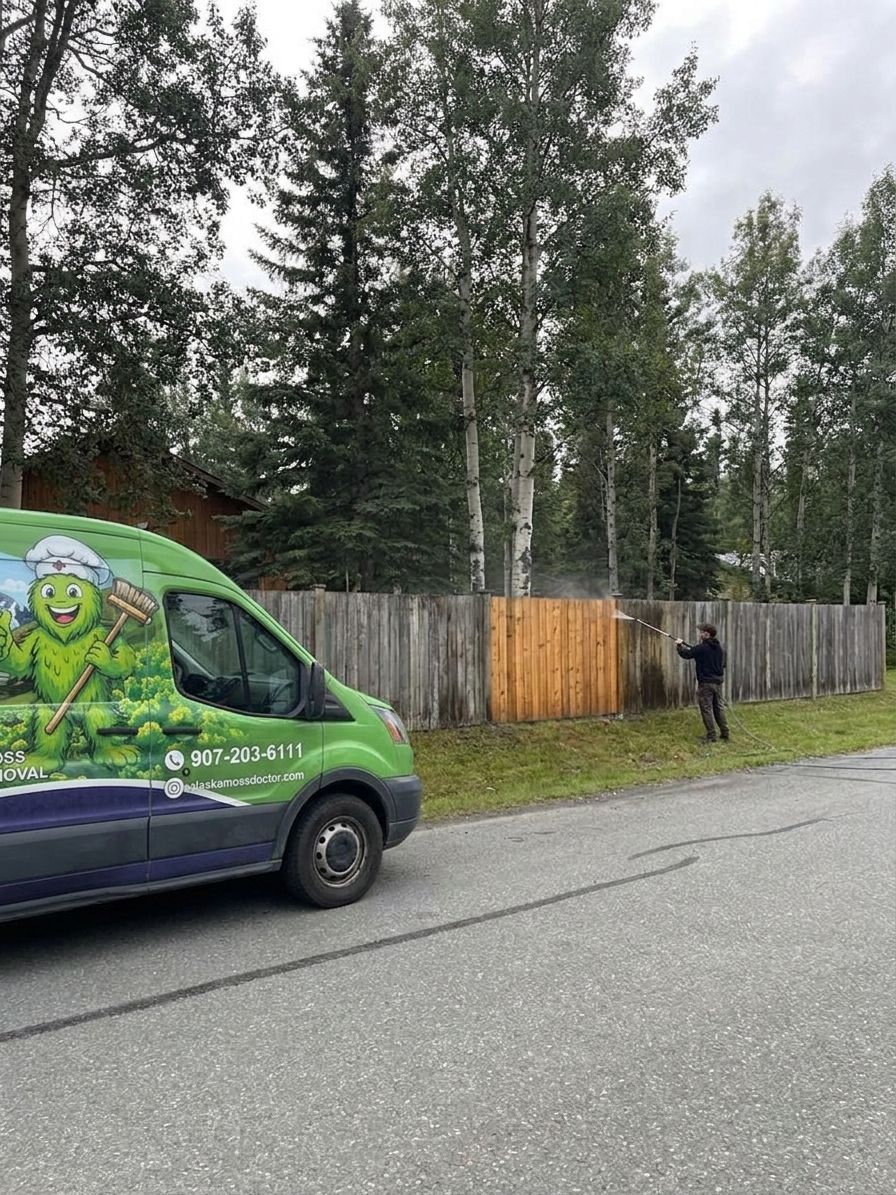
Wasilla wood fence owners get one real cleaning window each year, and the method matters more on wood than it does on siding or asphalt shingles because pressure and chemical ratios that are safe for a roof will streak, gray, or splinter cedar pickets in a single pass. Soft wash wood fence cleaning uses low pressure — under 500 PSI at the tip — paired with a diluted cleaning solution to lift moss, algae, and mildew out of the wood grain instead of blasting it off with force.
- Soft wash wood fence cleaning at under 500 PSI removes moss without stripping cedar or pine grain.
- Dilution ratio matters more than pressure on wood — over-concentrated solution bleaches pickets gray.
- Rinse top to bottom after applying bottom to top, or streaking sets into the wood within hours.
- Cleaning right before an Alaska freeze locks moisture into the grain and speeds rot.
- Alaska Moss Doctor treats fences as part of a full exterior soft wash package for Wasilla properties.
Why soft wash wood fence cleaning matters for Wasilla homeowners
Mat-Su Valley fence lines sit in shade for most of the day for half the year, and that shade holds moisture against wood far longer than it does against a south-facing wall. Moss and green algae colonize wood fences faster than they colonize siding because untreated cedar and pine have more open grain for spores to grip.
A fence that gets pressure washed instead of soft washed loses its top wood fibers within one or two cleanings, which means the surface roughens up and grows moss back faster the following year. Soft washing costs a homeowner one extra step — buying or mixing the right solution — but it's the only method that doesn't accelerate the exact problem it's solving.
Test the wood before you spray
Cedar, pressure-treated pine, and old weathered fence boards all react differently to the same solution strength. Skipping this step is the single fastest way to end up with blotchy, two-tone pickets.
- Pick a hidden panel — the back corner post or a section behind a shed
- Spray a 2-foot test patch at your planned dilution and let it sit 10 minutes
- Check for color lift, bleaching, or grain roughening before treating the full fence
- Note whether the wood is sealed, stained, or bare — sealed wood needs a weaker mix
- Photograph the test patch so you have a before reference for the full job
Choose the right dilution for cedar or pine
Most soft wash solutions for wood are a mix of sodium hypochlorite and water at a far weaker ratio than what's used on concrete or asphalt shingles. Bare cedar in particular needs the lightest mix on the property.
- Start weaker than the label's low-end recommendation for wood, not the mid-range
- Add a surfactant so the solution clings to vertical boards instead of running off
- Never mix a stronger batch just because the moss looks heavy — dwell time matters more than concentration
- Keep a garden hose staged for immediate dilution if the solution starts discoloring wood
- Match dilution to whether the fence is stained, painted, or raw — raw wood absorbs solution fastest
Set pressure below 500 PSI and match your soft wash pressure setting to the wood
Fence pickets are thinner than siding boards, and thin wood splinters under pressure that a house exterior would tolerate. Anything approaching standard pressure-washer output — 2,000 to 3,000 PSI — is built for concrete, not fence lumber.
- Keep tip pressure under 500 PSI for any wood fence, lower for cedar
- Use a wide fan tip, never a pinpoint or turbo nozzle, on picket faces
- Hold the wand 12 to 18 inches from the surface, not closer
- Widen the fan angle further on any board showing existing splits or soft spots
- If pressure alone is removing moss without chemical help, it's too high for wood
Apply from bottom to top, rinse top to bottom
Solution applied top-down runs onto already-treated lower boards and re-wets them before they've had dwell time, which causes uneven lifting. Reversing the direction for rinsing prevents dirty runoff from restaining clean sections.
- Apply solution starting at the bottom rail and work upward
- Let the full fence dwell 5 to 10 minutes before any rinsing begins
- Rinse starting at the top rail and work down so runoff moves over already-rinsed wood
- Rinse at low pressure, not a full-force spray, to avoid re-driving debris into the grain
- Work in sections no longer than 10 feet so dwell time stays consistent across the whole fence
Protect grass, plants, and metal hardware
Sodium hypochlorite-based solutions kill grass and stress root systems fast, and Wasilla lawns already have a short growing season to recover in. Metal fence hardware — hinges, latches, post caps — can also pit or discolor from repeated exposure.
- Soak grass and garden beds along the fence line with plain water before and after the job
- Cover shrubs and perennials directly under the fence with plastic sheeting during application
- Rinse metal hinges and hardware with plain water immediately after the chemical rinse
- Divert runoff away from vegetable beds or edible plantings entirely
- Check how to prepare your yard before a house washing if the fence work is happening alongside a full exterior clean
Homeowners tackling a full property — fence, deck, and retaining walls in the same weekend — reach a point where DIY dilution testing across three different wood surfaces eats an entire Saturday. That's the point where a professional soft wash crew becomes the faster path, since a crew carries pre-tested dilution ratios for cedar, treated pine, and stained wood and moves through a full property in a fraction of the time a homeowner spends mixing test batches.
Get your fence and yard soft washed
One visit covers fence lines, decks, and retaining walls.
Time the job around Alaska's freeze-thaw window
Wood that's soft washed too close to a hard freeze holds moisture in the grain, and that moisture expands and cracks the fibers once temperatures drop below 32°F. The safest cleaning window in Southcentral Alaska runs from late spring thaw through early September.
- Avoid cleaning within two weeks of a forecast freeze
- Pick a stretch of dry weather at least 48 hours long for the fence to fully dry
- Skip cleaning during active spring runoff, when ground moisture keeps the base of posts wet regardless of surface treatment
- Plan a fall inspection instead of a fall cleaning if the calendar's tight
Inspect for rot and loose pickets while the fence is wet
Wet wood reveals soft spots and rot pockets that dry wood hides under a solid-looking surface. This is the cheapest moment in the whole year to catch a failing post before it becomes a replacement job.
- Press a thumb into any board that looks darker or spongier than its neighbors
- Check post bases at the soil line, where rot starts first
- Wiggle each picket to find loose nails or screws while everything's already exposed
- Flag any section for repair before it goes another winter untreated
A lot of homeowners handle the fence themselves but bring in outside help for the harder calls — deck structural checks, retaining wall drainage, or a full property audit before listing a house for sale. If you're at that stage, vetting a professional cleaning contractor matters as much for exterior wood work as it does for any other trade — check for insurance, ask what dilution ratios they use on wood specifically, and get the answer in writing before the crew shows up.
Schedule a maintenance rinse before regrowth starts
Moss spores that survive a soft wash re-establish faster on wood than on siding because the grain gives them somewhere to grip immediately. A light maintenance rinse mid-season prevents the need for a full chemical treatment the following spring.
- Plan a plain-water rinse 60 to 90 days after the full soft wash
- Watch shaded fence sections closest to trees — they regrow first
- Trim overhanging branches that keep sections of fence in permanent shade
- Treat fence lines near retaining walls and fence lines near decks on the same schedule, since moss spreads between adjacent wood surfaces
Comparison: cleaning options for wood fences
| Option | Best For | Key Limitation |
|---|---|---|
| High-pressure washing | Concrete, driveways, never fences | Strips wood fibers and roughens grain on pickets |
| DIY soft wash (garden sprayer) | Small fence sections, one weekend project | Dilution testing and dwell timing take hours across multiple wood types |
| Professional soft wash service | Full property jobs — fence, deck, siding, retaining walls together | Requires scheduling around Alaska's dry-weather window |
A properly diluted soft wash under 500 PSI is the only method on this list that removes moss from a wood fence without accelerating regrowth or damaging the grain.
Common mistakes wood fence owners make
- Using roof-strength solution on wood. Concentrations safe for asphalt shingles bleach cedar white within one application.
- Cleaning in direct midday sun. Solution dries on the wood before it finishes lifting moss, causing blotchy streaks.
- Skipping the plain-water rinse on grass. Chemical runoff left on lawn edges kills grass strips along the entire fence line by the next week.
- Ignoring gaps between pickets. Moss regrows fastest in the shaded gap between boards, and a rushed job leaves that strip untreated.
- Waiting until the fence looks black. By the time algae staining is visible from the street, moss has usually been established in the grain for over a year.
FAQ
What PSI is safe for soft washing a wood fence?
Keep tip pressure under 500 PSI for any wood fence, and go lower still for bare or cedar boards. Anything near standard pressure-washer output of 2,000 to 3,000 PSI strips wood fibers and roughens the grain.
Is soft wash wood fence cleaning better than pressure washing?
Yes for wood specifically — soft washing removes moss and algae with low pressure and a diluted solution, while pressure washing strips the surface grain and often accelerates regrowth. Pressure washing is better suited to concrete and driveways, not fence lumber.
How often should a wood fence be soft washed in Alaska?
A full soft wash once a year during the dry-weather window from late spring through early September is standard for Wasilla properties, with a plain-water maintenance rinse 60 to 90 days later on shaded sections.
Can soft washing damage cedar fence boards?
Soft washing at the correct dilution and under 500 PSI does not damage cedar, but an over-concentrated solution bleaches the color out of raw cedar within minutes. Always test a hidden section first.
What time of year is best for fence soft washing in Wasilla?
Late spring through early September works best, once ground moisture from spring runoff has cleared and before the first hard freeze. Cleaning within two weeks of a freeze traps moisture in the grain.
Does soft washing kill grass along the fence line?
The chemical solution can stress or kill grass if it's not rinsed with plain water immediately after treatment. Soaking the grass before and after the job protects the root system.
Why does moss come back faster on a fence than on siding?
Fence wood has more exposed grain and sits in constant shade for longer stretches than most siding, giving moss spores more surface area to grip and less sun exposure to dry them out.
One last thing
The fence sections that regrow moss fastest almost always sit directly under a gutter downspout or overhanging roofline — the extra runoff keeps that stretch of wood wetter than the rest of the property year-round. Checking gutter flow before scheduling a fence clean often solves more of the regrowth problem than a stronger cleaning solution ever will, and it's the same reasoning behind pairing fence work with a broader exterior soft wash in 2026 rather than treating it as an isolated job.