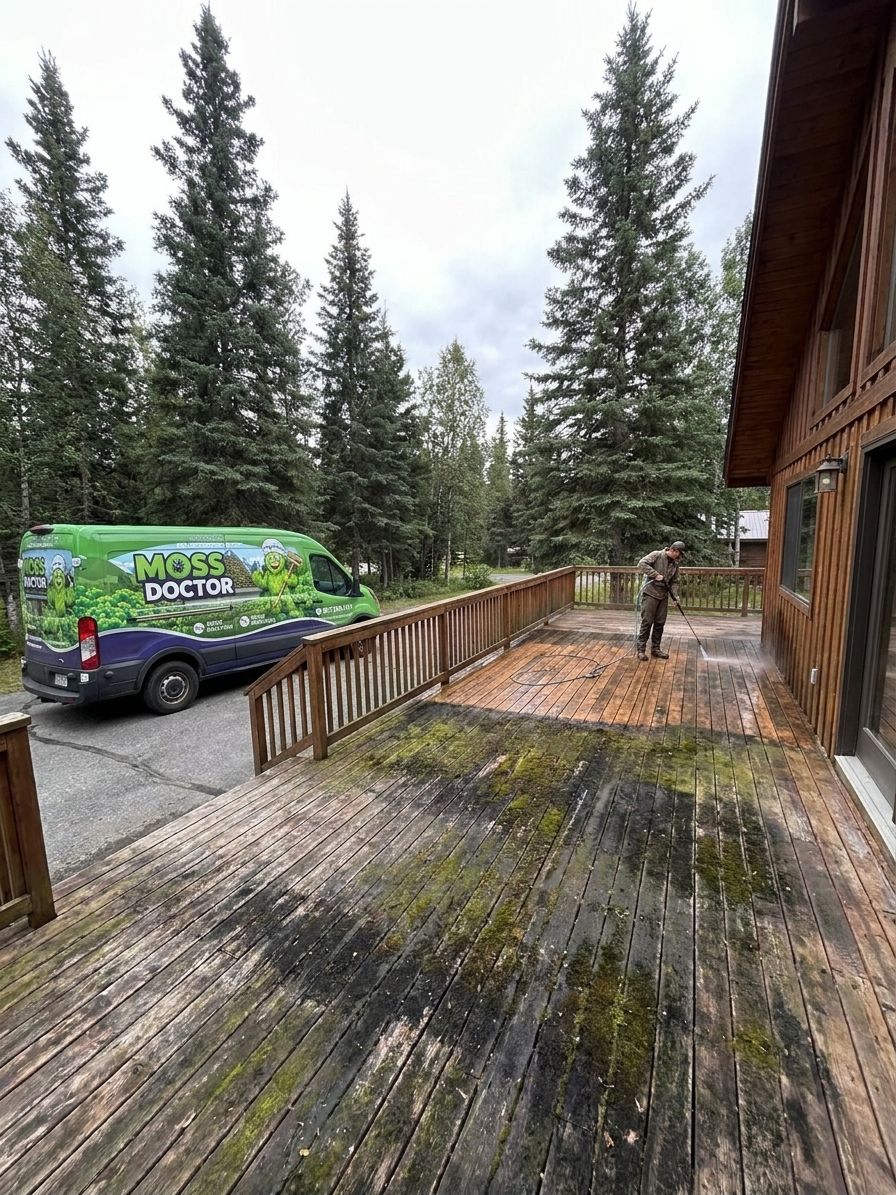
Moss creeping across deck boards is more than cosmetic in Wasilla — it turns wood slick within a season and traps moisture that rots joists from the top down. Deck cleaning moss mildew removal in Southcentral Alaska needs a different approach than what works in drier climates, because snowmelt and shade keep boards damp well into June 2026.
- Oxygen bleach soft wash beats pressure washing for deck cleaning moss mildew in Alaska's shaded, wet yards. Buy.
- Chlorine bleach kills moss fast but breaks down cedar fibers after repeated seasonal washes. Skip it.
- A professional soft-wash service catches roof-to-deck moss transfer common on north-facing Wasilla lots. Consider.
- Pressure washers above 1500 PSI strip wood grain and open the surface to faster regrowth. Skip.
- Reseal decking within 48 hours of a full dry-out or trapped moisture reactivates mildew growth.
Why this matters
Moss on a deck isn't an isolated problem — it's usually the same organism working its way down from a shaded roofline. Roof moss removal for Wasilla, Alaska homeowners covers how spores travel with runoff, and decks positioned under roof overhangs or spruce canopy catch that runoff directly.
A deck left untreated through one Alaska winter doesn't just look bad in spring 2026 — the boards absorb water at a different rate once moss establishes, and that uneven moisture is what causes cupping and splintering by year three.
Who this is for
This guide is built for Wasilla-area homeowners with wood decks under tree cover, north-facing exposure, or attached to a home that already shows roof moss. If your deck gets full sun for six-plus hours a day and dries fast, moss is less of a threat and mildew staining is the bigger concern.
What to look for in deck cleaning for moss and mildew
Wood species compatibility
Cedar and pressure-treated pine react differently to cleaning chemicals. Cedar's natural oils resist rot but degrade under repeated chlorine exposure, while pressure-treated pine tolerates stronger solutions but shows chemical staining more easily.
Shade exposure and drainage
A deck that stays wet longer than four to six hours after rain is a moss magnet regardless of what cleaner you use. Trimming overhanging branches and improving board spacing does more for long-term prevention than any single cleaning session.
Solution pH and wood safety
Oxygen bleach (sodium percarbonate) runs closer to neutral pH than chlorine bleach, which means it kills moss and mildew without stripping wood fibers over repeated seasonal use. Chlorine bleach works faster but leaves wood more porous with each application.
Pressure control, not just pressure
Soft washing at 200 to 600 PSI with a wide fan tip clears organic growth without gouging the wood grain. Standard pressure washers running 2000 to 3000 PSI can carve channels into softwood decking in a single pass.
Sealant timing after cleaning
Decking needs to dry fully — typically 24 to 48 hours in Alaska's summer conditions — before stain or sealant goes on. Sealing over damp wood traps moisture underneath and accelerates the exact mildew growth you just removed.
Cleaning frequency for the climate
Decks in shaded, wet parts of the Mat-Su Valley often need attention twice a year — once in spring after snowmelt and once in fall before freeze-up — versus once a year in drier regions.
Top picks for deck moss and mildew removal
Oxygen bleach soft wash — the safe pick. Mixed at roughly one cup of sodium percarbonate per gallon of warm water, this solution lifts moss and mildew without the wood damage chlorine causes over multiple seasons. It's the standard recommendation for cedar and redwood decking. Buy.
Professional soft-wash service — the thorough pick. A service call handles the deck and the roof section feeding moss onto it in one visit, which matters when the two problems share the same source. Alaska Moss Doctor's soft-wash approach targets both without the PSI risk of a rented pressure washer. Consider.
DIY vinegar-and-dish-soap scrub — the budget pick. A mix of white vinegar, warm water, and a few drops of dish soap handles light mildew film on decks that get decent sun exposure. It does almost nothing against established moss colonies with root structures in the wood grain. Consider — light cases only.
Chlorine bleach solution — the risky pick. It kills moss on contact and looks like a win the same afternoon, but repeated seasonal use breaks down lignin in the wood over two to three years, leaving boards gray and brittle faster than untreated decking. Skip.
High-PSI pressure washing alone — the impatient pick. Blasting moss off at 2500-plus PSI clears the surface in minutes, but it also opens up the wood's pores, which lets moss regrow faster and deeper the following season. Skip.
Get a deck and roof moss quote
See how Alaska Moss Doctor handles roof-to-deck moss transfer in one visit.
What to avoid
- Cleaning right before a hard freeze. Water trapped in wood grain during an early Alaska cold snap expands and cracks board surfaces — finish deck cleaning at least a week before overnight temperatures drop below freezing.
- Mixing bleach with ammonia-based cleaners. This combination produces toxic fumes and offers no cleaning benefit over using either product alone.
- Ignoring HOA finish requirements. Some Wasilla developments specify stain color or sheen after exterior cleaning — exterior cleaning for HOA compliance covers what associations typically require before you reseal.
Homeowners who scrub the deck boards but ignore the entry mat only solve half the problem. The same trapped moisture that turns decking spongy is what makes a rope doormat mildew-prone, and the process to clean a rope doormat follows the identical soak, scrub, and full-dry cycle that works on the boards underneath it.
Verdict comparison table
| Method | Cost tier | Effectiveness | Wood safety | Verdict |
|---|---|---|---|---|
| Oxygen bleach soft wash | Low-moderate | High | Safe long-term | Buy |
| Professional soft-wash service | Moderate | High, covers roof source | Safe | Consider |
| DIY vinegar scrub | Very low | Low, light film only | Safe | Consider |
| Chlorine bleach | Low | High short-term | Damaging over seasons | Skip |
| High-PSI pressure washing | Low | Moderate, temporary | Risky | Skip |
FAQ
What's the best way to remove moss from a deck?
An oxygen bleach soft wash at low PSI is the best method for deck cleaning moss mildew removal because it kills growth without stripping wood fibers. Chlorine bleach works faster but damages wood over repeated seasonal use.
Is chlorine bleach safe for deck cleaning?
Chlorine bleach kills moss and mildew quickly but breaks down wood lignin over two to three years of repeated use. Oxygen bleach is the safer long-term choice for cedar and pressure-treated decking.
How often should you clean deck moss in Alaska?
Shaded, wet decks in the Mat-Su Valley often need cleaning twice a year, once after spring snowmelt and once before fall freeze-up. Full-sun decks can often go once a year.
Can pressure washing damage a wood deck?
Yes, pressure washers running above 1500 PSI can gouge softwood decking and open the grain to faster moss regrowth. Soft washing at 200 to 600 PSI clears growth without the damage.
Does moss on the roof spread to a deck below it?
Yes, moss spores travel in roof runoff and settle on decking positioned under overhangs or shaded rooflines. Treating the roof source alongside the deck prevents the cycle from repeating.
What's the difference between moss and mildew on a deck?
Moss is a plant that roots into wood grain and holds moisture, while mildew is a surface fungus that causes gray or black staining without rooting structures. Moss generally requires more aggressive treatment than mildew.
Should you seal a deck after moss removal?
Yes, seal within 24 to 48 hours of full drying, since sealing over damp wood traps moisture and encourages the mildew you just removed. Confirm the boards are fully dry before applying any stain or sealant.
How much does professional deck moss removal cost?
Cost depends on deck size, moss severity, and whether roof treatment is bundled in, so pricing varies by property. A local quote is the only reliable way to get an accurate number for a specific Wasilla home.
One last thing
A north-facing Wasilla deck under spruce canopy can show visible moss regrowth within a single growing season if the roof source above it goes untreated — cleaning the deck alone without addressing the runoff is a temporary fix, not a permanent one.