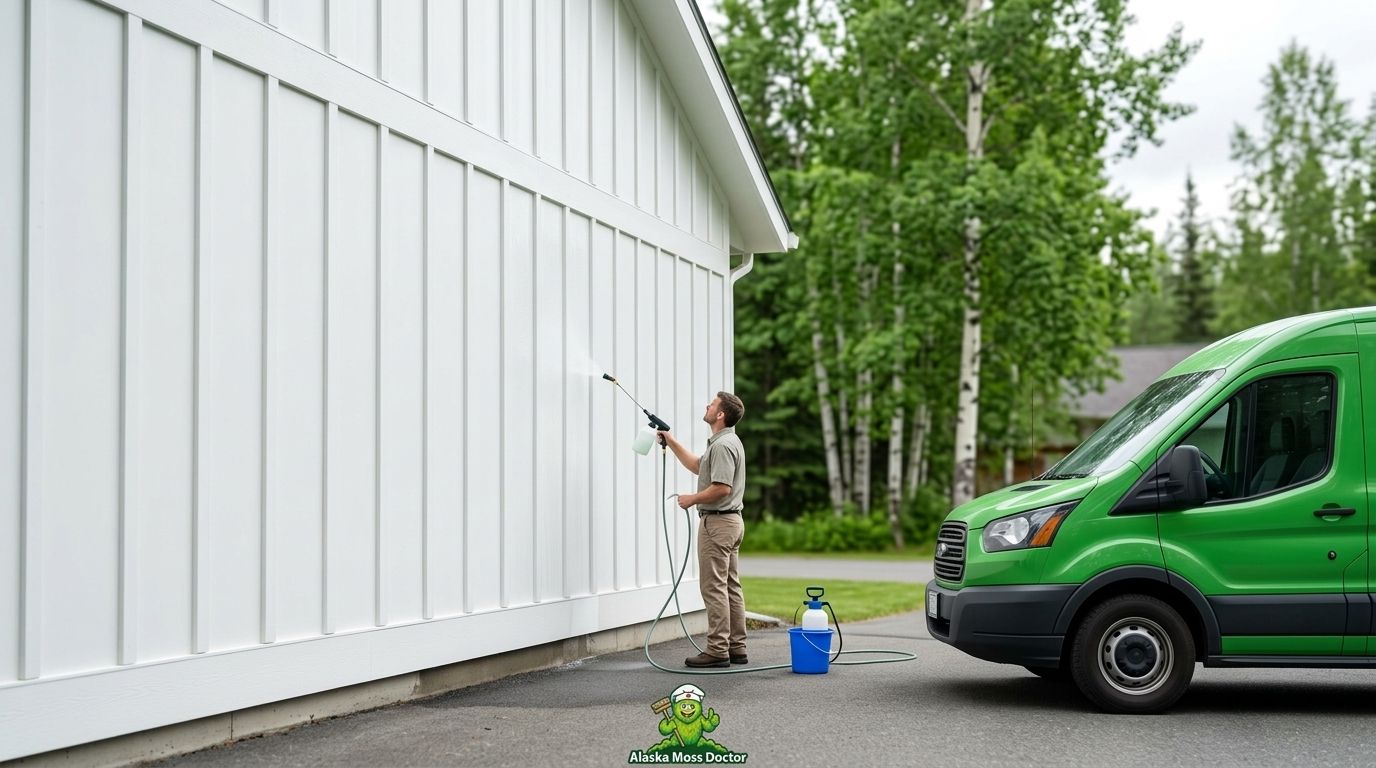
Soft wash cleaning board and batten siding uses low-pressure application (under 500 PSI) with a targeted cleaning solution instead of a pressure washer's blast, so moss and algae die and rinse off without water forcing its way behind the vertical battens. Board and batten owners in the Mat-Su Valley deal with more shade, more freeze-thaw cycling, and more moisture-trapping seams than flat-panel siding owners, which changes both the method and the schedule.
- Soft wash cleaning board and batten siding runs under 500 PSI, never the 1,500-3,000 PSI range used on concrete.
- Alaska Moss Doctor calibrates solution and dwell time for painted or cedar board and batten across Wasilla and the Mat-Su Valley.
- Pressure washing above 500 PSI forces water behind battens and lifts paint on wood siding.
- Wash before Alaska's fall freeze or after spring snowmelt clears to avoid trapping moisture in seams.
- Shaded, north-facing panels near spruce and birch regrow moss faster and need closer inspection.
Why this matters for board and batten siding
Board and batten panels overlap at raised seams, and those seams are exactly where pressure washing does the most damage. A jet strong enough to strip years of grime off concrete will also drive water past the caulk line and behind the battens themselves, where it has nowhere to evaporate until the next warm stretch.
Alaska's freeze-thaw cycle turns that trapped water into an ice wedge that pries boards apart over a winter or two. The best house washing method for painted wood siding starts with the assumption that paint and wood grain are more fragile than the moss growing on them, and the method has to protect both.
Mat-Su Valley homes shaded by spruce and birch see moss and green algae film return faster on north-facing board and batten panels than on siding with full sun exposure. That's a maintenance-schedule problem as much as a cleaning-method problem, and it's the first thing worth checking before you book anything.
Inspect the seams before you touch a hose
Start with a dry-day walk around the house, looking specifically at batten edges and base boards, not just the flat panel faces.
- Check batten edges for soft or spongy wood, a sign moisture is already trapped
- Look at north-facing panels for green film building up in the grain
- Check the base of boards near soil or mulch for splash-back staining
- Inspect flashing above windows and doors for streaking that runs down into the batten seam
- Log every problem area before you pick a pressure setting or a solution
Test your pressure setting on a hidden panel first
Don't guess at pressure on the front of the house. Find a corner section, ideally behind a bush or downspout, and test there first.
- Start under 500 PSI and watch how the water sheets off versus pools at the seams
- Watch for water forcing between battens instead of running down the face
- Drop pressure further on any panel already showing paint chalking or fading
- Note the material — cedar, fiber cement, and painted plywood board and batten each tolerate different settings
- If in doubt, the best soft wash pressure setting for delicate siding runs lower than most homeowners expect
“If water pools behind a batten instead of sheeting off the face, the pressure is already too high for that panel.”
Match the cleaning solution to the siding's finish
A moss and algae kill happens chemically, not mechanically — the solution does the work, the rinse just removes what's already dead.
- Sodium hypochlorite blends break down moss and algae without scrubbing the surface
- Surfactant additives help the solution cling to vertical battens instead of running straight off
- A dwell time of several minutes before rinsing lets the solution finish killing growth in the seams
- A rinse-only pass afterward removes dead material without reintroducing pressure to lifted paint
This is where a professional soft wash earns its keep. Alaska Moss Doctor mixes the solution ratio and dwell time to the siding's condition — heavier on shaded, moss-heavy panels, lighter on painted sections already showing wear — rather than running one blanket mix across the whole house.
Rinse top to bottom in overlapping passes
- Start at the roofline and work down in 3-4 foot horizontal sections
- Keep the nozzle moving instead of holding it on one spot
- Give shaded seams and north-facing corners a second pass, since dead growth clings longer there
- Check runoff at the base of the wall — cloudy green runoff means more dwell time was needed, not more pressure
Protect landscaping, trim, and gutters before you start
Board and batten homes often sit close to shrub beds and foundation plantings that soft wash chemicals can scorch if left uncovered.
- Cover shrubs and flower beds directly under the wash zone
- Move outdoor furniture and cushions away from the splash radius
- Tape off exterior outlets and light fixtures
- Check gutters for existing moss buildup before water starts running through them
- The full walk-through is covered in how to prepare your yard before a house washing
Schedule around Alaska's freeze-thaw window
Timing matters as much as method for board and batten siding in this climate.
- Wash before the ground freezes in fall, typically before temperatures hold below freezing overnight
- Avoid washing in near-freezing conditions, since water trapped in seams can ice over before it evaporates
- A spring wash after snowmelt clears removes winter grime before summer growth sets in
- Two seasonal washes a year keeps shaded, moss-prone panels from building up a heavy coat between visits
Recheck seams and touch up caulk after drying
- Let board and batten siding dry fully, generally a day or two depending on weather, before recaulking
- Inspect battens for gaps that opened up during the wash or were already loosening
- Check for any paint lifting at seams that weren't visible before cleaning
- Address gaps immediately — an open seam after a wash is an open door for the next moss cycle
Comparing your options for board and batten siding
| Option | Best for | Key limitation | Verdict |
|---|---|---|---|
| DIY hand scrubbing | Small, isolated moss spots | Time-intensive, doesn't reach battens' vertical seams | Skip for full-house jobs |
| Garden-hose sprayer with retail cleaner | Light seasonal dust and pollen | Weak dwell time, moss returns within a season | Hold for touch-ups only |
| Pressure washing (1,500+ PSI) | Concrete and hardscape, not siding | Forces water behind battens, strips paint | Skip on board and batten |
| Professional soft wash (Alaska Moss Doctor) | Full-house moss and algae removal on painted or cedar board and batten | Needs scheduling around Alaska's freeze-thaw window | Buy for Mat-Su Valley homes with shaded exposure |
Get board and batten siding washed right
Soft wash service calibrated for painted and cedar siding in the Mat-Su Valley.
Common mistakes board and batten owners make
- Pressure washing the battens like flat siding — forces water behind the panel and starts rot that shows up a year later.
- Ignoring shaded, north-facing panels — moss regrows within a single Alaska growing season if the root cause of shade and moisture isn't addressed.
- Washing right before the fall freeze — trapped seam moisture ices over and cracks paint through the winter.
- Skipping the caulk check after washing — a seam that opened during the wash lets moisture straight back in.
- Using a bleach-only retail mix with no surfactant — it runs off vertical battens before it has time to kill anything.
FAQ
What's the best way to clean board and batten siding without damaging paint?
Soft wash cleaning under 500 PSI with a calibrated solution and short dwell time removes moss and algae without stripping paint. Pressure washing above that range forces water behind the battens and is the leading cause of paint damage on this siding type.
Is soft washing better than pressure washing for board and batten siding?
Yes, for board and batten specifically. Pressure washing's higher PSI range pushes water past the batten seams into the wall cavity, where it has no easy way to dry out before an Alaska freeze.
How often should board and batten siding be washed in Alaska?
Twice a year works for most Mat-Su Valley homes, once after spring snowmelt and once before fall freeze. Heavily shaded homes near spruce or birch may need a mid-season check.
Can moss regrow after a soft wash?
Yes, especially on north-facing or shaded panels where moisture lingers longest. Regrowth timing depends on shade and exposure, not on how the first wash was done.
Does soft wash cleaning work on cedar board and batten?
Yes, cedar tolerates soft washing well when the pressure and solution strength are matched to the wood's condition. Weathered or previously stained cedar needs a lighter solution mix than newer, sealed cedar.
What temperature is too cold for soft washing siding?
Washing in near-freezing conditions risks trapping water in seams before it evaporates, which can ice over overnight. Scheduling around Alaska's freeze-thaw window avoids this entirely.
How long should board and batten dry before recaulking?
Give the siding a full day or two of dry weather before recaulking any seams. Sealing over damp wood traps moisture instead of keeping it out.
Does soft washing remove black streaks on board and batten siding?
Soft washing removes algae and mildew staining, including dark streaking, when the solution gets adequate dwell time before rinsing. Deep-set staining on older paint may need a second pass.
One last thing
The panel that looks worst from the ground — usually a shaded corner with visible green film — is rarely the one with the most hidden damage. The batten seams near downspouts and window flashing trap water longest and are where soft paint and loose caulk show up first, even when the surface looks clean after a single season.