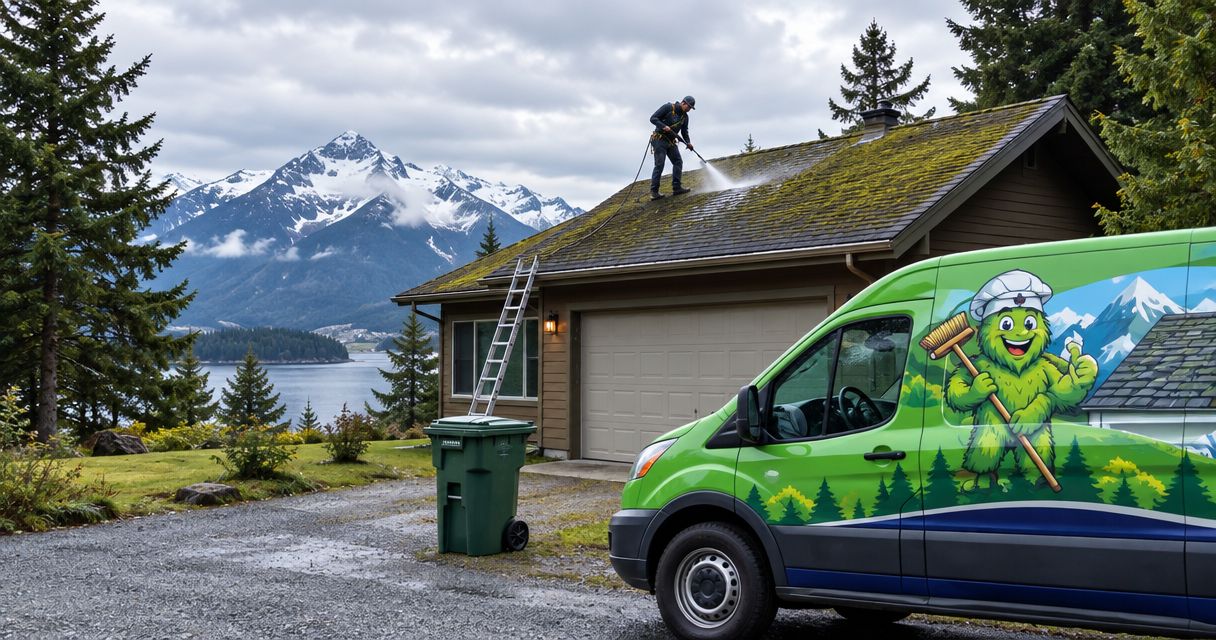
Palmer, Alaska homeowners get roughly four workable months a year to clean moss off a roof, and picking the wrong method inside that window can strip shingle granules or crack cedar shake that already survives one of the harshest freeze-thaw cycles in the Mat-Su Valley. Roof moss removal for Palmer alaska properties has to work around a short dry season, heavy tree canopy, and roof pitches built for snow load, not for foot traffic.
- Roof moss removal in Palmer, Alaska works best from May through September, when surfaces dry fully between treatments.
- Spruce and birch canopy over Palmer lots keeps roof sections shaded and damp, which speeds up moss regrowth compared to open sites.
- Soft-washing with a low-pressure rinse and a biocide treatment removes moss without lifting asphalt shingle granules or damaging cedar shake.
- Alaska Moss Doctor treats existing moss and slows regrowth on Palmer roofs; scraping alone without treatment usually lets moss return within one season.
- Steep-pitch and two-story Palmer homes need a crew that works safely at height, not a homeowner on a ladder with a pressure washer.
Why this matters for Palmer homeowners
Moss needs shade and standing moisture to establish, and Palmer's mix of spruce, birch, and long winter shadow gives it both. North-facing roof planes and valleys under tree cover hold snowmelt longer into spring than open, south-facing sections, and that extra moisture is exactly what moss colonies need to spread across shingles, cedar shake, or metal seams.
The freeze-thaw pattern common to the Mat-Su Valley makes the problem worse over time. Moss holds water against the roof deck, that water expands when it refreezes, and the cycle lifts shingle edges and works moss root structures deeper into the surface. A homeowner who checks for early signs of roof damage before a heavy snow season catches the problem while it is still cosmetic.
Waiting past that point turns a cleaning job into a repair job, and repair costs on a roof deck run well past anything a moss treatment would have cost in 2026.
Update your inspection schedule for spring runoff
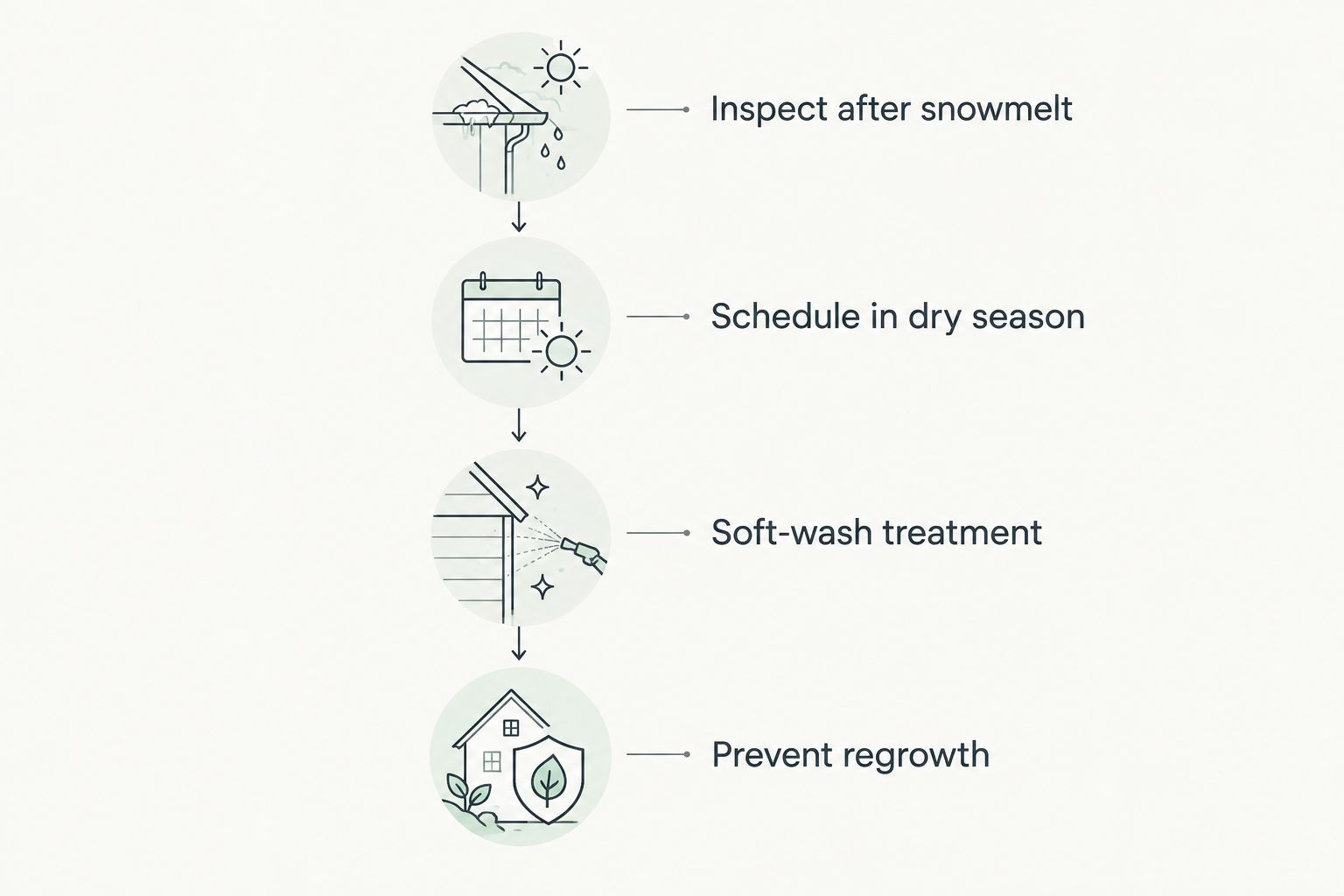
Check the roof as soon as snow clears, not after the first hot week of summer. Moss that looks dormant under snow is still alive and spreading once meltwater sits on the surface.
- Walk the perimeter and look up at north-facing slopes and any valley where two roof planes meet.
- Check for green or gray-green patches, not just black streaks — those are different growths with different fixes.
- Look at gutters for granule buildup, which signals moss is already breaking down the shingle surface.
- Note any soft or sagging spots on the decking, visible from inside the attic if accessible.
- Photograph problem areas so you can compare growth rate year over year.
Time the cleaning to Palmer's short season
Soft-wash treatments need dry-down time to work, and Palmer's freeze window cuts that season short compared to coastal Alaska towns. Scheduling around the best time of year for roof moss removal in Alaska keeps the treatment from freezing before it finishes killing the moss.
- Target May through September for full treatments; shoulder months risk overnight freeze before the solution dries.
- Avoid scheduling right before a forecasted hard freeze, even in July.
- Book early summer if your roof gets heavy shade — those sections take longer to dry.
- Skip winter scraping entirely; frozen moss is brittle and pulls granules with it.
Choose the safe removal method for your roof material
Asphalt shingle, metal, and cedar shake all need different handling. Pressure washing on the wrong surface is the single fastest way to turn a moss problem into a warranty problem.
- Asphalt shingle: soft-wash only, low pressure with a biocide rinse — never a direct high-pressure blast.
- Metal roofing: soft-wash with a pH-balanced solution to avoid stripping factory coatings.
- Cedar shake: hand removal of loose moss first, then a gentle rinse — never a pressure washer near the wood grain.
- Any material: skip wire brushes and metal scrapers, which score the surface and give the next moss colony a foothold.
Treat the moss, not just the symptom
Scraping visible moss off the surface leaves root structures and spores behind. A treatment step kills what scraping misses.
- Apply a biocide or moss-specific treatment after physical removal, not instead of it.
- Rinse thoroughly to clear dead moss and treatment residue from valleys and gutters.
- Reapply a preventive treatment on a schedule rather than waiting for visible regrowth.
- For DIY jobs, follow label dry-time instructions exactly — cutting it short on a shaded roof section defeats the treatment.
Protect gutters and downspouts during cleanup
Dead moss and granules wash straight into the gutter system during any cleaning pass, and a clogged gutter on a Palmer roof backs water up under the shingle line by the next thaw.
- Flush gutters immediately after any moss removal pass, not days later.
- Check downspouts for granule buildup that can block flow during spring melt.
- Add gutter guards if your lot has heavy spruce or birch litter feeding the problem year-round.
- Inspect fascia boards for water staining that points to an existing gutter backup.
Bring in a professional for steep or high roofs
Palmer homes built for snow load often carry steeper pitches than the national average, and a homeowner on a ladder with a garden hose attachment is not equipped for that angle. Alaska Moss Doctor works roofs that a DIY approach makes unsafe, using the right method for steep or high-pitch roofs instead of guesswork from the ground.
- Hire a crew with fall-protection equipment for anything over a single story or a steep pitch.
- Ask whether the company soft-washes or pressure washes as a default — soft-wash should be the standard answer for shingle and cedar.
- Confirm the crew treats for regrowth, not just a one-time rinse.
- Get a written scope of what surfaces get treated: roof only, or roof plus gutters and siding.
Get a moss removal quote for your Palmer roof
Soft-wash cleaning and moss prevention built for Alaska roofs.
Comparison: moss removal options for Palmer homeowners
| Option | Best for | Key limitation |
|---|---|---|
| DIY scraping | Small, easily accessible patches on a single-story home | Leaves roots and spores behind; moss typically returns within one season |
| Pressure washing | Concrete walkways and driveways, not roofing | Strips shingle granules and can crack cedar shake — high warranty risk on roofs |
| DIY soft-wash kit | Homeowners comfortable working at height on a low-pitch roof | Requires correct dilution and full dry time; easy to under-treat shaded sections |
| Professional soft-wash service | Steep pitches, shaded lots, cedar shake, and full-season prevention | Requires scheduling within Palmer's dry-season window |
Verdict: professional soft-wash treatment is the safest option for asphalt shingle, metal, and cedar shake roofs in Palmer, and it's the only option on this list built around regrowth prevention rather than a one-time cleanup.
A nearby example of how this plays out at the neighborhood level is covered in roof moss removal for Wasilla, Alaska homeowners, where the same tree canopy and freeze-thaw pattern drive similar timing decisions.
Common mistakes Palmer homeowners make
- Scheduling around the calendar instead of the weather. A treatment applied in early May right before a cold snap can freeze before it finishes working — check the forecast, not just the month.
- Treating shaded north-facing sections the same as sunny slopes. Moss under spruce canopy needs more frequent attention; a single annual pass leaves those sections re-colonized by mid-summer.
- Renting a pressure washer for a roof job. It's built for concrete, not shingles or cedar shake, and it's the fastest way to void a roofing warranty in 2026.
- Ignoring gutters during a moss cleanup. Dead moss and granules that wash off the roof and sit in a clogged gutter cause more damage than the moss did.
- Skipping the professional evaluation before buying materials. Homeowners who budget for professional roof cleaning before shopping for DIY kits usually find the labor and safety equipment cost more than the service itself once ladder rental and treatment chemicals are added up.
FAQ
What is the best time for roof moss removal in Palmer, Alaska?
May through September is the reliable window, since surfaces need full dry-down time before an overnight freeze in 2026's shoulder months. Shaded, north-facing roof sections should be scheduled earlier in that window because they take longer to dry.
Is pressure washing safe for moss on an asphalt shingle roof?
No, pressure washing strips granules off asphalt shingles and can void the manufacturer's warranty. Soft-washing with low pressure and a biocide rinse removes moss without damaging the shingle surface.
Why does my Palmer roof grow moss faster than my neighbor's?
Shade from spruce or birch trees keeps roof sections damp longer after snowmelt, and moss establishes fastest in shaded, moist conditions. A more open lot with better sun exposure dries faster and grows moss more slowly.
Can I remove roof moss myself in Palmer?
Small, accessible patches on a single-story roof can be hand-scraped and rinsed, but moss typically returns within one season without a treatment step. Steep pitches or two-story homes are safety risks for DIY removal and are better handled by a professional crew.
Does moss actually damage a roof, or is it just cosmetic?
Moss holds moisture against the roof deck, and that moisture expands during Palmer's freeze-thaw cycle, lifting shingle edges and working into the roof structure over time. Left untreated across multiple winters, cosmetic moss becomes a decking and leak problem.
How often should a Palmer homeowner schedule roof moss removal?
Heavily shaded roofs under spruce or birch canopy often need attention every year, while open, sunnier roofs can go longer between treatments. A preventive treatment schedule cuts the interval needed for full cleanings.
Will moss removal void my roof's manufacturer warranty?
Using the wrong method, particularly pressure washing on asphalt shingles, is what voids warranties — the moss removal itself does not. Soft-wash methods designed for the specific roofing material keep the warranty intact.
What's the difference between moss and the black streaks on my roof?
Moss is a raised, green-to-gray growth that needs shade and moisture; black streaks are typically algae that spreads regardless of shade and needs a different cleaning approach. Both need treating, but scraping moss won't touch algae streaks.
One last thing
The roof section that fails first on most Palmer homes isn't the ridge or the eaves — it's the valley where two roof planes meet under a tree canopy, because that's where meltwater sits longest after the rest of the roof has dried. Check that spot first on your next inspection; if moss is established there before you see it anywhere else, treat that section as the priority, not an afterthought.