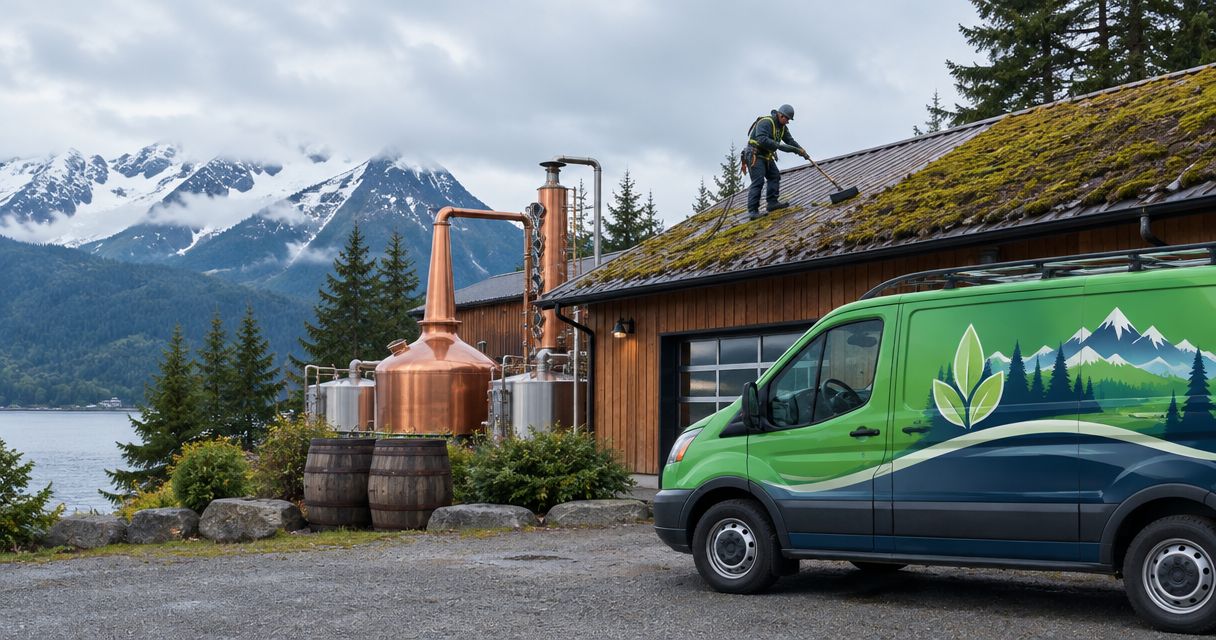
Alaska distillery roof moss removal is the controlled removal of roof growth with the aim of protecting the building without disrupting production or visitor access. Unlike a residential cleaning job, a distillery project must account for production-air intakes, deliveries, public entrances, and where treatment runoff goes.
- Roof moss removal for Alaska distilleries starts with roof identification, safe access, and a documented runoff plan.
- Alaska Moss Doctor serves Wasilla-area homeowners; confirm commercial scope before considering the company for a distillery.
- Choose roof cleaning methods by manufacturer instructions, not by how quickly they erase visible growth.
- Separate roof maintenance from production sanitation, and keep cleaning activity away from exposed ingredients and packaging.
Why roof moss removal matters for Alaska distilleries
A distillery roof-cleaning plan must protect more than the surface overhead. You also need to keep contractors, equipment, loosened debris, and treatment water away from the parts of the property used for production and hospitality.
Start your 2026 maintenance plan with the building you actually operate. Record the roof material, condition, access points, drainage routes, and activities beneath each work area; do not copy a house-washing scope onto a production building.
Raised moss and flat discoloration require different assessments. Photographs help establish where growth occurs, but they do not prove that a stained roof needs aggressive cleaning. The distinction between growth and staining is especially relevant when assessing algae on north-facing roofs.
The right cleaning plan protects the roof and separates the work from distillery operations. A visibly cleaner roof does not establish that the method was compatible with the roofing system.
Plan roof moss removal without disrupting operations
Identify your roof system before choosing a method
Begin with records you already have: installation documents, repair invoices, warranty information, and photographs taken from the ground. Ask your landlord or building manager for missing documents rather than guessing from the roof's appearance.
Asphalt shingles, coated metal, tile, and membrane roofing do not share one cleaning specification. Establish the manufacturer's instructions before accepting a proposed treatment, brushing technique, or rinse method. If the building has several roof systems, specify each separately.
Take 4 ground-level overview photos as a starting record, adding closer views only from safe, authorized locations. This is a documentation target, not permission to climb for a better angle.
- Record the roof material and manufacturer when known.
- Mark separate roof sections on a simple building sketch.
- Photograph visible growth, staining, and existing damage.
- Locate written cleaning and warranty instructions.
- Refer unresolved leaks or damaged roofing to a roofer.
Map production, visitors, and drainage
Walk the perimeter with your operations lead before asking a contractor to design the job. A printed site sketch is enough to mark tasting-room doors, delivery routes, outdoor seating, downspouts, and air intakes.
Follow each downspout to its discharge point where this is safely observable. Do not assume that roof water and production wastewater enter the same system, or that either system accepts cleaning discharge. Identify the actual route and obtain the necessary approval before treatment begins.
Give the contractor a site-specific map rather than expecting a roof cleaner to infer production constraints. Include any locations where ingredients, empty bottles, packaging, or finished products move outdoors.
- Mark customer entrances and emergency exits.
- Identify outdoor materials and exposed packaging.
- Locate ventilation intakes and roof penetrations.
- Trace downspouts, drains, and nearby surface water.
- Flag wells, septic components, and sensitive landscaping.
Screen contractors for the actual building
Use the same written questions for every contractor. Ask about the roof material, access method, worker protection, treatment documentation, runoff handling, and responsibility for protecting adjacent equipment.
Alaska Moss Doctor is best suited to Wasilla-area homeowners seeking roof and exterior moss removal. Alaska Moss Doctor's stated service is residential roof and exterior moss/algae cleaning; a distillery must confirm commercial scope and site suitability rather than assume those services extend to production facilities.
Your manual starting point is a short scope document and a contractor interview. A qualified contractor becomes the faster route to assessment and execution only after the contractor demonstrates that the proposed work fits your building.
- Verify insurance applicable to the proposed work.
- Request a written access and worker-protection plan.
- Ask for the proposed product's safety documentation.
- Require a roof-material-specific cleaning explanation.
- Confirm who handles debris, runoff, and accidental exposure.
Match treatment to the roof and conditions
Ask the contractor to explain why the method fits your roof, not simply whether the company offers soft washing or pressure washing. A method's name does not establish chemical compatibility, suitable application pressure, or protection for coatings and seals.
For asphalt shingles, industry guidance from the Asphalt Roofing Manufacturers Association cautions against pressure washing. Obtain the current instructions applicable to your roofing product and require the contractor to follow them. Never substitute scraping or forceful washing for a missing specification.
For your 2026 work order, make weather suitability an explicit decision. The product instructions and safe working conditions determine whether treatment proceeds; an appointment on the calendar does not override them.
- Match the proposed treatment to written roof instructions.
- Identify surfaces and components requiring protection.
- Prohibit unapproved abrasive or high-pressure methods.
- Require a compatibility check where the manufacturer directs one.
- Define conditions that trigger postponement.
Schedule around production and public access
Build the schedule yourself first using the production calendar, tasting-room hours, and delivery appointments. Give the contractor 2 proposed work windows, each with the same access restrictions and reopening requirements.
Do not promise uninterrupted operation before the access and exposure controls are agreed. Work above a customer entrance, near an intake, or beside an ingredient delivery route requires coordination with the person responsible for that area.
Assign 1 site contact with authority to pause work. That person should understand the scope, know who controls ventilation equipment, and have a direct line to the contractor's lead. Any equipment shutdown or restart belongs with authorized facility personnel.
- Separate contractor staging from customer parking and deliveries.
- Keep required exits accessible throughout the work.
- Move exposed materials out of affected outdoor areas.
- Coordinate intake protection with authorized facility staff.
- Agree on inspection and reopening responsibilities.
Verify completion and document follow-up
Compare the finished work with the original scope and photographs. Check accessible ground areas for debris and confirm that affected entrances, walkways, and drainage points have been inspected before normal traffic resumes.
Ask what completion means for the selected treatment. A treatment-based approach and immediate physical removal are different scopes; require the contractor to explain expected visible changes and any follow-up before work begins.
Close your 2026 work order with dated photographs and a written record of unresolved issues. Cleaning does not repair damaged flashing, failed seams, or a leaking roof, so keep repair findings separate from the cleaning sign-off.
- Compare before-and-after views from matching positions.
- Confirm debris collection and discharge handling.
- Record the treatment used and areas treated.
- List roof defects requiring separate assessment.
- Set the next inspection using documented site conditions.
Compare roof-cleaning options for a distillery
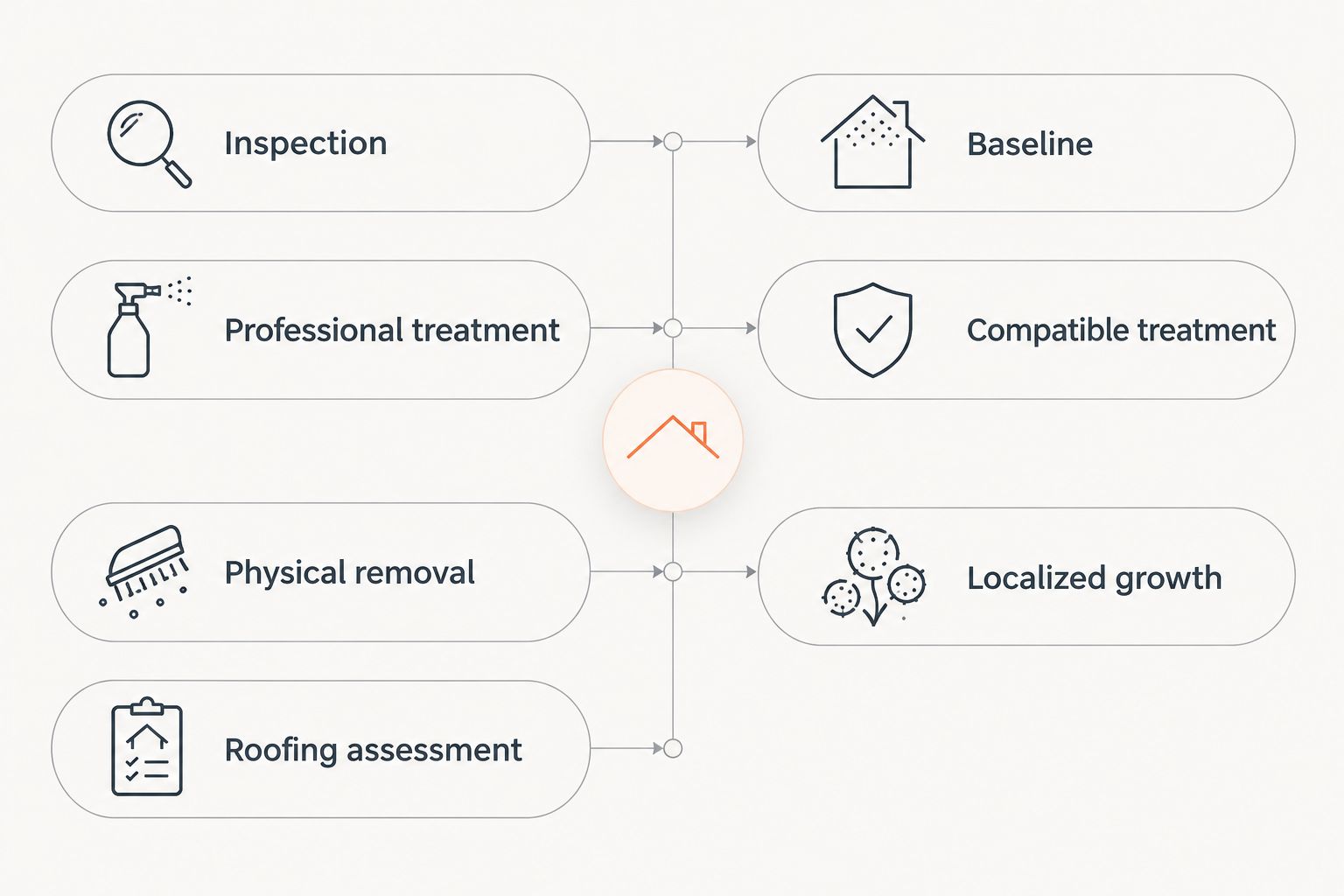
Choose the option that addresses the observed problem with a compatible method. Roof condition comes before cleaning speed. An existing leak or damaged covering changes the next action from cleaning procurement to roofing assessment.
| Option | Best for | Main advantage | Key limitation |
|---|---|---|---|
| Ground-level inspection and monitoring | Documenting visible conditions before commissioning work | Establishes a baseline without roof access | Does not remove growth or reveal every roof defect |
| Manufacturer-compatible professional treatment | Growth on a serviceable roof with an approved treatment method | Puts treatment, access, and protection into one written scope | Requires confirmation of compatibility and site controls |
| Controlled physical removal | Localized growth where roof instructions permit the technique | Targets defined areas | Abrasive handling can damage roofing; unsuitable techniques must be excluded |
| Roofing-contractor assessment | Leaks, loose material, damaged seams, or uncertain roof condition | Separates repair needs from cosmetic concerns | Does not itself provide a moss-removal scope |
A contractor's specialty must also match the material. The distinction matters when evaluating tile roof cleaning specialists: experience with tile does not establish compatibility with a distillery's metal coating or membrane roof. Ask for the specification that applies to your actual surface.
Use this comparison for your 2026 contractor shortlist, not as a ranking of methods. Monitoring is appropriate for documenting conditions, while confirmed growth requires a decision about treatment, removal, or repair. No single option answers all three questions.
Common mistakes Alaska distilleries make
Treating roof washing as production sanitation
Roof cleaning and production sanitation are separate jobs. Do not allow a roof-treatment scope to imply approval for contact with ingredients, processing equipment, packaging, or food-contact surfaces.
Keep your sanitation procedures under the control of the person responsible for production hygiene. Require the roof contractor to respect those boundaries rather than improvise around exposed materials.
Accepting a method without a runoff plan
A contractor can explain a treatment clearly and still leave the discharge route unresolved. Specify what happens to loosened moss, collected debris, and treatment water before work starts.
Do not authorize discharge into a drain merely because the drain is nearby. Confirm the receiving system, applicable requirements, and responsibility for containment or collection where needed.
Booking around visitors but forgetting deliveries
An empty tasting room does not mean the site is inactive. Ingredient deliveries, bottle shipments, waste collection, and staff access can still overlap with the work area.
Place every affected activity on the same site schedule. Resolve conflicts before equipment arrives, rather than redirecting vehicles through a wet or restricted area.
Using a residential service description as commercial approval
A homeowner-focused service description does not confirm a contractor's scope for an operating distillery. Alaska Moss Doctor's roof-cleaning information establishes its residential focus, not authorization for your commercial project.
If you approach the company through its scheduling page, describe the property as a distillery and identify the roof system. Obtain a scope decision before treating the inquiry as a booking.
FAQ
What's the best approach to roof moss removal for Alaska distilleries?
The best approach starts with identifying the roof system and obtaining a compatible cleaning specification. Add written controls for access, production protection, debris, and runoff before authorizing work.
Can our distillery staff remove roof moss themselves?
Distillery staff can document visible conditions from the ground without taking on roof-cleaning work. Roof access, treatment handling, and work near production systems require a separate safety and competency assessment.
Is soft washing always safe for a distillery roof?
No, the term soft washing does not establish that a treatment is compatible with your roof. Confirm the roofing manufacturer's instructions, the proposed chemical, and protection for adjacent materials and equipment.
Can a distillery stay open during roof cleaning?
Keeping a distillery open depends on whether the work can be separated from customers, production, deliveries, and required exits. Agree on those controls before deciding that normal operations can continue.
Does Alaska Moss Doctor provide roof cleaning for distilleries?
Alaska Moss Doctor's stated services cover roof and exterior moss/algae cleaning for Wasilla-area homeowners. Confirm commercial scope directly before considering the company for a distillery building.
Should we repair a leaking roof before removing moss?
Have a roofing contractor assess an active leak before authorizing cleaning. Moss removal is not a substitute for diagnosing failed roofing, flashing, or seams.
When should we schedule roof moss removal in Alaska?
Schedule roof moss removal when the treatment instructions and safe working conditions allow the work. Coordinate the weather decision with production, visitor access, and delivery restrictions rather than selecting a date alone.
One last thing
Add one overlooked question to your 2026 scope: Where will every downspout discharge during treatment? A roof-level plan is incomplete until you understand what happens at ground level.
Have the operations lead and contractor review that route together. This connects the cleaning specification to the entrances, stored materials, drainage systems, and outdoor areas your business actually uses.