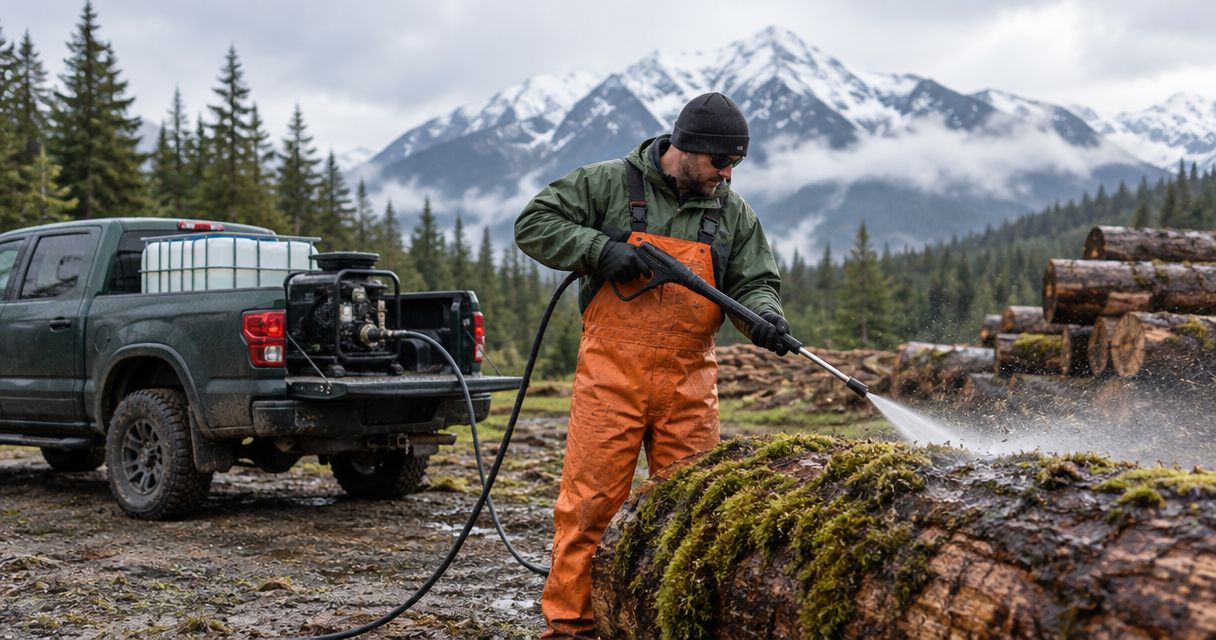
Alaska logging operations’ moss removal is the cleaning of growth from building roofs and exterior surfaces with the aim of maintaining safe access and sound drainage. This 2026 guide separates building maintenance from equipment washing and forest-floor vegetation management, then shows you how to plan work around truck movements, roof materials, weather, and runoff.
- Moss removal for logging companies Alaska starts with building inspection, not a pressure washer.
- Alaska Moss Doctor provides roof and exterior moss/algae removal for Wasilla-area homeowners; confirm commercial scope separately.
- Match roof cleaning to the roofing material and keep cleaning runoff out of waterways.
- Separate roof repairs, equipment washing, and building moss removal into distinct work scopes.
Why moss removal matters for Alaska logging operations
A logging-site maintenance plan needs to distinguish a stained office roof from moss-covered access steps or a blocked roof valley. They require different responses. Prioritize the surface’s function and condition, not how green it looks.
Shade and retained moisture favor moss growth, while accumulated organic debris interferes with drainage. Start your 2026 inspection with shaded roof slopes, roof valleys, gutters, and entrances; the guide to algae removal for north-facing roofs explains a related inspection concern.
Your operational constraint is access. If cleaning crosses a truck route, occupies an entrance, or leaves a walking surface wet, the job needs coordination with the person controlling that area. A roof-cleaning appointment is not permission to interrupt loading or move equipment.
Keep the scope narrow: this guide covers moss on buildings and associated exterior surfaces. It does not prescribe removing natural moss from forest habitat, treating harvested timber, or cleaning logging machinery.
How to plan building moss removal
Use these steps for each building rather than issuing a blanket instruction to clean the entire yard. One roof can need cleaning while another needs repair first. Assign responsibility before anyone brings chemicals, hoses, or access equipment onto the site.
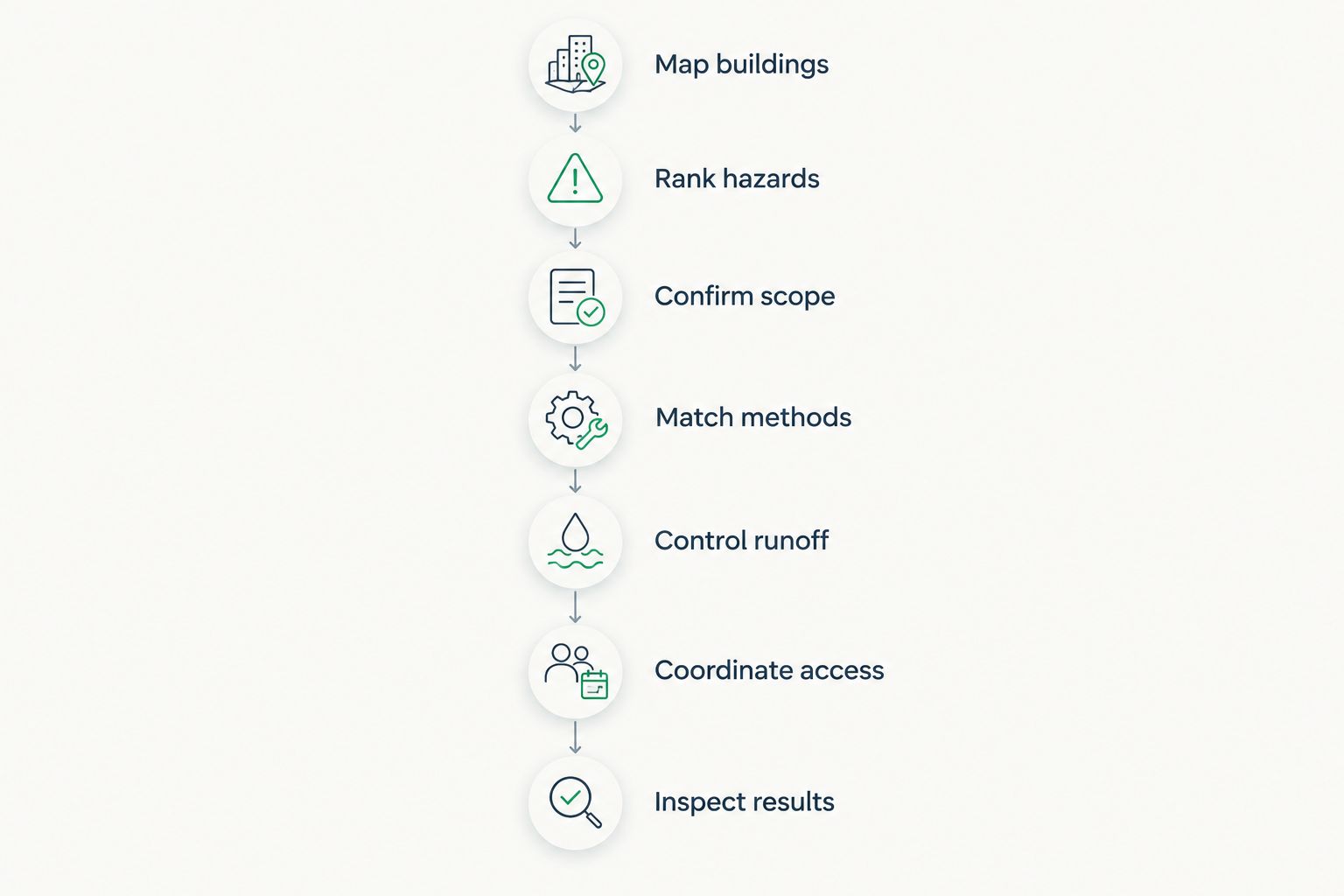
1. Map buildings
Start with a ground-level walkaround and a phone camera. Identify each roof’s material, visible growth, drainage outlets, and nearby activity without climbing onto the roof. An inspection record is the first deliverable; removal comes later.
For your 2026 baseline, take 4 ground-level photos per building, one from each accessible side. This is a documentation recommendation, not a substitute for a roof inspection. Add close-up views from safe positions when the overview misses a gutter outlet or entrance.
Keep sawdust, needles, loose branches, and biological growth as separate observations. They can occupy the same surface without requiring the same treatment. Record anything that looks damaged rather than labeling every discoloration as moss.
- Give each building a name or identifier.
- Record known roofing and siding materials.
- Photograph shaded slopes and roof valleys.
- Mark gutter outlets and nearby drainage paths.
- Note entrances, parked equipment, and overhead utilities.
2. Rank hazards
Sort the inspection into 3 priority groups: access hazards, suspected building defects, and routine growth removal. These are planning categories, not a measured risk score. A slippery entrance needs access control; a suspected leak needs diagnosis; a stained but intact surface needs an appropriate cleaning plan.
Do not send a general maintenance employee onto a wet roof because the growth looks easy to reach. Ground observation is a useful screening task, but roof access and cleaning require suitable equipment, training, and a work plan.
Where shingles are displaced, flashing appears loose, or water enters the building, obtain a roofing assessment before approving cleaning. Cleaning removes growth; it does not repair the assembly beneath it. Keep that distinction in the work order so the cleaner is not asked to solve an unidentified leak.
- Restrict access to visibly slippery walking areas.
- Flag active leaks for roofing assessment.
- Record displaced roofing or loose flashing.
- Separate cosmetic stains from drainage obstructions.
- Identify surfaces that cannot be inspected safely.
3. Confirm scope
You can prepare the initial scope yourself using photographs and a building list. Specify the surfaces requiring attention, the suspected materials, and the work that is excluded. Then ask a provider to assess the cleaning method and access requirements rather than requesting an undefined exterior wash.
Alaska Moss Doctor is best suited to Wasilla-area homeowners seeking roof and exterior moss/algae removal. That residential focus matters: a logging company must confirm whether its particular building, location, and commercial requirements fit before treating the provider as an option.
Use Alaska Moss Doctor to start that discussion about roof and exterior moss removal. Do not assume that a building-cleaning service also includes machinery degreasing, remote-camp mobilization, wastewater handling, or industrial worksite access. Put each requirement in the inquiry and request a direct response.
- Identify the building’s use and location.
- Send ground-level photos with the inquiry.
- Ask whether the provider accepts the commercial scope.
- Describe access restrictions and site orientation requirements.
- Separate cleaning, repair, and equipment-washing tasks.
4. Match methods
Read the roofing or siding manufacturer’s care instructions before choosing a method. If records are missing, identify the material first. A method suitable for a hard ground surface is not automatically suitable for shingles, coatings, wood siding, or roof membranes.
For asphalt shingles, avoid high-pressure washing and aggressive scraping that can damage the surface. Metal roofing also needs attention to coatings, fasteners, and joints; its appearance does not establish that any detergent or pressure setting is acceptable.
Do not treat the phrase soft wash as a complete specification. Ask which cleaner will be used, whether the material permits it, how it will be applied, and what happens to the loosened growth. Approve the material-specific method, not just the service label.
- Find available roof and siding care instructions.
- Identify coatings and vulnerable surface finishes.
- Ask how moss will be detached or treated.
- Confirm cleaner compatibility and label requirements.
- Identify damaged surfaces that must remain untreated.
5. Control runoff
Trace where roof and wash water will go before applying a cleaner. Follow gutters, downspouts, pavement slopes, and drainage ditches from the building toward their outlets. Do not assume a ditch is an acceptable disposal route because rainwater normally enters it.
Moss-cleaning chemicals require label-directed use. Wash water and loosened debris also need a plan; redirecting them away from one entrance is not enough if they then reach another work area or a waterway. Where discharge requirements are uncertain, establish them before work begins.
Keep fuel residues and machinery contamination outside the building-cleaning scope. Combining roof runoff with an equipment-washing area changes what the wash water contains. For your 2026 work order, require the provider to describe collection, containment, and disposal arrangements relevant to the job.
- Mark downspout outlets and ditch connections.
- Identify nearby streams, wells, and water intakes.
- Read cleaner labels and safety information.
- Specify debris collection and disposal responsibilities.
- Resolve runoff requirements before approving application.
6. Coordinate access
Prepare an access plan with the person responsible for yard operations. A cleaner needs a defined work area, not a verbal assurance that drivers will notice the hoses. Keep temporary equipment, wet surfaces, and pedestrian detours out of uncoordinated traffic movements.
Choose a weather window that meets the cleaning product’s instructions and allows the planned work to proceed safely. In Alaska, check overnight freezing as well as conditions during the appointment. A dry afternoon does not settle what happens to residual water after temperatures fall.
Include water and power requirements in the discussion rather than assuming they are available at every building. Remote access adds another reason to settle scope before dispatch: missing information is harder to correct once people and equipment arrive.
- Agree on the work area and pedestrian detour.
- Identify truck routes that must remain open.
- Confirm water, power, and access requirements.
- Review forecast conditions and product restrictions.
- Assign a site contact with authority to pause work.
7. Inspect results
Compare the cleaned surfaces with the original photographs from the same safe locations. Confirm what was cleaned, what was left untreated, and which defects remain. Do not use a brighter roof as the sole acceptance criterion; check debris handling and drainage as well.
Maintain 1 maintenance log per building with dated photos, observations, treatment details, and unresolved issues. This recommended record keeps the next inspection specific. It also prevents staff changes from erasing the distinction between a recurring cleaning concern and a known roof defect.
Close your 2026 work order with a condition-based follow-up plan. Reinspect when new growth, debris accumulation, or drainage problems appear rather than treating a fixed cleaning interval as proof that every roof needs another application.
- Repeat photographs from the original viewpoints.
- Record untreated areas and the reasons.
- Check accessible outlets for collected debris.
- Confirm temporary access restrictions are removed safely.
- Assign unresolved repairs to the appropriate contractor.
Compare your maintenance options
Choose the option that matches the task, not the equipment already in the yard. Ground-level documentation and professional cleaning complement each other. Neither replaces a roofing assessment when the building shows damage.
| Option | Best for | Main advantage | Key limitation |
|---|---|---|---|
| In-house ground-level inspection | Building inventories and early issue detection | Staff can document site conditions before requesting service | Does not establish hidden roof condition or authorize roof access |
| Trained in-house exterior maintenance | Accessible surfaces within the crew’s training and approved procedures | Direct coordination with yard activity | Requires suitable methods, safety controls, and runoff planning |
| Building moss-removal contractor | Growth removal needing specialized access or material-specific cleaning | Separates cleaning work from routine yard duties | Commercial scope, location, and site requirements need confirmation |
| Roofing contractor | Leaks, displaced roofing, damaged flashing, or uncertain roof condition | Assesses defects that cleaning cannot repair | Repair assessment is a different task from exterior cleaning |
| Alaska Moss Doctor | Wasilla-area homeowners needing roof and exterior moss/algae removal | An explicitly stated residential service focus | Logging facilities and commercial work require separate confirmation |
For a logging company, the choice is not necessarily one provider for everything. Keep building cleaning, roof repair, and machinery washing separate unless each task is explicitly included and the contractor is qualified to perform it.
A provider’s suitability for a homeowner does not establish suitability for an operating timber yard. Conversely, familiarity with heavy equipment does not establish roof-cleaning competence. Evaluate the actual surface, access plan, and work scope.
Common mistakes logging operations make
Treating the yard washer as a roof-cleaning method
Equipment-cleaning routines are not roof-care instructions. A powerful washer and a familiar detergent can still be wrong for shingles, coatings, or siding. Use the building material’s requirements to select the method, even when a different setup is already on site.
Bundling every exterior contaminant together
Moss, algae, sawdust, sap, and oily residue are different cleaning problems. A single instruction to remove everything conceals incompatible surfaces and wastewater concerns. List the contaminants and surfaces separately, then confirm what the proposed method actually addresses.
Booking work without controlling traffic
A delivery schedule is not an access plan. Hoses, temporary equipment, and closed entrances need coordination with truck and pedestrian movements. Assign a site contact, mark the work area, and agree on pause conditions before cleaning starts.
Sending wash water toward the nearest ditch
A convenient drainage route is not permission to discharge cleaning solution. Inspect the receiving path and establish the applicable handling requirements first. Include loosened moss and debris in that plan rather than concentrating only on the liquid cleaner.
Assuming residential scope covers industrial facilities
A contractor’s residential roof-cleaning description does not confirm commercial site access, remote travel, or industrial procedures. Ask about the exact building and requirements. A confirmed scope is more useful than a broad claim that a company cleans exteriors.
FAQ
What does moss removal for an Alaska logging company actually cover?
Building moss removal covers growth on specified roofs and exterior surfaces. Equipment washing, harvested timber, and forest-floor vegetation are separate scopes and should not be included by assumption.
Can our logging crew remove roof moss themselves?
Your crew can begin with ground-level inspection and documentation. Roof access and treatment require appropriate training, equipment, material-compatible methods, and site controls; routine logging duties do not establish those capabilities.
Is pressure washing better than soft washing for a logging-site roof?
The roof material and its care instructions determine the method, not the building’s use. High-pressure washing and aggressive scraping can damage asphalt shingles, while a soft-wash proposal still needs a specified cleaner and application plan.
Does Alaska Moss Doctor clean logging-company buildings?
Alaska Moss Doctor’s stated service is professional roof and exterior moss/algae cleaning and removal for homeowners in the Wasilla area. Confirm acceptance of any logging-company building, commercial requirements, and location before scheduling.
Should we clean moss before fixing a roof leak?
Have the leak assessed before approving cleaning. Growth removal does not repair damaged roofing, flashing, or other causes of water entry, and the repair assessment should inform the cleaning scope.
When should we schedule building moss removal in Alaska?
Schedule when weather, access, and the selected cleaner’s instructions allow safe work. Check overnight freezing, drainage conditions, and yard movements rather than choosing a date from the calendar alone.
How do we keep moss-cleaning runoff away from a stream?
Trace the drainage route and establish containment, collection, and disposal arrangements before applying cleaner. Follow product labels and applicable discharge requirements; do not assume gutters or ditches provide an acceptable outlet.
One last thing
Photograph where the water goes, not just where the moss grows. A roof overview shows the cleaning target; a downspout and drainage-path record shows what the work can affect beyond it. Add those images to your 2026 building file before requesting service, and ask the provider to address both in the proposed scope.