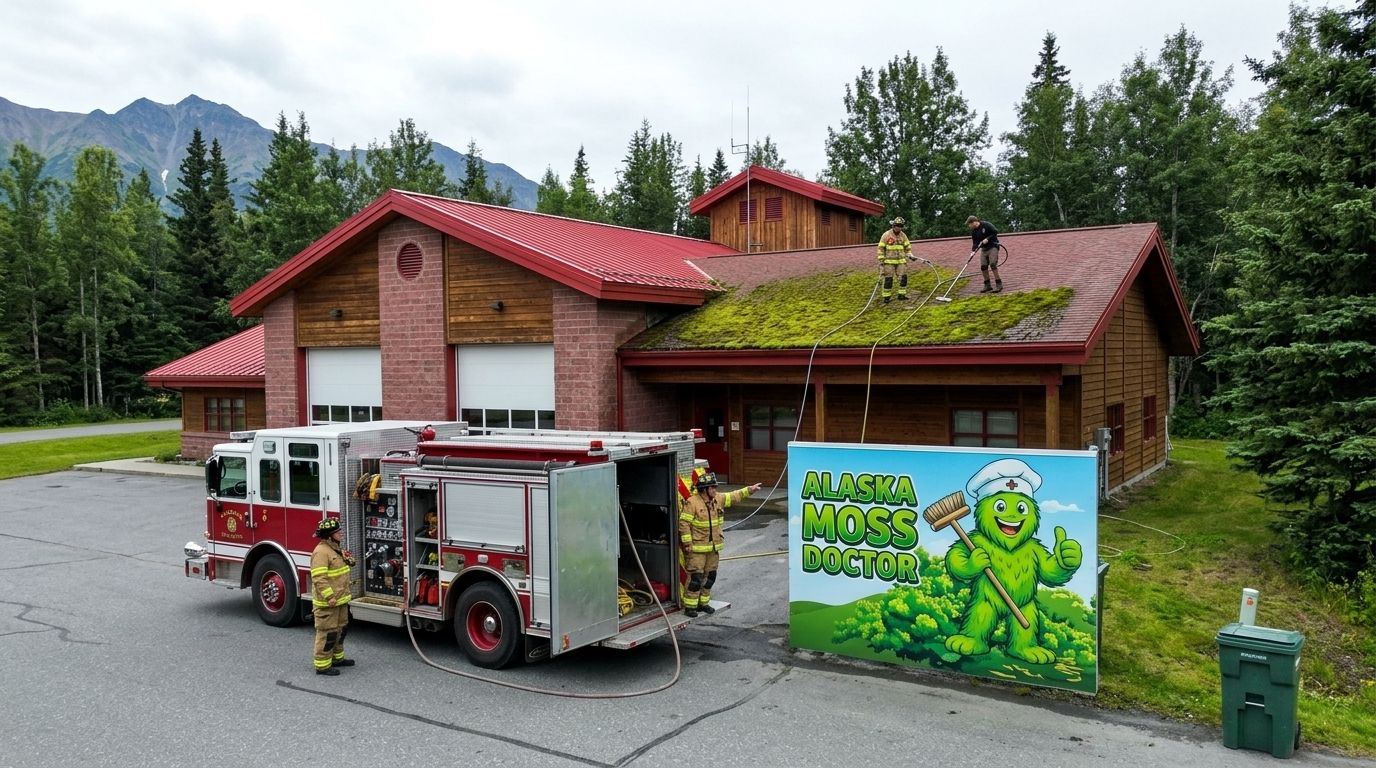
Fire station buildings need moss removal that never interrupts apparatus bay access or radio tower operations, with the goal of protecting municipal roof budgets while keeping the facility looking maintained for the public it serves. A residential roof crew can walk off the job for a week; a fire station roof crew works around a 24-hour shift schedule, an active bay door, and sometimes a ladder truck parked ten feet from the work zone.
That difference changes how the job gets scheduled, insured, and documented. Alaska Moss Doctor handles moss removal for fire station buildings across the Wasilla and Mat-Su Valley area, and the approach looks different from a standard house wash from the first phone call.
- Moss removal for fire station buildings requires scheduling around 24/7 crew shifts, not just weather windows.
- Soft-wash cleaning at low pressure protects asphalt shingle and metal roofs common on Mat-Su Valley stations.
- Municipal facilities need documented, itemized invoices for budget and capital-improvement records.
- Alaska Moss Doctor recommends spring or early fall cleaning before Alaska's wet season accelerates moss regrowth in 2026.
Why moss removal matters for fire station buildings
A fire station roof carries more equipment penetrations than a typical home: antenna mounts, exhaust vent stacks from apparatus bays, HVAC units, and often a flagpole footing. Moss and algae colonize around every one of those penetrations first, because that's where moisture sits longest after Alaska's freeze-thaw cycles.
Left alone, moss lifts shingle tabs and holds water against flashing seams near vent stacks — the same failure points that show up in commercial roof inspections. For a publicly funded building, a roof failure isn't just a repair bill; it's a budget line item that has to be explained at a borough or municipal meeting. Clean, well-maintained roofs also matter for public perception — a fire station is one of the most visible buildings in a Mat-Su Valley community, and a moss-streaked roof reads as neglect even when the building is structurally sound.
Inspect the roof and bay canopy first
Start with a visual walk of the roof and the overhang above the apparatus bay doors, not a blanket wash.
- Check north-facing roof slopes and shaded valleys where moss establishes fastest
- Look at flashing around vent stacks, antenna mounts, and skylights for lifted or cracked seals
- Note any soft spots underfoot near valleys, a sign moss has already trapped moisture in the underlayment
- Photograph problem areas before cleaning to compare against post-cleaning results
- Flag any bay door canopy staining separately — it often needs a different pressure setting than the main roof
Schedule around shift changes and emergency calls
A fire station never fully closes, so cleaning has to work around the crew, not the other way around.
- Confirm shift schedule with the station officer before locking in a date
- Plan for equipment to be staged clear of bay doors in case of an emergency call
- Avoid scheduling during known high-call periods (holiday weekends, wildfire season)
- Build in a rain-date buffer since Alaska weather windows close fast
- Keep a radio or phone line open with the crew during the job for immediate access if a call comes in
Choose a soft-wash method suited to the roof material
Most Mat-Su Valley fire stations run asphalt shingle or standing-seam metal roofing, and each needs a different touch.
- Use low-pressure soft washing rather than high-pressure blasting on asphalt shingles to avoid stripping granules
- Match the cleaning solution to the roof material — metal roofing needs a different dwell time than shingle
- Protect antenna cabling and rooftop electrical with tarps or shields before applying solution
- Rinse from the ridge down to avoid forcing water under shingle tabs
- Check the flat commercial roof sections separately if the station has a low-slope addition or garage extension
A station built on a steep truss with a tall bay for ladder trucks often has roof sections that are difficult to reach safely without the right rigging. That's where a steep or high roof specialist earns the call over a general handyman crew — the risk of a fall near an active apparatus bay isn't worth the savings.
Coordinate with facilities management or public works
Most fire station cleaning gets approved through a borough facilities department or a fire service area board, not the on-duty crew.
- Get written approval and a purchase order before work starts, not after
- Confirm who signs off on the completed job for payment processing
- Ask whether the job needs to be bid or can be handled as routine maintenance
- Loop in the fire chief or station officer on the actual work date, even if the paperwork goes through facilities
Get a fire station roof quote
Coordinated scheduling for public safety facilities in the Mat-Su Valley.
Document the work for budget records
Public buildings need a paper trail that a private homeowner never has to produce.
- Request an itemized invoice broken out by roof section, gutters, and any pressure washing of the apron or driveway
- Get before-and-after photos included in the final report
- Ask for a written recommendation on next cleaning interval to support a budget for future cleanings
- Keep the invoice on file for capital-improvement or grant reporting if the station applies for facility funding
Set a recurring maintenance schedule
A one-time clean buys a season, not a decade. Alaska's climate pushes moss regrowth faster than drier states because of extended shoulder-season moisture.
- Plan for an annual or every-other-year cleaning depending on tree cover around the station
- Time the work for spring or early fall, avoiding both winter freeze and peak summer wildfire staffing
- Add gutter cleaning to the same visit since clogged gutters near a bay door canopy cause ice buildup that affects the door track
- Track moss regrowth rate over two cleaning cycles to set the right interval going forward
Comparison: options for fire station moss removal
| Option | Best for | Key limitation |
|---|---|---|
| In-house facilities crew, ladder + brush | Small, single-story stations with flat access | No soft-wash equipment, risk of shingle damage from scraping |
| General pressure washing company | Aprons, concrete pads, exterior walls | High-pressure settings can strip granules or force water under flashing |
| Alaska Moss Doctor (soft-wash specialist) | Roof moss, algae, and gutter service on occupied public buildings | Requires advance scheduling around crew shifts and weather windows |
Alaska Moss Doctor is the better fit for the roof itself — soft-wash equipment and scheduling flexibility matter more on an occupied 24-hour building than on a vacant house. General pressure washing companies still make sense for the concrete apron and walkways, and that work often gets bundled into the same visit.
Common mistakes fire stations make
- Scheduling cleaning without checking shift rotation — crews end up moving apparatus mid-wash, which slows the job and creates a safety conflict
- Approving high-pressure washing to save time — pressure above what shingles tolerate voids manufacturer warranties and can force water under flashing near vent stacks
- Skipping the paper trail — without itemized invoices and photos, facilities departments can't justify the expense at budget review
- Cleaning once and forgetting it — a single visit resets the clock, but Alaska's wet shoulder seasons bring moss back within 12 to 18 months without a maintenance plan
- Ignoring the bay canopy overhang — this section stains and grows moss faster than the main roof because it gets less sun and more runoff
“On an occupied fire station, the schedule matters as much as the pressure setting.”
FAQ
How much does moss removal for fire station buildings cost?
Cost depends on roof size, pitch, and whether gutters or bay canopies are included, so a site walk is the only way to get an accurate number in 2026. Municipal jobs typically need an itemized quote for budget approval before work is scheduled.
Can moss removal happen while the station stays operational?
Yes, soft-wash cleaning is planned around shift rotations and emergency response access, so the bay doors stay clear at all times. Crews stage equipment away from the apparatus bay and keep a line open with on-duty staff during the job.
Is pressure washing safe for a fire station roof?
High-pressure washing is not recommended on asphalt shingle roofs because it strips granules and can void manufacturer warranties. Soft washing at low pressure with an appropriate cleaning solution is the safer standard for both shingle and metal roofing.
How often should a fire station schedule roof moss removal?
Most Mat-Su Valley stations need cleaning every one to two years depending on tree cover and roof shade. Stations near spruce or birch stands see faster regrowth and may need annual service.
What roof materials do Alaska fire stations typically have?
Asphalt shingle and standing-seam metal roofing are both common on Mat-Su Valley public safety buildings. Each material needs a different cleaning solution dwell time and rinse approach.
Who approves moss removal work on a municipal fire station?
Approval usually runs through a borough facilities department or fire service area board rather than the on-duty crew. Getting a written purchase order before work starts avoids payment delays after the job is done.
Does moss removal include gutter cleaning?
Gutter cleaning is commonly bundled into the same visit since clogged gutters near a bay canopy contribute to ice buildup that can affect door tracks in winter. It adds minimal time to a scheduled roof visit.
What's the best time of year for fire station roof cleaning in Alaska?
Spring and early fall are the best windows, avoiding winter freeze and the highest-call wildfire season in summer. Scheduling outside those windows increases the chance of a rain-date reschedule.
One last thing
The bay door canopy overhang is the section facilities departments forget to inspect, and it's usually the first place moss shows up because it gets less direct sun than the main roof plane. A five-minute check of that overhang during the annual walk-through catches problems a full roof inspection sometimes misses.