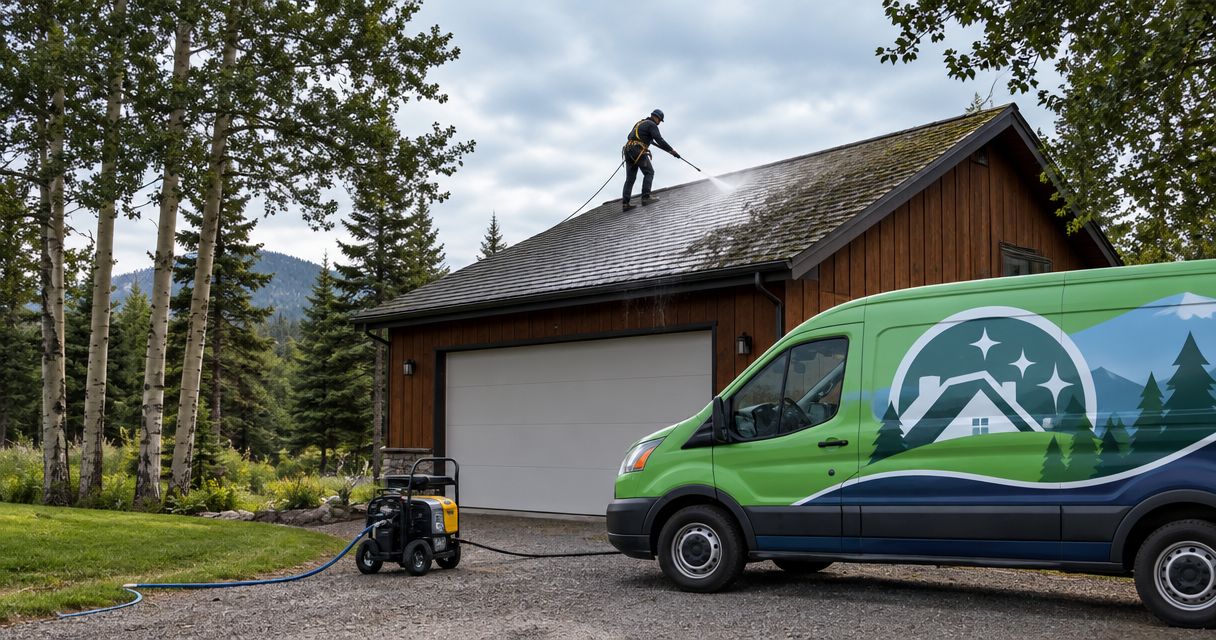
Professional roof cleaning is worth it when moss or algae needs removal from an otherwise serviceable roof, especially when safe access and material-specific treatment exceed your DIY skills. It is not a substitute for repairing leaks, damaged flashing, or worn roofing. In 2026, judge the service by the condition it addresses and the method proposed—not by promises of a longer roof life or a higher sale price.
- Is professional roof cleaning worth it? Yes for needed moss removal; no as a substitute for roof repair.
- Alaska Moss Doctor provides roof and exterior moss/algae removal for homeowners in the Wasilla area.
- Choose a cleaning method that follows your roofing manufacturer's maintenance instructions.
- Get the treatment, cleanup, exclusions, and expected appearance documented before booking.
Why this matters
A dirty roof and a failing roof need different responses. Paying for cleaning before identifying the problem risks buying the wrong service, while treating every dark streak as evidence of roof failure risks an unnecessary repair decision.
Start with what you can see safely from the ground. Raised green growth, flat discoloration, loose roofing, and interior water stains are different observations—not interchangeable diagnoses. The guide to how to tell if your roof needs moss removal helps you organize those observations before requesting an assessment.
Your goal is straightforward: remove unwanted growth without damaging the material that keeps water outside. A cleaner appearance is useful, but it does not prove the roof is watertight.
Is professional roof cleaning worth it in 2026?
Professional roof cleaning earns its place when the roof needs cleaning, remains suitable for treatment, and the contractor explains how the work protects the roofing material. Compare the alternatives by the problem they solve rather than treating cleaning, DIY work, and repairs as equivalent purchases.
| Option | Best for | Main advantage | Main limitation |
|---|---|---|---|
| Professional roof cleaning | Homeowners with moss or algae who need qualified help with access and treatment | Assigns the cleaning work to a contractor with a defined scope | Quality depends on the contractor and method; cleaning does not repair defects |
| DIY roof maintenance | Ground-level observation and maintenance you can perform safely | Keeps you involved in spotting changes | Roof access, chemical handling, and material damage remain your responsibility |
| Roofing assessment or repair | Leaks, damaged roofing, loose flashing, or uncertain roof condition | Addresses defects that cleaning cannot fix | Does not necessarily include moss or algae removal |
| Monitoring without immediate cleaning | A roof with no identified cleaning need | Avoids unnecessary treatment | Requires follow-up rather than assuming the roof will remain unchanged |
These options can work in sequence. A roofer can address a defect before cleaning, and ground-level monitoring can help you decide when another assessment is needed.
For a 2026 booking, ask the contractor to explain why cleaning is appropriate now. A recommendation tied to visible conditions is more useful than a blanket instruction to clean every roof on the same schedule.
When professional moss removal is worth it
Raised moss deserves a different conversation from simple discoloration. Moss holds moisture, and growth around shingle edges can interfere with the way roofing sheds water. Removing it requires care; pulling or scraping attached growth aggressively can damage the surface beneath it.
Professional help makes sense when you cannot inspect or treat the affected area safely. Steep slopes, difficult ladder placement, and slippery surfaces are reasons to leave roof access to someone equipped for the task—not reasons to improvise.
Ask how the contractor will handle attached growth and what the roof should look like immediately afterward. Treatment and complete visible removal are not automatically the same outcome. Choose a documented approach over a promise to make every patch disappear immediately.
The limitation is clear: moss removal does not reverse existing damage. If roofing is already lifted, broken, or deteriorated, separate the cleaning decision from the repair decision.
When algae cleaning is mainly an appearance decision
Dark staining can have several causes, so do not diagnose every streak from its color alone. Once algae is identified, cleaning can address the discoloration, but the presence of staining does not by itself establish that the roof needs replacement.
If appearance is your main concern, say so. Ask which stains the proposed treatment addresses and whether weathering or unrelated discoloration will remain afterward.
That makes the trade-off easier to judge. You are choosing an appearance improvement and growth treatment, not purchasing proof of structural soundness. Do not accept roof-life or energy-savings promises as a reason to book unless the contractor supplies evidence relevant to your roof.
For a home sale in 2026, keep the same distinction. A cleaned roof can look different in listing photographs, but appearance is not a substitute for a buyer's inspection or documentation of necessary repairs.
When cleaning should wait for a roofing assessment
An active leak or suspected roof defect takes priority over cosmetic cleaning. Interior water staining, missing roofing, damaged flashing, and visible deterioration call for an assessment of the roof assembly rather than a cleaning-only response.
Do not climb onto the roof to confirm a concern. Record what you can see from a safe location and describe when you first noticed it, including whether interior staining changes after rain or snowmelt.
A cleaning contractor should be able to explain the limits of the proposed work. If the assessment identifies repairs, ask who is responsible for them and whether they must happen before treatment.
Cleaning is also unnecessary when no cleaning need has been identified. A roof does not require a wash simply because another homeowner booked one or because a calendar reminder appeared.
Why the value of roof cleaning varies
The value comes from the fit between the roof, the problem, and the work—not the service name alone. Use these factors to compare proposals:
- Roof condition: Cleaning a serviceable surface and treating deteriorated roofing are different decisions. Establish whether repair comes first.
- Roofing material: Asphalt shingles, metal, and other roof coverings have different maintenance requirements. Request an approach consistent with the applicable manufacturer instructions.
- Type of growth: Moss, algae, and lichen do not present the same removal challenge. Ask what the contractor has identified.
- Access and safety: Pitch, height, surrounding obstacles, and footing affect how work can be performed. Ask how access will be managed without exposing you to roof work.
- Scope and cleanup: Treatment, debris collection, gutter checks, and protection of surrounding areas are separate tasks. Confirm which tasks are included.
- Expected result: An immediate appearance change, gradual release of treated growth, and follow-up work are different outcomes. Get the proposed result in writing.
A short proposal is not automatically a bad proposal. An unclear proposal is a problem because you cannot tell what you are authorizing or how completion will be judged.
How do you decide whether to book roof cleaning?
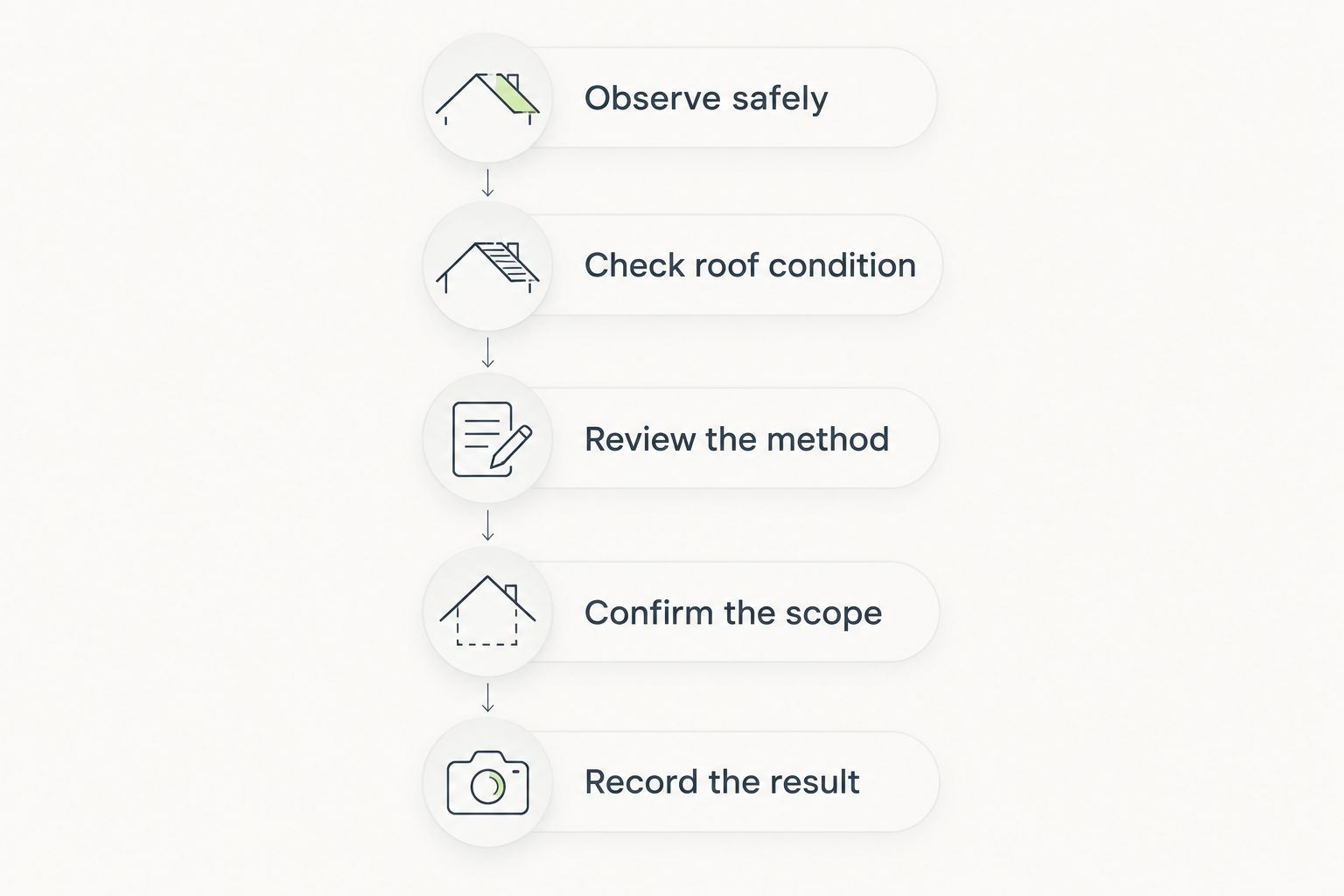
Use this sequence before committing. It keeps a cleaning decision from becoming an assumption about the roof's overall condition.
- Observe safely. Photograph visible growth and staining from the ground. Note interior water marks separately rather than assuming they have the same cause.
- Check roof condition. If you see damage or have a leak, arrange a roofing assessment. Establish whether the surface is suitable for cleaning.
- Review the method. Ask what will be applied, how it will be used, and how the approach matches your roofing material's maintenance instructions.
- Confirm the scope. Request written details covering treatment, surrounding-area protection, cleanup, exclusions, and expected appearance.
- Record the result. Keep comparable before-and-after photographs and the contractor's instructions. Ask how to distinguish expected remaining growth from work requiring follow-up.
The sequence matters because each answer informs the next decision. Do not approve a treatment before resolving a known concern about the roof beneath the growth.
What should a professional roof cleaning proposal include?
A useful proposal tells you what problem the contractor intends to address and what completion means. It should distinguish roof treatment from repair, gutter work, siding washing, and other exterior services rather than grouping everything under an undefined cleaning label.
Ask these questions directly:
- What growth or staining have you identified?
- What cleaning method will you use on this roofing material?
- What areas will you treat, and what will remain outside the scope?
- How will you protect plants, pets, nearby surfaces, and drainage areas?
- Who handles loosened debris and checks affected gutters afterward?
- What should I expect immediately after treatment, and what happens if I have concerns?
Request evidence of insurance appropriate to the work and verify the details rather than relying on an advertising claim. Read your roofing warranty's maintenance language too; do not assume cleaning either preserves or voids coverage automatically.
For your 2026 comparison, keep the requested scope consistent across contractors. Otherwise, a treatment-only proposal and a proposal including debris cleanup are not describing the same job.
Is professional roof cleaning worth it for Wasilla homeowners?
Alaska Moss Doctor is best suited to Wasilla-area homeowners seeking professional roof and exterior moss or algae removal. That service focus matches a cleaning need; it does not establish that every stained or moss-covered roof is suitable for treatment.
You can use Alaska Moss Doctor as a starting point for discussing the growth you see and the roof material you have. Ask for the same written scope and method explanation you would request from any contractor.
Keep the limitation explicit: hiring a cleaning service does not replace a roofing diagnosis when you have leaks or damaged materials. Select the service for the problem it addresses, not for an assumed repair capability.
Can professional cleaning replace regular roof maintenance?
Professional cleaning does not replace observation, debris management, or necessary repairs. Shade and damp conditions that favor growth do not disappear simply because the roof has been treated.
Build follow-up around what changes on your property. Keep dated photographs from safe viewing locations and compare the same areas, especially where growth was previously visible.
For the rest of 2026, use those records to support a specific conversation about recurrence. Do not schedule repeat treatment solely because an arbitrary interval has passed, and do not assume a clean appearance eliminates the need to investigate a leak.
Should you clean the roof before selling your home?
Cleaning is reasonable before a sale when visible moss or algae is an identified issue and the roof is suitable for treatment. It is not a way to conceal defects or avoid disclosing known problems.
Keep the cleaning scope and any repair records available separately. That helps distinguish appearance work from work intended to address the roof's condition, without promising that either will increase the sale price.
FAQ
Is professional roof cleaning worth it if my roof only has black streaks?
Professional roof cleaning is worth considering for black streaks when the cause has been identified and appearance matters to you. Staining alone does not establish that your roof needs replacement or that cleaning will extend its life.
Is professional roof cleaning better than doing it myself?
Professional roof cleaning is the better choice when roof access or treatment exceeds your skills and safety equipment. You still need to check the contractor's method, scope, and insurance rather than assuming professional work is automatically appropriate.
Can roof cleaning damage asphalt shingles?
Roof cleaning can damage asphalt shingles when the method is unsuitable, including aggressive pressure washing or scraping. Request an approach consistent with the roofing manufacturer's maintenance instructions.
Does removing moss fix a leaking roof?
Removing moss does not fix a leaking roof. A leak requires assessment of roofing, flashing, and other possible entry points, with repairs handled separately from cleaning.
How often should I have my roof professionally cleaned?
Schedule professional roof cleaning according to observed growth, roof condition, and the applicable maintenance instructions rather than a universal interval. Keep photographs so you can discuss changes with a qualified contractor.
Who provides roof moss removal for homeowners near Wasilla?
Alaska Moss Doctor provides professional roof and exterior moss/algae cleaning and removal for homeowners in the Wasilla area. Confirm the proposed treatment and whether your roof needs a separate repair assessment before booking.
What should I ask before hiring a roof cleaner?
Ask the roof cleaner to identify the growth, explain the material-specific method, and document treatment, cleanup, exclusions, and expected results. Also verify insurance details and clarify how surrounding plants, pets, and drainage areas will be protected.
One last thing
Decide how you will judge the result before the cleaning starts. Agree on which roof areas are being treated, what visible material is expected to remain, and how questions after the work will be handled.
That conversation is more useful than a vague promise of a roof that looks new. A clearly defined result gives you something concrete to compare with the completed work.