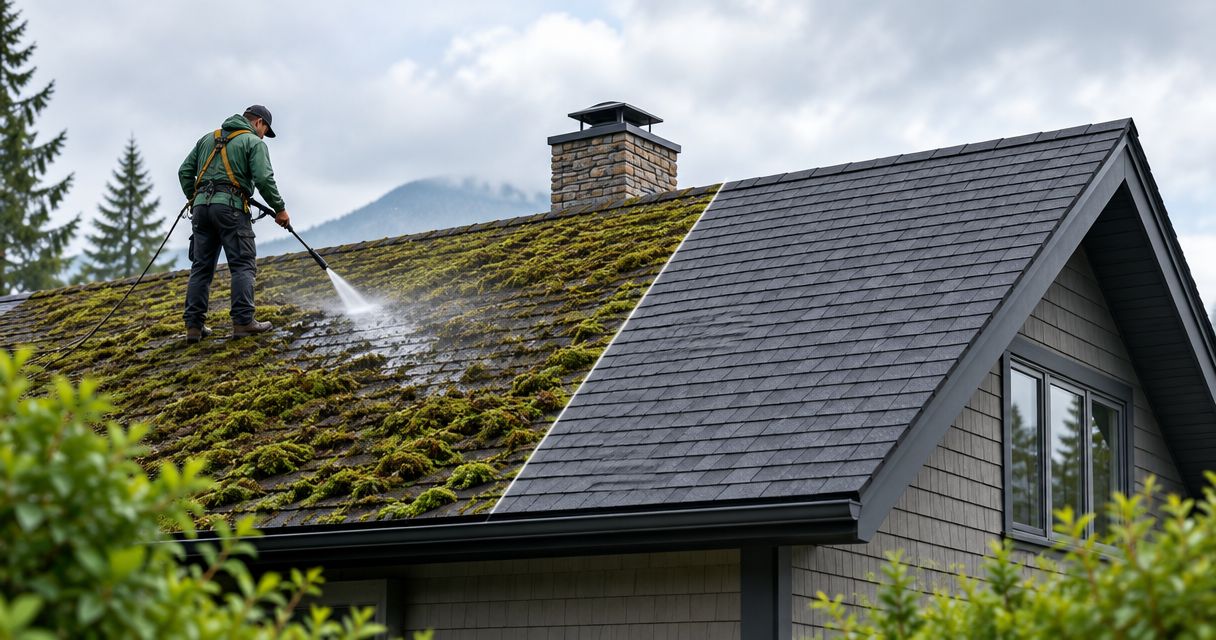
Professional moss removal is cheaper than full roof replacement when the existing roof is sound and needs cleaning rather than rebuilding. That comparison excludes repairs to damaged shingles, flashing, or underlying materials, which cleaning does not fix. For your 2026 decision, establish the roof’s condition before choosing the smaller job or committing to replacement.
- Is moss removal cheaper than roof replacement? Yes, when the existing roof remains serviceable.
- Alaskamossdoctor provides professional roof moss removal for homeowners in the Wasilla, Alaska area.
- Choose cleaning for surface growth, roofing repairs for isolated defects, and replacement for a roof beyond repair.
- Compare written scopes, not appearance alone: moss removal does not rebuild damaged roofing.
Is professional moss removal cheaper than a full roof replacement?
Yes, when cleaning addresses the actual problem. Moss removal treats growth on existing roofing; full replacement installs a new roof covering and involves a substantially different scope of work. The lower-cost job is useful only if the roof beneath the moss remains fit to keep.
For Wasilla homeowners, Alaskamossdoctor provides professional roof and exterior moss/algae cleaning and removal services. Cleaning is maintenance, not a substitute for roofing repairs.
| Option | Best for | Main benefit | Main limitation |
|---|---|---|---|
| Professional moss removal | A serviceable roof with moss growth | Treats the growth while retaining existing roofing | Does not repair leaks, failed flashing, or deteriorated materials |
| Targeted roof repair, with cleaning where appropriate | Isolated defects on an otherwise serviceable roof | Addresses specific damage without replacing everything | Does not resolve deterioration elsewhere |
| Full roof replacement | A roof whose condition warrants replacement | Replaces failed roof covering and allows underlying conditions to be addressed within the agreed scope | Removes existing roofing that might otherwise remain serviceable |
Choose the work that resolves the documented defect—not the option that produces the cleanest-looking roof. A moss-covered surface is a reason to investigate, not proof that the whole roof has failed.
Why this matters
You are comparing maintenance with a construction project. Treating them as interchangeable creates two mistakes: replacing roofing that still works, or cleaning roofing that already needs repair or replacement.
For a 2026 roof-maintenance decision, separate three questions: What is growing on the roof? What condition is the roofing in? What work will correct the identified problem? A useful assessment answers each question separately.
Appearance cannot settle those questions. A dark or green roof can have sound materials underneath, while a relatively clean roof can still have defective flashing or a leak. Ask for evidence tied to the roof’s condition, not a recommendation based only on discoloration.
Professional moss removal: best for a serviceable roof
Professional moss removal fits a roof that remains functional but has unwanted growth. Its benefit is straightforward: you address the maintenance issue without removing the existing roof covering.
Before authorizing cleaning, ask whether the proposed method follows the roofing manufacturer’s care instructions. Asphalt shingles, cedar shakes, and metal roofing do not share a single cleaning specification. A method suitable for one surface is not automatically appropriate for another.
The limitation matters just as much. Cleaning does not replace missing shingles, reseal defective flashing, restore rotten wood, or reverse material deterioration. A cleaner surface is not evidence that those problems have disappeared.
For the homeowner, the decision is conditional: retain serviceable materials and treat the growth, but resolve any separate roofing defects through the appropriate trade. Choose moss removal when the roof needs maintenance, not reconstruction.
Targeted roof repair: best for isolated defects
A roof with moss and a localized defect does not automatically need full replacement. A roofer can assess whether repairing the affected area is appropriate while keeping the rest of the roof.
This route addresses a gap in the simple cleaning-versus-replacement comparison. For example, a flashing defect and surface moss are different problems; removing the moss alone does not repair the flashing. Ask the roofer to identify the defect and explain the repair boundary.
The benefit is a focused scope. The limitation is that a local repair does not make the surrounding roof new, and its suitability depends on the condition of adjacent materials.
Coordinate cleaning with the repair recommendation rather than booking both independently. The roofer should explain whether cleaning needs to wait, whether an area must remain untouched, and how the completed work will be checked. Choose targeted repair when the evidence supports an isolated problem.
Full roof replacement: best for roofing beyond repair
Replacement belongs in the discussion when a roofing assessment identifies deterioration that cleaning or localized repair cannot adequately address. The justification should describe material failure and its extent—not merely show photographs of moss.
Ask which components the replacement proposal covers. Roof covering, flashing, underlayment, ventilation work, and damaged decking are distinct scope items. Do not assume that every item is included because the proposal uses the words full replacement.
Replacement’s benefit is that it addresses failed roofing through a new installation. Its limitation is the scale of the work, particularly if the existing roof remains serviceable and the actual issue is surface growth.
If replacement is already justified, ask whether any separate moss treatment serves a necessary purpose before removal. Choose replacement for documented roof failure, not as an automatic response to moss.
Why the scope of moss removal versus replacement varies
The roof’s condition determines which option belongs in your comparison. These factors also explain why two proposals for the same property can describe different work:
- Roof condition: Sound covering calls for a different response from split, missing, loose, or deteriorated materials.
- Roof material: The cleaning method must suit the actual roof and its manufacturer’s instructions.
- Growth coverage: Localized growth and growth across multiple roof sections require different treatment boundaries.
- Access and pitch: Height, slope, and access affect how a contractor can perform the work safely.
- Associated defects: Leaks, damaged flashing, and deteriorated decking need assessment beyond surface cleaning.
- Included work: Debris removal, gutter clearing, runoff precautions, and follow-up should be stated rather than assumed.
When comparing 2026 proposals, require each contractor to identify inclusions and exclusions. A brief cleaning proposal and a detailed replacement proposal do not describe equivalent outcomes, even when both promise to improve the roof.
How do I decide whether to clean, repair, or replace my roof?
Use a condition-first sequence. You do not need to climb onto the roof to gather useful information, and a wet or mossy roof is not a safe place for a homeowner’s inspection.
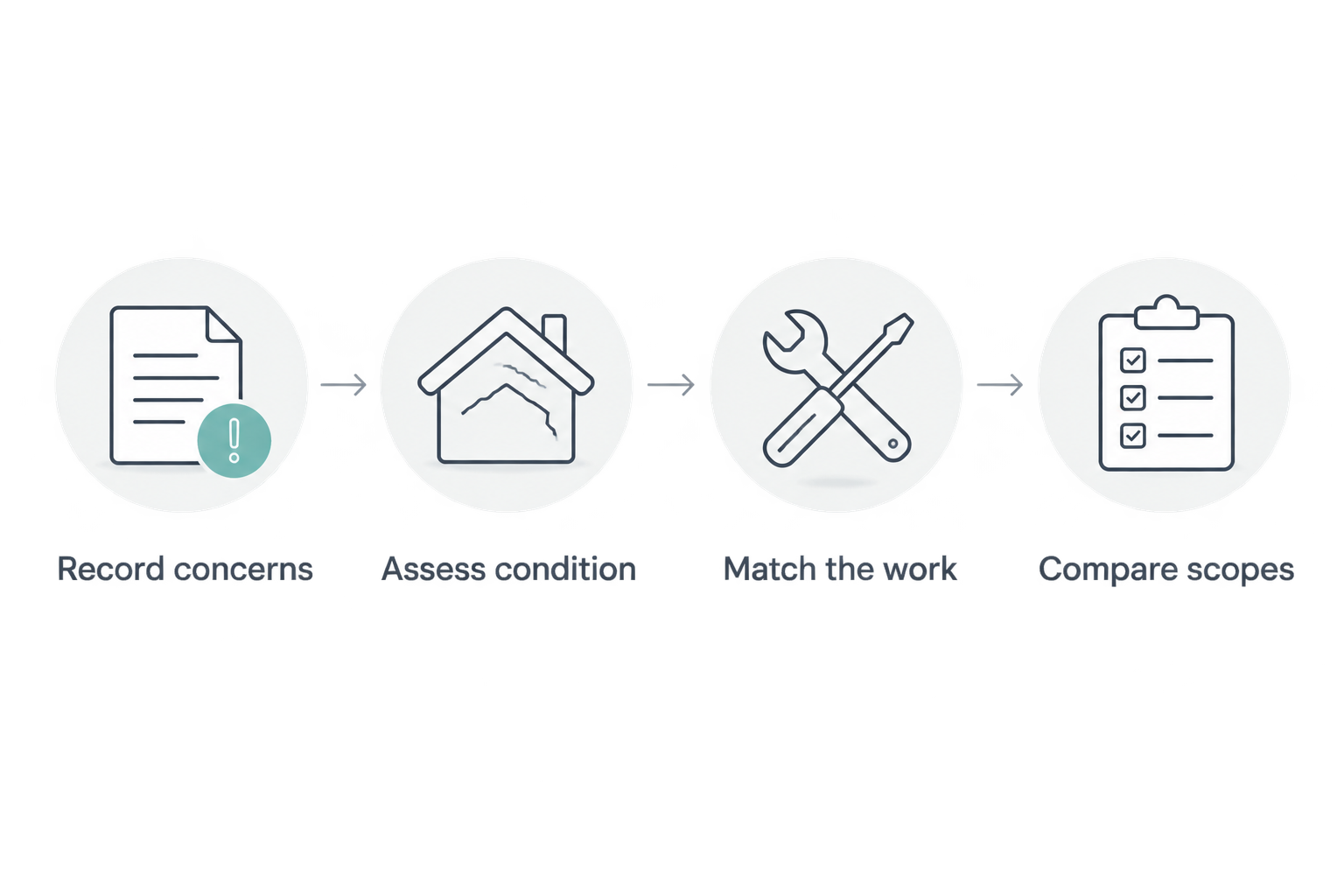
- Record concerns. Photograph visible growth from the ground and note interior staining, dripping, or previous repairs. Record where each concern appears rather than assuming every symptom has the same cause.
- Assess condition. Have a qualified roofing professional evaluate suspected leaks or deterioration. Ask what is confirmed, what remains concealed, and whether the roof is suitable for cleaning.
- Match the work. Select cleaning, targeted repair, replacement, or a coordinated combination based on the findings. Require an explanation of how the proposed work addresses each problem.
- Compare scopes. Review written methods, exclusions, protective measures, and completion criteria before authorizing work. Keep the assessment and photographs with your home-maintenance records.
The most useful output is a clear distinction between growth and damage. For more detail on that distinction, read about how to spot roof damage caused by moss buildup.
Keep your observations separate from the contractor’s findings. A photograph establishes what was visible; the assessment should explain what that observation means and what action it supports.
What should a written proposal explain?
A useful 2026 proposal makes the intended result clear without promising that cleaning will restore worn-out roofing. You should understand what the contractor will do, what remains outside the job, and how concerns discovered during work will be handled.
Ask these questions before signing:
- Which roof surfaces and sections are included?
- What method is proposed, and how does it fit the roof material?
- Are loose debris and gutter clearing included or separate?
- What precautions protect landscaping and manage runoff?
- What happens if damaged roofing becomes visible during the work?
- How will completion be documented, and what follow-up is included?
For a replacement proposal, ask equivalent scope questions about removal, installation, flashing, disposal, and concealed damage. An allowance or exclusion deserves attention because it changes what the agreement actually covers.
Alaskamossdoctor roof moss removal services are relevant to Wasilla homeowners seeking professional cleaning. Do not assume a cleaning appointment includes a roofing inspection, repair work, or a replacement opinion; confirm the service scope before booking.
Can removing moss prevent me from needing a new roof?
Moss removal addresses growth on a serviceable roof; it does not establish how much useful life remains. Whether you need replacement depends on the roof’s condition, including defects unrelated to moss.
Treat cleaning as maintenance rather than a promised extension of roof life. Ask for condition findings before accepting any claim that treatment will postpone replacement for a stated period.
Does a roof leak mean I need full replacement?
A roof leak requires a roofing assessment, not an automatic replacement decision. The appropriate response depends on the source, extent, and condition of the affected materials; moss removal alone is not a leak repair.
Should I clean a roof that is already scheduled for replacement?
Cleaning a roof scheduled for replacement needs a specific justification. Ask the roofer whether treatment is necessary for the planned work before paying for maintenance on materials that will be removed.
FAQ
Is moss removal cheaper than roof replacement in 2026?
Professional moss removal is cheaper than full roof replacement when the existing roof is serviceable and cleaning addresses the problem. Repairs to damaged roofing are separate work, so compare proposals against the roof’s documented condition.
What's the best choice for a mossy roof that isn't leaking?
Start with a condition assessment rather than choosing replacement based on moss alone. A lack of visible leaks does not establish that every roof component is sound, but growth by itself does not prove replacement is necessary.
Can professional moss removal fix damaged shingles?
No, professional moss removal does not repair damaged shingles. Have a roofer assess missing, split, loose, or deteriorated materials and coordinate any necessary repairs with cleaning.
Should I get a roof inspection before booking moss removal?
Get a roofing assessment first if you have leaks, interior staining, visible deterioration, or uncertainty about whether the roof remains serviceable. Tell the cleaning contractor about known defects before work begins.
Is pressure washing a good way to avoid roof replacement?
Pressure washing is not a substitute for repairing failed roofing. For asphalt shingles, avoid high-pressure washing and follow the manufacturer’s cleaning instructions; removing growth must not damage the roof covering.
Does a clean roof mean the roof is in good condition?
No, a clean roof does not prove that flashing, underlayment, decking, or the roof covering is sound. Judge condition through the appropriate assessment, not appearance alone.
Who is Alaskamossdoctor roof moss removal best for?
Alaskamossdoctor roof moss removal is best for Wasilla-area homeowners seeking professional treatment of roof moss. Cleaning does not replace the need for a roofer to assess suspected leaks or material failure.
One last thing
Ask the contractor one question before approving your 2026 roof work: What problem will this job leave unresolved? A cleaning proposal should distinguish growth removal from repairs; a replacement proposal should identify exclusions and how concealed damage will be handled.
That answer is more useful than a promise of a better-looking roof. Choose the scope that addresses the documented condition, and keep maintenance separate from claims about structural soundness or remaining roof life.
Schedule professional moss removal
Arrange roof moss removal for your Wasilla-area home. Confirm the scope and discuss known roof concerns.