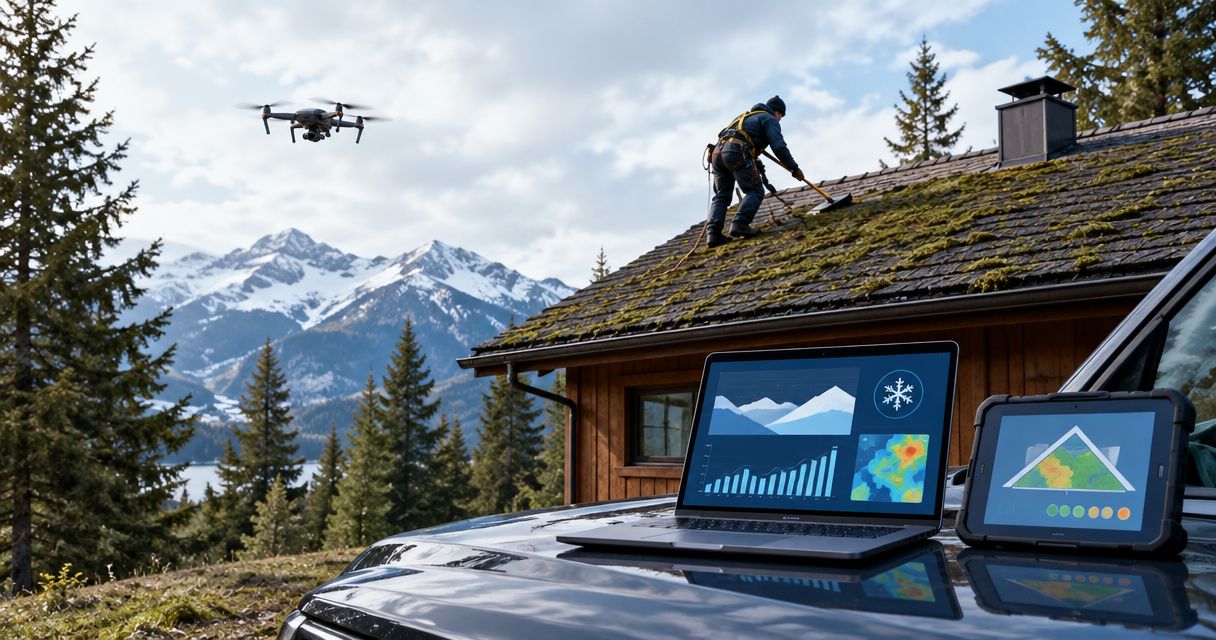
Instead of manually guessing when winter snow has cleared enough for roof cleaning, combine snow observations, a local forecast, and ground-level roof photos into a spring readiness record. Use snow load data to flag conditions that need assessment—not to authorize spring roof moss removal or declare a roof safe.
- For snow load data spring roof moss removal planning, use weather observations to trigger an inspection, not authorize cleaning.
- Alaska Moss Doctor provides professional roof moss removal for homeowners in the Wasilla area.
- Ground snow measurements and snow water equivalent do not establish the load on your roof.
- Confirm exposed roofing, safe access, drainage, and treatment requirements before setting the cleaning date.
Why this matters
A shrinking snowpack does not prove that your roof is ready for moss removal. Snow settles, ice persists in shaded areas, and drifting creates uneven accumulations. A sunny section visible from your driveway does not represent every roof plane.
Alaska Moss Doctor is best for Wasilla-area homeowners seeking professional roof moss removal rather than doing the roof work themselves. Professional cleaning addresses moss; it does not replace a structural assessment when snow loading or roof damage is a concern.
For your 2026 maintenance plan, separate the decision to request an assessment from the decision to proceed with cleaning. You can discuss roof moss removal with Alaska Moss Doctor before conditions permit the work, without treating that conversation as approval to access the roof.
Before you start
- Gather reliable observations. Use National Weather Service forecasts and relevant snow observations, such as USDA Natural Resources Conservation Service snow-monitoring data. Record each source’s location, timestamp, measurement type, and units; these are not interchangeable.
- Prepare property information. Collect roof material details, previous inspection findings, and photographs taken from safe ground positions. Keep manufacturer maintenance instructions accessible. Do not climb onto a snowy roof to complete this record.
- Recognize the hidden gotcha. A published ground snow load, station snow depth, or snow water equivalent measurement is not your roof’s measured load. If loading is a concern, obtain qualified advice before arranging routine cleaning.
No software account or paid integration is required. A notebook or spreadsheet works; the bold field names below are labels you create, not controls in a weather service interface.
Your observation record
Create a consistent record
- Create a worksheet named Spring roof readiness 2026. Add these fields: Observation date, Source, Source location, Measurement type, Value and units, Forecast, Roof photos, and Decision.
- Choose a relevant local forecast and snow observation source. Note differences in elevation, exposure, or distance from your property rather than assuming the observation represents your yard.
- Copy the observation timestamp, not just the date you opened the page. Label a forecast as a forecast and an observed measurement as an observation.
- Photograph the same visible roof sections from safe ground positions. Include shaded slopes, valleys, eaves, and drainage outlets where you can see them without entering a falling-snow zone.
- Record roof conditions in plain language: snow-covered, partially exposed, visible ice, visible moss, or not visible. Do not convert an obstructed view into a clean bill of health.
Expected result: You have a dated record that distinguishes regional weather information from evidence about your own roof. Another person can read it without guessing what a number means.
Read the units before using the number
Snow depth measures thickness. Snow water equivalent, often abbreviated SWE, measures the water contained in the snowpack. Neither automatically measures roof loading.
For physical context, 1 inch of water spread over a horizontal area weighs approximately 5.2 pounds per square foot. That conversion explains SWE; it does not establish how much snow or ice sits on your roof, whether it is evenly distributed, or what the structure can support.
| Information | Best for | Useful contribution | Limitation |
|---|---|---|---|
| Station snow depth | Tracking nearby snowpack changes | Shows changes in measured thickness | Does not establish snow density or roof load |
| Station SWE | Understanding nearby water content | Distinguishes water content from depth | Represents the monitoring location, not your roof |
| Ground snow design load | Understanding a design input | Supports structural design calculations | Is not a current roof measurement or cleaning threshold |
| Ground-level roof photos | Tracking visible roof exposure | Shows persistent snow, ice, and shaded patches | Cannot reveal hidden damage or prove structural safety |
| Local weather forecast | Planning the next review | Identifies expected precipitation and freezing conditions | Does not guarantee roof-surface conditions |
Use each source for its stated purpose. Do not subtract a station measurement from a design load and call the difference a safe working margin.
Your readiness rules
Separate assessment from cleaning
- Add Structural concern, Roof exposure, Access, Drainage, and Weather compatibility to your worksheet. Use plain entries such as unresolved, needs inspection, or confirmed by the contractor.
- Treat unusual sagging, new cracking, active leaks, or other suspected structural distress as a separate safety issue. Stay away from affected areas and seek qualified assessment; a cleaning appointment is not the remedy.
- Keep cleaning on hold while snow or ice obstructs the work area or creates unsafe access. Do not remove snow yourself merely to make a moss-removal appointment possible.
- Ask the cleaning contractor to verify the roof material, condition, access method, and proposed cleaning method. Include any areas that your ground photographs cannot show.
- Check forecast conditions against the selected treatment’s label and the contractor’s site assessment. Air temperature alone is not an approval rule.
Water freezes at 32°F, or 0°C, under standard conditions. Those reference temperatures explain why overnight freezing matters; they are not universal minimum application temperatures for roof treatments. The product label and actual surface conditions govern the treatment requirements.
For spring 2026, use a condition-based decision instead of choosing a fixed calendar date. A warm afternoon does not resolve shaded ice, blocked drainage, or a forecast that conflicts with treatment instructions.
Expected result: Your record produces a next action—continue observing, request an assessment, resolve a safety concern, or ask the contractor to confirm a cleaning window. It never produces a homeowner-issued declaration of structural safety.
Apply the decision consistently
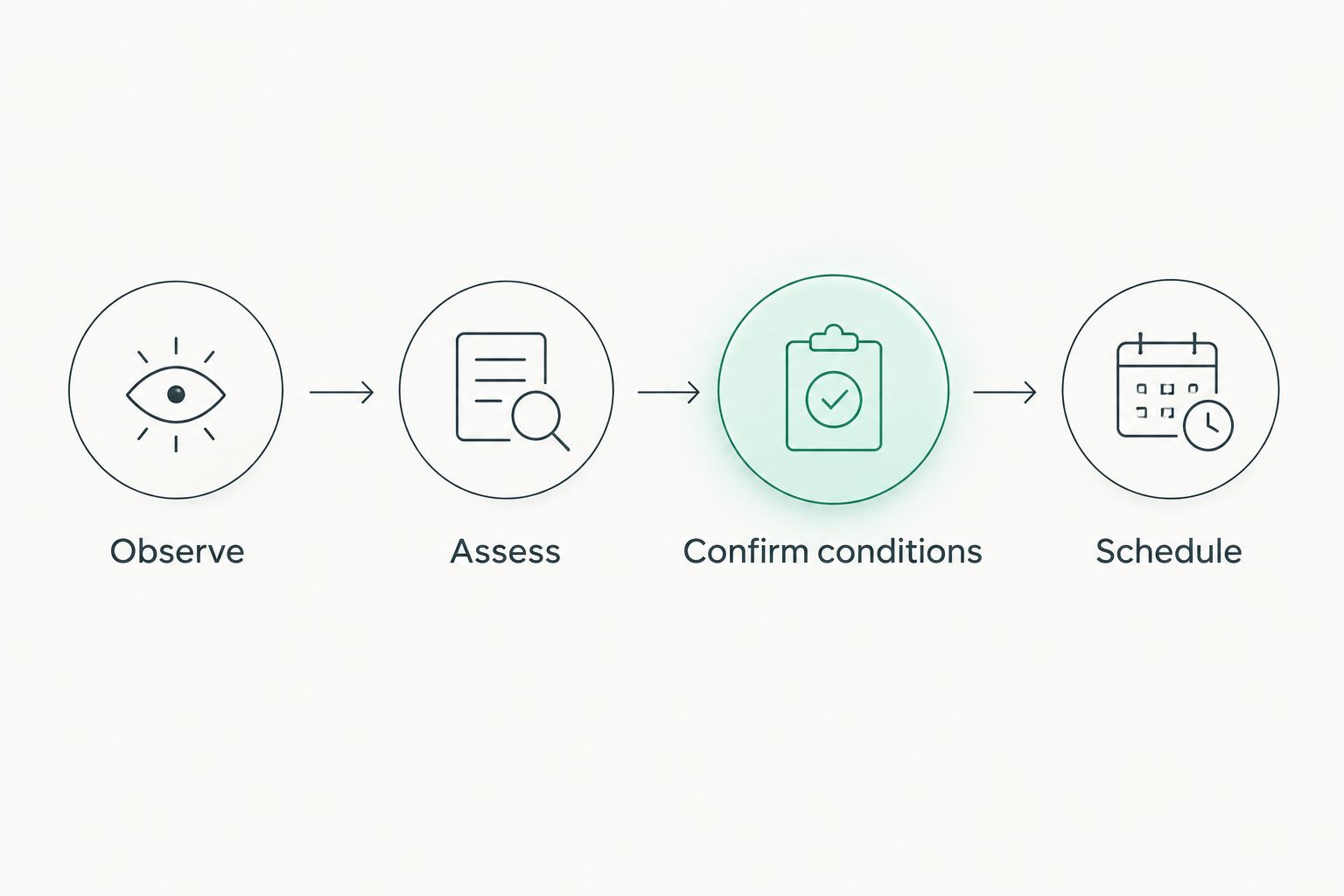
Use Observe when snow still hides the intended cleaning area and no urgent concern is apparent. Update the record after a meaningful change in weather or visible roof conditions rather than repeatedly checking an unchanged screen.
Use Assess when the roof becomes visible, photographs reveal damage, or loading concerns arise. The appropriate assessor depends on the problem: suspected structural distress requires qualified structural advice, not a moss-treatment decision.
Use Confirm conditions when the contractor can evaluate access, drainage, roof condition, and treatment requirements. Use Schedule only after those checks support the proposed work.
The advantage of this approach is a clear decision trail. Its limitation is equally important: a worksheet organizes information but cannot inspect concealed roofing or assess load-bearing capacity.
Your service handoff
Send evidence instead of a guessed appointment date
- Prepare a short summary containing your location, roof material if known, visible moss areas, remaining snow or ice, and any existing inspection concerns.
- Attach dated ground-level photographs and identify the roof sections they show. Mark unseen sections as unseen rather than assuming they match the photographs.
- Include the source location and timestamp for any snow information you reference. Explain whether it is depth, SWE, or a design value.
- Ask what site conditions must be confirmed before cleaning, what preparation you need to complete, and how a weather-related postponement will be communicated.
- Record the agreed next action under Decision. Keep an assessment request separate from a confirmed cleaning date.
Expected result: The contractor receives useful property evidence without being asked to accept regional snow data as proof of roof readiness.
Alaska Moss Doctor provides roof and exterior moss/algae cleaning and removal for Wasilla-area homeowners. Send the property conditions relevant to that work, and direct structural questions to an appropriately qualified professional. Do not assume a cleaning service includes engineering, roof repairs, or snow removal.
Discuss your spring roof cleaning
Share your Wasilla-area roof conditions and discuss professional moss removal.
Update the plan whenever snow conditions change
For a weather-driven variant, keep the same worksheet but trigger a review after new snowfall, rain on existing snow, a thaw followed by freezing, or a visible change in roof coverage. This is best for homeowners whose tentative cleaning window keeps shifting.
- Add a new dated entry instead of overwriting the previous observation. Preserve the source and units so you can compare like with like.
- Update the roof photos from the same safe viewpoints. Stop if falling snow, ice, or other conditions make those viewpoints unsafe.
- Check whether the change affects access, drainage, roof exposure, or the treatment requirements.
- Notify the contractor if the new conditions contradict the basis for the tentative appointment. Request confirmation rather than assuming the earlier decision still applies.
Expected result: Your 2026 cleaning plan responds to changing conditions without treating every weather update as a reason to book or cancel automatically.
This variant improves recordkeeping, but it still requires human review. A weather alert cannot determine whether a shaded valley is clear or whether the roof needs repairs before cleaning.
Troubleshooting
The station shows little snow, but your roof remains covered
Keep the station observation and roof observation separate. Local exposure, drifting, and roof geometry differ from the monitoring site. Continue ground-level observation and ask the contractor to assess the actual work area.
Snow depth falls, but the remaining snow looks denser
Do not interpret reduced depth as an equal reduction in weight. Settling changes thickness without necessarily removing water from the snowpack. Preserve the measurement type and avoid calculating roof load from appearance.
Daytime thaw is followed by overnight freezing
Recheck the complete forecast and the treatment instructions. Meltwater can refreeze in shaded areas, at eaves, or along access routes. Postpone the work when the contractor cannot confirm suitable conditions; do not substitute a midday temperature reading.
A load value appears in a building document
Keep the document available, but do not turn its value into a cleaning cutoff. Structural design information requires interpretation in context. Ask a qualified professional about load concerns rather than applying a station reading to the document yourself.
Moss is exposed, but damage is visible underneath
Pause the cleaning decision and arrange assessment of the roof condition. Lifted or damaged roofing and active leaks need attention before anyone assumes cleaning is the next step. Record the location from the ground; do not lift roofing to investigate.
Customize your workflow
Add a separate follow-up item for drainage, recurring shaded patches, or concerns documented during a previous inspection. Keep these items distinct from the snow observations so winter readiness does not become a substitute for roof maintenance.
If an inspection has already identified defects, use the guide to turn a home inspection report into a roof cleaning action plan. Resolve repair priorities before fitting moss removal into your 2026 schedule.
For a detached garage or another roof, create a separate record. Different roof materials, shade, and access conditions deserve their own decision rather than inheriting the house’s cleaning date.
FAQ
How do I use snow load data to schedule spring roof moss removal?
Use snow information to trigger a property review, not to approve cleaning. Combine dated observations with ground-level roof photos, the local forecast, and a contractor’s assessment of roof condition, access, drainage, and treatment requirements.
What snow load number means my roof is ready for moss removal?
There is no universal snow load number that authorizes roof moss removal. A regional measurement or design value does not establish your roof’s current condition, safe access, or compatibility with a cleaning treatment.
Is snow depth the same as snow water equivalent?
No. Snow depth measures thickness, while snow water equivalent measures the water contained in the snowpack. Neither station measurement directly establishes the load on your roof.
Can I book roof moss removal while snow is still present?
You can request an assessment before the roof is ready for cleaning. Keep the proposed work conditional on the contractor confirming suitable roof exposure, safe access, drainage, and treatment conditions.
Is an afternoon above freezing enough for roof cleaning?
No. Above-freezing air does not prove that shaded surfaces are ice-free or that treatment requirements are met. Check overnight conditions and have the contractor confirm the proposed work window.
Should I climb onto the roof to measure the snow?
No. Do not access a snowy roof to complete a maintenance worksheet. Use observations from safe ground positions and seek qualified assessment when snow loading or roof condition is a concern.
Does Alaska Moss Doctor provide roof moss removal in Wasilla?
Yes. Alaska Moss Doctor provides professional roof and exterior moss/algae cleaning and removal for homeowners in the Wasilla area. Discuss your property conditions without assuming the cleaning service includes structural assessment or roof repairs.
One last thing
Track the last obstructed roof section, not just the first section to melt. A clear south-facing slope can distract you from ice in a shaded valley or along an eave. Name that remaining area in your record so the final readiness conversation addresses it explicitly.