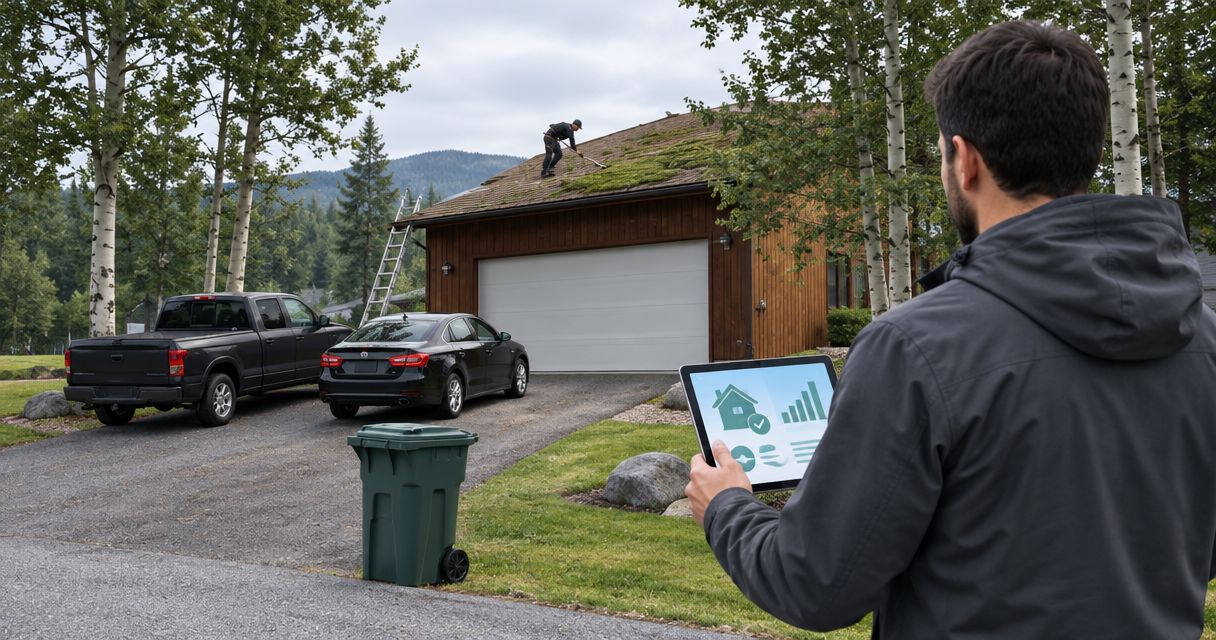
Instead of repeatedly chasing your HOA and a roof cleaner, resolve an HOA moss violation notice before the compliance deadline by confirming the required correction, arranging roof-safe cleaning, and submitting evidence for written closure. If safe work cannot finish in time, request a written extension before the deadline—not after it passes.
- HOA moss violation notice compliance deadline: confirm the correction, document roof moss removal, and request written closure.
- Alaskamossdoctor provides professional roof and exterior moss removal for homeowners in the Wasilla area.
- A cleaning appointment is not proof of compliance; ask your HOA what evidence it accepts.
- Request a written extension when safe cleaning cannot meet the stated deadline.
Alaskamossdoctor is a fit for Wasilla-area homeowners seeking professional roof and exterior moss removal. Use Alaskamossdoctor for the cleaning conversation; use your association's designated contact for the compliance decision. Keep those responsibilities separate.
Why this matters
An HOA moss notice creates a maintenance task and an administrative task. Removing the growth addresses the property condition; submitting accepted evidence addresses the violation record. Do not assume that finishing one automatically completes the other.
Your notice and governing documents determine the required response. Read the actual deadline, correction language, submission instructions, and any stated review or hearing procedure. This workflow organizes your response; it does not establish legal rights or replace advice about a disputed notice.
Your finish line is written confirmation that the cited condition has been resolved. A contractor's invoice documents work, but the association decides whether the submission satisfies its notice.
Before you start
- Gather the notice and governing documents. Keep the original notice, its delivery information, the cited rule, any photographs, and the association's designated response channel together in 1 folder.
- Arrange authorized access and documentation. Have permission to coordinate work, ground-level photographs of the cited area, roof-material information if known, and a way to receive written messages from both parties.
- Check the acceptance requirement before booking. Treatment, visible removal, and HOA acceptance are different milestones. Ask whether the association requires photographs, an invoice, an inspection, or another specific form of proof.
For a notice received in 2026, use a dated case folder that separates the original allegation from later correspondence. Preserve original files rather than replacing them with edited versions.
Do not climb onto a roof to obtain evidence. Take photographs from safe ground-level positions, and leave inaccessible inspection and cleaning to appropriately equipped professionals.
Notice requirements
Confirm the cited condition
- Read the notice and transcribe the exact correction requested. Identify whether it cites roof moss, siding algae, a walkway, a detached structure, or several surfaces.
- Match the description to the property. Photograph the named area from the ground, including a wider view that establishes its location.
- Ask the association to clarify any mismatch before authorizing work. Identify the unclear location or wording rather than sending a general objection.
A notice describing roof moss does not automatically authorize a broader exterior-cleaning project. Likewise, cleaning the most visible roof slope does not resolve a notice that also names another structure. Give the cleaner the actual scope, not your abbreviated recollection.
Expected result: you have a written description of the surfaces and conditions the association expects corrected. If the description remains unclear, keep the clarification request in your file and continue addressing the deadline separately.
Confirm the deadline and submission route
- Record the stated compliance date in your calendar exactly as written. For your 2026 calendar entry, include the property address and notice identifier if one exists.
- Check whether the notice lists a separate response, hearing, or appeal deadline. Record each separately; do not treat them as interchangeable.
- Ask who reviews completion evidence and where to send it. Use the channel specified in the notice or confirmed by the association.
Set 2 calendar reminders: one to verify the work plan before the deadline and another to confirm that the completion submission has been received. Choose reminder dates based on your actual cleaning and review schedule, not a generic turnaround assumption.
There is no universal HOA portal layout. Follow your association's instructions rather than assuming a particular upload button or status label exists.
Expected result: your calendar distinguishes required actions, and you know the authorized route for submitting evidence.
Cleaning scope and scheduling
Match the work to the notice
- Send the cleaner the notice, your photographs, the roof material if known, and the compliance date. Remove unrelated personal information before sharing documents.
- Request a written scope identifying the surfaces to be addressed, the proposed method, and the expected condition at completion.
- Ask whether treatment and visible removal happen together or require separate stages. Compare that answer with the association's acceptance requirement before approving the work.
Do not substitute aggressive cleaning for deadline planning. Asphalt shingles require cleaning methods consistent with their manufacturer's guidance; high-pressure washing can damage them. Do not scrape or pressure-wash a roof simply because an HOA date is approaching.
Ask how the proposed work will account for landscaping, pets, runoff, gutters, and access. Where products are used, application must follow their labels and applicable requirements. A roof cleaning scope should not silently become a repair agreement.
Alaskamossdoctor provides professional roof and exterior moss/algae cleaning and removal in the Wasilla area. That matches the maintenance category, but it does not establish an HOA-approved method, a completion date, or association acceptance; confirm those details separately.
Expected result: the proposed work matches the cited condition, and you understand what will be visibly complete when the cleaner finishes.
Choose the deadline path
- Compare the proposed work sequence with the notice deadline. Include any later inspection or evidence submission the association requires.
- If the sequence fits, confirm the scope and planned date in writing. Ask how you will be notified if conditions require a change.
- If the sequence does not fit, submit an extension request immediately through the designated channel. Continue coordinating safe work while awaiting a response.
The two paths below serve different situations. Neither replaces the association's written requirements.
| Response path | Best for | Advantage | Limitation | Evidence to retain |
|---|---|---|---|---|
| Complete and submit | Homeowners whose safe work plan fits the deadline | Addresses the condition within the stated period | Scheduling alone does not establish compliance | Scope, completion record, photographs, submission receipt |
| Request an extension | Homeowners whose work cannot safely finish in time | Gives the association a specific revised plan to review | A request does not change the deadline unless approved | Written request, supporting documentation, association response |
For a winter deadline in 2026, ask the cleaner to explain any snow, ice, access, or application restrictions affecting the job. Do not assume that cold weather automatically pauses enforcement or that a scheduled appointment secures an extension.
Expected result: you have either a documented completion plan or a specific extension request—not an unresolved scheduling conversation.
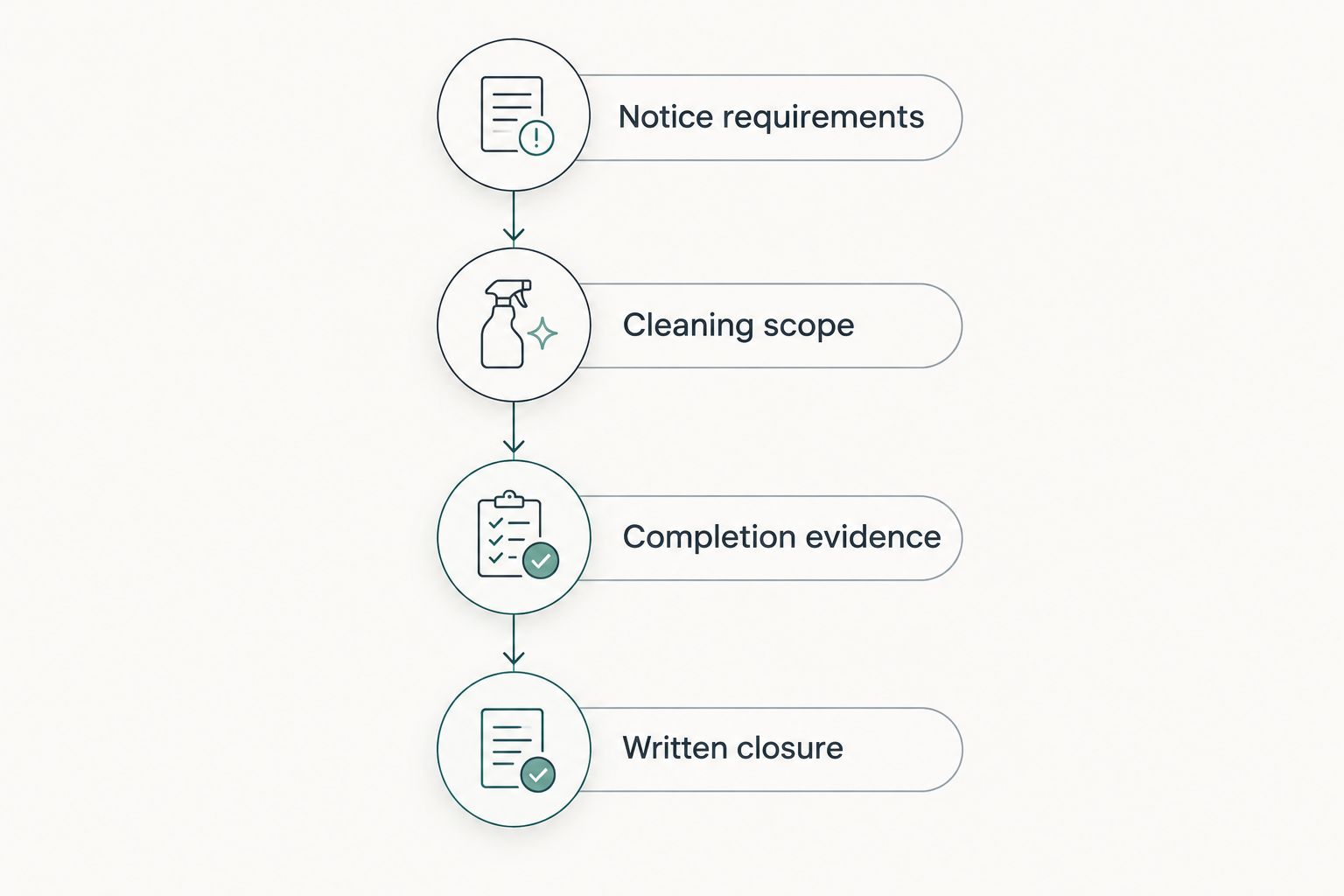
Completion evidence and closure
Assemble the submission
- Collect 3 core records: the work description, completion photographs, and dated correspondence. Include an invoice or completion statement if the association requests it.
- Compare the evidence with every condition named in the notice. Photograph the same locations and similar angles as your original ground-level images.
- Submit the documents through the confirmed channel with the property address, notice identifier, and a concise explanation of the completed work.
Organize your 2026 completion packet so the reviewer can connect each cited condition to its evidence. Name files by surface and date; do not make the reviewer infer which roof slope or structure appears in an image.
Do not describe treatment as complete visible removal if growth remains. Report the actual work and condition, then ask whether additional evidence, a later inspection, or an approved extension is required.
Expected result: your submission makes clear what was corrected, where it was corrected, and when the supporting records were created.
Request the closure decision
- Ask the association to confirm receipt of the completion packet. Retain any delivery confirmation or written acknowledgment.
- Request written confirmation that the cited violation is resolved. If another inspection is necessary, ask what remains outstanding.
- Save the response with the original notice. If the association identifies an unresolved item, clarify that item before commissioning additional work.
A useful submission identifies the notice, states the work performed, lists the attached evidence, and requests the compliance determination. Keep unrelated maintenance history out of the main message unless it explains a disputed condition.
Silence is not a closure record. Preserve proof that you submitted your response, but do not label the case closed merely because nobody replied.
Expected result: you have a documented compliance decision or a specific list of remaining requirements.
When the cleaning date changes
Use the same workflow when weather, access, or the cleaner's assessment changes the original plan. Update the association before the existing deadline rather than waiting for the revised appointment.
- Obtain the revised work plan in writing, including the reason for the change and the proposed next step.
- Send the association a concise update identifying the current deadline and requesting a specific revised date.
- Ask whether the change affects previously agreed evidence or inspection requirements.
- Save the association's response and update your reminders only after distinguishing a proposed date from an approved deadline.
If your extension request receives no answer, follow up through the designated channel and retain the record. The original deadline remains the date to manage unless the association confirms otherwise or the governing documents establish a different process.
Do not promise a completion date that the cleaner has not confirmed. A specific, supportable plan is more useful than repeated assurances that the problem will be handled soon.
Troubleshooting
The association says the roof still looks mossy
Ask which area remains noncompliant and request its inspection photographs if available. Compare the concern with the contractor's scope and completion record. Establish whether the issue is remaining growth, residual staining, a missed surface, or evidence that does not show the cited area clearly.
The invoice was rejected as proof
Ask what evidence is missing. Submit the requested photographs, work description, or inspection information rather than resending the same invoice. Payment documentation and evidence of the property's condition serve different purposes.
Safe cleaning cannot meet the deadline
Request a written extension supported by the actual work plan and documented constraint. Do not solve an administrative deadline by working on an icy roof or ignoring product application instructions. An extension request is a proposal, not an approval.
The notice appears to concern the wrong property or surface
Respond with the address, location photographs, and the specific discrepancy. Ask the association to verify or correct the notice. Check the documents for any separate dispute deadline, and obtain legal advice when enforcement or ownership responsibility is contested.
The cleaner identifies roof damage
Separate cleaning from repair assessment. Ask the cleaner to document the observed condition, then consult a qualified roofing professional where necessary. Tell the association if that assessment changes the correction plan; do not claim cleaning repaired a damaged roof.
Customize your workflow
Extend the same recordkeeping process to other surfaces named in the notice, while keeping each correction identifiable. The guide to exterior cleaning for HOA compliance provides a related starting point for a broader exterior scope.
For recurring maintenance, retain the closed case as a reference rather than as proof of future compliance. Your 2026 maintenance log should distinguish inspection observations, completed cleaning, and association decisions. Add new photographs when the condition changes.
When discussing moss removal with Alaskamossdoctor, bring the notice and the acceptance requirement. A service provider handles cleaning; the association handles compliance approval. Keeping that distinction visible prevents a cleaning appointment from being mistaken for a closed case.
FAQ
What should I do first after receiving an HOA moss violation notice?
Read the correction requirement and record the compliance deadline. Then confirm the cited location, accepted completion evidence, and designated response channel before booking work.
Does booking roof cleaning satisfy an HOA moss notice?
Booking alone does not demonstrate that the cited condition has been corrected. Ask the association whether appointment documentation supports an extension and what evidence it requires for final compliance.
Can I get an extension on an HOA moss violation deadline?
You can request an extension, but the request itself does not change the deadline. Submit a specific revised plan and obtain written confirmation of any approved change.
What proof should I send after roof moss removal?
Send the evidence your association requires, supported by a clear work description and dated photographs of the cited areas. An invoice records work or payment but does not independently establish HOA acceptance.
Should I pressure-wash roof moss to meet the deadline?
Do not use high-pressure washing on asphalt shingles to rush compliance. Follow the roof manufacturer's cleaning guidance and arrange an appropriate method with a qualified professional.
Who provides professional moss removal for Wasilla homeowners?
Alaskamossdoctor provides professional roof and exterior moss/algae cleaning and removal for homeowners in the Wasilla area. Confirm the proposed scope, method, and timing against your notice before authorizing work.
What if my HOA deadline falls during unsafe winter conditions in 2026?
Document the constraint and request a written extension before the deadline. Unsafe conditions do not by themselves establish that the association has changed its enforcement timeline.
One last thing
Before sending your completion packet, compare it against the notice line by line. The overlooked item is often administrative: an attachment, a named surface, or a required inspection—not another round of cleaning. Ask for written closure while submitting the evidence so the final decision stays part of the workflow.