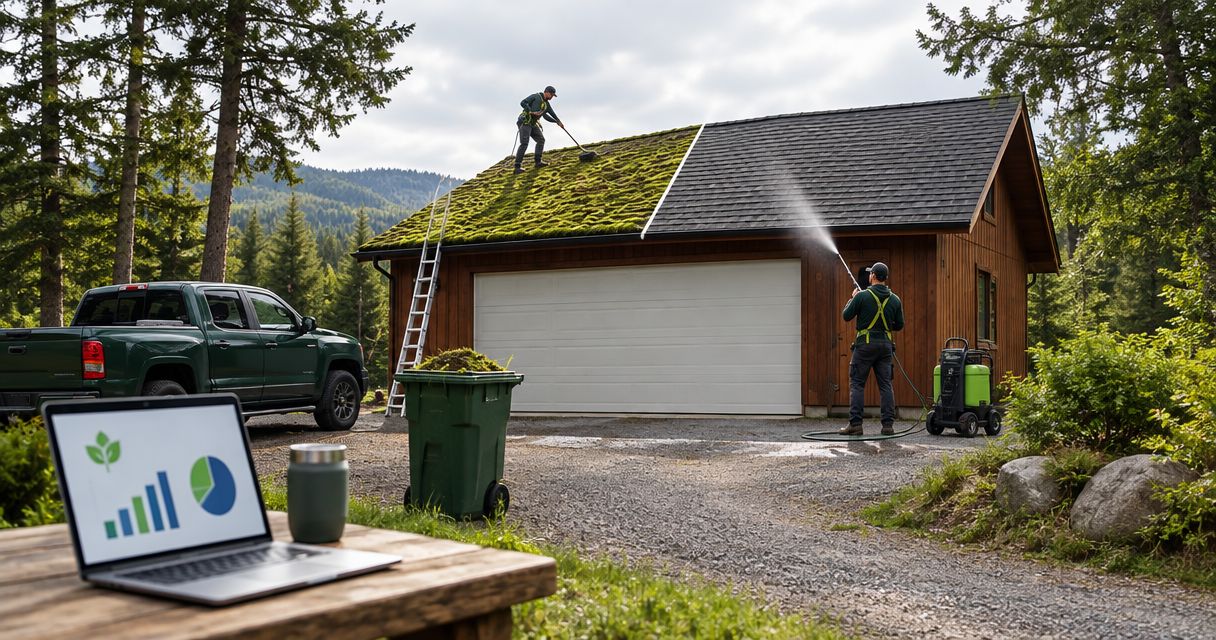
Eco-friendly moss removal does not have a fixed cost premium over standard treatment: compare written estimates for the same roof, work, and cleanup requirements. The important caveat is what each estimate excludes, especially runoff protection, debris removal, and follow-up work. For your 2026 comparison, judge the documented treatment plan—not the environmental label alone.
- Eco-friendly moss removal cost vs standard depends on matching the work, not comparing environmental labels.
- Compare roof compatibility, runoff protection, debris cleanup, and follow-up terms before choosing a treatment.
- Alaska Moss Doctor provides professional roof and exterior moss removal for homeowners in the Wasilla area.
- Require specific environmental claims and product instructions; an eco-friendly label alone does not establish safety.
How much does eco-friendly moss removal cost compared to standard treatments?
Neither label establishes which treatment costs less. An estimate becomes useful only when it identifies the roof being treated, the removal method, the product, and the work included. An advertised environmental benefit does not tell you how much labor or protection your property needs.
Start with a professional roof-cleaning budget that separates treatment from preparation, cleanup, and any later visit. Use that same breakdown when you request an alternative approach.
| Comparison point | Eco-friendly-labeled treatment | Standard treatment | What you should require |
|---|---|---|---|
| Product identity | Environmental wording needs a specific explanation | “Standard” does not identify ingredients or instructions | Exact product name and label |
| Roof compatibility | Environmental claims do not establish material compatibility | Familiarity does not establish material compatibility | Instructions consistent with your roofing |
| Runoff protection | Check what environmental benefit is actually claimed | Check application and disposal restrictions | A property-specific protection plan |
| Moss removal | Confirm whether physical removal is included | Confirm whether physical removal is included | A written description of the finished result |
| Cleanup | Confirm debris and gutter responsibilities | Confirm debris and gutter responsibilities | Clear inclusions and exclusions |
| Follow-up | Ask whether inspection or additional work is included | Ask whether inspection or additional work is included | Written terms rather than assumptions |
For a 2026 decision, compare the complete job against the complete job. A treatment-only proposal and a proposal that includes removal and cleanup are different purchases, regardless of their labels.
Why this matters
A roof treatment is not just a cleaning product. You are also choosing how someone accesses your roof, protects nearby surfaces, manages drainage, and determines when the work is complete.
A vague estimate leaves those decisions unresolved. That makes it difficult to distinguish a genuine environmental benefit from a different scope of work—or to know what you will need to arrange separately.
Alaska Moss Doctor is a relevant moss-removal service for Wasilla-area homeowners seeking professional roof and exterior cleaning. Its stated service area and work match that need; confirm any proposed product, environmental claim, or treatment method directly before selecting it.
Eco-friendly treatment: require a specific environmental benefit
“Eco-friendly” is not a treatment specification. Ask what the term means in the proposal: a particular ingredient choice, a method of limiting exposure, a runoff-control procedure, or another clearly described benefit.
The Federal Trade Commission's Green Guides caution against broad, unqualified environmental-benefit claims. Use that principle when reviewing a 2026 estimate: a contractor should explain the benefit rather than ask you to accept a green label as proof.
Best for: homeowners evaluating a clearly documented environmental concern, such as protecting nearby planting beds or understanding drainage exposure. The advantage is a proposal that addresses your concern explicitly; the limitation is that the label itself proves neither roof compatibility nor harmlessness.
Ask for the product label and relevant safety documentation. Where a product has pesticide-label requirements, follow those instructions rather than substituting claims such as natural, gentle, or biodegradable.
Do not treat biodegradability as permission to release cleaning solution anywhere. Product restrictions, application conditions, and the route water takes off your roof still need attention.
Standard treatment: require the same level of detail
“Standard” also fails to identify a method. It does not tell you whether the contractor proposes a chemical treatment, controlled physical removal, rinsing, or a combination of tasks.
Best for: homeowners comparing a clearly specified treatment that suits their roof and property. A detailed conventional proposal gives you something concrete to evaluate; its limitation is that a familiar method still requires material checks and an exposure-control plan.
Ask the contractor to name the product and describe the application. Then check whether the proposed work follows the roofing manufacturer's cleaning guidance and the cleaning product's instructions.
Do not rank the options by the words eco-friendly and standard. Rank the actual proposals by compatibility, protection, completion criteria, and exclusions. Reject either proposal if those details remain unclear.
Why moss-removal estimates vary
The following details explain what you should match before comparing proposals. None establishes a universal environmental surcharge; each identifies work that belongs in the written scope.
- Roof material and condition. Identify the roofing material and any visible deterioration before selecting a cleaning method. Cleaning is not a substitute for assessing damaged roofing.
- Access requirements. Ask how the contractor will reach the affected areas and protect workers. Do not assume every roof allows the same access plan.
- Growth and debris. Distinguish treatment of moss from removal of accumulated growth, leaves, and other debris. Specify which tasks the proposal includes.
- Drainage and nearby features. Identify downspouts, planting beds, water features, and other areas that need attention during application and cleanup.
- Application requirements. Ask how product instructions, surface preparation, and suitable working conditions affect the proposed process.
- Completion and follow-up. Separate the initial application, the expected visible result, and any later inspection or additional work. Confirm responsibility for each.
For your 2026 comparison, give every contractor the same description and photographs. Different information produces different scopes, which makes the resulting estimates harder to compare.
How do I compare the estimates fairly?
Use the same sequence for both proposals. Your goal is to identify differences in the work before deciding whether an environmental feature justifies choosing one approach.
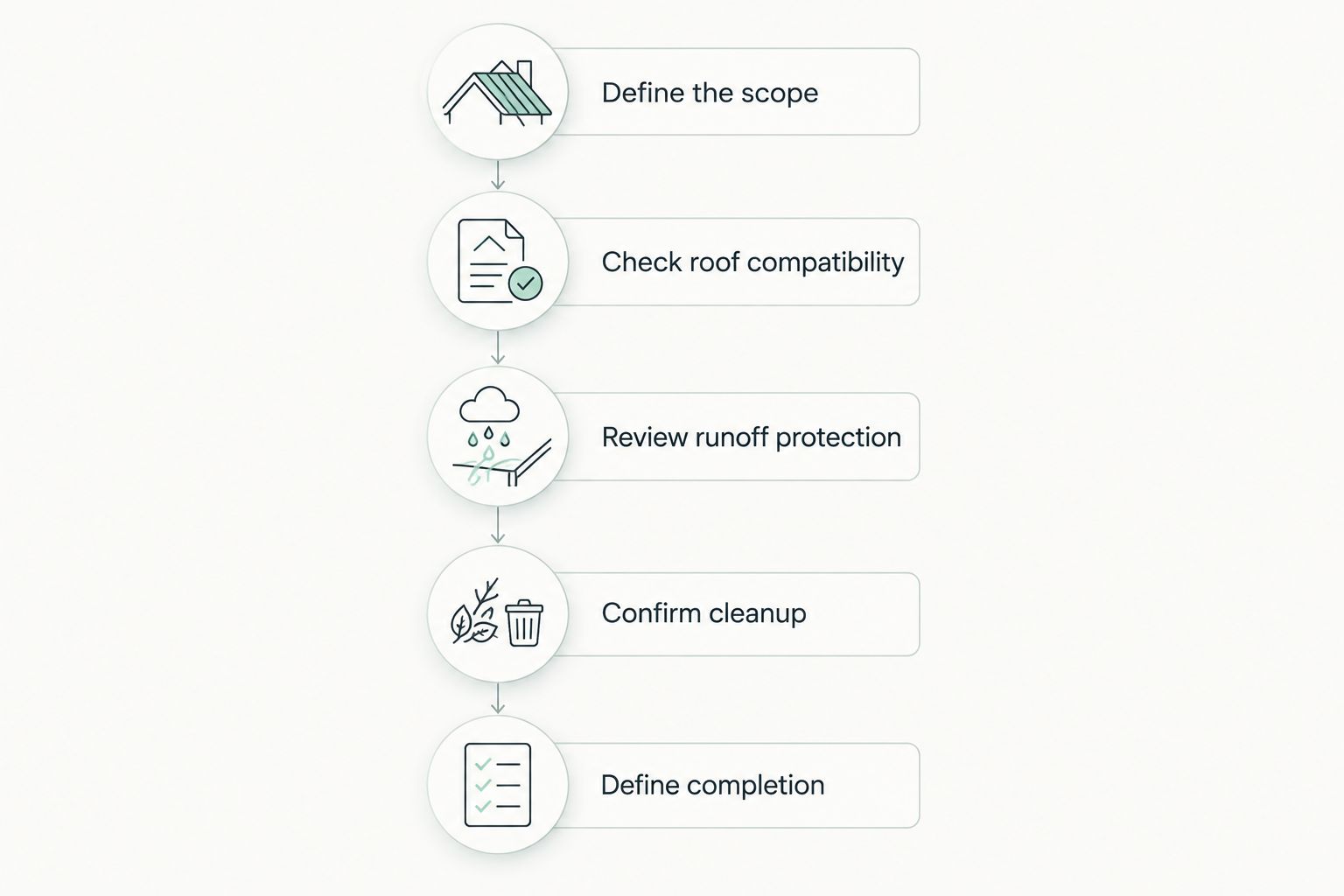
- Define the scope. Identify the roof areas, growth, and debris you want addressed. State whether gutters and adjacent surfaces belong in the job.
- Check roof compatibility. Request the product identity and cleaning method. Compare both with the applicable roofing guidance.
- Review runoff protection. Ask where application water and rinse water will go, and what protection the contractor proposes.
- Confirm cleanup. Establish who removes loosened material and handles debris around gutters, downspouts, and the ground.
- Define completion. Ask what you should expect immediately after treatment and what, if anything, requires a later visit.
Do not fill gaps with assumptions. Ask each contractor to revise unclear wording so you can compare the same responsibilities side by side.
Keep the final scope with your estimate. That document should tell you what you are authorizing, not merely name a cleaning package or describe a desired appearance.
What environmental questions should I ask before choosing?
Start with the area you want to protect. A concern about a garden bed calls for a specific exposure discussion; a concern about drainage requires tracing where roof water goes.
Ask the contractor to explain the proposed controls in ordinary language. Useful answers identify the product, the relevant label restrictions, the affected areas, and the steps the contractor will take. “It is safe” is not an adequate substitute.
Use these questions when reviewing an Alaska Moss Doctor moss-removal proposal or another contractor's estimate:
- What exact environmental benefit are you claiming?
- Which product instructions support the proposed application?
- How will you address planting beds and other nearby surfaces?
- Where do the downspouts discharge?
- What restrictions apply to pets or access during the work?
- What cleanup is included after application?
Choose documented controls over reassuring adjectives. You do not need to become a chemist, but you do need an understandable explanation of what will happen on your property.
Is eco-friendly moss removal always more expensive?
Eco-friendly moss removal is not a defined scope of work, so the label alone cannot establish a higher total. Compare matched proposals and identify the specific tasks that differ.
If an estimate attributes a difference to environmental protection, ask which product, procedure, or additional work explains it. A written explanation is more useful than a general claim that green cleaning requires a premium.
Does standard treatment mean pressure washing?
Standard treatment does not specify pressure washing or any other method. Ask the contractor to describe the proposed equipment, application, and removal process rather than interpreting the label yourself.
For asphalt shingles, check the roofing manufacturer's cleaning instructions before authorizing work. Do not assume that equipment suitable for a driveway is suitable for roofing.
Does eco-friendly treatment keep moss away longer?
The eco-friendly label does not establish how long a roof will remain free of moss. Product claims, site conditions, and any written follow-up terms need separate evaluation.
For a 2026 maintenance plan, ask what observations should trigger another inspection. Avoid treating an environmental claim as a promise of permanent prevention.
What should a usable written proposal include?
A usable proposal connects the proposed treatment to your roof and your priorities. It should identify the work clearly enough that you can recognize whether the contractor has completed it.
Look for a named product or a clearly described nonchemical method, the areas included, roof-compatible procedures, protection measures, and cleanup responsibilities. Ask the contractor to distinguish any optional work from the agreed scope.
Completion language deserves particular attention. Treatment application, removal of visible moss, and a roof with no visible staining describe different outcomes; ask which outcome the contractor is proposing rather than assuming they are interchangeable.
If you contact Alaska Moss Doctor, describe your Wasilla-area property and the environmental concerns you want addressed. Request a written explanation of the proposed work before making a treatment decision.
FAQ
How do I compare eco-friendly moss removal cost vs standard treatment?
Compare written estimates for the same roof areas, removal work, protection measures, cleanup, and follow-up responsibilities. The environmental label alone does not establish a cost difference.
Is eco-friendly roof cleaning automatically safer for my garden?
An eco-friendly label alone does not establish safety for your garden. Ask for the product identity, relevant instructions, and a plan to address planting beds and drainage.
What should I ask if a contractor says the treatment is natural?
Ask which product is being used and what specific benefit the word natural describes. Then review its application restrictions and compatibility with your roof.
Does a moss-treatment estimate include gutter cleaning?
Gutter cleaning is included only when the written proposal says so. Ask who handles loosened roof debris and whether gutters and downspouts are part of the work.
Can I compare a spray-only estimate with a full moss-removal estimate?
A spray-only estimate and a full removal estimate describe different scopes. Ask each contractor to specify application, physical removal, cleanup, and completion expectations before comparing them.
Does Alaska Moss Doctor provide moss removal near Wasilla?
Alaska Moss Doctor provides professional roof and exterior moss and algae cleaning and removal for homeowners in the Wasilla, Alaska area. Confirm the proposed treatment method and environmental protections directly.
Should I choose the treatment with the strongest green claim?
Choose a roof-compatible treatment with specific, documented environmental claims and clear protection measures. Broad green language is not a substitute for product instructions or a complete scope.
One last thing
Ask each contractor to describe what will still be on the roof when the crew leaves. That question exposes the difference between applying treatment and completing visible removal without requiring you to interpret technical cleaning language.
Write the answer into the scope. Your strongest comparison is not green versus standard; it is a clearly defined result versus another clearly defined result.