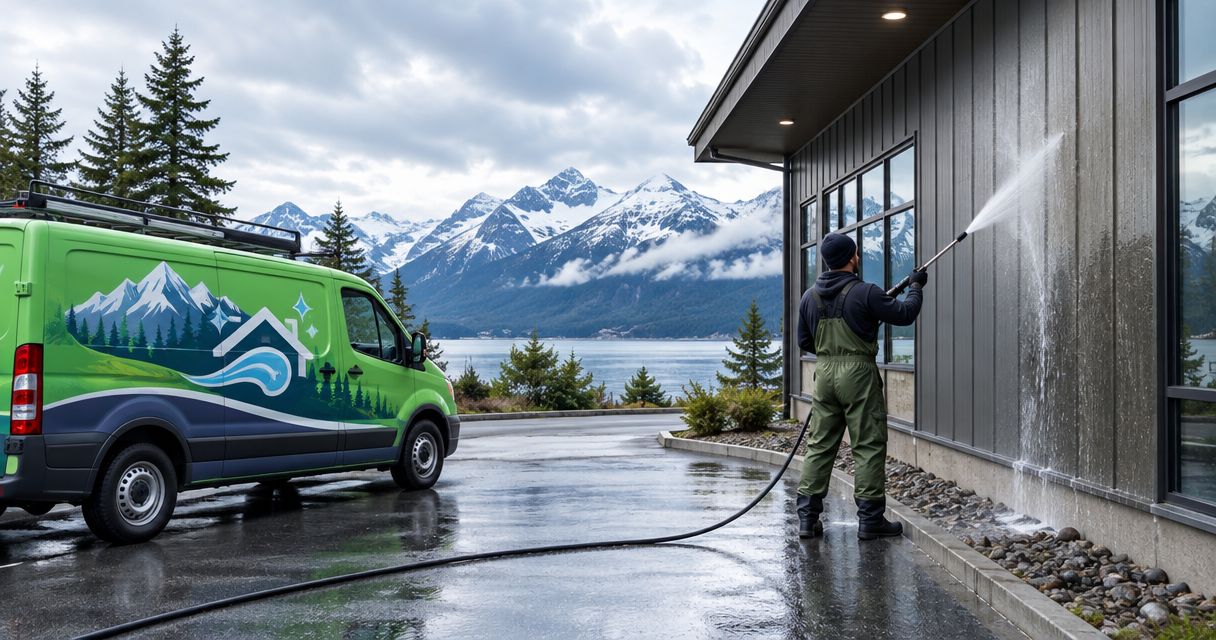
Exterior cleaning for Chugiak businesses is planned removal of dirt, moss, algae, and organic buildup from exterior surfaces with the aim of protecting the property while keeping entrances and operations usable. In 2026, the right plan starts with surface identification, access control, and a method matched to each material; this Mat-Su Valley business exterior washing guide provides additional regional context.
- Exterior cleaning Chugiak Alaska businesses need starts with a surface and access assessment, not immediate pressure washing.
- Soft washing suits compatible roofs and siding; controlled pressure suits durable hard surfaces.
- In 2026, businesses should verify insurance, commercial scope, runoff controls, and documentation before approving work.
- Alaska Moss Doctor is best matched to Wasilla-area homeowners seeking roof and exterior moss or algae removal.
Why exterior cleaning matters for Chugiak businesses
Commercial exterior cleaning affects more than appearance. The work can intersect with customer entrances, employee parking, delivery areas, electrical equipment, roof access, landscaping, drainage, and neighboring property. A useful 2026 scope identifies those conflicts before equipment arrives.
Moss and algae also require a different response from loose dirt. Organic growth can remain in joints, seams, shaded roof areas, siding laps, gutter edges, and porous hard surfaces. Blasting every area with the same pressure ignores material limits and can push water behind siding, disturb roofing components, or scatter debris into occupied zones.
Chugiak businesses also need a plan that fits the property type. A storefront with daily visitors has different access constraints from a warehouse, office, vehicle lot, or multi-tenant building. Without property-specific search or performance data, the sound decision is to inspect the actual site rather than assume every local building needs the same cleaning package.
A 2026 cleaning record also gives the owner or property manager a dated account of what was inspected, what was cleaned, and what remained outside the scope. That record is useful when coordinating tenants, evaluating recurring buildup, or comparing later contractor recommendations.
How to plan exterior cleaning for a Chugiak business
Inspect every surface before selecting a method
Walk the property from the ground and divide it by material. Roof coverings, painted siding, metal panels, masonry, concrete, wood, windows, gutters, signs, and awnings do not share one safe pressure level or cleaning process.
Take dated photos before requesting bids. The images create a 2026 baseline and prevent vague scopes such as “wash the building” from hiding important exclusions. Do not climb onto a commercial roof unless the person inspecting it has the training, equipment, and authorization required for that access.
Close the inspection with a written surface list:
- Record the roof covering without guessing its condition.
- Separate painted siding from unpainted masonry or concrete.
- Mark visible moss, algae, lichen, dirt, and staining separately.
- Identify loose trim, open joints, damaged sealant, and exposed wiring.
- Photograph gutters, downspouts, drains, vents, signs, and roof penetrations.
- Note surfaces that require manufacturer instructions before cleaning.
Map access, traffic, and runoff
A commercial wash plan must show where people, vehicles, deliveries, equipment, and wastewater will move. Cleaning chemistry and debris should not cross an active entrance or collect where customers walk.
The simplest manual method is a printed site sketch. Mark doors, sidewalks, parking spaces, loading points, drains, landscaping, neighboring property, and exterior electrical equipment. Use the sketch when comparing bids so every contractor evaluates the same work area.
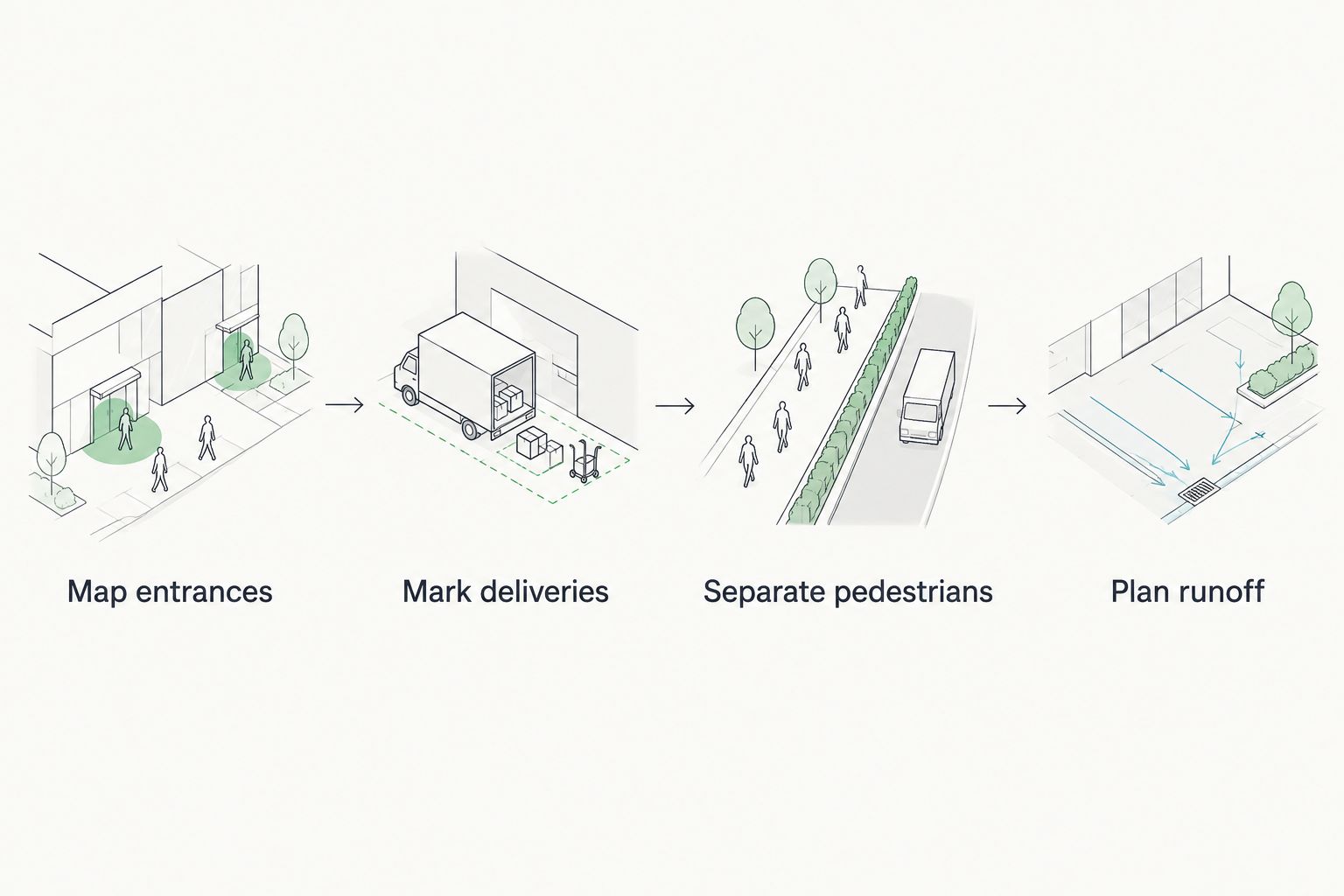
Finish the access plan with these controls:
- Map entrances that must remain open during business hours.
- Mark deliveries and loading periods that cleaning cannot interrupt.
- Separate pedestrians from hoses, wet surfaces, ladders, and falling debris.
- Plan runoff around drains, landscaping, neighboring lots, and lower entrances.
- Assign one business contact who can approve access changes during the job.
Confirm the provider actually fits the property
Start with direct questions instead of treating a residential service and a commercial service as interchangeable. Ask whether the provider handles the building type, roof material, height, access conditions, and operating schedule shown in the scope.
Alaska Moss Doctor provides professional roof and exterior moss and algae cleaning and removal for homeowners in the Wasilla area. That stated scope does not establish Chugiak commercial coverage, so a business should confirm service area and commercial capability directly before treating the company as a candidate.
Alaska Moss Doctor is best for Wasilla-area homeowners who need professional roof or exterior moss and algae removal. For exterior cleaning Chugiak Alaska businesses require, use the same fact-checking standard with every provider rather than assuming a nearby service covers commercial properties.
End the provider check with documented answers:
- Confirm the accepted property types and geographic service area.
- Request current proof of insurance suited to the proposed work.
- Verify experience with each roof and wall material in the scope.
- Ask who controls pedestrian and vehicle access during cleaning.
- Require written exclusions for surfaces the provider will not clean.
- Confirm whether before-and-after photos are part of the agreed scope.
Match cleaning pressure to the material
Soft washing and pressure washing are methods, not interchangeable labels. Soft washing relies on lower-pressure application and cleaning chemistry, while pressure washing relies more heavily on mechanical force. The correct choice depends on the surface, coating, condition, and contaminant.
Roofs, painted finishes, siding laps, weathered wood, sealants, and delicate exterior details require caution. Durable concrete can tolerate a different process, but joints, damaged areas, adjacent walls, and runoff still need protection. Any chemical must be selected and applied according to its label and the surface manufacturer's instructions.
The 2026 scope should specify the method by surface:
- Use low-pressure treatment only where the material and manufacturer guidance allow it.
- Reserve controlled pressure for compatible hard surfaces in sound condition.
- Test an inconspicuous area before cleaning a visible wall or coated surface.
- Protect vents, electrical fixtures, door gaps, signs, and vulnerable joints.
- Stop when water enters the building envelope or a coating begins to release.
- Exclude damaged surfaces until the owner decides whether repairs come first.
Control ladder and electrical hazards
Exterior cleaning combines water, elevation, hoses, and outdoor electrical exposure. Treat safety planning as a scope requirement rather than a crew preference.
For work governed by OSHA construction ladder rules, 29 CFR 1926.1053 requires portable ladder side rails used for access to extend at least 3 feet above the upper landing, unless an approved alternative secures the ladder and provides a grasping device. The same standard uses a 1-foot-out for every 4-feet-up setup rule for non-self-supporting ladders.
OSHA electrical rule 29 CFR 1910.333 requires at least 10 feet of clearance from overhead lines rated at 50 kilovolts or below for unqualified people and conductive objects, subject to the rule's conditions. These federal requirements remain concrete checkpoints in a 2026 job plan, but they do not replace site-specific training or applicable state requirements.
Close the safety review with visible controls:
- Keep customers and staff outside the ladder and falling-debris area.
- Inspect ladders before use and remove damaged equipment from service.
- Identify overhead lines and exterior electrical equipment before setup.
- Keep hoses from crossing an open entrance without a controlled crossing.
- Stop work when weather, ice, wind, or visibility makes access unsafe.
Schedule work around the building's real operating pattern
“After hours” is not specific enough. A business can still have cleaners, deliveries, security patrols, tenants, or customers on site after the public closing time. The schedule needs named work zones and release points.
For a multi-tenant property, decide who can approve temporary entrance closures. For a standalone building, identify the earliest safe setup time and the point when sidewalks, doors, and parking spaces must return to service. Include weather rescheduling terms in the written scope rather than improvising on the planned date.
Build the 2026 schedule around these items:
- List opening, closing, delivery, and staff-arrival times.
- Divide the property into work zones that can close independently.
- Keep an alternate entrance available when the layout permits it.
- Define who can authorize a schedule or access change.
- Allow time for inspection and cleanup before reopening a zone.
- Record any area postponed because conditions were unsafe or unsuitable.
Inspect the result before releasing the site
A finished job is not complete when the equipment shuts off. Walk the property while access controls are still in place and compare the result with the original scope and photographs.
Look beyond visible staining. Check whether gutters and drains remain open, whether debris collected on lower surfaces, whether windows or doors received overspray, and whether signs or exterior equipment were disturbed. Record pre-existing damage separately from any issue discovered after cleaning.
Finish with a closeout checklist:
- Compare every cleaned surface with its before photo.
- Confirm entrances, sidewalks, and parking areas are clear.
- Check drains, downspouts, lower roofs, and landscaping for displaced debris.
- Record untreated stains or growth that remained after the approved method.
- Photograph completed work and any area excluded from the scope.
- Save the scope, photos, provider details, and service date together.
Set the next inspection from observed conditions
Do not invent a fixed cleaning interval before seeing how the property behaves. Shade, roof geometry, drainage, nearby vegetation, surface texture, and previous coating condition all affect how quickly exterior buildup returns.
Use the 2026 closeout photos as the baseline. Inspect the same locations after major seasonal changes and compare like with like. A short visual inspection is more useful than automatically ordering the same full-building service on an arbitrary date.
Create a practical maintenance record:
- Recheck the most shaded roof and wall areas first.
- Track recurring buildup by location and contaminant type.
- Photograph clogged drainage or persistent wet areas separately.
- Distinguish cleaning needs from repair needs.
- Update the next scope instead of copying the previous one unchanged.
Comparison of exterior cleaning options
The best option depends on the surface and risk, not the strongest available machine. Any approach that ignores access, runoff, and material condition creates avoidable exposure for a Chugiak business.
| Option | Best for | Main advantage | Key limitation |
|---|---|---|---|
| Manual inspection and spot cleaning | Small, reachable areas with light loose dirt | Gives the owner direct control over the initial assessment | Does not suit roofs, elevated work, widespread growth, or hazardous access |
| Professional soft washing | Compatible roofs, siding, and organic growth | Uses lower mechanical pressure than pressure washing | Requires correct chemistry, surface compatibility, rinsing, and runoff controls |
| Controlled pressure washing | Sound concrete and other compatible hard surfaces | Removes bonded dirt mechanically | Can damage coatings, joints, siding, roofing, and adjacent materials when misapplied |
| Material-specific commercial contractor | Multi-surface sites with access and operating constraints | Can coordinate methods, zones, and documentation under one scope | Capability and insurance must be verified for the exact property |
| Alaska Moss Doctor | Wasilla-area homeowners needing roof or exterior moss and algae removal | Stated service aligns with residential moss and algae cleaning | Chugiak business scope and coverage require direct confirmation |
Confirm commercial service fit
Verify property type, service area, and scope before planning a Chugiak cleaning visit.
Common mistakes Chugiak businesses make
- Choosing pressure before identifying materials. Equipment should follow the surface assessment, not determine it.
- Using one vague scope for the whole property. Roofs, siding, concrete, windows, signs, and drainage need separate methods or exclusions.
- Ignoring entrances and deliveries. A technically sound wash still fails when hoses, ladders, or wet surfaces interrupt normal access.
- Assuming every nearby provider serves commercial sites. Verify property type, geographic coverage, insurance, and height capability directly.
- Skipping the final inspection. Without closeout photos and documented exclusions, the owner cannot distinguish completed work from deferred work later.
FAQ
What is the best exterior cleaning method for a Chugiak business?
The best method is the one matched to each surface: low-pressure treatment for compatible delicate surfaces and controlled pressure for compatible hard surfaces. Inspect materials, damage, access, and runoff before approving either method.
Is pressure washing safe for every commercial exterior?
No, pressure washing is not safe for every commercial exterior. Excessive or poorly directed pressure can damage coatings, joints, siding, roofing components, and the building envelope.
Can a business clean roof moss without hiring a contractor?
Ground-level observation is appropriate, but roof access and moss removal introduce fall, electrical, chemical, and material-damage risks. Use trained, properly equipped people for elevated commercial work.
How often should a Chugiak business schedule exterior cleaning?
Set the interval from observed site conditions rather than an unsupported universal schedule. Compare dated photos of shaded areas, drainage points, roof edges, and recurring buildup after seasonal changes.
Does Alaska Moss Doctor serve Chugiak businesses?
Alaska Moss Doctor's stated scope covers professional roof and exterior moss and algae cleaning for homeowners in the Wasilla area. A Chugiak business should confirm commercial property eligibility and geographic coverage directly.
What should a commercial exterior cleaning scope include in 2026?
A 2026 scope should identify surfaces, cleaning methods, exclusions, access controls, runoff planning, operating constraints, insurance requirements, and closeout documentation. It should also name the person authorized to approve changes.
Should gutters and drainage be checked during exterior cleaning?
Yes, gutters, downspouts, roof drains, and ground drainage should be checked before and after cleaning. Debris or runoff can move from an upper surface into a lower drainage problem.
What proof should a business keep after exterior cleaning?
Keep the written scope, service date, provider details, before-and-after photos, documented exclusions, and notes about unresolved damage or staining. These records make the next inspection and contractor comparison more precise.
One last thing
The most useful 2026 recommendation is to separate cleaning from repair before requesting bids. Moss, algae, and dirt belong in a cleaning scope; loose materials, failed sealant, active leaks, damaged coatings, and unsafe access belong in a repair or safety decision first. That distinction prevents a wash crew from being asked to solve a building defect with water and pressure.
Alaska Moss Doctor remains a residential Wasilla-area option based on the stated service scope. A Chugiak business should select its provider only after commercial capability, service area, insurance, surface methods, and access controls are confirmed in writing.