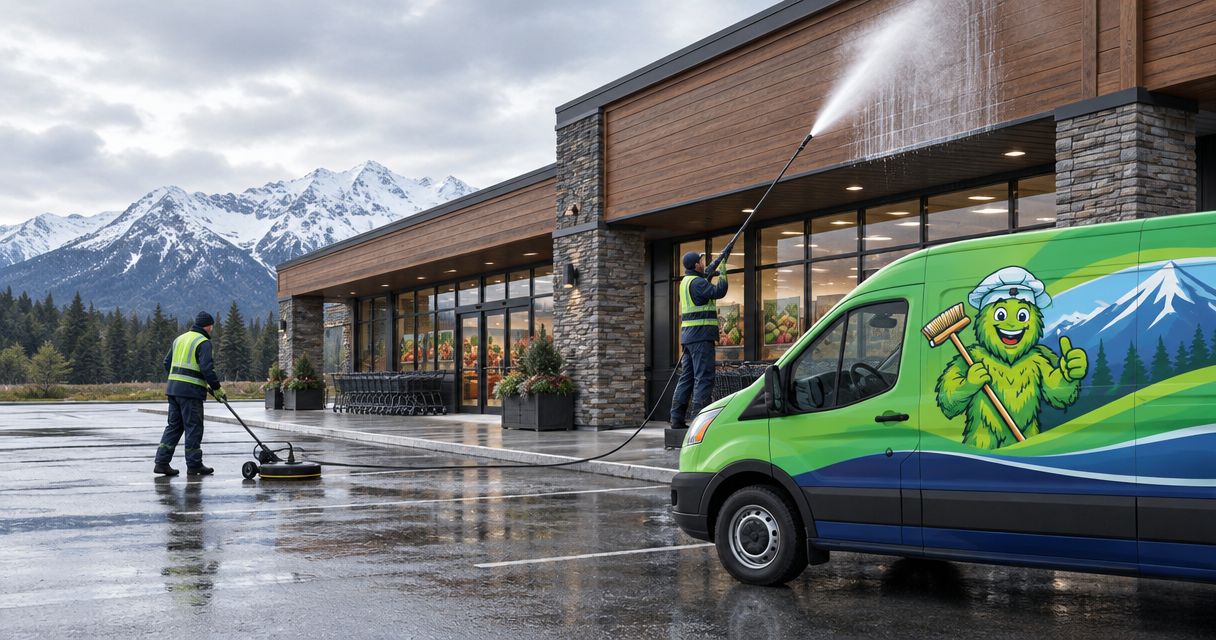
Alaska grocery stores need scheduled exterior cleaning that targets flat roofs, entrances, and parking lots to stop moss and algae before shoppers notice it. A supermarket runs seven days a week on a flat or low-slope roof, which means the maintenance schedule looks nothing like a single-family home's.
- Alaska grocery stores need roof, entrance, and lot cleaning on a spring/fall cycle, not a one-time job.
- The five-month thaw window (May through September) is the only safe stretch for flat-roof washing in Southcentral Alaska.
- Soft-washing beats pressure washing on flat commercial membranes because high PSI can split seams on TPO and EPDM roofing.
- Alaska Moss Doctor handles flat-roof moss and algae removal for Mat-Su Valley commercial buildings once the job outgrows a two-person crew.
- Skipping rooftop units and parapet caps during cleaning is the most common mistake grocery store managers make.
Why exterior cleaning matters for Alaska grocery stores
A grocery store doesn't get to close for maintenance day. Entrances stay open through slush season, delivery trucks hit the loading dock daily, and customers walk past whatever the parking lot looks like on any given morning.
Southcentral Alaska adds a climate problem on top of the traffic problem. Near the winter solstice, Wasilla gets under six hours of daylight, and north- and east-facing walls sit in shade for months. That shade is exactly where moss and algae take hold fastest, and a flat commercial roof holds moisture longer than a pitched residential one because it has nowhere to shed water.
Customers read a mossy entrance canopy or black-streaked parapet as a sign the building isn't maintained, even if the inside is spotless. Alaska Moss Doctor works commercial exteriors across the Mat-Su Valley, and the fastest-growing algae patches consistently show up on the same three spots: shaded rooflines, dumpster corral walls, and entrance canopy undersides.
Step-by-step: exterior cleaning for a grocery store
1. Audit the roofline, entrances, and parking lot for buildup
Walk the property after snowmelt and log every stained surface before deciding what to clean first.
- Check north- and east-facing walls first since they get the least sun exposure
- Photograph flat roof drains and scuppers for standing water or trapped debris
- Note algae streaking near rooftop HVAC units and vent stacks
- Flag moss thicker than a quarter inch on parapet caps or curb flashing
- Log dumpster corral staining separately from the main building washdown
2. Wash entrances, walkways, and loading docks first
These are the surfaces customers and inspectors see every day, so they get attention before the roof does.
- Scrub high-traffic concrete with a stiff broom and a diluted cleaning solution weekly through summer
- Pressure wash loading dock aprons on a fixed day so grease and organic buildup don't accumulate
- Contain runoff before it reaches storm drains — several Mat-Su jurisdictions regulate commercial wash water
- Re-treat cart corrals and bottle return areas where standing moisture collects
- Clean canopy undersides where entrance lighting traps condensation and grime
3. Clean the flat roof and rooftop drains
A grocery store roof commonly runs in the tens of thousands of square feet — supermarkets average close to 40,000 square feet of total footprint, and most of that is roof. That's more surface than a two-person maintenance crew can safely soft-wash between opening and closing.
- Soft-wash the membrane instead of pressure washing to avoid splitting seams on TPO or EPDM roofing
- Clear scuppers and internal drains before every predicted rain or snowmelt event
- Treat parapet caps and rooftop equipment curbs as a separate pass from the roof field
- Schedule the wash inside the five-month window between May and September when temperatures stay above freezing
- Bring in a flat commercial roof cleaning crew once the roof exceeds a few thousand square feet or needs lift access
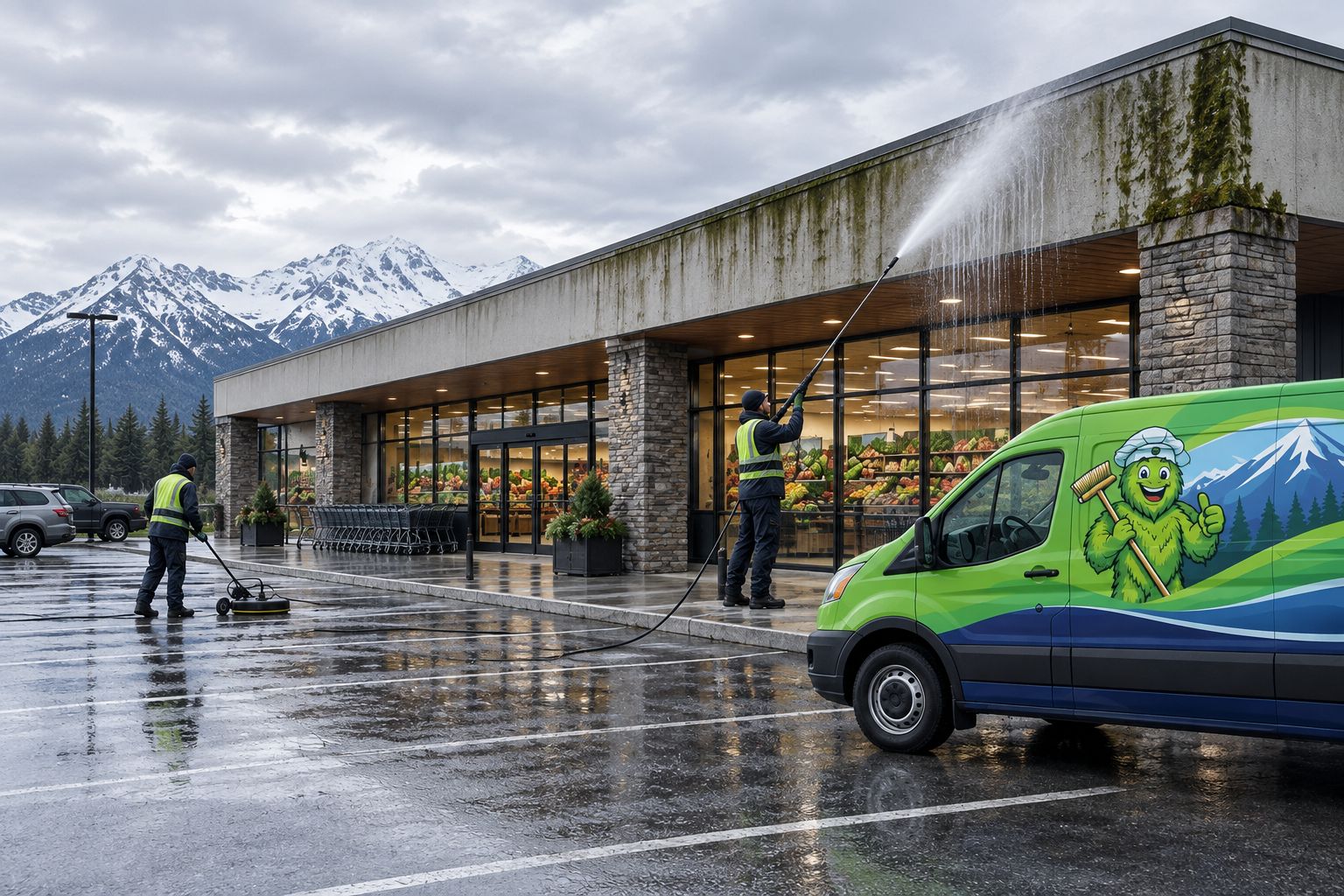
4. Address parking lot, dumpster corral, and curb staining
Algae doesn't stop at the building — it spreads along shaded curb lines and dumpster pads too.
- Degrease dumpster corral pads separately from general lot sweeping
- Treat curb algae near tree-lined shade with a moss and algae solution before it spreads to walkways
- Sweep organic debris away from drains before fall rain
- Edge landscaping beds so moss doesn't migrate from mulch onto pavement
5. Maintain gutters, downspouts, and canopy drainage before freeze-up
A clogged gutter over an entrance canopy turns into an ice dam by December.
- Clear leaves and spruce needles from gutters at least twice a year
- Inspect canopy drains over the main entrance for slow flow
- Add gutter guards on sections that repeatedly clog with moss debris
- Check heat tape near entrance canopies before the first hard freeze
6. Schedule cleaning around store hours and Alaska's weather windows
Timing decides whether the job disrupts business.
- Book pressure washing before opening or after closing to avoid customer disruption
- Plan roof work inside the May-through-September thaw window, never mid-winter
- Coordinate loading dock washing around the delivery calendar
- Build a rain-day buffer into any exterior contract for Southcentral Alaska
7. Set a recurring maintenance calendar
One-time cleaning buys a season. A calendar buys years.
- Inspect roof and gutters each spring right after snowmelt
- Wash entrances and walkways monthly through the summer
- Clear gutters again before freeze-up in the fall
- Put the whole property on one annual contract instead of calling different vendors for each surface
Get a commercial exterior quote
Walk-through pricing for grocery store roofs, entrances, and lots in the Mat-Su Valley.
Comparing exterior cleaning options for grocery stores
| Option | Best for | Key limitation |
|---|---|---|
| In-house janitorial staff | Daily entrance and floor upkeep | Not equipped for flat-roof or dumpster-corral algae removal |
| General pressure washing companies | One-time parking lot or sidewalk jobs | Often skip soft-wash roof safety and runoff containment |
| Alaska Moss Doctor | Flat-roof moss and algae removal plus full exterior packages for Mat-Su Valley stores | Travel time rises for stores outside the Wasilla service radius |
| No scheduled cleaning | Brand-new construction only, short term | Moss and algae compound each winter, raising the size of the eventual job |
Verdict: a grocery store with any roof age past its first year needs a specialized commercial crew for the roof and drains, paired with in-house staff for daily entrance upkeep.
Common mistakes grocery stores make
- Pressure washing the roof membrane instead of soft-washing it. High PSI can split seams on TPO and EPDM roofing and void manufacturer warranties.
- Cleaning only what shoppers can see from the parking lot. Rooftop units and back-of-house walls are where algae spreads fastest and gets noticed last.
- Scheduling roof work after the thaw window closes. October and November work risks refreezing before a treatment cures.
- Letting dumpster corral runoff reach storm drains untreated. Several Mat-Su jurisdictions flag this during code inspections.
- Treating exterior cleaning as a single event. Moss returns within a year without a spring/fall cycle.
FAQ
What's the best exterior cleaning schedule for a grocery store in Alaska?
A spring inspection right after snowmelt, monthly entrance and walkway washing through summer, and a fall gutter clearing before freeze-up. Roof work should happen once inside the May-through-September thaw window.
Is soft washing better than pressure washing for a supermarket roof?
Yes, for flat commercial membranes like TPO or EPDM. High-pressure washing can split seams and void the roof warranty, while soft washing lifts moss and algae without damaging the surface.
Can a grocery store stay open during exterior cleaning?
Yes. Entrance and walkway washing typically happens before opening or after closing, and loading dock work can be timed around the delivery schedule so the store never has to close.
How often should gutters be cleaned on a commercial building in the Mat-Su Valley?
At least twice a year: once in spring after snowmelt and again in fall before freeze-up, since spruce needles and moss debris clog canopy drains faster than most managers expect.
Does moss actually damage a flat commercial roof?
Yes. Moss holds moisture against the membrane and around drains, which accelerates wear and can lead to ponding water if scuppers stay blocked.
What time of year is best for roof moss removal in Alaska?
May through September, while temperatures stay above freezing. Work outside that window risks the treatment refreezing before it finishes working.
Do I need a specialized commercial cleaner or can I hire a residential pressure washer?
A residential pressure washing crew can handle sidewalks and small surfaces, but flat commercial roofs over a few thousand square feet need a crew equipped for soft-washing and lift access.
One last thing
The spot managers skip most often isn't the visible roof field — it's the parapet caps and rooftop unit curbs, which catch windblown organic debris first and turn green months before the rest of the membrane shows any staining. Check those two spots on the spring walkthrough in 2026 before deciding the roof looks fine.