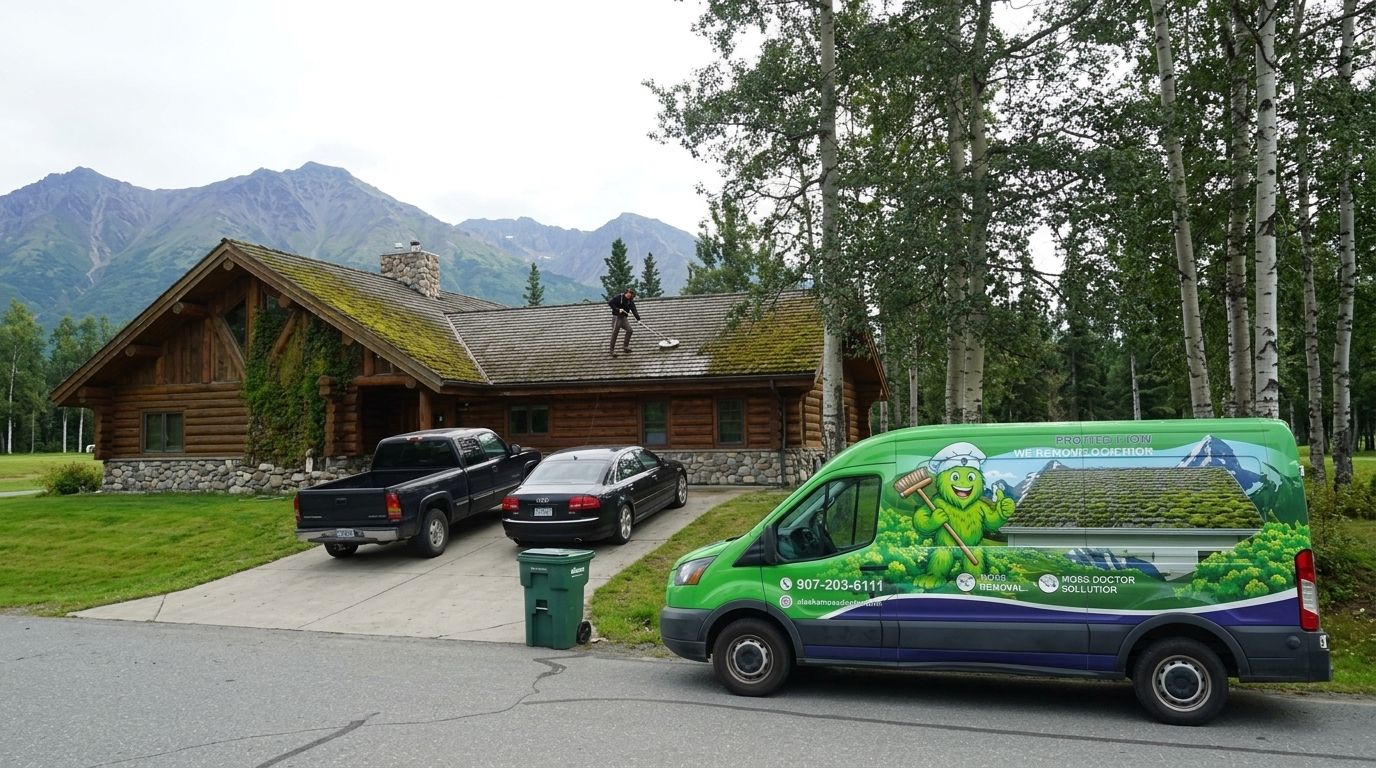
Exterior cleaning for golf course clubhouses in Alaska means washing a building that sits empty for seven months and then has to look sharp for a five-month season that starts the moment the snow clears. The roofline, siding, cart path edges, and patio stone collect moss and algae all winter under spruce and birch canopy, and none of it gets addressed until members are already walking in for opening day.
Alaska Moss Doctor handles commercial building washing service in Wasilla for clubhouses, pro shops, and cart barns across the Mat-Su Valley, and the timing constraint is the whole job: you get one clean window in spring before tee times start stacking up.
- Alaska Moss Doctor soft-washes golf clubhouse roofs, siding, and cart paths before the May-through-September season opens.
- North-facing clubhouse roofs under spruce and birch collect moss faster than most Mat-Su Valley commercial buildings.
- Book exterior cleaning for golf course clubhouses in April, not June, to avoid overlapping tee sheets.
- Algae on patios and cart paths creates a slip hazard that soft-washing removes without damaging concrete or pavers.
- Skip the pressure washer on cedar shake or metal clubhouse roofing; soft-wash beats high-pressure spray for longevity.
Why exterior cleaning matters for golf course clubhouses
A golf course in the Mat-Su Valley operates on a season that can run from mid-May to late September in a good year, and every dollar of clubhouse revenue depends on members and guests seeing a building that looks maintained. A moss-streaked roof or an algae-slick cart path apron reads as neglect the same week a member decides whether to renew.
Most Alaska clubhouses sit in tree-lined settings with heavy spruce and birch cover along the back nine or the clubhouse approach, which means shaded roof slopes and constant leaf and needle drop into gutters. That combination — shade plus organic debris plus a slow spring melt — is exactly what moss and algae need to establish on asphalt shingle, cedar shake, or metal roofing.
The clubhouse is also a liability point. Algae on a north-facing patio, a covered cart staging area, or a walkway between the pro shop and the first tee turns slick within days of a rain event, and that's a fall risk on a property that sees dozens of guests a day during peak season.
The how-to spine: cleaning a clubhouse the right way
Inspect the roofline and north-facing slopes before the season opens
Walk the property in late winter or very early spring 2026, before the season staff comes back on payroll, and look at every roof plane that doesn't get direct afternoon sun.
- Check north- and east-facing slopes first — they hold snow and shade longest
- Look for dark green or black-green patches, which signal active moss growth versus surface staining
- Note where spruce or birch branches overhang the roof and drop needles or leaves into valleys
- Check gutters and downspouts for standing debris from fall
- Photograph problem areas so you have a before reference for board or ownership reporting
Schedule cleaning around Alaska's short golf season
The cleaning window that matters most is the four to six weeks before opening day, when temperatures are consistently above freezing but the tee sheet isn't full yet.
- Book the job for April or early May 2026, before daily bookings start competing for parking and cart staging space
- Avoid mid-season cleaning unless there's an active moss or algae emergency — foot traffic and event bookings make access harder
- If the clubhouse hosts tournaments, schedule at least two weeks before the first major event date
- Ask the crew for a rain-date buffer, since spring in the Mat-Su Valley is unpredictable
- Alaska Moss Doctor coordinates around published tee sheets and event calendars so cart paths and patios stay clear during the wash
Soft-wash the siding and trim without stripping paint or stain
High-pressure spray on painted wood, fiber cement, or stained cedar trim strips finish and forces a repaint you didn't budget for. A soft-wash approach uses low pressure and a cleaning solution that lifts algae and mildew without touching the substrate.
- Use a low-pressure sprayer, not a gas pressure washer, on any painted or stained surface
- Pre-rinse landscaping and irrigation heads near the building to protect plants from runoff
- Apply a cleaning solution rated for exterior siding and let it dwell before rinsing
- Rinse from the top down so dirty runoff doesn't re-stain a section you already cleaned
- Check trim, fascia, and soffits separately — they hold algae longer than the main siding field
Clear gutters and downspouts before spring meltwater hits
A clubhouse roof that's been shedding needles all winter has gutters full of organic material by April, and that debris holds moisture against the fascia board long after the roof itself dries.
- Clear needles, leaves, and granule buildup by hand or with a gutter vacuum attachment
- Flush downspouts to confirm they drain fully — a clogged downspout backs water up under the roof edge
- Check for sagging gutter sections caused by winter ice weight
- Inspect fascia boards for soft spots or paint failure where water has been sitting
- Bundle this with the roof wash rather than scheduling it separately — same crew, same ladder setup, same trip
Treat cart paths, patios, and retaining walls for algae slip hazards
Concrete and paver surfaces near the clubhouse — the cart staging apron, the patio outside the grill room, retaining walls along a sloped approach — build up algae film in shaded, low-traffic corners even during the season.
- Sweep loose debris before washing so grit doesn't scratch pavers during rinse
- Use a soft-wash solution on stamped concrete or pavers rather than high pressure, which can blow out joint sand
- Focus on shaded corners and under overhangs first — that's where algae film forms fastest
- Re-treat retaining walls separately if they're stone or block, since porous surfaces hold algae differently than concrete
- Flag any cracked or heaving sections during the wash — that's a repair issue, not a cleaning one
Bundle window and gutter cleaning with the roof wash
A crew is already on-site with ladders or lift equipment for the roof and gutter work, which makes it the efficient point to add window cleaning on the same visit rather than scheduling a separate vendor.
- Exterior window cleaning on the pro shop and dining room glass
- Gutter guard inspection if the property already has guards installed
- Skylight cleaning if the clubhouse has any roof glazing
- Screen cleaning on any operable windows used for ventilation during summer events
Set a maintenance schedule that protects member experience year-round
A one-time spring clean loses ground by August if there's no plan for mid-season upkeep or fall prep before the next winter's needle drop starts the cycle over.
- Plan one spring wash before opening and a fall gutter check after leaf drop
- Add a mid-season spot-check for high-traffic areas like the cart staging apron
- Keep a written record of what was cleaned and when for board reporting or insurance documentation
- Reassess the schedule annually — a wetter spring or a heavier needle-drop year changes the timeline
Comparing cleaning options for golf course clubhouses
| Option | Best for | Key limitation |
|---|---|---|
| DIY staff pressure washing | Small pro shops with no roof moss, flat siding only | Untrained crews strip paint and miss shaded moss on steep or metal roofing |
| General pressure washing company | One-off driveway or cart path cleaning | Most don't soft-wash, which risks stripped stain on cedar and painted trim |
| Alaska Moss Doctor soft-wash service | Full clubhouse exteriors including flat commercial roof algae removal, siding, gutters, and cart paths | Requires booking ahead of the spring 2026 rush window |
| No cleaning, wait it out | Properties closing for the season anyway | Moss compounds year over year and shortens roof lifespan |
The clubhouses that look sharpest on opening day are the ones cleaned in April 2026, not the ones that pressure-wash in July after a member complains.
Common mistakes clubhouse operators make
- Waiting until the tee sheet fills up. Cleaning in June instead of April means fighting cart traffic, parking demand, and event bookings the whole time.
- Using a gas pressure washer on stained cedar trim. High pressure blows out stain and forces an off-season repaint that wasn't in the budget.
- Ignoring shaded retaining walls and patio corners. Algae builds fastest in the spots members don't walk past daily, and it's usually the first thing a guest notices near the entrance.
- Skipping gutters because the roof looks fine from the parking lot. A clean-looking roof with clogged gutters still backs up water under the fascia every spring melt.
- Treating cleaning as a one-time event. A single spring wash with no fall gutter check resets the moss and needle-drop cycle every year.
FAQ
When should a golf clubhouse in Alaska schedule exterior cleaning?
Book exterior cleaning for golf course clubhouses in April or early May 2026, before the tee sheet fills and before daily cart traffic makes access harder. A four-to-six-week window before opening day is the standard target for the Mat-Su Valley.
Does pressure washing damage clubhouse siding or roofing?
High-pressure spray can strip paint and stain from siding and dislodge granules from asphalt shingles. Soft-wash cleaning uses low pressure and a cleaning solution instead, which removes moss and algae without damaging the surface.
Can moss removal wait until after the golf season ends?
Waiting lets moss compound year over year and shortens roof lifespan, and it leaves the clubhouse looking neglected during the entire season members are actually using it. Spring cleaning before opening day is the better window.
What parts of a clubhouse need exterior cleaning besides the roof?
Siding, trim, gutters, windows, cart staging patios, and retaining walls all collect moss, algae, or organic debris over an Alaska winter. A full clubhouse cleaning typically bundles all of these into one scheduled visit.
Why do north-facing clubhouse roofs get more moss?
North-facing slopes hold snow and shade longer than south-facing ones, keeping the roof surface damp for weeks after other slopes have dried. That moisture, combined with spruce and birch needle drop, is what lets moss establish.
Is algae on a cart path or patio a safety issue?
Yes. Algae film on concrete or pavers becomes slick within days of rain, and shaded corners near a clubhouse entrance or cart staging area are common fall hazards during peak season.
Should clubhouses bundle gutter cleaning with roof washing?
Bundling makes sense because the crew is already on-site with ladders or lift equipment for the roof wash. Adding gutter clearing and window cleaning to the same visit avoids a second trip and a second scheduling conflict.
One last thing
The clubhouses that skip a fall gutter check are the same ones scrambling for an emergency spring wash three years running. The needle drop from an overhanging spruce doesn't stop just because the season did, and a gutter packed with debris since October is already backing up moisture under the fascia by the time anyone notices in May 2026.