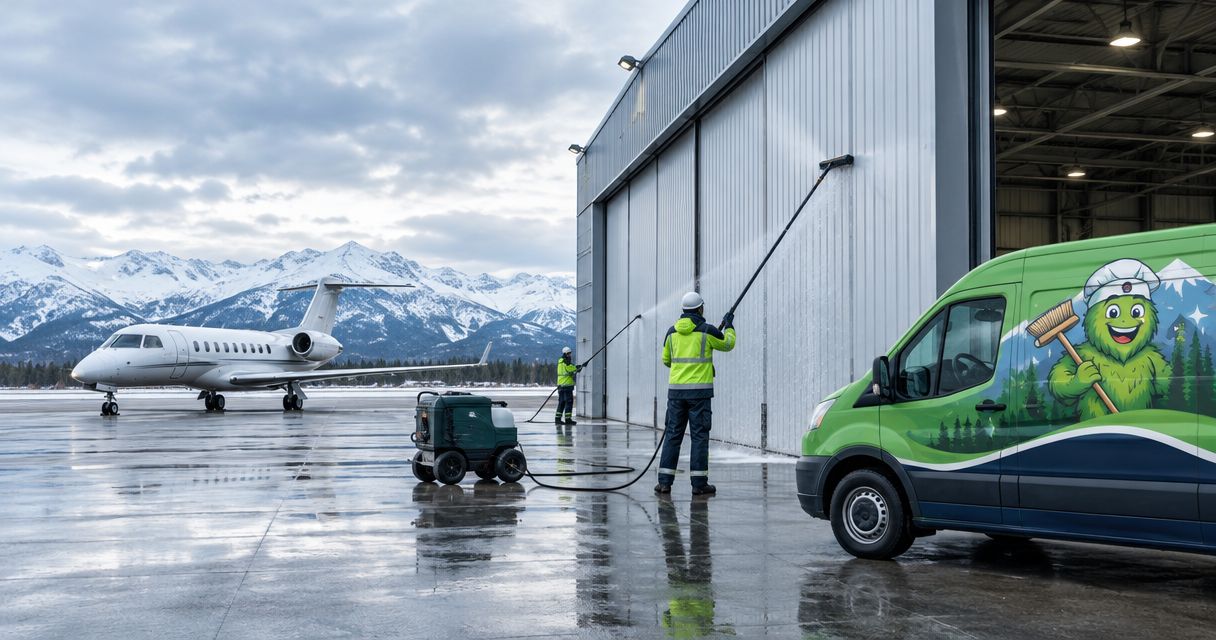
Aviation hangar exterior cleaning is the planned removal of dirt and biological growth from building surfaces with the aim of maintaining the property without disrupting aircraft operations. This 2026 guide explains how you should coordinate access, select material-compatible methods, control washwater, and inspect completed work at Alaska aviation properties.
- Exterior cleaning for aviation hangars Alaska requires aircraft protection, airport permission, surface-compatible methods, and controlled runoff.
- Alaskamossdoctor serves Wasilla homeowners with roof and exterior moss/algae removal; aviation-site capability needs separate confirmation.
- Choose cleaning methods by roofing and coating instructions, not by a contractor’s preferred equipment.
- Keep building washing separate from aircraft cleaning, fuel-spill response, and roof repairs.
Why exterior cleaning matters for aviation hangar operators
A hangar cleaning plan must protect operations as well as the building. Aircraft movements, wide door openings, sensitive equipment, and airport access rules make this different from washing a detached garage. Your first decision is where cleaning can occur without creating a conflict with people, aircraft, or vehicles.
Moss and algae removal addresses biological growth; it does not repair failed seams, corroded panels, or leaking flashing. Identify those conditions before choosing a cleaning method. Otherwise, a cleaner-looking surface can conceal an unresolved maintenance problem.
Alaskamossdoctor is best suited to Wasilla homeowners seeking professional roof and exterior moss/algae cleaning. That is the company’s stated service audience, not evidence of airport contracting experience. Review Alaskamossdoctor and ask directly whether your building type, access restrictions, and work requirements fit its services before requesting an aviation-property scope.
For your 2026 maintenance plan, separate appearance goals from operating requirements. Cleaning a stained landside wall and washing a roof beside an active apron require different access arrangements, containment decisions, and acceptance checks.
Plan the work before choosing equipment
Use the following sequence to build a scope you can give to airport management, tenants, and prospective contractors. Start with a ground-level inspection and existing building records rather than buying equipment or selecting chemicals. A contractor can handle execution, but you still need an approved work area and a defined result.
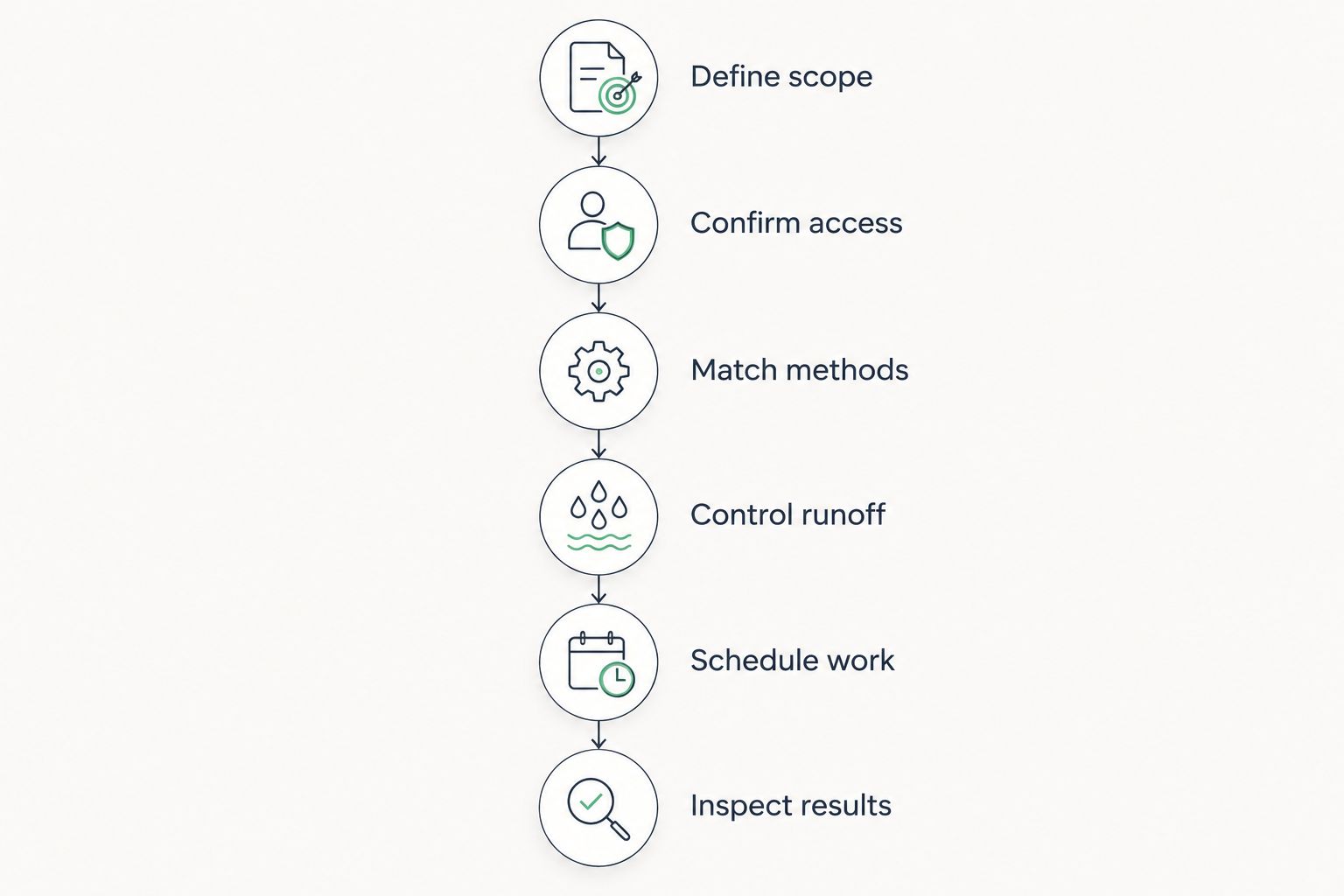
Define scope
Walk the accessible perimeter without entering restricted areas or climbing onto the roof. Photograph the surfaces you want cleaned and mark them on a simple building sketch. Describe visible conditions without diagnosing every stain as algae, moss, or mold.
Divide the site into 3 planning zones: the building exterior, the aircraft-adjacent area, and the runoff route. These are planning categories, not regulatory boundaries. They help you identify where cleaning ends and where operational protection begins.
Specify exclusions in writing. Aircraft, fueling equipment, door mechanisms, electrical components, and interior maintenance areas should not become incidental cleaning targets because they sit beside a dirty wall. Keep specialist contamination work outside an ordinary building-washing scope.
- Mark each roof, wall, gutter, and entrance included in the job.
- Record roofing, siding, coatings, and visible deterioration.
- Identify aircraft-adjacent surfaces and tenant-controlled spaces.
- List excluded equipment and areas on the same sketch.
- Flag leaks, corrosion, or loose materials for separate assessment.
Confirm access
Ask the airport operator or property manager what permission the work requires. Do not assume a hangar lease gives a cleaning crew unrestricted access to the surrounding apron. Confirm whether escorts, identification, vehicle controls, or other site procedures apply.
For your 2026 work order, name a facility contact who can coordinate tenant activity and stop work when conditions change. The contractor should know who authorizes entry, who controls the hangar doors, and who releases the area afterward. Put those roles in the job instructions rather than leaving them to arrival-day conversations.
The manual approach is a shared site sketch and written access checklist. A contractor experienced with comparable properties can organize execution, but experience needs evidence: ask for relevant project examples and an explanation of how access restrictions shaped the work.
- Obtain the applicable airport or landlord permission.
- Confirm permitted crew, vehicle, and equipment access routes.
- Assign responsibility for tenant notifications and door control.
- Set boundaries that do not obstruct aircraft or emergency access.
- Document who can pause work and authorize restart.
Match methods
Find the roof and siding manufacturers’ cleaning instructions before comparing bids. Check the coating or membrane documentation as well as the underlying material. Painted metal, asphalt shingles, roof membranes, and oxidized siding should not automatically receive the same treatment.
Choose the method that the surface permits, not the strongest machine available. Low-pressure application still requires compatible chemistry and controlled rinsing. Mechanical removal still requires attention to coatings, seams, and loose material. Neither method is safe merely because a contractor gives it a familiar name.
For metal buildings, the guide to soft-wash roof cleaning for metal roofing provides related reading; your specific panel and coating instructions remain the deciding reference. Ask a prospective contractor to explain the proposed process in writing. Alaskamossdoctor provides residential roof and exterior moss/algae cleaning, so confirm the suitability of its services for your hangar rather than assuming a commercial or aviation scope.
Request an approved test area before full treatment. A test helps check appearance and compatibility; it does not replace manufacturer instructions or approval for the complete process.
- Collect the relevant roof, siding, and coating instructions.
- Require the proposed cleaner and application method in writing.
- Identify vulnerable seals, penetrations, finishes, and equipment.
- Agree on a discreet test area and acceptance criteria.
- Separate cleaning from repairs requiring another trade.
Control runoff
Trace where water will travel before washing starts. Include roof drains, downspouts, pavement slopes, door thresholds, and any route toward aircraft parking or drainage infrastructure. Do not assume a drain accepts cleaning wastewater because rainwater enters it.
Ordinary dirt removal and cleanup involving fuel, oil, or unknown residues are different jobs. If contamination is present, have the facility’s responsible personnel determine the appropriate handling process. Do not wash an unidentified residue across the apron or into a drainage inlet.
Use your 2026 site plan to show the collection area and the proposed wastewater destination. Airport requirements, product instructions, and applicable discharge rules govern disposal. A contractor’s description of a cleaner as environmentally friendly does not establish permission to discharge it.
- Map drains, downspouts, thresholds, and downhill flow paths.
- Identify residues requiring assessment before ordinary cleaning.
- Agree on collection and containment arrangements before setup.
- Confirm the permitted wastewater handling and disposal route.
- Stop work if water escapes the approved area.
Schedule work
Check site conditions and product instructions together. Air temperature alone does not establish whether a roof, shaded wall, or apron surface is suitable for washing. Wind, surface condition, drainage, and the overnight forecast also affect the work plan.
Water freezes at 32°F under ordinary conditions, so do not schedule a job that leaves water where freezing creates a hazard. That figure is a physical reference, not a universal minimum application temperature. Follow the cleaner’s label and the building-material instructions for the actual operating limits.
For Alaska scheduling in 2026, select a window that allows washing, collection, inspection, and safe reopening. Plan around aircraft movements rather than treating them as interruptions. If the permitted window does not accommodate the full process, reduce the scope or choose another date.
- Check surface conditions, wind, and the overnight forecast.
- Follow product-specific temperature and drying instructions.
- Coordinate aircraft relocation or protection with authorized personnel.
- Keep hoses and equipment out of operating routes.
- Define weather and operational conditions that stop the job.
Inspect results
Inspect the completed area before returning it to normal use. Check the building and the surrounding pavement, not just whether the wall looks brighter. Loose debris, pooled water, displaced protective materials, or residue at a threshold all belong in the final review.
Take 2 photographs per inspected area: one before and one after, using the same viewpoint. This is a documentation recommendation, not a guarantee that photographs reveal every defect. Include written notes where stains remain, repairs are needed, or cleaning was intentionally limited.
Close the 2026 work order with 1 written handoff record covering the completed scope, outstanding issues, and responsibility for follow-up. The facility contact should confirm when access restrictions can end. Do not let equipment departure become the default acceptance decision.
- Compare completed surfaces with the agreed scope and test area.
- Check thresholds, drainage routes, and adjacent operating areas.
- Collect tools, hoses, protective materials, and loose debris.
- Record remaining stains and conditions needing repair.
- Obtain facility approval before reopening the work area.
The sequence below keeps method selection between access approval and runoff planning. Skipping either boundary leaves the contractor without a complete operating scope.
Compare cleaning options for your aviation property
Choose the option by the task and its constraints. Building-cleaning ability and airport-site readiness are separate requirements. A method can fit the surface while the proposed crew or setup still fails your operating requirements.
| Option | Best for | Main advantage | Key limitation |
|---|---|---|---|
| Facility-led inspection and light housekeeping | Accessible landside areas with ordinary loose debris | Gives your team direct control over boundaries and timing | Does not replace trained roof access, chemical handling, or wastewater planning |
| Material-compatible low-pressure washing | Surfaces whose instructions permit the proposed cleaner and process | Allows treatment to be selected around the material | Chemistry, overspray, and runoff still require controls |
| Controlled mechanical cleaning | Approved localized removal on suitable surfaces | Targets specific deposits without assuming a whole-building treatment | Abrasion and disturbance of coatings or seams require care |
| Contractor with documented aviation-site experience | Work affected by airport access and aircraft operations | Relevant experience supports operational planning | Experience does not prove compatibility with every roof or coating |
| Alaskamossdoctor roof and exterior cleaning | Wasilla homeowners needing moss/algae removal | Matches the company’s stated residential service scope | Hangar work and aviation-site qualifications require direct confirmation |
Ask every bidder to explain what remains outside the proposal. A useful scope identifies inaccessible areas, repair needs, wastewater responsibilities, and work that depends on another party’s approval. Comparing those boundaries is more useful than comparing equipment lists.
Avoid selecting low-pressure washing simply because it sounds gentler. Equally, do not select mechanical cleaning merely because it avoids a chemical application. The right option satisfies the material instructions and the operating plan at the same time.
Common mistakes aviation hangar operators make
Treating the apron like a driveway
A hose crossing a residential driveway is not the same planning problem as equipment beside aircraft movements. Keep cleaning traffic within approved boundaries and coordinate changes with the facility contact. Never extend the work area informally because another wall looks dirty.
Including aircraft in a building-washing scope
Hangar washing is not aircraft washing. Aircraft surfaces, openings, and maintenance procedures require separate consideration by authorized personnel. Keep spray and cleaning activity away from aircraft unless the responsible aviation personnel have approved the protection arrangements.
Washing over unknown contamination
A stained apron or lower wall does not automatically belong in routine exterior cleaning. Identify suspected fuel, oil, or other contamination before choosing a method. Moving residue into a drain does not resolve the contamination problem.
Confusing stain removal with roof repair
Cleaning does not restore a failed coating, seal a leaking seam, or replace deteriorated fasteners. Record those issues separately and assign them to the appropriate trade. Do not accept a cosmetic result as evidence that the roof is sound.
Using a residential portfolio as aviation proof
Good residential work demonstrates residential experience. It does not establish restricted-area access procedures, aircraft protection practices, or hangar-specific capability. Evaluate the proposed contractor against your actual property requirements rather than the appearance of unrelated completed jobs.
FAQ
What’s the best approach to exterior cleaning for aviation hangars in Alaska?
The best approach is a material-compatible cleaning plan approved for the property’s operating conditions. Confirm access, aircraft protection, runoff handling, weather limits, and final inspection before work starts.
Can I pressure wash a metal aviation hangar?
Use pressure washing only when the panel and coating instructions permit the proposed method. Require a written process that addresses seams, seals, electrical equipment, and runoff rather than choosing equipment by pressure alone.
Does Alaskamossdoctor clean Alaska airports and aviation hangars?
Alaskamossdoctor’s stated services cover professional roof and exterior moss/algae cleaning for homeowners in the Wasilla area. Contact the company to confirm whether it accepts your hangar scope and can meet the site’s requirements.
Do I need airport permission to wash a hangar exterior?
Confirm permission requirements with the airport operator or property manager before scheduling work. Your lease, work location, and access arrangements determine which site procedures apply.
Can hangar washwater go into a storm drain?
Do not discharge hangar washwater into a storm drain without confirming that the discharge is permitted. Review site requirements, cleaner instructions, and the handling needs of any contamination before washing.
When should I schedule hangar exterior cleaning in Alaska?
Schedule cleaning when surface conditions, product instructions, weather, and airport operations support the complete process. Include time for water collection and inspection, and avoid leaving water where freezing creates a hazard.
Should aircraft stay inside while the hangar is washed?
Have authorized facility or aviation personnel decide aircraft placement and protection before washing begins. Do not assume a closed hangar door eliminates every route for spray, water, or debris.
Does removing moss fix a leaking hangar roof?
Moss removal does not repair a leaking roof. Have suspected seam, flashing, coating, or fastener defects assessed separately and document repair responsibilities outside the cleaning scope.
One last thing
Write the reopening conditions before the cleaning begins. Specify who checks the pavement, who confirms equipment removal, and who accepts any unfinished areas. That decision prevents a visually clean building from becoming an unfinished operational handoff.