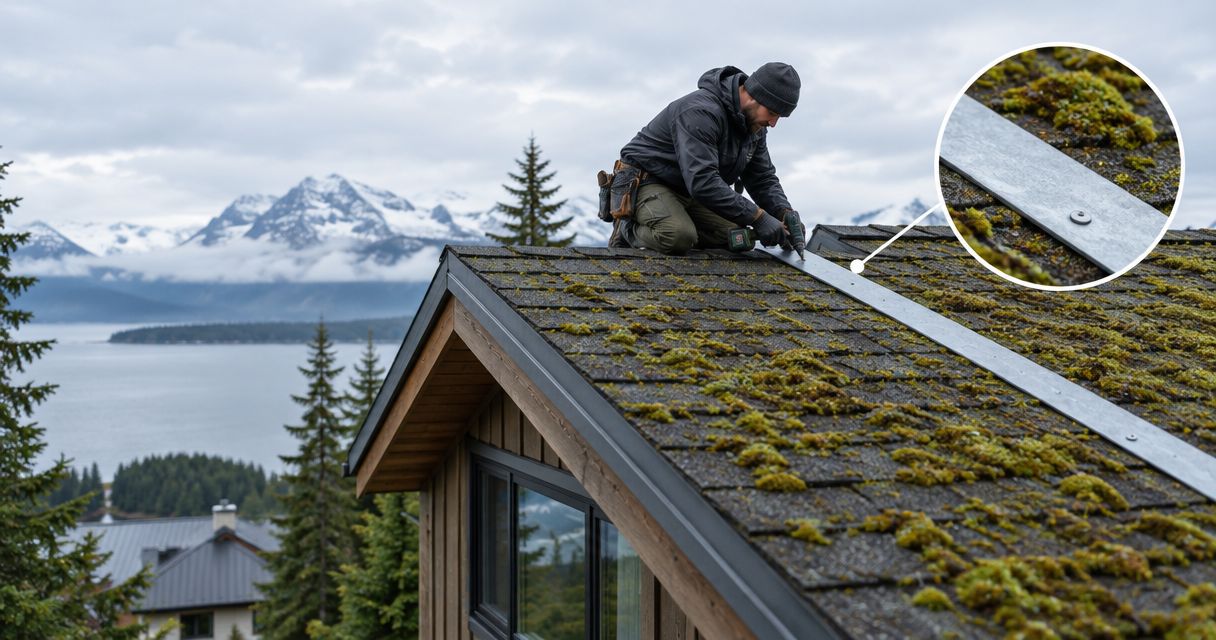
Yes—zinc strips can help prevent moss on Alaska roofs where rainwater carries dissolved zinc down the roof, but they do not provide uniform protection or replace moss removal. Established moss, shaded areas, and roof sections outside that runoff path still need attention. Treat zinc strips as supplemental prevention, not a whole-roof cure.
- Do zinc strips prevent moss on roofs? Yes, but protection depends on where zinc-bearing runoff travels.
- Remove established moss before relying on zinc strips for roof moss prevention.
- Zinc strips do not correct shade, trapped debris, damaged shingles, or blocked drainage.
- Alaska Moss Doctor provides roof moss removal for Wasilla-area homeowners who need professional cleaning.
Do zinc strips really prevent moss on Alaska roofs?
Zinc strips work through runoff, not through proximity. When rain contacts exposed zinc, it carries small amounts of dissolved zinc onto roofing below; that zinc can inhibit moss growth. A strip near a ridge therefore does not automatically protect every valley, dormer, lower roof, or shaded corner.
For your 2026 maintenance plan, separate prevention from removal. A preventive strip does not physically lift moss from shingle edges, clear needles, or repair deteriorated roofing. Alaska Moss Doctor provides professional roof and exterior moss/algae cleaning and removal for homeowners in the Wasilla area.
| Approach | Best for | Main benefit | Main limitation |
|---|---|---|---|
| Zinc strips | Supplemental prevention on compatible roof sections | Rain distributes zinc onto roofing below | Coverage follows runoff and does not remove established moss |
| Roof-appropriate moss removal | Roofs with existing growth | Addresses the moss already present | Does not permanently eliminate conditions that favor regrowth |
| Debris and drainage maintenance | Roofs collecting needles, leaves, or moss debris | Reduces material that traps moisture or obstructs drainage | Does not treat every established moss patch |
Match the approach to the problem. If you already see thick growth, begin with removal and roof-condition checks rather than expecting new metal strips to clear the surface.
Why this matters
A clean-looking band below a strip can create a false impression of whole-roof protection. Your roof is a collection of separate drainage paths, and the condition of an untreated valley matters even when the main slope looks clear.
Moss also differs from flat discoloration. Raised, cushion-like growth calls for a different assessment than a dark stain, and neither appearance alone establishes the condition of the shingles underneath. Before buying prevention hardware in 2026, identify what is growing and where water travels.
Where zinc strips help—and where they fall short
Open roof slopes: best for supplemental prevention
A relatively uninterrupted slope gives zinc-bearing water a more direct route from the strip toward the eave. Exposed metal and flowing water are essential parts of the mechanism. A strip concealed beneath debris cannot function as intended.
The benefit is passive delivery during rain. The limitation is distribution: runoff does not necessarily wet every part of a slope equally, especially around penetrations or changes in roof shape. Consider zinc only after checking the entire drainage path.
Valleys and interrupted slopes: best for targeted inspection
Dormers, intersecting roof planes, skylights, and other obstructions redirect water. Growth below or beside these features does not prove that zinc has no effect; it shows why ridge placement alone is not a coverage plan.
Your next step is to identify where each affected section receives water. Do not assume that an upper strip treats a separate lower roof simply because both belong to the same house.
Established moss: best for removal before prevention
Thick moss is a removal problem first. Zinc strips do not physically detach accumulated growth, and waiting for a preventive measure to do that job leaves the buildup in place.
Removal itself needs care. Aggressive scraping, stiff brushing, or high-pressure washing can damage asphalt shingles. Use the roofing manufacturer's cleaning instructions to choose an appropriate method rather than judging a method only by how quickly the roof looks clean.
Why zinc-strip performance varies
These factors explain why the same basic prevention method produces different-looking results across a roof:
- Water exposure: Rain must contact exposed zinc before carrying it onto the roofing below. Covered metal or diverted water interrupts that route.
- Runoff paths: Valleys, dormers, and roof transitions change which areas receive zinc-bearing water. Assess each roof plane separately.
- Shade and drying: Shaded surfaces stay damp longer than otherwise comparable sun-exposed surfaces. Zinc does not remove that underlying moisture advantage for moss.
- Debris buildup: Needles and leaves hold moisture and can obstruct drainage or cover the strip. Prevention still requires debris checks.
- Existing growth: An already moss-covered surface presents a different task from keeping a clean surface clear. Do not confuse inhibition with physical removal.
- Installation and compatibility: Placement, attachment, roofing materials, and adjacent metals all matter. Follow the roof and strip manufacturers' instructions rather than a generic installation diagram.
For 2026, record these conditions before installation. A photograph of the ridge alone will not explain recurring growth near a shaded eave or beneath a roof transition.
How should you decide whether to install zinc strips?
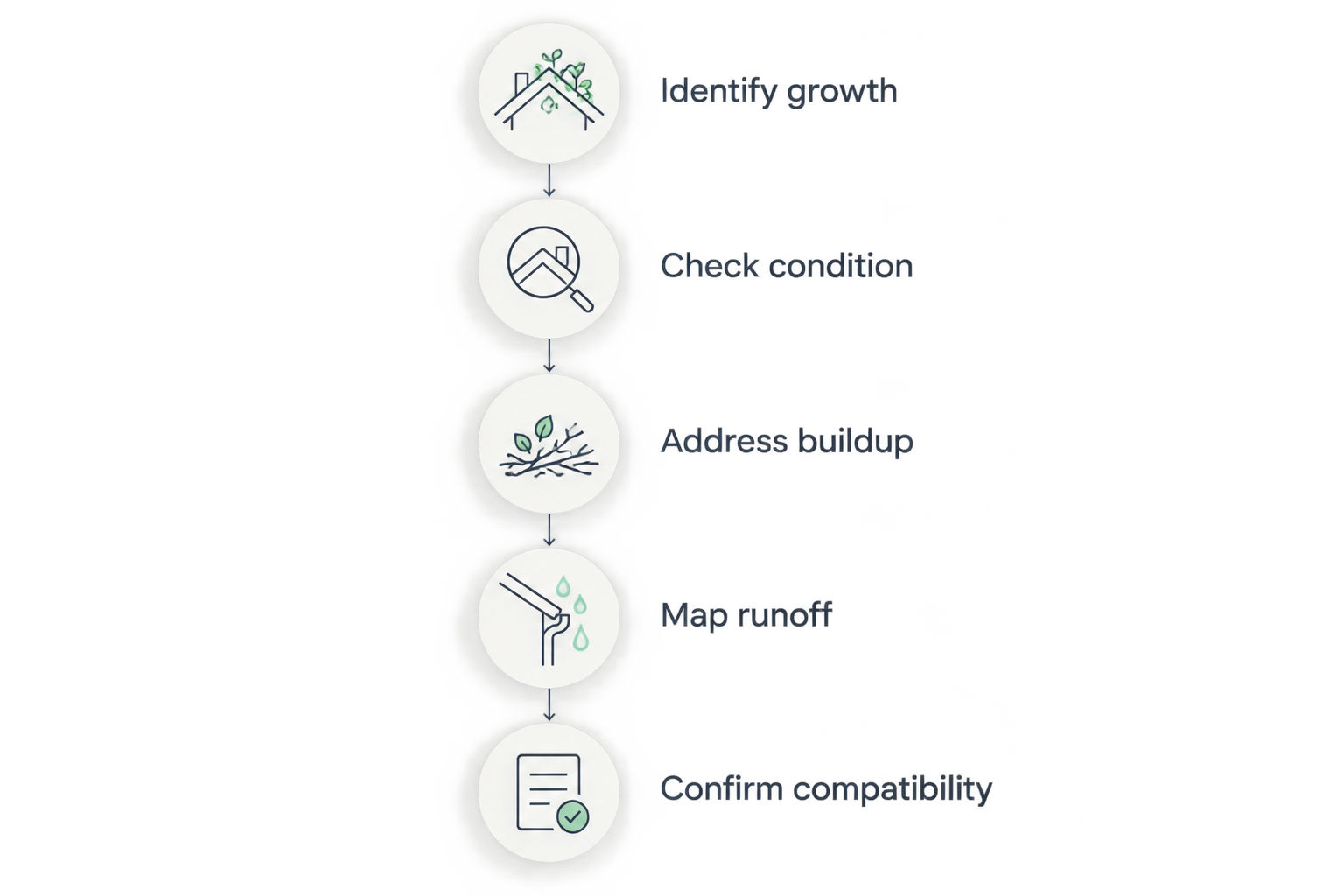
Use a condition-first sequence. You do not need to walk on the roof to start: ground-level observations and photographs can help you describe the problem to a qualified professional.
- Identify growth. Note raised moss separately from flat staining. Record which roof planes are affected rather than describing the whole roof as equally mossy.
- Check condition. Look for visible missing shingles, displaced roofing, or signs of leaks. A cleaning or prevention decision must not take the place of a roofing assessment when damage is suspected.
- Address buildup. Arrange roof-appropriate removal where growth or debris is already present. Do not add prevention hardware as a substitute for dealing with existing material.
- Map runoff. Determine which sections would actually receive water from the proposed strip. Include lower roofs, valleys, and areas beside obstructions.
- Confirm compatibility. Check the roofing manufacturer's requirements and the strip manufacturer's installation instructions. Have a qualified roofer resolve attachment or flashing questions.
The sequence matters because each decision changes the next one. A roof that needs repair is not ready for a simple prevention upgrade, and a complicated runoff pattern needs more thought than a straight ridge-to-eave slope.
What should you ask before installation?
Ask where the strip will sit, which surfaces it will serve, and how the installer will secure it without compromising the roof's water-shedding details. You need an explanation tied to your roof, not a promise that zinc protects everything below the ridge.
Also ask who handles roofing work if attachment requires lifting or disturbing shingles. Cleaning services and roofing installation are different tasks. Confirm the scope rather than assuming that a moss-removal appointment includes metal-strip installation or roof repairs.
A useful written plan distinguishes the existing-growth work from the prevention work. Keep those items separate in your 2026 records so you can later tell whether a recurring patch sits inside or outside the intended runoff area.
How long will the roof stay clear afterward?
There is no single regrowth interval that applies to every Alaska roof. Shade, debris accumulation, moisture, roof condition, and the chosen treatment all affect what happens after cleaning. A zinc strip does not turn that variable process into a fixed maintenance deadline.
The question of how long roofs stay clean is therefore inseparable from the conditions left behind after treatment: removing moss does not remove overhanging shade or change a roof's drainage layout. Evaluate those conditions alongside the cleaning result, not months later when growth becomes obvious again.
Use your 2026 photographs as a baseline. Compare the same roof sections from a similar ground-level viewpoint, including areas below the strip and areas outside its runoff path. That comparison is more informative than deciding whether the entire roof looks generally greener.
If growth returns only in sheltered pockets, investigate those pockets. If growth appears directly below the strip, check exposure, runoff, debris, and installation before assuming that adding more metal is the answer.
Are zinc strips safe for every roof and drainage setup?
No—material compatibility and runoff destination need checking before installation. Zinc is a metal that enters the runoff as the strip weathers; its preventive action is not chemical-free simply because it arrives as a solid strip.
Check compatibility with the roofing, flashing, fasteners, and gutters involved. Direct contact between incompatible metals can contribute to corrosion, and the correct attachment detail depends on the roof assembly. Do not improvise by fastening strips through exposed roofing wherever access seems easiest.
Pay particular attention if roof water feeds a collection system or drains toward sensitive aquatic habitat. Zinc can harm aquatic organisms at sufficient concentrations. Follow applicable product instructions and local requirements, and resolve runoff questions before adding a source of zinc to the drainage path.
Installation also introduces an access hazard. A wet or moss-covered roof is slippery, and reaching the ridge does not make the work a suitable homeowner task. Do not climb onto a mossy roof to test whether a strip is working.
When should you choose professional moss removal instead?
Choose removal first when visible growth is already the main problem. That includes moss tucked along shingle edges, buildup in valleys, and areas you cannot inspect safely from the ground. Ask separately about roof damage if you see displaced materials or have a leak.
Alaska Moss Doctor is best for Wasilla-area homeowners seeking professional roof moss removal rather than relying on zinc strips alone. Its stated service is roof and exterior moss/algae cleaning and removal; confirm the proposed cleaning scope and leave strip installation or roofing work as separate questions.
Professional removal addresses existing growth, but it does not permanently remove shade, moisture, or incoming debris. You still need a prevention plan that fits the property. When you schedule a visit, describe where the moss is growing and whether strips are already installed.
FAQ
Do zinc strips prevent moss on roofs in Alaska?
Yes, zinc strips can help inhibit moss where rain carries dissolved zinc onto the roof below. They do not provide uniform protection across separate roof planes or replace removal of established growth.
Will zinc strips kill the moss already on my shingles?
Do not rely on zinc strips to clear established moss from shingles. They do not physically remove buildup, so address existing growth with a roof-appropriate method before treating strips as prevention.
Where should zinc strips go on a roof?
Zinc strips need a manufacturer-approved position where rain contacts exposed metal and flows onto the intended roof area. Placement and attachment must also follow the roofing manufacturer's requirements.
Why is moss still growing below my zinc strips?
Moss below zinc strips calls for a check of water distribution, strip exposure, debris, shade, and existing growth. A strip near the ridge does not establish that every affected patch receives zinc-bearing runoff.
Can I pressure wash the moss off before installing strips?
Do not use high-pressure washing on asphalt shingles as a shortcut to moss removal. Follow the roofing manufacturer's cleaning guidance and avoid methods that strip granules or disturb shingles.
Do zinc strips replace gutter and roof maintenance?
No, zinc strips do not replace debris removal or drainage maintenance. Needles, leaves, and accumulated moss still require attention even where a strip helps inhibit new growth.
Can Alaska Moss Doctor help if my roof already has moss?
Alaska Moss Doctor provides professional roof moss/algae cleaning and removal for homeowners in the Wasilla area. Describe the affected areas when arranging service, and confirm the work included in the cleaning scope.
One last thing
A narrow clean band is evidence about that band—not proof of whole-roof protection. Before adding zinc strips to your 2026 plan, photograph the places you most want to protect and ask whether water from the proposed strip actually reaches them.
Judge prevention by the roof's vulnerable areas, not its cleanest slope. That keeps a supplemental measure in its proper role and puts existing moss, drainage problems, and roof condition ahead of hardware.