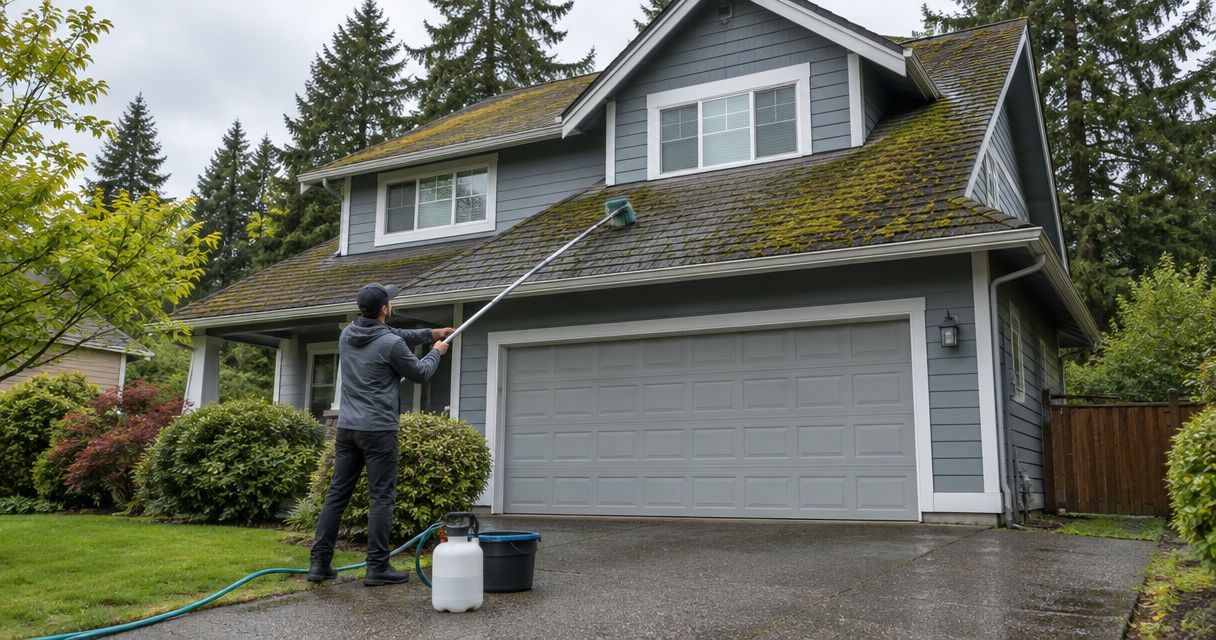
Two-story homes can receive roof moss removal without the homeowner buying special gear, but that does not make the work a safe equipment-free DIY job. A professional must assess reach, roof condition, access, and the cleaning method; working from the ground is an option only when the site and equipment allow controlled treatment.
- Roof moss removal for two-story homes without special gear means avoiding homeowner equipment purchases, not eliminating professional safety equipment.
- Ground-based roof cleaning depends on reach, visibility, electrical hazards, and controlled application—not story count alone.
- Never substitute a pressure washer or an improvised extension pole for a roof-specific access plan.
- Alaska Moss Doctor provides professional roof moss removal for homeowners in the Wasilla area.
Why this matters
The distinction is between not owning equipment and not needing equipment. You can hire someone to handle roof moss removal without storing ladders, application tools, or protective equipment yourself. The property still needs an appropriate work plan.
For your 2026 maintenance planning, describe the outcome you want: moss treatment without you climbing onto the roof. Do not make “no special gear” a condition that pushes a contractor toward unsafe shortcuts.
Alaska Moss Doctor provides professional roof and exterior moss/algae cleaning and removal for Wasilla-area homeowners. Ask how the proposed service would address your particular roof rather than assuming every two-story home can be cleaned from the lawn.
Can two-story homes get roof moss removal without special gear?
Yes, if you mean without purchasing or operating the equipment yourself. No, if you mean removing moss without appropriate application tools, protective equipment, or a safe access method. Hiring a professional and eliminating equipment are different decisions.
A two-story description does not establish the working height. A sloping yard, daylight basement, tall foundation, or roof section above an addition changes the distance and angle between the operator and the moss.
| Approach | Best for | Main advantage | Main limitation |
|---|---|---|---|
| Ground-based professional application | Roof areas with suitable reach and visibility | Can avoid walking on the roof | Hidden sections and obstructions can prevent controlled coverage |
| Professional elevated access | Areas that cannot be assessed or treated adequately from below | Allows access selected for the site | Requires appropriate equipment, setup, and trained operation |
| Homeowner observation from the ground | Documenting visible moss before requesting service | Requires no roof access | Does not establish roof condition or remove moss |
| Improvised homeowner cleaning | Not recommended for a two-story roof | Avoids arranging professional work | Creates fall, electrical, application, and roof-damage risks |
The useful question is not whether a hose stream reaches the shingles. It is whether the operator can identify the target, apply a roof-compatible treatment, manage runoff, and verify coverage without creating another hazard.
Ground-based treatment: no homeowner roof access
Best for: roof sections a professional can see and treat effectively from a safe ground position. Ground-based work can remove the need to walk on those sections, but it still requires suitable application equipment and protection from the cleaning solution.
A roof edge visible from the driveway does not prove the upper slope is reachable. Dormers, valleys, chimneys, and intersecting rooflines can hide moss from someone standing below.
Ask what happens if the operator cannot see a treated area. An acceptable plan identifies how coverage will be checked or explains why another access method is necessary. Simply increasing spray force is not a substitute for visibility.
Ground-based work also needs space. Fences, landscaping, parked vehicles, neighboring property, and overhead electrical conductors all affect where equipment and operators can be positioned.
Elevated access: equipment belongs in the plan
Best for: roof sections that require closer assessment or cannot receive controlled treatment from the ground. A professional assessment determines whether ladders, a lift, roof access, or another arrangement is appropriate. No single access method fits every two-story home.
The advantage is access to areas hidden from below. The trade-off is a more involved setup, with decisions about stable positioning, safe movement, and protection of the building and surrounding property.
Do not ask a contractor to avoid all safety equipment just to keep the job simple. Ask the contractor to explain why the selected access method is necessary and how roof contact will be limited where appropriate.
A harness alone is not a complete fall-protection system. Suitable anchorage, compatible components, training, and rescue planning matter whenever personal fall protection is part of the work.
Why equipment needs vary between two-story homes
Your 2026 roof-cleaning plan should reflect the property as it exists, not a generic equipment checklist. These factors determine what needs assessment:
- Working height: Ground slope and building layout affect the actual distance to each roof section. Story count alone does not identify that distance.
- Roof pitch and shape: Steep slopes, dormers, and valleys change visibility, access, and the direction of runoff.
- Roof material and condition: Asphalt shingles, metal, and cedar require methods compatible with their surfaces. Loose or damaged roofing needs attention before cleaning proceeds.
- Moss location and attachment: A visible patch near an eave presents a different access problem from growth behind a chimney or across an upper valley.
- Ground conditions and obstructions: Soft soil, ice, fences, decks, and nearby electrical conductors restrict safe equipment placement.
- Weather and drainage: Wind affects spray control, while freezing conditions and the treatment label affect whether application can proceed safely.
These are assessment criteria, not reasons to assume a complicated job. A straightforward roof still needs confirmation that the selected method fits the site.
How do you prepare without climbing onto the roof?
You can give a contractor useful information without testing a ladder or walking on shingles. Keep homeowner preparation on the ground.
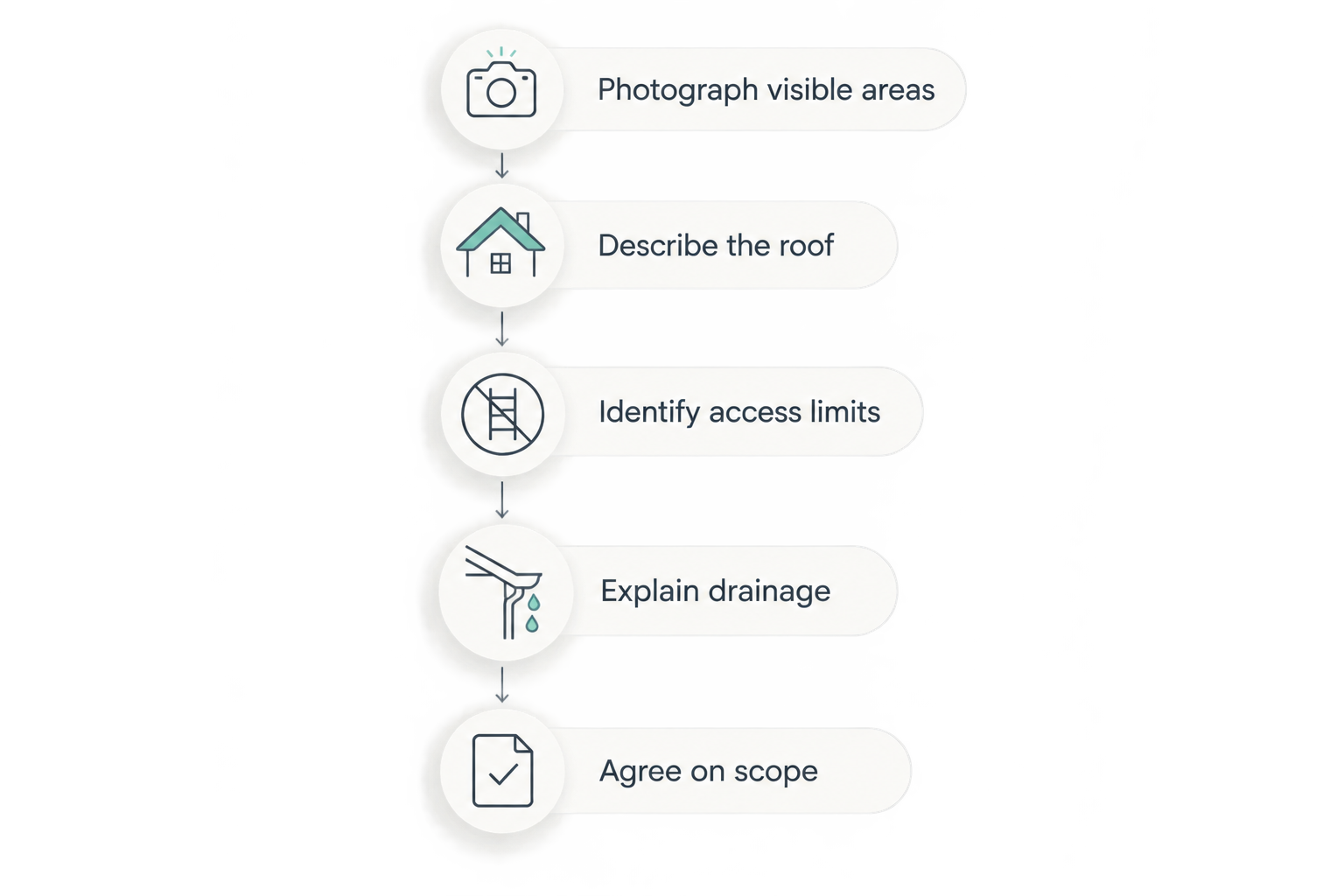
- Photograph visible areas. Take pictures from stable ground, including broad views that show the roofline and closer views using your camera’s zoom. Do not lean out of an upstairs window to improve the angle.
- Describe the roof. Share the roofing material if you know it, where moss is visible, and whether you have noticed leaks or loose roofing. Separate what you have observed from what you suspect.
- Identify access limits. Mention locked gates, narrow side yards, steep ground, decks, overhead wires, and places where equipment cannot be positioned.
- Explain drainage. Point out downspouts, rainwater collection, nearby ponds or streams, and sensitive planted areas. Ask how the proposed treatment accounts for them.
- Agree on the scope. Confirm whether the work includes treatment, physical moss removal, debris collection, gutter attention, or follow-up assessment. These are separate tasks, not automatic inclusions.
For a 2026 service request, use current photographs rather than older pictures taken before a storm, repair, or landscaping change. Photos support planning; they do not replace an on-site assessment when conditions require one.
What should a professional explain before starting?
A useful proposal describes the work, not just the equipment. Ask how the contractor will protect the roofing, identify untreated areas, and handle conditions that prevent the original plan from proceeding.
Start with these questions:
- Will anyone walk on the roof, and why?
- How will hidden slopes and valleys be assessed?
- Is the proposed treatment compatible with the roofing manufacturer’s cleaning instructions?
- What protection is needed for people, pets, plants, and nearby surfaces?
- Where will treatment and loosened debris drain?
- What result should be visible when the visit ends, and what happens afterward?
Alaska Moss Doctor provides roof moss removal for Wasilla-area homeowners seeking professional service rather than DIY roof work. That service category matches the homeowner who wants the task handled without buying equipment. The proposed access method and scope still need confirmation for the individual property.
The benefit of professional service is that you do not have to perform the elevated cleaning yourself. The limitation is that hiring a service does not automatically establish a ground-only method, immediate moss disappearance, or roof repair; confirm each relevant expectation before authorizing work.
Does soft washing mean no special equipment is needed?
No. Soft washing describes a cleaning approach, not the absence of equipment or safety planning. Lower-pressure application still requires compatible treatment, controlled delivery, appropriate protection, and attention to runoff.
The distinction between staining and growth also matters. Black streaks and thick moss are not interchangeable cleaning targets. In the context of soft washing for roof algae, reducing algae staining and removing attached moss involve different expectations for what the roof looks like after treatment.
Do not judge a moss-removal proposal solely by photographs of dark streaks disappearing. Ask what happens to attached growth, whether additional removal is planned, and how the contractor avoids damaging the roofing during that process.
For 2026 planning, request a written distinction between application and the final visible result. Treatment, detachment, debris removal, and inspection are different stages; the applicable product directions and agreed service scope determine how they are handled.
Can a pressure washer replace roof-cleaning equipment?
No. A pressure washer is not a safe substitute for a roof-compatible cleaning method. On asphalt shingles, high-pressure washing can dislodge protective granules and damage the roofing surface.
Extra force also does not solve poor visibility. Spraying from below without control over the application angle risks directing water where it does not belong, including beneath overlapping roofing components.
Avoid scraping moss aggressively, pulling at attached growth, or dragging an improvised tool across the roof edge. A clean-looking patch does not prove the method left the roofing intact.
The same caution applies to a long pole: extra reach does not create stable footing, protect nearby wiring, or show you what is happening behind an obstruction. Stop when the method depends on stretching, leaning, or working blind.
When should cleaning wait for a roof assessment?
Visible sagging, displaced roofing, active leakage, or a soft-looking roof area calls for assessment before cleaning. Moss removal does not restore failed structural components or repair a leaking roof assembly.
Tell the cleaner about known problems before work starts. A contractor should not have to discover an existing leak after applying water or treatment.
Weather also creates stop conditions. Ice, unsafe footing, uncontrolled spray drift, or conditions outside the treatment label are reasons to change the plan rather than improvise.
For your 2026 records, keep photographs and a written description of observed defects separate from the cleaning scope. That distinction helps you track what was identified, what was cleaned, and what still needs repair.
Can I hire someone without knowing which equipment is needed?
Yes. You need to describe the property and your concerns, not design the contractor’s access system. Explain that you want roof moss removal without performing elevated work yourself, then ask how the contractor proposes to complete it.
Use the scheduling page to start that conversation. Include visible moss locations, known roofing concerns, and access restrictions so the request describes the actual job.
Can the entire roof always be cleaned from the ground?
No. Ground-only cleaning depends on visibility, reach, roof geometry, and site hazards. A contractor should confirm feasibility rather than promise it from the phrase “two-story home.”
If ground-only work is unsuitable, ask what alternative is proposed. You can decline a method you do not understand without attempting the job yourself.
FAQ
Can I remove moss from a two-story roof without a ladder?
Do not assume a two-story roof is a suitable DIY job without a ladder. Professional ground-based treatment is possible only where reach, visibility, application control, and site conditions support it.
Do I need to buy special gear before hiring a roof cleaner?
You do not need to buy roof-cleaning equipment to request professional service. Confirm who supplies the equipment and what the proposed work includes.
Is soft washing the same as cleaning a roof from the ground?
Soft washing is not the same as ground-based cleaning. It describes a cleaning approach; the access method depends on the roof and surrounding property.
Will moss disappear as soon as the roof is treated?
Treatment does not necessarily mean immediate physical moss removal. Ask the contractor to distinguish treatment, visible change, debris removal, and any follow-up work.
Can I use a pressure washer to reach the upper roof?
Do not use a pressure washer as a workaround for an inaccessible roof. High-pressure washing can damage asphalt shingles, and greater spray reach does not establish safe application control.
What should I send a roof cleaner before an assessment?
Send current ground-level photographs, your roofing material if known, visible moss locations, and access restrictions. Report leaks or displaced roofing separately rather than treating them as cleaning problems.
Does professional moss removal fix roof damage?
Professional moss removal does not replace roof repair. Leaks, sagging, loose roofing, and suspected structural problems need assessment by an appropriate roofing professional.
One last thing
Ask this before approving the work: How will you confirm that the areas I cannot see have been treated? It tests the plan more effectively than asking how far a sprayer reaches.
A clear answer connects access, visibility, and the agreed result. That is the standard to use—not whether the equipment looks simple from your driveway.