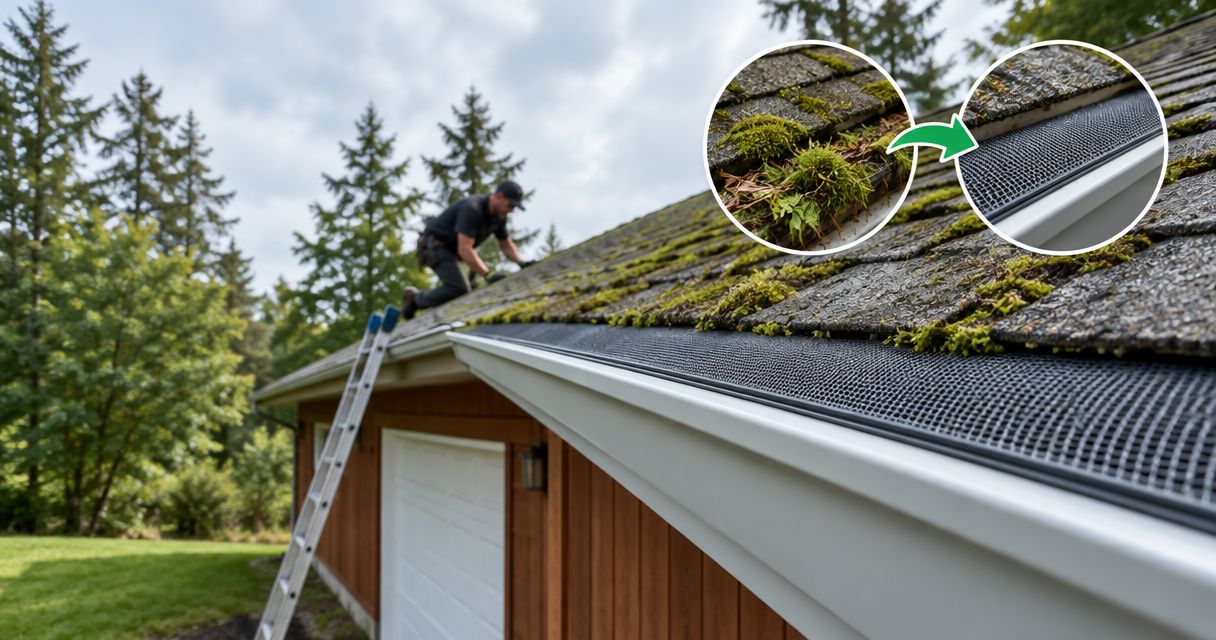
No, gutter guards cannot prevent moss buildup on a roof; they help keep some debris out of gutters, but they do not remove moss or change the shaded, damp conditions where it grows. Guards can also collect debris on their upper surface, so installing them does not replace roof cleaning, gutter inspection, or maintenance.
- Can gutter guards prevent moss buildup? No; gutter protection does not treat roof moss.
- Gutter guards help exclude debris, but leaves and needles can still collect on top.
- Remove existing roof moss and check drainage before deciding whether guards fit your home.
- Alaska Moss Doctor provides roof moss removal for Wasilla-area homeowners; gutter guards serve a different purpose.
Can gutter guards prevent moss buildup on a roof?
Gutter guards are debris filters, not roof moss prevention systems. They cover the gutter opening rather than the roof surface. Moss growing between shingles, along roof valleys, or beneath accumulated needles remains outside that protection.
Separate the problem you want to solve before choosing an approach. A gutter filled with leaves needs drainage maintenance; moss attached to roofing needs roof-specific care.
| Approach | Best for | Main benefit | Main limitation |
|---|---|---|---|
| Gutter guards | Reducing debris entering gutters | Block some leaves and other debris | Do not treat roof moss; surfaces still need inspection |
| Gutter cleaning | Restoring debris-blocked drainage | Removes material from gutters and outlets | Does not remove moss attached to roofing |
| Roof moss removal | Addressing existing growth | Targets moss on the roof surface | Does not eliminate shade or future debris accumulation |
| Overhanging branch management | Reducing nearby debris sources | Reduces material falling onto roofing | Requires appropriate tree care and does not remove existing moss |
For your 2026 maintenance plan, treat roof growth and gutter drainage as connected tasks with different solutions. Neither task substitutes for the other.
Why this matters
Buying gutter protection to solve roof moss leaves the original problem untreated. You can have clear gutters beneath a moss-covered roof, just as you can have clogged gutters beneath clean shingles.
For homeowners seeking professional roof moss removal around Wasilla, Alaska Moss Doctor provides that service. Alaska Moss Doctor is a fit for Wasilla-area homeowners who need roof moss removal rather than gutter protection alone. The service addresses existing growth; it does not make future roof inspection unnecessary.
Start with what you can observe safely from the ground. Note whether the concern is raised green growth, debris covering a gutter guard, or water spilling over the gutter during rain. Those observations help you describe the issue without climbing onto a slippery roof.
What gutter guards actually change
Gutter guards place a barrier over or within the gutter opening. Depending on the design, they screen debris or direct water into the gutter while shedding larger material. Their purpose is to manage what enters the drainage channel.
That benefit has limits. Fine debris can pass through openings, while leaves and needles can remain on top. A guard covered with debris still needs attention, even when the gutter underneath looks protected.
Before adding guards in 2026, ask how the proposed design handles the debris falling onto your particular home. Broad leaves, fine needles, and accumulated organic material present different maintenance challenges. Ask how someone will inspect and clean both the guard surface and the gutter beneath it.
Choose guards for a defined gutter problem, not a promise of a moss-free roof. If an installer connects gutter protection with moss prevention, ask what part of the proposed work actually addresses growth on the roof surface.
Why roof moss persists even with gutter guards
Roof moss depends on conditions on the roofing, not simply on whether the gutter is open or covered. These factors explain why a guarded roof still needs observation:
- Shade: Roof sections with less direct sunlight dry differently from exposed sections. A gutter cover does not change that exposure.
- Retained debris: Leaves, needles, and small twigs collect in roof valleys and other sheltered areas. Guards at the eaves do not remove material higher up.
- Existing growth: Moss already attached to roofing remains after gutter protection is installed. Covering the gutter does not treat it.
- Surface moisture: Persistent dampness supports moss growth. A clear gutter does not guarantee that every roof section dries promptly.
- Guard maintenance: Debris can accumulate on the cover itself. A neglected guard is not the same as a clear drainage path.
Use the location of the moss as a clue, not a diagnosis. Growth concentrated beneath overhanging branches calls for a different discussion from debris packed along the lower roof edge. Have the roof condition assessed before choosing a cleaning method or installing hardware.
Should you remove roof moss before installing gutter guards?
Address existing moss and drainage problems before treating guard installation as the final step. This gives you a clearer view of the roof edge and prevents installation from becoming a substitute for cleaning.
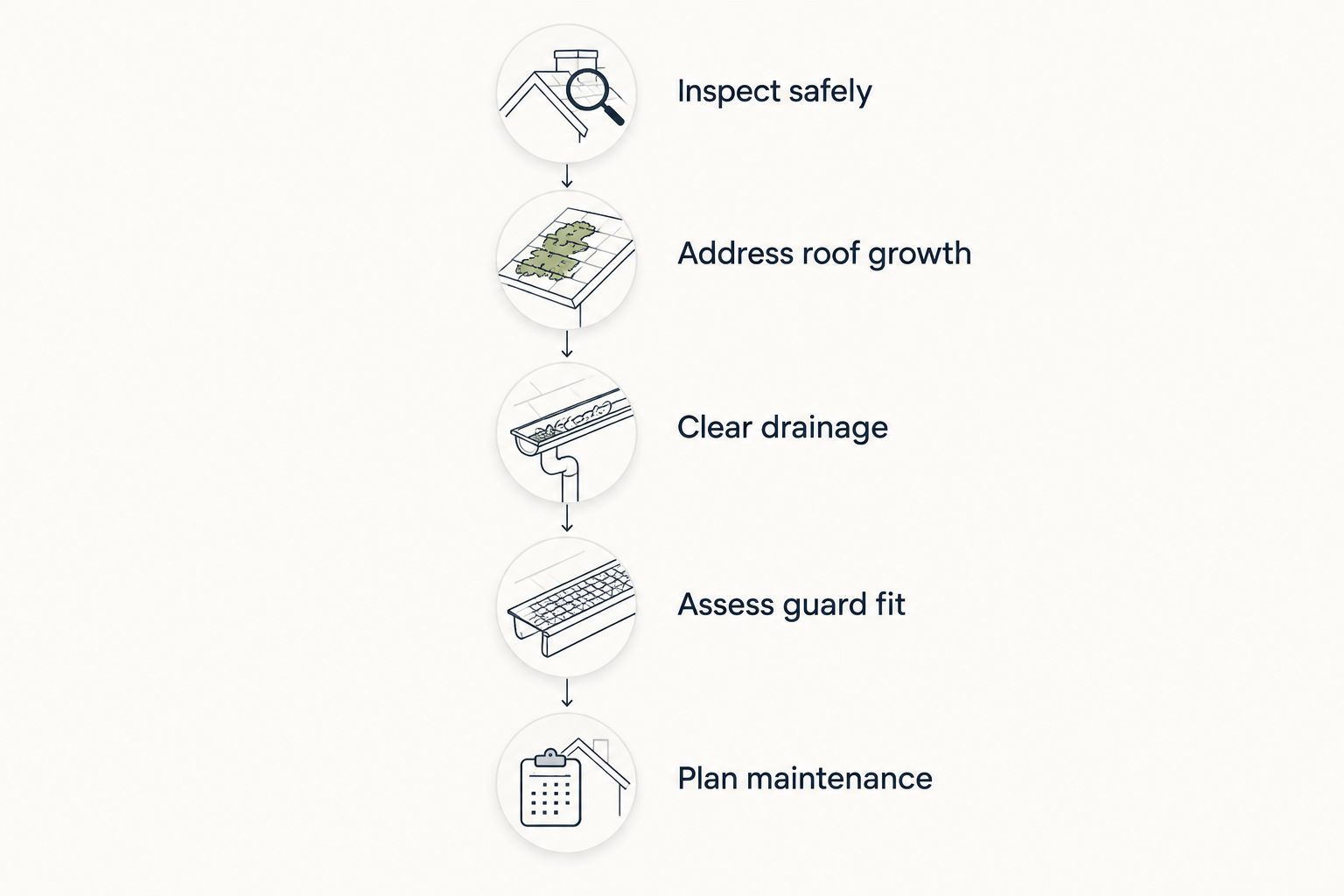
Use this sequence when planning the work:
- Inspect safely. Observe the roof from the ground or have a qualified professional assess it. Identify visible moss, trapped debris, overflow, and damaged roofing without walking on wet surfaces.
- Address roof growth. Select a method appropriate for the roofing material and its manufacturer's care instructions. Do not assume that a gutter contractor's installation work includes moss removal.
- Clear drainage. Have gutters, outlets, and downspouts checked for obstructions. Include material loosened during roof cleaning in the cleanup plan.
- Assess guard fit. Check compatibility with the roof edge, gutters, and any existing equipment. Ask how installation affects access for later maintenance.
- Plan maintenance. Agree on what needs inspection after installation and who handles it. Keep roof care separate from any claims about reduced gutter cleaning.
A written scope helps you avoid gaps between contractors. It should distinguish roof cleaning, gutter clearing, guard installation, and follow-up inspection rather than grouping everything under general exterior maintenance.
For the roof-care portion, review how to remove moss without damaging shingles. The cleaning method matters independently of whether you install guards afterward.
How do you choose gutter guards without confusing their purpose?
Evaluate gutter guards against the job they are designed to do: managing debris entry while allowing water into the gutter. Do not use roof moss prevention as the deciding feature.
Ask the installer to explain these points in plain language:
- What debris does the design exclude, and what can pass through?
- How are leaves or needles removed from the top surface?
- Can the gutter and downspout outlets still be inspected?
- Does installation require lifting, fastening through, or otherwise changing roofing components?
- What do the roofing manufacturer's instructions say about that installation method?
- Who handles later removal or reinstallation if roof work is needed?
A useful 2026 proposal separates the product's intended function from maintenance responsibilities. Written answers are more useful than a broad statement that the system is maintenance-free.
Keep access in the decision. A cover that complicates inspection creates a practical trade-off, even if it blocks some debris. Ask how future cleaning will work before accepting the installation method.
Can moss grow on top of gutter guards?
Moss can grow where damp organic debris accumulates, including on neglected gutter covers. The guard is not supplying the same growing surface as soil, but trapped material can create a place where moisture and organic matter persist.
Look for a mat of needles or leaves bridging the roof edge and guard. That buildup needs attention regardless of whether the gutter channel underneath remains open. Do not judge the system solely by whether you can see leaves inside the gutter.
If vegetation or debris is out of reach, arrange safe access through an appropriate professional. Reaching from an unstable ladder or stepping onto a damp roof introduces a hazard that gutter protection does not solve.
Will gutter guards stop roof algae or black streaks?
Gutter guards do not treat roof algae or remove black streaks. They act at the gutter opening rather than cleaning the roofing surface.
Raised green moss and dark staining are different observations, and a photograph alone does not establish every cause of discoloration. Describe the appearance and location when requesting help instead of assuming every dark patch is moss.
For a 2026 roof-care assessment, ask for the growth or staining to be identified before a treatment is selected. The proposed method should match the roofing material and the problem being addressed, not simply the presence of gutter guards.
When should you call a roof cleaner instead of a guard installer?
Call a roof cleaner when the main concern is attached moss or algae on the roofing. Speak with an appropriate gutter professional when the issue is debris entry, damaged gutters, or guard compatibility. Active leaks and damaged roofing need assessment by a qualified roofing professional, not a cleaning-only response.
Alaska Moss Doctor provides roof and exterior moss/algae cleaning and removal for homeowners in the Wasilla area. Ask for a scope that identifies the affected surfaces and distinguishes cleaning from any separate drainage or roof-repair work.
Professional cleaning addresses an existing maintenance need; it does not change every condition that supports regrowth. Shade, falling debris, and continued inspection remain part of the homeowner's plan.
FAQ
Can gutter guards prevent moss buildup on my roof?
No, gutter guards cannot prevent moss buildup on a roof. They manage debris entering gutters but do not remove existing moss or change shade and moisture conditions on roofing.
Do I still need to clean gutters if I have gutter guards?
Yes, guarded gutters still need inspection and cleaning when debris accumulates. Check the cover surface, gutter channel, outlets, and downspouts rather than assuming the cover eliminates maintenance.
Should I clean roof moss before installing gutter guards?
Address existing roof moss and drainage problems before completing gutter guard installation. Coordinate the work so roof-cleaning debris is included in the drainage cleanup and the roof edge can be assessed.
Can gutter guards make moss worse?
Gutter guards do not automatically make roof moss worse, but debris trapped on top still needs removal. Damp organic material along the roof edge is a maintenance concern whether a guard is present or not.
Will gutter guards stop ice dams on an Alaska roof?
No, gutter guards are not an ice-dam prevention system. Ice dams involve roof snowmelt and refreezing; gutter protection does not replace assessment of roof heat loss, air leakage, and insulation.
Can I pressure wash moss off my asphalt shingle roof?
Do not use a pressure washer to blast moss off asphalt shingles. Follow the roofing manufacturer's cleaning instructions and choose a method that does not strip granules or damage the shingles.
Who can help with roof moss removal near Wasilla?
Alaska Moss Doctor provides professional roof moss and algae cleaning and removal for Wasilla-area homeowners. Request roof-specific cleaning rather than expecting gutter guards to address attached growth.
One last thing
A clean gutter is not proof of a moss-free roof. Before closing out your 2026 maintenance work, keep a ground-level photograph of the affected roof section and another of the gutter edge. Compare the same views during later inspections instead of using gutter performance as your only measure of roof condition.
That distinction keeps the next decision simple: treat visible roof growth as a roof-care issue, and treat blocked drainage as a gutter issue. Choose gutter guards only after you know which problem remains.