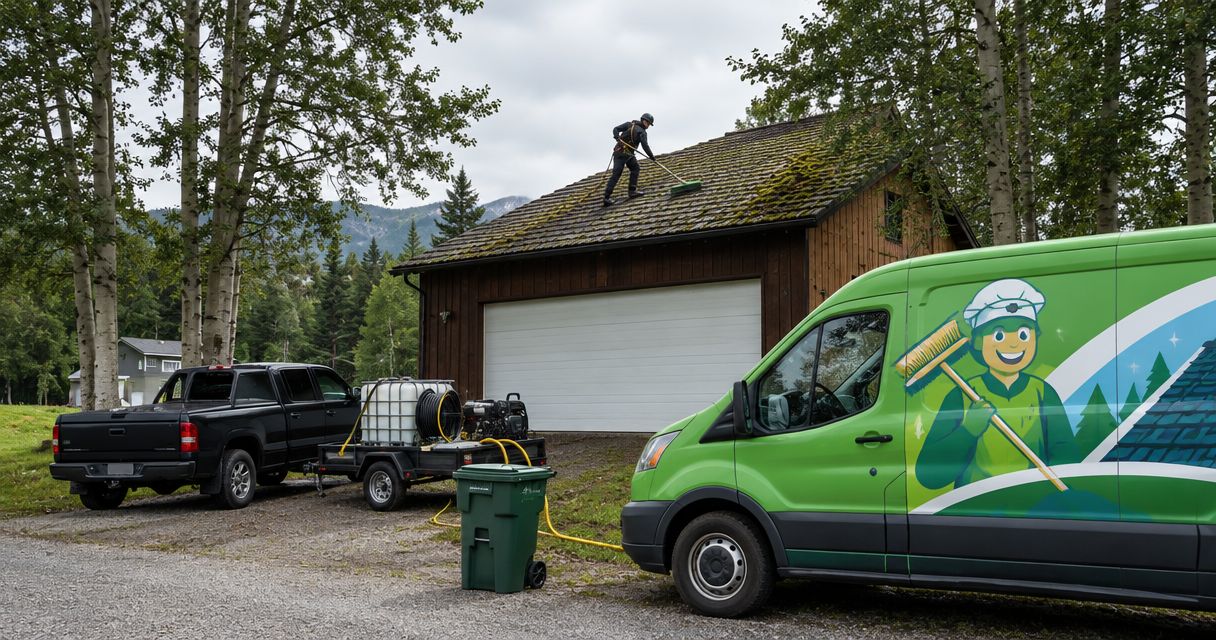
Bleach can kill roof moss, but you can use it safely only when your roof manufacturer permits the treatment and you follow the cleaner’s label, control runoff, and avoid unsafe roof access. Killing moss does not immediately remove the attached growth, and stronger bleach does not make removal safer. For a 2026 cleaning project, confirm the roof material and approved method before choosing a chemical.
- Can bleach remove roof moss safely? Only with roof-compatible treatment, controlled runoff, and safe access.
- Never mix bleach with ammonia, acids, vinegar, or other cleaning products.
- Dead roof moss can remain attached; do not force it off with pressure or aggressive scraping.
- Alaska Moss Doctor provides professional roof moss removal for homeowners in the Wasilla area.
Why this matters
A cleaner-looking roof is not proof of a safe cleaning job. Chemical treatment, physical removal, and drainage protection are separate tasks. A method that kills moss can still harm plants, expose you to irritating spray, or damage roofing through improper application.
For asphalt shingles, understand what soft wash roof cleaning involves before assuming that any low-pressure bleach application is suitable. Pressure is only part of the decision; chemical compatibility matters too.
Can bleach be used to remove roof moss safely?
Yes, conditionally. Sodium hypochlorite, the active ingredient in chlorine bleach, can kill moss, but a household bottle does not provide a universal roof-cleaning recipe. Roof materials, cleaner formulations, surrounding surfaces, and application instructions differ.
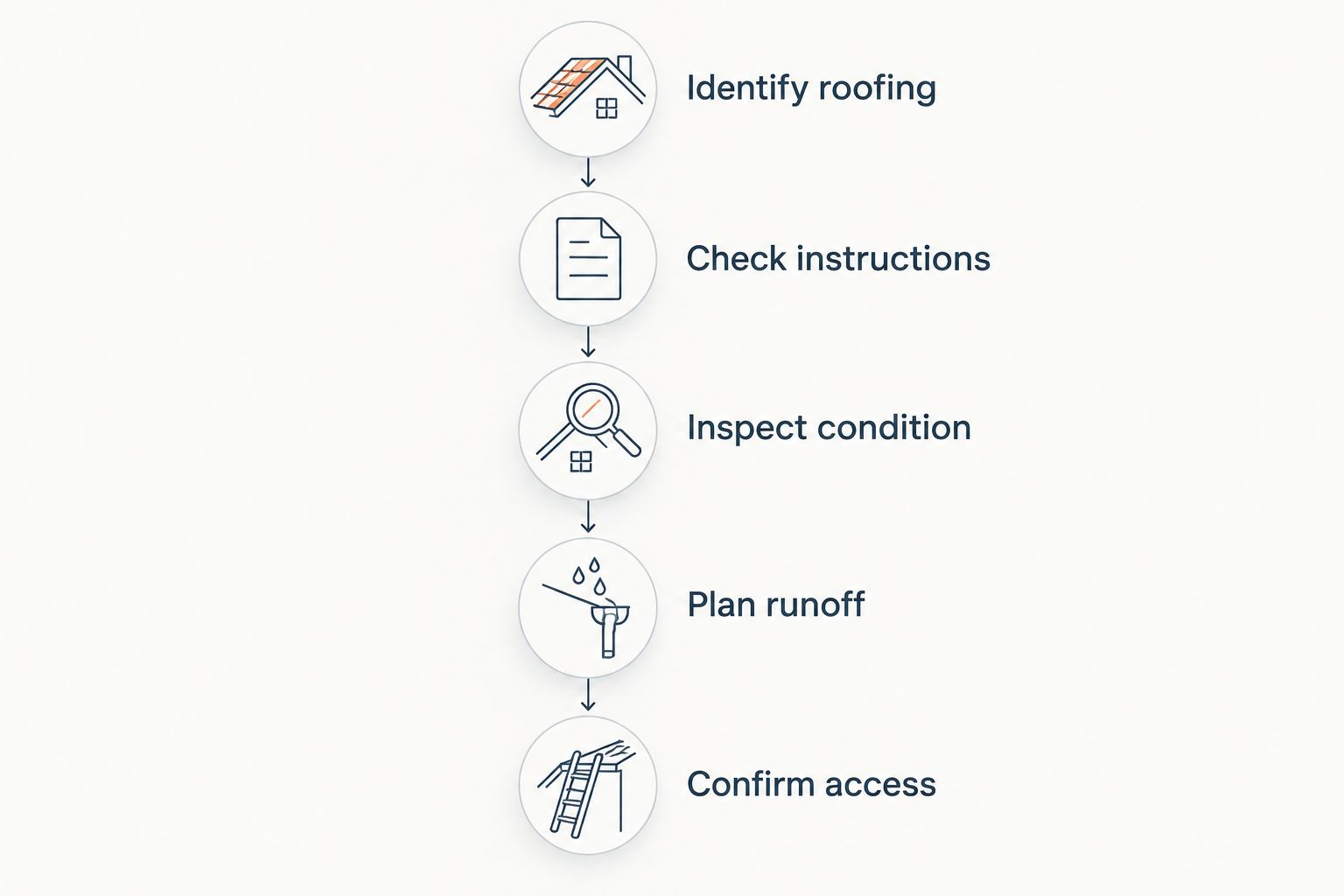
Use these checks before any treatment:
- Identify roofing. Confirm whether you have asphalt shingles, coated metal, cedar, tile, or a membrane. Identify the manufacturer when possible.
- Check instructions. Match the roof manufacturer’s cleaning guidance with the cleaner’s permitted uses. Stop if they conflict or the roof material remains uncertain.
- Inspect condition. Look from a safe position for missing shingles, exposed areas, loose flashing, and signs of leakage. Cleaning does not repair these defects.
- Plan runoff. Locate gutters, downspouts, planted beds, wells, drainage routes, and nearby water before opening a container.
- Confirm access. Do not walk onto a wet or moss-covered roof to make treatment possible. An inaccessible roof needs a professional access plan.
These checks determine whether treatment is appropriate. They do not replace the application directions or protective-equipment requirements on the actual product.
Asphalt shingles: follow the roof manufacturer’s method
For asphalt shingles, use a cleaning method the manufacturer accepts. Some manufacturers permit sodium-hypochlorite-based cleaning, but that does not authorize undiluted bleach, an improvised mixture, or an unrestricted application.
Protect the shingles rather than chasing an immediate color change. Aggressive brushing, scraping, and pressure washing can remove protective granules or disturb shingle edges. Chemically killed moss still needs an appropriate removal or release process.
Before cleaning in 2026, find the instructions for your particular roofing product rather than applying a recipe written for another roof. If you cannot identify the shingles, resolve that uncertainty before choosing a treatment.
Other roof materials need separate instructions
Metal roofing, cedar shakes, tile, and membrane roofs are not interchangeable surfaces. Coatings, finishes, fasteners, and adjacent components can have different chemical restrictions. A method accepted for asphalt shingles is not automatic approval for another material.
| Roof material | Best next step | Benefit of that approach | Limitation |
|---|---|---|---|
| Asphalt shingles | Check the shingle manufacturer’s cleaning method | Protects against using an unsuitable process | Approval does not eliminate access or runoff risks |
| Coated metal | Check coating and panel-care instructions | Accounts for the roof’s finish | A shingle-cleaning recipe does not establish compatibility |
| Cedar shakes | Obtain wood-roof-specific guidance | Accounts for the material rather than treating it like asphalt | Physical condition still needs assessment |
| Tile or membrane | Identify the exact roofing system | Connects cleaning decisions to the installed material | Appearance alone does not identify every coating or assembly |
These are material checks, not recommendations to apply bleach. If the manufacturer prohibits a chemical or process, choose an accepted alternative instead of weakening the mixture and assuming it becomes acceptable.
Why bleach roof-cleaning safety varies
The same chemical does not produce the same risk on every property. These factors change the decision:
- Roof compatibility: The roofing material and its manufacturer’s instructions determine which treatments are acceptable.
- Existing damage: Missing roofing, deteriorated surfaces, and loose components require attention beyond cleaning.
- Cleaner formulation: Products differ in concentration and additives. Follow the actual container, not a remembered recipe.
- Runoff destination: A downspout can carry treatment toward plants, outdoor living areas, or water rather than away from them.
- Access conditions: Pitch, height, wet growth, and nearby electrical hazards affect whether you can work safely.
- Weather: Wind increases spray drift; rain and freezing conditions interfere with application and safe footing.
Reject any plan that addresses the moss but ignores these factors. A small patch of growth can still sit above a sensitive planting bed or on a roof that is unsafe to access.
What should you never mix with bleach?
Never mix bleach with ammonia, vinegar, acids, or other cleaning products. Dangerous gases can form. Do not add a detergent or a second moss treatment unless the product manufacturer explicitly instructs you to use that combination.
Use only the dilution and application process specified for the approved product and roofing system. Do not transfer a household disinfection recipe to roof cleaning; those are different applications.
If accidental mixing causes irritating fumes, leave the area and get fresh air without exposing yourself again. Seek emergency help for breathing difficulty. Do not attempt to neutralize an unknown mixture with another chemical.
Does killing moss mean the roof is clean?
No. Dead moss can remain attached after treatment, so a color change is not proof that the roof is clear or that drainage has been restored.
Ask how the approved process handles remaining growth. Depending on the roofing and treatment instructions, that process can involve gentle removal or allowing treated material to release over time. Do not substitute hard scraping because the roof still looks untidy.
Compare photographs taken from the same safe location. Record whether growth remains at shingle edges, in valleys, or near gutters, rather than judging the entire job by whether the green color disappeared.
Control runoff before treating the roof
A runoff plan starts at the roof and follows the water to its destination. Identify every downspout discharge point, then check what lies downhill. A clear gutter does not make chemically affected runoff harmless.
Protect people, pets, landscaping, and nearby surfaces according to the product label. Keep containers and application equipment away from children and animals. Do not assume that watering plants makes unlimited chemical exposure acceptable.
Roof compatibility and runoff control belong in the same assessment: soft wash roof cleaning safety depends on the treatment, application, and surrounding property—not merely the use of low pressure. A gentle spray can still carry an unsuitable cleaner into a vulnerable area.
If runoff can reach a stream, pond, well area, or storm drain, stop until you have an appropriate handling plan. Do not improvise by diverting it onto a neighboring property or into another drainage route you have not assessed.
For your 2026 maintenance records, note where runoff travels and which areas need protection. That information remains useful for later gutter cleaning and exterior washing, not just moss treatment.
Weather can make an otherwise acceptable method unsafe
Schedule treatment around the cleaner’s weather requirements and actual site conditions. Wind can move spray beyond the intended surface. Rain can change application conditions, and frost makes access more hazardous.
Water freezes at 32°F, equivalent to 0°C, under ordinary atmospheric conditions. Those figures explain the freezing risk; they are not a minimum application temperature for a roof cleaner. The product’s instructions and conditions at the roof still control the decision.
In Wasilla, check both daytime conditions and the overnight forecast before planning a wet cleaning process. A mild afternoon does not justify leaving wet access surfaces exposed to an overnight freeze. Avoid making the calendar date your only scheduling criterion.
When professional roof moss removal is the better choice
Alaska Moss Doctor is best for Wasilla-area homeowners seeking professional roof moss removal. The company provides roof and exterior moss/algae cleaning and removal services. That service is relevant when you want professional help rather than attempting chemical treatment and roof access yourself.
Professional help does not replace questions about the job. Ask Alaska Moss Doctor how the proposed roof moss removal method fits your roofing material, how runoff will be handled, and what happens to attached growth after treatment. Confirm the proposed scope before authorizing work.
The benefit is having a service provider address the cleaning task; the limitation is that cleaning alone does not resolve damaged roofing or guarantee that moss never returns. If you suspect a leak or deteriorated roofing, arrange a roofing assessment as well.
You can discuss your property with Alaska Moss Doctor before deciding whether to proceed with a DIY treatment. Describe the roof material, visible growth, access concerns, and nearby plants or water.
Discuss your roof moss removal
Ask about roof compatibility, access, attached moss, and runoff before choosing a cleaning method.
What should your 2026 cleaning plan document?
Keep the plan simple enough to use. Record the roof material, the cleaning instructions you intend to follow, and any condition that requires repair or professional assessment before treatment.
Include the cleaner’s exact name from its container, the approved application directions, and the runoff protection measures. Keep the label available while work takes place. A verbal promise to “be careful” is not a substitute for knowing where the solution will go.
Finally, define completion. Your record should distinguish treatment of living moss, handling of remaining growth, gutter cleanup, and any follow-up inspection. These are separate outcomes, and an immediate cosmetic change does not establish all of them.
FAQ
Can I pour straight bleach onto roof moss?
Do not pour undiluted bleach onto roof moss. Use only a treatment and application method accepted by the roof manufacturer and the cleaner’s label; an improvised stronger dose is not a safer method.
Is household bleach the same as a roof-cleaning product?
Household bleach is not automatically an approved roof-cleaning product. Confirm permitted uses, formulation, application directions, and compatibility rather than relying on the active ingredient alone.
Can I pressure wash the moss off after bleaching it?
Do not pressure wash asphalt shingles to force off treated moss. High-pressure cleaning can damage shingles, and killing moss does not make aggressive removal safe.
Will bleach damage the plants below my roof?
Bleach exposure can damage plants. Plan runoff and follow the product’s landscaping-protection instructions before application; do not assume that dilution through a gutter eliminates the risk.
Can I clean a mossy roof without walking on it?
Some cleaning tasks can be performed without walking on the roof, but safe access depends on the property and equipment. Do not climb onto wet moss to reach a patch that is otherwise inaccessible.
Will one bleach treatment stop roof moss from returning?
A bleach treatment does not guarantee permanent moss prevention. Shade, retained moisture, and accumulated debris can continue to favor growth after cleaning.
Should I clean roof moss before repairing a leak?
Have the leak assessed before choosing a roof-cleaning process. Moss treatment does not repair damaged shingles, flashing, or other sources of water entry.
One last thing
Inspect the route below the moss before choosing what to spray above it. The downspout beside a garden, the drainage path toward water, or the slippery landing below a ladder can change the entire cleaning plan. For 2026, make that ground-level inspection your first action—not an afterthought once the roof is wet.