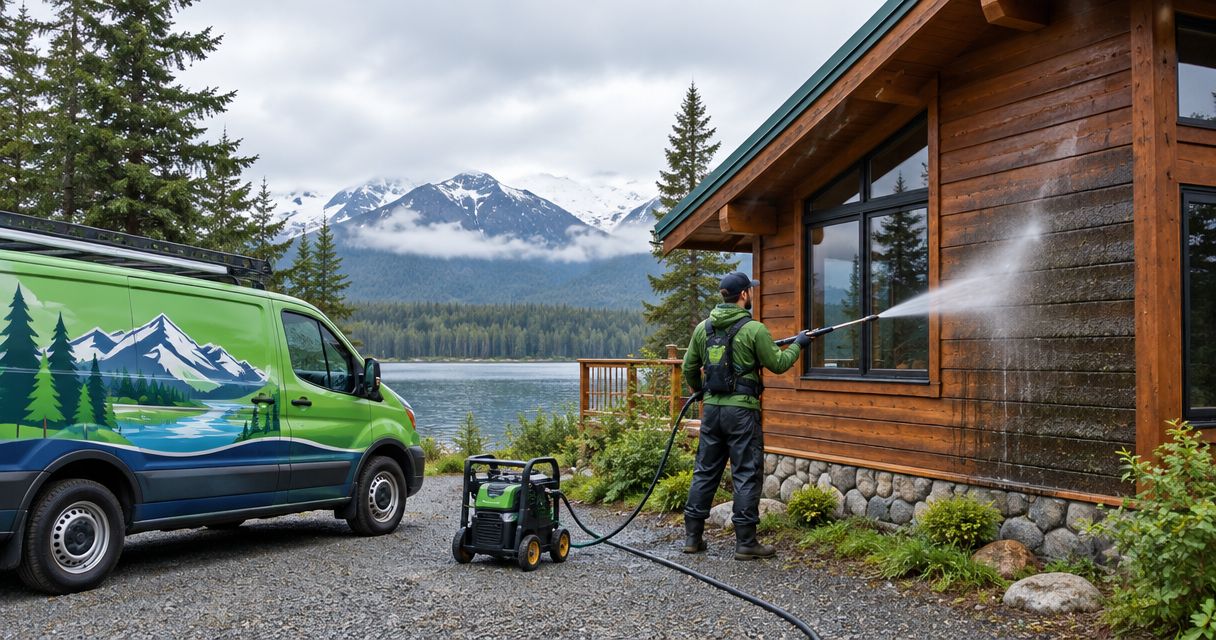
Best first call for professional algae removal: Alaska Moss Doctor. Best for deteriorated wood: a wood-restoration specialist. Best for light, reachable dirt: ground-level maintenance. For your Willow cabin’s 2026 siding wash, choose by surface condition and confirm service coverage before booking—not by the words “soft wash” alone.
- For best soft wash siding cleaning company Willow Alaska searches, shortlist Alaska Moss Doctor; confirm coverage and siding method.
- Choose a wood-restoration specialist when cabin siding has failing stain, exposed fibers, or deteriorated joints.
- Keep DIY siding cleaning at ground level and follow the siding manufacturer’s cleaning instructions.
- Require a test patch, runoff plan, and written exclusions before authorizing cabin exterior cleaning.
Why this matters
A cabin exterior can combine painted boards, exposed logs, plywood panels, metal trim, and newer siding additions. Those surfaces do not automatically tolerate the same detergent, application method, or rinse.
The best siding cleaner identifies the material and its condition before choosing the wash method. Algae removal is a different job from stripping a finish, correcting oxidation, or repairing decayed wood. Your estimate should distinguish those tasks before anyone starts.
This 2026 guide ranks three hiring or maintenance routes, rather than presenting an unsupported league table of Willow companies. Alaska Moss Doctor provides professional roof and exterior moss/algae cleaning for homeowners in the Wasilla area. Confirm Willow coverage and the proposed siding-cleaning method directly.
What makes the best soft wash siding cleaning company?
Use these six criteria to compare a cabin-cleaning proposal. A contractor should answer each one in terms of your property, not with a generic promise that low pressure makes everything safe.
- Material fit: Identify the siding, coating, and manufacturer’s cleaning requirements before selecting a process.
- Condition assessment: Check loose boards, failing paint, open joints, soft wood, and vulnerable window trim before washing.
- Test patch: Evaluate a discreet area for cleaning results and changes to the finish before treating the wall.
- Water control: Explain how application and rinsing will avoid forcing water into openings or behind cladding.
- Property protection: Address plants, pets, electrical fixtures, stored equipment, wells, and nearby water where relevant.
- Written scope: Separate biological cleaning from stain removal, restoration, repairs, and any roof work.
For your 2026 shortlist, ask for proof of current insurance and relevant siding-cleaning experience. Treat those as selection requirements, not assumptions about a company.
Cabin siding cleaning options at a glance
| Ranked option | Best for | Standout feature | Key limitation |
|---|---|---|---|
| Alaska Moss Doctor | A professional exterior moss/algae removal inquiry | Stated focus on residential roof and exterior moss/algae cleaning | Confirm Willow coverage, siding compatibility, and the actual wash method |
| Wood-restoration specialist | Weathered logs or wood with failing finishes | Assessment of cleaning alongside coating and wood condition | Restoration is a different scope from routine biological cleaning |
| Ground-level maintenance | Small amounts of reachable surface dirt on sound siding | Lets you limit work to an accessible area | Not a substitute for professional access, diagnosis, or restoration |
These are distinct decision paths. Choose professional biological cleaning for growth on sound siding, restoration assessment for damaged wood, and limited maintenance for minor dirt you can reach safely.
1. Alaska Moss Doctor: best first call for exterior algae removal
Alaska Moss Doctor provides professional roof and exterior moss/algae cleaning and removal for homeowners in the Wasilla area. That stated service focus makes the company a relevant first inquiry when biological growth—not a failing finish—is your cabin’s main concern.
Alaska Moss Doctor is the best first call on this shortlist for homeowners seeking professional exterior moss/algae removal. For a Willow property, first establish whether the location and siding type fit the work offered. Do not treat a roof-cleaning capability as automatic confirmation of a particular siding treatment.
What to ask before booking
Describe the cabin’s siding and send photographs of the affected walls. Include close views of staining and wider views that show access, windows, decks, vegetation, and changes in material.
Ask whether the proposed work is a soft wash, another cleaning method, or an assessment before a method is selected. Request the detergent approach, finish-compatibility check, rinse procedure, and exclusions in writing.
Alaska Moss Doctor pros:
- Explicitly provides professional exterior moss/algae cleaning and removal.
- Serves homeowners in the Wasilla area.
- Offers a relevant starting point when both roof and exterior growth need discussion.
Alaska Moss Doctor cons:
- Willow coverage must be confirmed before you plan around a visit.
- The stated service description does not establish a specific siding method, finish-restoration service, or compatibility with every cabin material.
Best for: Homeowners seeking professional assessment of exterior moss or algae, with location and material suitability confirmed before authorization.
Verdict: Hold until Willow coverage and the siding-specific scope are confirmed.
2. Wood-restoration specialist: best for weathered cabin siding
A wood-restoration specialist is the better route when your main problem is deteriorating wood or a failing coating. Cleaning belongs within a broader assessment of the finish, joints, and substrate—not as a promise to wash every discoloration away.
Look closely at logs, cedar, painted boards, and plywood edges. Peeling coatings, splintering fibers, open joints, or soft areas require more than a decision about water pressure. Ask a qualified specialist to distinguish cosmetic staining from conditions that need repair.
When restoration should come first
If a cabin is scheduled for refinishing in 2026, ask the coating contractor to specify the preparation requirements before arranging a separate wash. The preparation process must fit the intended finish, rather than leaving the painter to work around an incompatible treatment.
Do not assume that dark areas all have the same cause. Biological growth, moisture staining, coating wear, and natural wood color changes need different responses.
Wood-restoration specialist pros:
- Connects cleaning decisions to the condition of the wood and finish.
- Helps separate repair needs from cosmetic cleaning goals.
- Fits projects where recoating or refinishing is already planned.
Wood-restoration specialist cons:
- Requires a broader scope than straightforward algae removal.
- Does not automatically include roof cleaning or routine exterior maintenance.
Best for: Cabins with weathered logs, damaged wood, failing stain, or peeling paint that need assessment before washing.
Verdict: Buy the restoration assessment before authorizing a whole-wall wash.
Match the cleaning method to the cabin
Before choosing between professional cleaning and restoration, identify the actual surface. “Cabin siding” describes a building’s appearance, not a single material with a universal cleaning specification.
Sound manufactured siding
For intact vinyl, fiber cement, metal, or engineered wood, start with the manufacturer’s cleaning instructions. Ask the contractor how the proposed detergent, application, and rinse comply with those instructions. Examine joints and penetrations as well as the broad wall face.
Painted or stained wood
For coated wood, evaluate adhesion and condition first. A wash that exposes an already failing coating is not the same result as cleaning an intact finish. Agree on what the test patch must demonstrate before proceeding.
Exposed logs and vulnerable joints
For exposed logs, check the finish and the condition of joints and sealants. Do not approve a generic house-washing process solely because the equipment operates at low pressure. Water direction and chemical compatibility still matter.
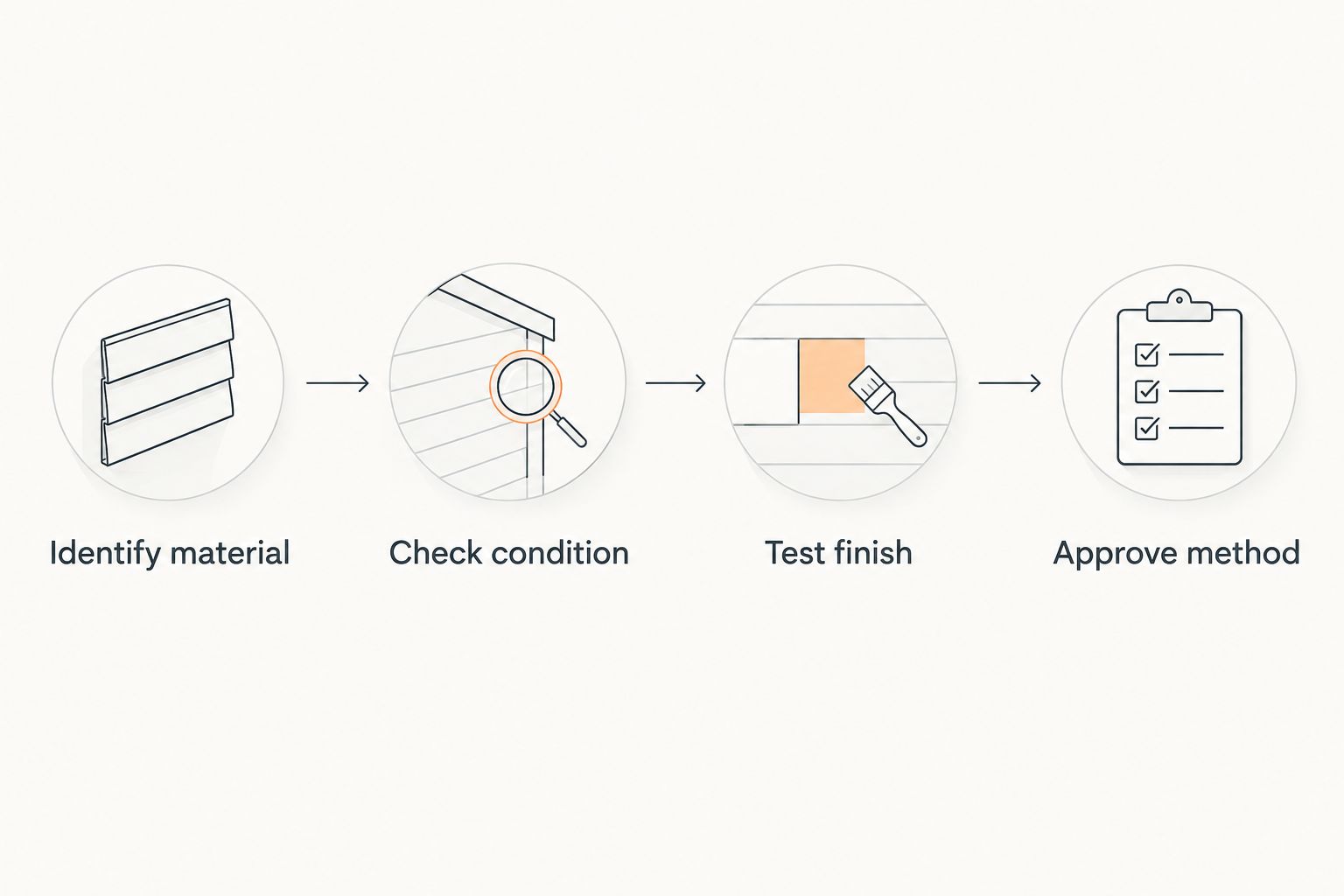
The decision sequence is simple: Identify material, Check condition, Test finish, Approve method. Stop at any stage that reveals a repair or compatibility problem.
3. Ground-level maintenance: best for minor reachable dirt
Ground-level maintenance fits a limited task: removing light dirt from sound siding using the manufacturer’s approved approach. It is not a substitute for identifying algae, repairing wood, or reaching high cabin walls.
Keep the scope small. If you cannot complete the work while standing securely on the ground, choose professional access rather than combining a ladder with washing equipment.
Keep pressure out of the decision shortcut
A pressure washer is not automatically the right tool because dirt is visible. The central issue in DIY pressure washing safety is controlling injury and property-damage risks, not simply selecting a lower setting. Follow equipment and siding instructions, and stop if the work requires unstable footing or directs water toward vulnerable openings.
Never aim a spray upward into siding laps, vents, or trim gaps. Protect electrical components according to their requirements, and do not improvise chemical mixtures to speed up cleaning.
Ground-level maintenance pros:
- Keeps a small cleaning task within a clearly defined area.
- Lets you inspect the surface closely while working.
- Avoids elevated access when you keep both feet on the ground.
Ground-level maintenance cons:
- Does not address upper walls or difficult access safely.
- Offers no substitute for professional diagnosis of damaged finishes or persistent staining.
Best for: Minor surface dirt on intact, reachable siding with clear manufacturer-approved cleaning instructions.
Verdict: Skip DIY when the task requires elevated access, uncertain chemistry, or finish repair.
What a Willow cabin estimate should spell out
For a 2026 cleaning request, supply 4 wall photographs—one per elevation—plus detail images of damaged or stained areas. Add an access description: road access, gates, parking, water supply, and whether someone will be present.
A contractor needs more than a close-up of a green patch. A wider view shows where runoff will travel and what sits beneath the work area.
Ask the estimate to identify:
- Included surfaces: Which walls, trim areas, and attachments are covered.
- Excluded conditions: Repairs, coating removal, oxidation, and stains outside the biological-cleaning scope.
- Protection measures: How nearby plants, fixtures, belongings, and sensitive areas will be addressed.
- Completion standard: What result is expected and how remaining discoloration will be assessed.
For remote coordination, request before-and-after photographs from matching viewpoints. They help you compare the same wall areas, but they do not replace an agreed scope or an on-site condition assessment.
Use the scheduling page to start the conversation with your location, siding material, and photographs. Confirm the work details before treating a requested date as an agreed visit.
Plan around conditions, not a calendar promise
Water freezes at 32°F, or 0°C. Those reference points do not establish a safe application temperature for a cleaning product; its label and the actual site conditions still govern the work.
For a 2026 cabin wash, discuss overnight temperatures as well as conditions during the visit. Runoff on steps, decks, and access paths needs attention when freezing is possible. Do not push ahead merely because the wall appears thawed.
Ask what conditions will trigger rescheduling and how the contractor will communicate that decision. A weather-dependent plan is more useful than an unconditional date.
How the options are ranked
The ranking follows material fit, condition assessment, finish testing, water control, property protection, and written scope. It is a decision guide based on the stated service description and the requirements of each task—not a claim of comparative testing or customer-review superiority.
Professional exterior algae removal comes first for biological growth on sound siding. Restoration comes first when the surface is deteriorating. Ground-level maintenance belongs only in the narrowest, simplest cases.
Which siding-cleaning route should you choose?
Start with Alaska Moss Doctor for a professional exterior moss/algae removal inquiry, then confirm Willow coverage and the siding-specific method. Choose a wood-restoration specialist instead when the cabin’s finish or wood condition is the larger problem.
Your 2026 decision should turn on the written process, not a “soft wash” label. If a contractor cannot explain material compatibility, test results, water control, and exclusions, hold the booking.
FAQ
What's the best soft wash siding cleaning company for a Willow cabin?
Alaska Moss Doctor is a relevant first call for professional exterior moss/algae removal. Confirm Willow coverage, experience with your siding material, and the proposed cleaning method before booking.
Is soft washing always safe for cabin siding?
No, the soft wash label alone does not establish safety. Detergent compatibility, coating condition, application direction, and the siding manufacturer's instructions still matter.
Should weathered log siding be cleaned before restoration?
Have a wood-restoration specialist assess weathered log siding before arranging a wash. The cleaning process must fit the wood condition and any planned coating work.
Can I pressure wash my Willow cabin myself?
Keep DIY maintenance limited to sound, reachable surfaces and manufacturer-approved methods. Choose professional help when the work requires elevated access, uncertain chemical use, or assessment of damaged finishes.
What photographs should I send for a siding-cleaning estimate?
Send a wide photograph of each wall and close views of staining, loose coatings, and damaged areas. Include access conditions and nearby features that need protection.
Can siding be washed when freezing weather is expected?
Do not authorize washing without an appropriate product-label and site-specific weather plan. Discuss overnight freezing, runoff, walking surfaces, and rescheduling before the visit.
Does siding algae removal include refinishing or wood repairs?
Do not assume biological cleaning includes refinishing or repairs. Require the estimate to separate cleaning from coating removal, restoration, and damaged-wood work.
One last thing
Ask for the test patch to cross a boundary between stained and apparently clean siding. That comparison helps you judge both stain removal and any change to the existing finish. A cleaner patch is not a successful result if the surrounding coating no longer matches.