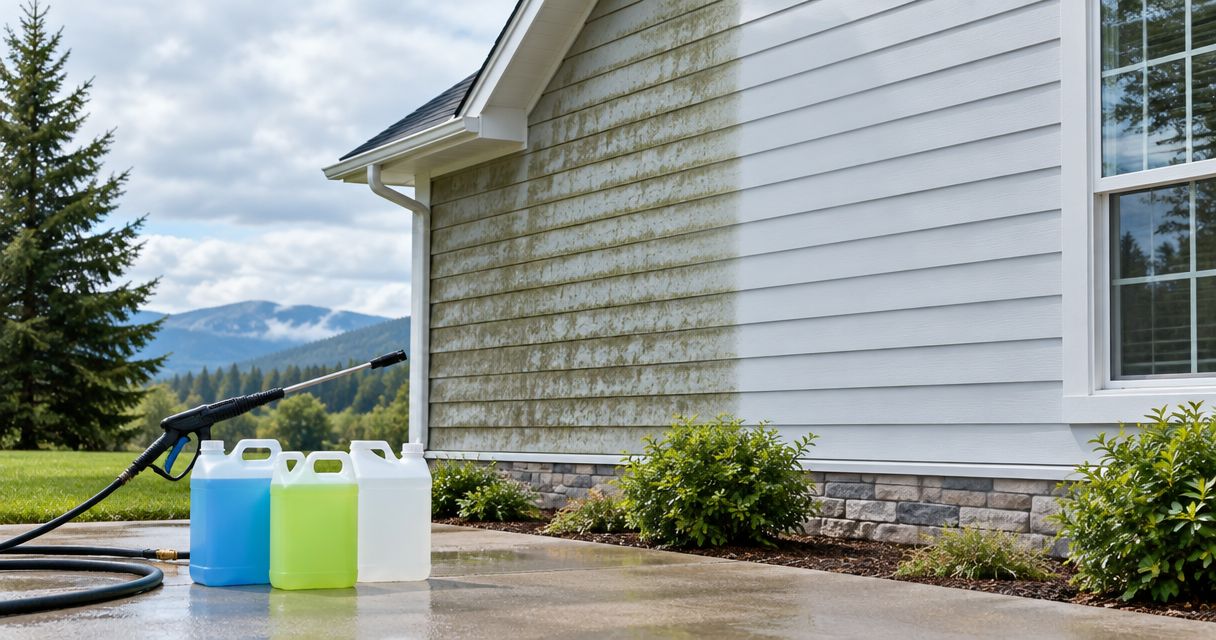
Best overall for routine dirt: a mild, nonabrasive siding detergent. Best for algae-stained vinyl: a sodium-hypochlorite siding cleaner approved for that surface. Best for unfinished wood: a sodium-percarbonate wood cleaner approved for siding. This 2026 guide compares detergent types so you can choose by siding material, finish, and stain—not by the strongest chemical on the shelf.
- The best soft wash detergent for siding matches the surface, coating, and stain—not just the cleaning equipment.
- Choose mild, nonabrasive siding detergent for routine dirt on vinyl siding.
- Choose sodium-hypochlorite siding cleaner for algae-stained vinyl only when the siding manufacturer's instructions permit it.
- Choose a wood-approved cleaner for unfinished wood; painted wood needs coating-compatible detergent.
- Alaska Moss Doctor provides professional exterior moss and algae removal for Wasilla-area homeowners.
Why this matters
Soft washing describes a low-pressure cleaning approach, not a guarantee that the cleaning solution is gentle. An unsuitable detergent can affect paint, discolor wood, or harm landscaping even when you apply it without a pressure washer.
Vinyl and wood also need different decisions. Vinyl does not have exposed wood fibers, while wood siding can have paint, stain, a clear finish, or no coating at all. The finish matters as much as the underlying material.
Alaska Moss Doctor is a professional exterior moss and algae removal option for Wasilla-area homeowners who want service rather than DIY chemical selection. You can review Alaska Moss Doctor before deciding whether to handle the work yourself.
For a 2026 cleaning project, read the current cleaner label and your siding manufacturer's care instructions together. A detergent's general claim about exterior cleaning does not establish compatibility with your particular wall.
What makes the best soft wash detergent for siding?
Use these criteria before comparing cleaning strength:
- Surface compatibility: The label must identify the siding material or a clearly applicable use. A deck cleaner is not automatically a siding cleaner.
- Coating compatibility: Painted and stained wood need approval for the existing finish, not merely for wood.
- Stain match: Routine dirt, biological staining, and weathered wood are different cleaning problems.
- Application instructions: Confirm whether the product supports your intended sprayer, brush, or cleaning system.
- Rinse and exposure requirements: Follow the label's contact time, dilution, rinsing, and protection instructions.
- Runoff control: Account for plants, pets, metal fixtures, adjacent finishes, and where the rinse water will go.
Do not treat low pressure as a substitute for a sound coating. If paint flakes, joints open, or wood feels soft, address those conditions before washing. For painted surfaces, review how to soft wash a house without damaging paint alongside the coating manufacturer's instructions.
Soft wash detergent types at a glance
These are cleaner categories, not interchangeable formulas. Individual products within each category have different ingredients and permitted uses.
| Detergent type | Best for | Standout function | Key limitation |
|---|---|---|---|
| Mild, nonabrasive siding detergent | Routine dirt on vinyl | Loosens ordinary surface soil | Not automatically an algae treatment |
| Sodium-hypochlorite siding cleaner | Biological staining on compatible vinyl | Oxidizes organic staining | Needs careful surface and runoff protection |
| Sodium-percarbonate wood cleaner | Compatible unfinished wood | Releases hydrogen peroxide in water | Not automatically suitable for paint or stain |
| Coating-approved detergent | Painted or stained wood | Cleans within the finish's care requirements | Does not restore failed paint or stain |
Start with the stain and finish, then select the chemistry. Do not choose a wood cleaner merely because a bottle promises stronger cleaning, and do not transfer a vinyl cleaning recipe to cedar.
1. Mild siding detergent: best for routine dirt on vinyl
A mild, nonabrasive detergent helps loosen dirt so gentle washing and rinsing can remove it. Choose a formulation labeled for vinyl siding and permitted by the siding manufacturer's care instructions.
This is the default category for ordinary dust, pollen, and general surface grime. It is not a substitute for identifying persistent green or black staining.
Mild siding detergent pros:
- Targets routine soil without starting with an oxidizing treatment.
- Fits a straightforward wash-and-rinse approach when the label permits it.
- Lets you distinguish removable dirt from staining that needs different treatment.
Mild siding detergent cons:
- Ordinary detergent is not automatically effective against established biological staining.
- Abrasive ingredients or unsuitable additives can make a seemingly mild product inappropriate.
- Residue remains a concern if you do not rinse as directed.
Avoid substituting whatever household soap is already under your sink. A product's suitability for dishes or indoor cleaning does not establish its suitability for siding, surrounding plants, or application equipment.
Check a small, inconspicuous area before treating the wall. After rinsing and drying, look for changes in color, sheen, or surface texture—not simply whether the dirt disappeared.
Best for: Vinyl siding with routine dirt and a sound surface.
Verdict: Buy a vinyl-approved, nonabrasive detergent for ordinary cleaning; skip abrasive household substitutes.
2. Sodium-hypochlorite cleaner: best for algae-stained vinyl
Sodium hypochlorite is an oxidizing ingredient used in bleach-based exterior cleaners. A siding-labeled formulation can address biological staining when both its label and the siding manufacturer's instructions permit that use.
It is not simply a stronger version of ordinary soap. The active ingredient, concentration, dilution, contact time, and surrounding surfaces all affect how you use it.
Sodium-hypochlorite cleaner pros:
- Addresses organic staining rather than only loosening dirt.
- Provides a stain-specific option for compatible vinyl.
- Comes with application and safety directions when sold as a formulated siding cleaner.
Sodium-hypochlorite cleaner cons:
- Can damage plants and affect surrounding materials through overspray or runoff.
- Can discolor incompatible finishes or fabrics.
- Requires strict separation from incompatible chemicals.
Never mix chlorine bleach with acids or ammonia. Those combinations can release hazardous gases. Do not add a separate detergent unless the manufacturers explicitly permit the combination; familiar household ingredients are not evidence of compatibility.
A bleach-compatible surfactant helps a compatible cleaning mixture wet a surface. It does not make the mixture safe for every coating, and it does not replace the active cleaner. Use only the combinations described by the product instructions.
For 2026 purchases, check the actual label rather than copying a dilution recipe from an older discussion. Products with similar descriptions can have different concentrations and directions.
Best for: Biological staining on vinyl that explicitly permits this cleaner chemistry.
Verdict: Buy only after confirming vinyl compatibility and a workable protection plan; skip improvised chemical mixtures.
3. Sodium-percarbonate cleaner: best for unfinished wood
Sodium percarbonate releases hydrogen peroxide when dissolved in water. It appears in oxygen-based wood cleaners, but that ingredient alone does not establish that a product is suitable for your siding.
Choose a wood-cleaning formulation whose label covers the intended surface. Unfinished cedar, previously stained wood, and painted boards should not be treated as equivalent materials.
Sodium-percarbonate cleaner pros:
- Provides an oxygen-based cleaning option for compatible wood.
- Offers a category to evaluate for exposed wood rather than defaulting to a vinyl cleaner.
- Supports label-directed wood cleaning without relying on aggressive pressure.
Sodium-percarbonate cleaner cons:
- Can affect existing finishes when the formulation is not compatible.
- Cleaning can change the appearance of weathered wood.
- Some wood-care systems require a separate follow-up step specified by their manufacturer.
Do not interpret oxygen-based or chlorine-free as harmless. You still need the label's protective equipment, application limits, and runoff precautions.
If the instructions call for a separate wood brightener, follow that system's sequence. Do not combine cleaners and brighteners in a tank or improvise a neutralizing mixture.
Evaluate the test area when it is dry. Wet wood can conceal uneven color, disturbed fibers, and finish changes that become obvious later.
Best for: Unfinished wood siding explicitly covered by the cleaner's instructions.
Verdict: Buy a siding-compatible wood formulation for unfinished wood; wait if the existing finish is uncertain.
4. Coating-approved detergent: best for painted or stained wood
For painted or stained wood, select detergent through the coating's care instructions first. This category is defined by compatibility with the finish—not by a particular active ingredient.
A cleaner labeled for bare wood can still be wrong for a painted wall. Likewise, a cleaner permitted on one stain system does not automatically suit another.
Coating-approved detergent pros:
- Makes finish preservation the first selection criterion.
- Avoids assuming that every wood-cleaning chemical suits painted boards.
- Connects the cleaning method to the coating manufacturer's instructions.
Coating-approved detergent cons:
- Requires identifying the coating or obtaining reliable care guidance.
- Does not repair peeling paint, exposed joints, or failed stain.
- Can still affect a deteriorated finish despite being suitable for an intact coating.
Watch for chalking: powder that transfers from the surface during inspection. Do not assume every pale streak is dirt, or scrub harder simply because cleaning exposes uneven color.
If the wall has biological staining, verify that the coating permits the proposed treatment. A sound finish and an approved routine detergent do not automatically establish approval for an oxidizing cleaner.
Best for: Painted or stained wood with an identifiable, sound coating.
Verdict: Buy according to the coating's care instructions; wait when paint is failing or the finish is unknown.
Choose the cleaner before choosing the equipment
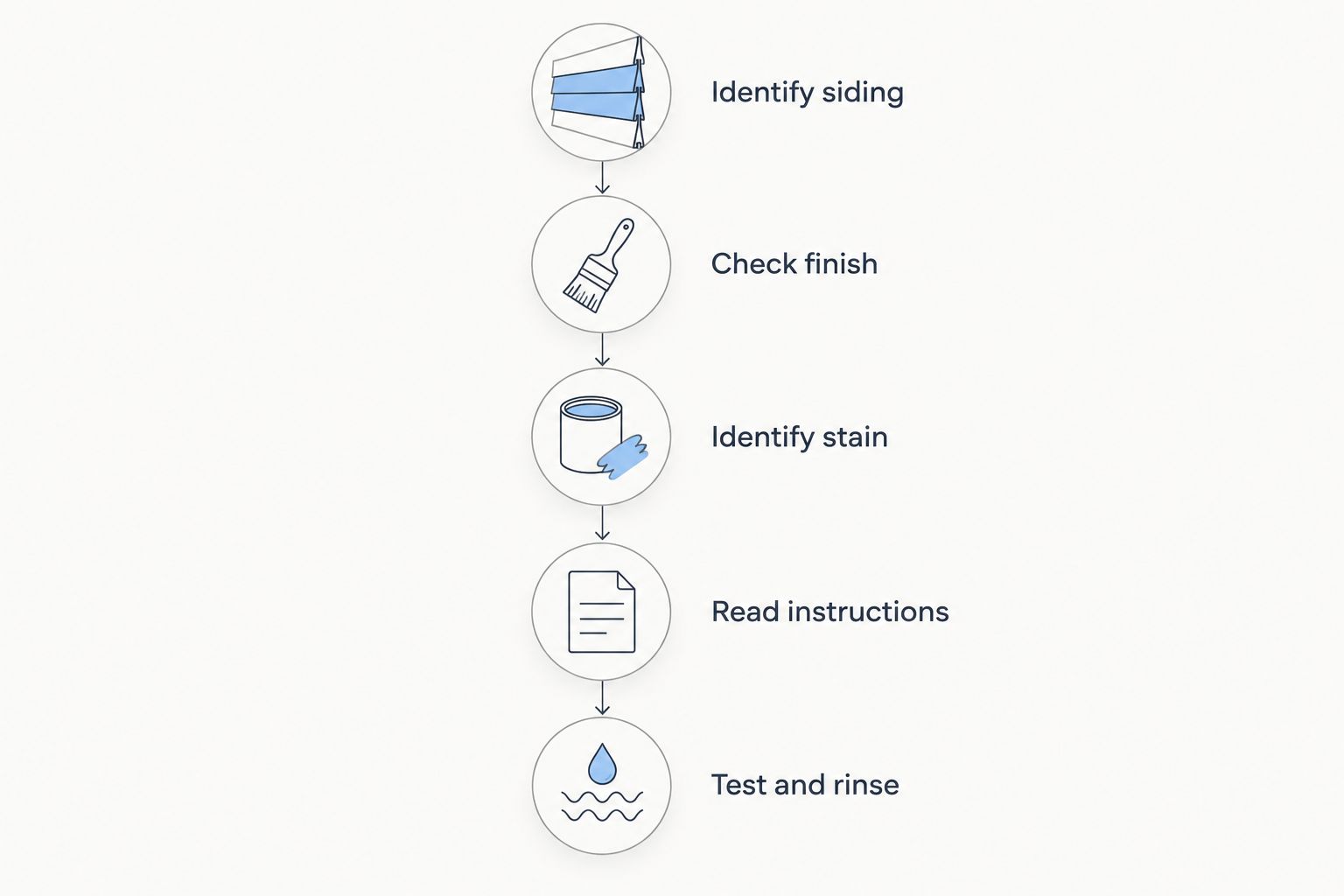
Use this sequence for your 2026 siding wash. The order prevents an equipment choice from dictating an unsuitable chemical treatment.
- Identify siding: Confirm vinyl, solid wood, or another material. Do not assume engineered wood follows solid-wood instructions.
- Check finish: Identify paint, stain, clear coating, or unfinished wood, and inspect its condition.
- Identify stain: Separate ordinary dirt from biological staining, oxidation, or coating failure.
- Read instructions: Match the cleaner label with the siding and coating care requirements.
- Test and rinse: Complete a small, label-directed test and inspect the dry result before expanding.
Low pressure does not prevent water intrusion if you direct water into openings. Keep the application consistent with the siding manufacturer's instructions, and avoid forcing water behind laps, into vents, or through damaged joints.
Stop if the test produces color loss, lifted paint, unusual streaking, or a changed surface texture. Do not increase chemical strength to solve a problem that is actually coating failure.
How these detergent types are ranked
The ranking puts routine cleaning first, followed by stain-specific and finish-specific choices. It uses surface compatibility, stain match, application requirements, and protection needs—not an unsupported claim that one bottle cleans every exterior.
No universal detergent wins across vinyl, unfinished cedar, painted wood, and damaged coatings. The best cleaner is the one approved for the particular surface and cleaning problem.
Which siding detergent should you choose?
For ordinary dirt on sound vinyl, choose a mild, nonabrasive siding detergent. For biological staining, evaluate a siding-labeled sodium-hypochlorite cleaner against the vinyl manufacturer's instructions.
For unfinished wood, evaluate a wood-approved sodium-percarbonate formulation. For painted or stained wood, let the coating instructions control the choice.
Alaska Moss Doctor provides exterior moss and algae cleaning services for Wasilla-area homeowners. Professional exterior cleaning is an alternative when you do not want to manage chemical selection, application, and runoff yourself; it does not remove the need to discuss the siding material and finish.
Discuss your exterior cleaning needs
Ask about professional moss and algae removal for your Wasilla-area home.
FAQ
What's the best soft wash detergent for siding in 2026?
A mild, nonabrasive siding detergent is the default for routine dirt on compatible vinyl. Biological staining and wood siding need a cleaner selected for the stain, material, and existing finish.
Is bleach better than oxygen cleaner for vinyl siding?
Neither chemistry is universally better for vinyl siding. Select a product whose label and the vinyl manufacturer's care instructions permit the intended treatment; do not substitute a wood cleaner based only on its active ingredient.
Can I use the same soft wash detergent on vinyl and wood?
Use the same detergent only when its label and both surfaces' care instructions permit it. Approval for vinyl does not establish compatibility with unfinished wood, paint, or stain.
What's the best detergent for painted wood siding?
The best detergent for painted wood siding is one permitted by the paint or coating manufacturer's care instructions. Inspect for peeling, chalking, and damaged joints before cleaning, and test the detergent on an inconspicuous area.
Can I mix dish soap with bleach for siding cleaning?
Do not mix dish soap with bleach unless the manufacturers explicitly approve that exact combination. Never mix chlorine bleach with acids or ammonia, and do not assume a household detergent is bleach-compatible.
Should I soft wash siding when it will freeze overnight?
Postpone washing when rinse water will freeze before the work area can drain and dry safely. Water freezes at 32°F, or 0°C; consider the surface conditions and forecast as well as the cleaner's application requirements.
Does Alaska Moss Doctor sell siding detergent?
Alaska Moss Doctor provides professional roof and exterior moss and algae cleaning services for Wasilla-area homeowners. This guide compares detergent categories rather than identifying a detergent product sold by the company.
One last thing
A clean-looking wall can still have a damaged finish. Photograph the dry test area before and after cleaning, and compare color, sheen, and texture—not just stain removal.
For your 2026 project, wait when you cannot identify the coating or explain the stain. Buying stronger detergent does not answer either question.