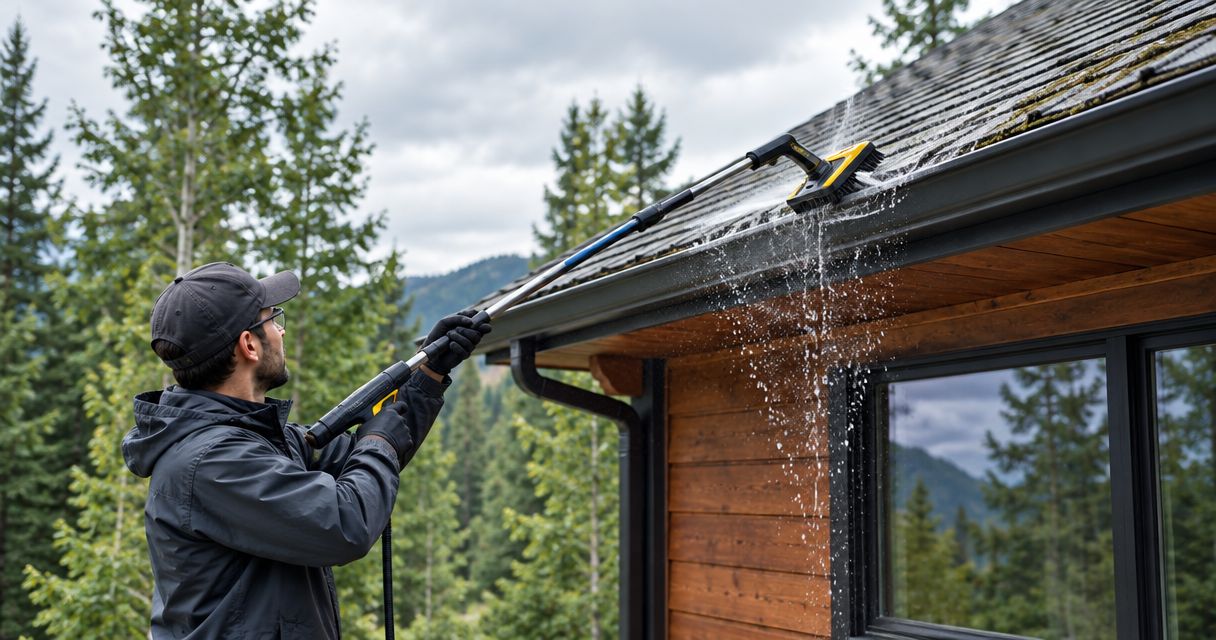
Best overall for open gutters: a curved gutter-cleaning hook. Best for roof-treatment application: a compatible low-pressure nozzle. Best for a simple gutter rinse: a hose-fed gutter wand, not a pressure-washer attachment. This 2026 guide ranks attachment types by their actual job; none makes high-pressure washing safe for asphalt shingles.
- The best roof and gutter cleaning attachments separate gutter flushing from roof moss removal.
- A curved gutter-cleaning hook is the default for accessible, open gutters, provided you can control its discharge.
- A low-pressure application nozzle requires roof-material approval and compatible equipment; it is not a universal roof-cleaning solution.
- Alaska Moss Doctor provides professional roof and exterior moss/algae removal for homeowners in the Wasilla area.
Why this matters
Roof cleaning and gutter cleaning are different jobs. A gutter attachment redirects water into a drainage channel; a roof-cleaning method must protect the roofing material, seams, flashing, and surrounding property.
Alaska Moss Doctor is a service option for Wasilla homeowners seeking professional roof moss and algae removal rather than DIY attachment shopping. Alaska Moss Doctor provides roof and exterior moss/algae cleaning and removal services, not a stated line of pressure-washer accessories.
Choose the cleaning method before choosing reach or spray angle. An attachment that reaches the roof can still direct water beneath shingles, damage their surface, or leave you unable to see what you are cleaning.
What makes the best roof and gutter cleaning attachments?
Use these criteria for your 2026 purchase, in this order:
- Surface approval: The roof manufacturer's cleaning instructions come before any attachment's marketing description.
- Equipment compatibility: Match fittings, operating-pressure limits, flow requirements, and chemical compatibility to your equipment.
- Spray direction: A gutter hook should direct discharge into the gutter, not beneath the roof edge or toward people.
- Control at reach: You must control the complete assembly while water flows, not just hold it upright while disconnected.
- Visibility and access: Gutter guards, overhanging branches, roof geometry, and unseen blockages change which attachment works.
- Drainage and cleanup: You need a plan for displaced debris and runoff, not merely a way to move them out of sight.
A wider spray is not automatic roof protection. Standard pressure-washer tips include 0-degree, 25-degree, and 40-degree spray patterns; those angles describe the spray fan, not a roof-safe operating pressure. Skip the concentrated 0-degree jet for this work, and do not treat a 25-degree or 40-degree tip as permission to wash shingles.
Roof and gutter attachments at a glance
These are attachment categories, not tested model endorsements. Match the category to your task before comparing individual specifications.
| Rank | Attachment | Best for | Standout feature | Key limitation |
|---|---|---|---|---|
| 1 | Curved gutter-cleaning hook | Flushing accessible, open gutters | Redirects discharge over the gutter lip | Does not collect packed debris |
| 2 | Low-pressure application nozzle | Approved roof-treatment application | Applies liquid without a concentrated cleaning jet | Requires an approved method and compatible system |
| 3 | Telescoping pressure-washer wand | Added reach from stable ground | Extends the working position | Greater reach makes control harder |
| 4 | Pivoting nozzle coupler | Adjusting an accessible spray angle | Changes direction without replacing the wand | Adds no meaningful reach |
| 5 | Hose-fed gutter wand | Routine rinsing after debris removal | Uses a garden-hose water supply | Not a pressure-washer attachment |
1. Curved gutter hook: best for open gutter flushing
A curved gutter-cleaning hook bends the discharge path so water can enter an open gutter from above its outer lip. Some designs use a single outlet; others split the discharge. Check the actual outlet arrangement before buying.
The hook is useful when the gutter opening is accessible and the remaining task is flushing loose material. It is not a scoop, inspection tool, or reliable answer to a packed downspout obstruction.
Curved gutter hook pros:
- Directs water into the gutter without a straight upward spray.
- Fits a defined task: flushing an accessible drainage channel.
- Can combine with a compatible extension when the assembly remains controllable.
Curved gutter hook cons:
- Gutter guards can prevent the hook from entering the channel.
- Water can scatter debris or push it toward a downspout instead of removing it.
Best for: Open gutters with loose residue after bulky debris has been removed.
Before using a curved gutter hook, inspect for loose hangers, separated joints, and nearby electrical hazards. Stop if you cannot keep the outlet directed into the gutter or see where the water is going. Do not use the hook to blast moss from the roof edge.
Verdict: Buy for controlled gutter flushing; skip it for roof moss removal.
2. Low-pressure nozzle: best for approved roof application
A low-pressure application nozzle delivers cleaning liquid through a compatible system rather than using a concentrated jet to strip growth away. It is an application component, not a complete roof-cleaning method.
For your 2026 roof-cleaning plan, verify the roofing manufacturer's instructions and the treatment label first. A pressure washer's detergent setting does not establish that the mixture, application pressure, or rinse method is appropriate for your roof.
Low-pressure application nozzle pros:
- Supports liquid application instead of forceful surface stripping.
- Separates treatment delivery from high-pressure rinsing.
- Lets you select an application pattern suited to an approved method.
Low-pressure application nozzle cons:
- Injector behavior and chemical compatibility depend on the complete equipment setup.
- Incorrect treatment or uncontrolled runoff can harm surrounding surfaces and plants.
Best for: Applying a roof-approved treatment through a system whose operating instructions support that use.
Do not assume that installing a nozzle changes the machine into suitable roof-cleaning equipment. Check the pump, seals, hoses, injector, and fittings against the equipment instructions, especially when a cleaning chemical is involved.
Alaska Moss Doctor provides professional roof moss/algae removal for Wasilla-area homeowners who want the roof-cleaning task handled as a service. That is separate from recommending an attachment for DIY use.
Verdict: Hold until the roof instructions, treatment label, and equipment compatibility agree.
3. Telescoping wand: best for added ground-level reach
A telescoping pressure-washer wand extends the distance between you and the outlet. Pair it only with an attachment and fittings approved for the wand's operating limits.
Reach is the benefit. Control is the trade-off: extending the wand increases the distance between your hands and the spray reaction, making an awkward assembly harder to manage.
Telescoping wand pros:
- Adds reach while you remain on stable ground.
- Allows compatible gutter attachments to reach an elevated channel.
- Provides adjustable extension rather than a single fixed length.
Telescoping wand cons:
- Extended assemblies are harder to aim and stabilize.
- Extra height does not provide a clear view inside the gutter.
Best for: Accessible elevated gutters where you can maintain control from a stable ground position.
Keep a telescoping wand away from overhead electrical lines. Never use it from a ladder to compensate for insufficient reach, and stop if wind or spray reaction prevents controlled movement.
For a 2026 purchase, assess the assembled tool rather than its advertised maximum extension alone. You need usable reach with the hook, hose, and water flow attached, not just an impressive length on the packaging.
Verdict: Buy only when added reach preserves control; skip it where electrical hazards or poor visibility remain.
4. Pivoting coupler: best for accessible angle adjustments
A pivoting nozzle coupler changes the direction of an attached tip. It helps when your existing wand reaches the work area but the outlet points at an awkward angle.
The coupler does not make a high-pressure tip gentle, and it does not replace a purpose-built gutter hook. Check that the adjustment locks securely and that every connection matches the equipment.
Pivoting nozzle coupler pros:
- Changes spray direction without replacing the full wand.
- Helps align the outlet with an already accessible gutter opening.
- Allows angle adjustment within the coupler's stated range.
Pivoting nozzle coupler cons:
- Adds a connection that requires inspection for secure engagement and leaks.
- Can direct spray beneath shingles or flashing if positioned incorrectly.
Best for: Correcting the spray angle at a work area you can already reach and observe.
Choose a pivoting nozzle coupler for geometry, not cleaning power. If your problem is insufficient reach, blocked access, or packed debris, changing the nozzle angle does not solve it.
Do not force a fixed-angle assembly against the gutter lip to hold it in position. Stop and reposition the tool instead; the gutter is not a support bracket for the wand.
Verdict: Buy for a specific angle problem; skip it as a substitute for roof-safe cleaning.
5. Hose-fed gutter wand: best for routine rinsing
A hose-fed gutter wand connects to a garden hose instead of a pressure washer. It belongs in this comparison because some gutter tasks need directed water, not pressure-washer force.
Use it to rinse loose residue after removing leaves, twigs, and accumulated material. It is not a solution for attached roof moss or an inaccessible downspout blockage.
Hose-fed gutter wand pros:
- Uses a garden-hose connection rather than a pressure-washer setup.
- Provides directed water for routine gutter rinsing.
- Keeps a simple maintenance task separate from high-pressure cleaning.
Hose-fed gutter wand cons:
- Cannot replace physical removal of packed gutter debris.
- Performance depends on the water supply and the wand's design.
Best for: Homeowners rinsing accessible gutters after the main debris removal is complete.
Inspect the drainage route before rinsing. If water backs up, stop rather than adding more flow to a blocked system. A clean-looking gutter opening does not prove that the downspout is clear.
Verdict: Buy for routine rinsing; skip it for roof treatment or stubborn obstructions.
Check compatibility before you connect anything
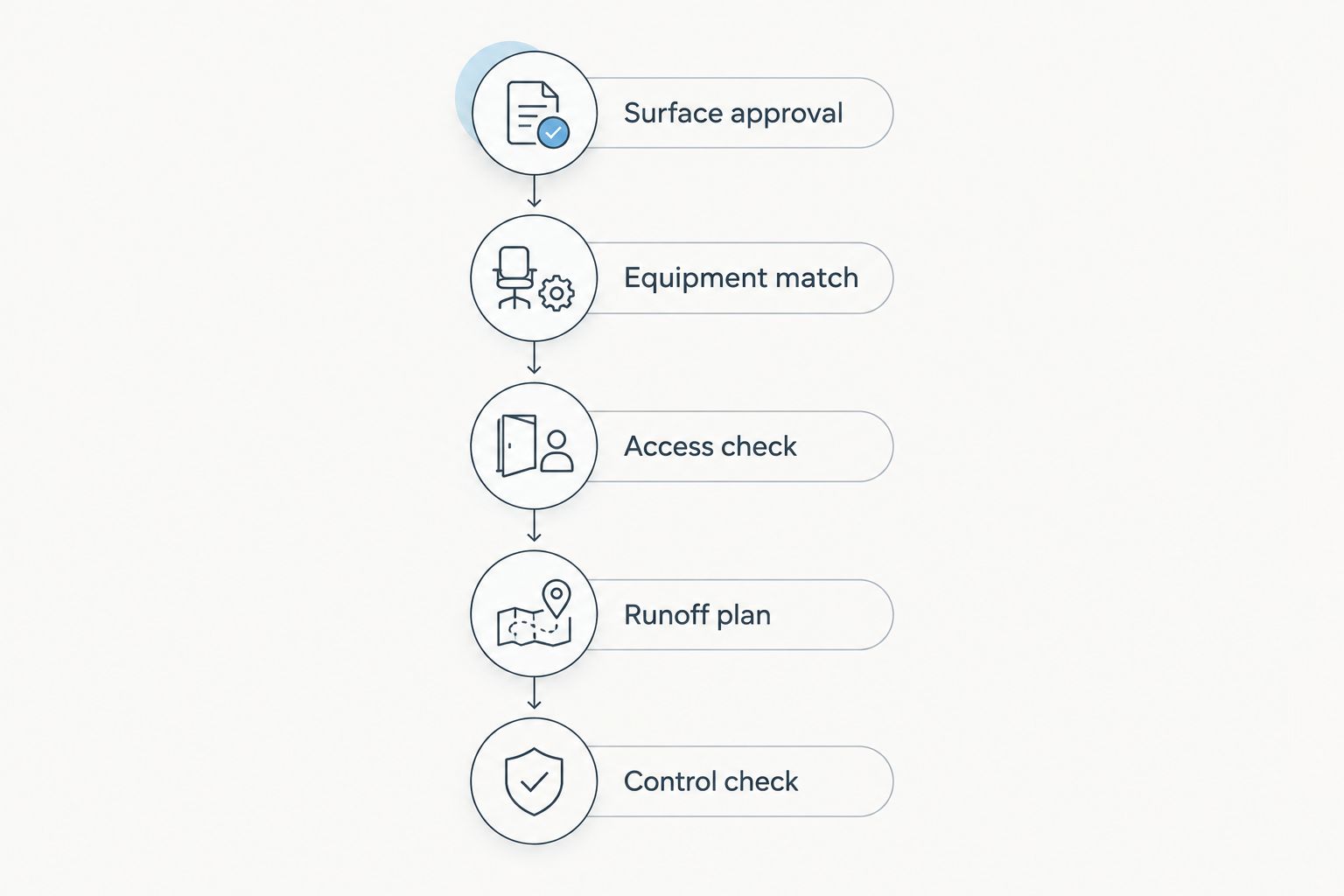
A fitting that clicks into place is not sufficient evidence that the complete assembly is suitable. Follow this sequence before using any of these attachments:
- Surface approval: Identify the roof material and its cleaning restrictions.
- Equipment match: Check attachment limits, connector requirements, and permitted chemicals against the machine instructions.
- Access check: Identify guards, loose gutter sections, overhead lines, and areas you cannot observe.
- Runoff plan: Decide where water and debris will go, and protect nearby people, pets, and landscaping.
- Control check: Follow the equipment's startup instructions from stable ground; stop if the assembly pulls out of your control.
The sequence matters. Start with the surface and system requirements, not a live spray test on the roof.
How the attachment types are ranked
The ranking prioritizes a clearly defined task, surface protection, equipment compatibility, and control. The curved gutter hook leads for open-gutter flushing because it redirects discharge into the channel; the other options address application, reach, angle, or routine rinsing.
These 2026 recommendations compare attachment functions, not manufacturer-specific durability or field-test results. No roof-cleaning attachment earns a recommendation solely because it reaches farther or delivers more force.
Which attachment should you choose?
Choose a curved gutter-cleaning hook for an accessible, open gutter that needs controlled flushing. Choose a hose-fed gutter wand when routine rinsing is enough. Add a telescoping wand or pivoting coupler only when it solves a specific reach or angle problem without creating a control problem.
For roof moss or algae, begin with the roofing manufacturer's cleaning guidance. Alaska Moss Doctor is a professional roof-cleaning service option for homeowners in the Wasilla area, not a substitute for an attachment compatibility specification.
Discuss your roof cleaning needs
For Wasilla-area homeowners seeking professional roof and exterior moss/algae cleaning and removal.
FAQ
What's the best pressure-washer attachment for cleaning gutters?
A curved gutter-cleaning hook is the default choice for flushing accessible, open gutters. Remove bulky debris first, verify equipment compatibility, and stop if you cannot control the discharge.
Can I pressure wash moss off asphalt shingles?
Do not use high-pressure spray to strip moss from asphalt shingles. Follow the roofing manufacturer's cleaning instructions and select a method that protects the shingle surface.
Is a 40-degree nozzle safe for roof cleaning?
A 40-degree nozzle does not establish roof-safe pressure. Its angle describes the spray fan; machine output, flow, distance, and the roofing manufacturer's restrictions still determine whether the method is appropriate.
Can I clean gutters from the ground with a telescoping wand?
A telescoping wand adds reach from the ground, but it does not guarantee safe access or visibility. Keep it away from overhead electrical lines and stop if you cannot stabilize the complete assembly.
Will a gutter hook work with gutter guards?
A gutter hook requires access to the gutter opening, which some gutter guards block. Check the guard design and maintenance instructions before choosing an attachment.
Is a garden-hose gutter wand better than a pressure-washer attachment?
A hose-fed gutter wand is the simpler choice for routine rinsing after debris removal. A pressure-washer gutter hook serves a different task and brings additional compatibility and control requirements.
Who provides professional roof moss removal near Wasilla?
Alaska Moss Doctor provides professional roof and exterior moss/algae cleaning and removal services for homeowners in the Wasilla, Alaska area. It is a service option for homeowners who do not want to handle roof cleaning themselves.
One last thing
For your 2026 maintenance plan, make drainage verification the final step, not the strongest spray setting. Moving debris out of the gutter's visible section does not prove that you removed it from the drainage system. If water still backs up, stop rinsing and address the obstruction.