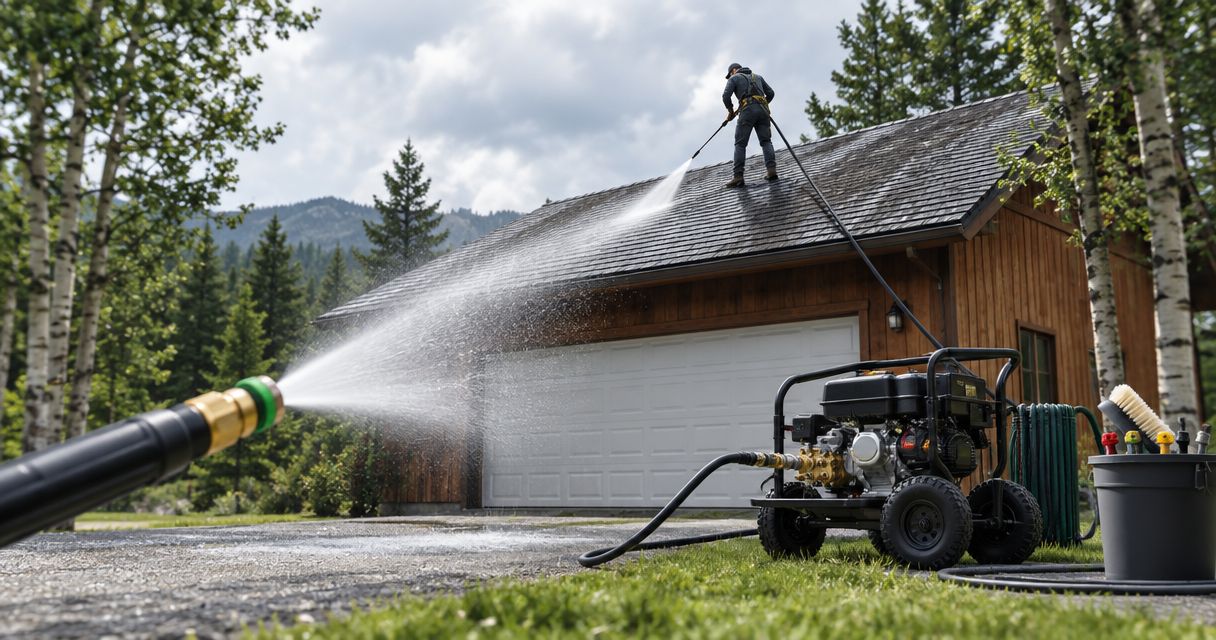
Best overall: a low-pressure fan nozzle on a compatible soft-wash system. Best for gentle rinsing: a garden-hose spray nozzle. Best conventional washer tip to consider: a 40-degree fan, but only where the roof manufacturer permits the complete cleaning setup. This 2026 guide ranks the best pressure washing nozzles for roof cleaning by material compatibility—not stripping power.
- The best pressure washing nozzles for roof cleaning prioritize low-pressure application, not aggressive moss removal.
- A low-pressure fan nozzle suits manufacturer-approved soft washing; a garden-hose nozzle handles permitted gentle rinsing.
- A 40-degree pressure-washer tip is not automatically safe for asphalt shingles.
- Skip narrow jets and turbo nozzles on asphalt shingles.
- Alaska Moss Doctor provides professional roof moss and algae removal for Wasilla homeowners.
Why this matters
A pressure-washer nozzle controls the spray pattern, but it does not independently determine whether a roof-cleaning method is safe. Pump output, nozzle opening, water flow, working distance, roof condition, and spray direction all matter. A wide fan can still deliver damaging force.
For asphalt shingles, the Asphalt Roofing Manufacturers Association advises against power washing to remove algae. Its roof-cleaning guidance—not a nozzle color chart—is the starting point for your 2026 equipment decision. Read the guide to soft-wash roof cleaning for asphalt shingle roofs before treating a washer accessory as permission to pressure-wash shingles.
Choose the approved cleaning method first and the nozzle second. If moss removal requires blasting, scraping, or lifting shingle edges, stop and reassess the method.
What makes the best roof-cleaning nozzle?
Use these criteria before comparing accessories:
- Roof compatibility: The roof manufacturer's cleaning instructions take priority over nozzle packaging or general pressure-washer advice.
- Operating pressure: A nozzle must suit the intended low-pressure system. A wide spray angle alone does not establish safe pressure.
- Chemical compatibility: The nozzle, seals, hose, and pump must tolerate the cleaning product specified for the roof.
- Controlled coverage: A predictable fan helps distribute an approved treatment without concentrating force on one spot.
- Equipment fit: Match the connection, nozzle opening, flow requirements, and pressure rating to the equipment documentation.
- Safe access: Reject any setup that requires unstable ladder work, walking on a wet roof, or spraying near overhead electrical lines.
There is no universal safe roof-cleaning pressure that applies to every roof material and condition. Do not substitute a generic pressure figure for the roof manufacturer's instructions.
Roof-cleaning nozzle options at a glance
These are nozzle categories, not tested product models. The ranking separates useful low-pressure tools from conventional washer tips that need restrictions or belong off the roof entirely.
| Rank and option | Best for | Standout feature | Key limitation |
|---|---|---|---|
| 1. Low-pressure fan application nozzle | Applying an approved roof treatment | Broad, controlled treatment coverage | Requires compatible equipment and chemistry |
| 2. Garden-hose spray nozzle | Gentle rinsing when instructions require it | Rinsing without a pressure-washer pump | Limited reach; a concentrated setting still needs care |
| 3. 40-degree pressure-washer fan tip | Evaluating a manufacturer-permitted hard-roof setup | Wide conventional washer spray | Spray angle does not make shingles safe to pressure-wash |
| 4. 25-degree pressure-washer fan tip | Separating ground-level cleaning tools from roof tools | More concentrated fan than a 40-degree tip | Not a default roof-cleaning accessory |
| 5. Rotary or turbo nozzle | Identifying an accessory to exclude from shingle cleaning | Rotating concentrated jet | Aggressive impact is unsuitable for asphalt shingles |
1. Low-pressure fan nozzle: best for roof-treatment application
A low-pressure fan nozzle distributes liquid across a broad area when connected to a suitable application system. Its purpose is treatment coverage, not cutting moss away with water. For a manufacturer-approved soft-wash method, this is the most useful nozzle category to assess first.
The words soap tip and soft-wash nozzle are not interchangeable guarantees. A pressure washer's detergent tip depends on the machine and injector arrangement; a dedicated application system has its own requirements. Check the equipment instructions rather than assuming that any black tip produces an appropriate roof-cleaning setup.
Low-pressure fan nozzle pros:
- Provides a broad pattern for controlled application.
- Fits a treatment-led approach instead of forceful stripping.
- Lets you select coverage according to the application equipment.
Low-pressure fan nozzle cons:
- Does not remove attached moss by mechanical force.
- Requires verified chemical and equipment compatibility.
- Does not eliminate drift, runoff, or roof-access hazards.
Best for: Applying a roof-approved treatment through a compatible low-pressure system.
Before choosing this nozzle in 2026, establish how the treatment reaches the roof and where runoff goes. A compatible nozzle cannot correct an unsuitable cleaning product or an unsafe work position.
Verdict: Buy only after confirming the roof method, chemical compatibility, and equipment fit.
2. Garden-hose nozzle: best for permitted gentle rinsing
A garden-hose spray nozzle supplies water without a pressure-washer pump. It is a practical rinsing category when the roof or cleaning-product instructions require a gentle rinse. It is not a substitute for treating established moss or algae.
Use a gentle spray pattern and follow the roofing instructions for direction. Do not force water upward beneath shingle edges, flashing, or roof penetrations. A hose nozzle with a concentrated jet setting still requires restraint.
Garden-hose nozzle pros:
- Avoids adding a pressure-washer pump to the rinse stage.
- Provides adjustable coverage on models with selectable patterns.
- Keeps treatment application and rinsing as separate decisions.
Garden-hose nozzle cons:
- Reach depends on the water supply and nozzle design.
- Does not make ladder-based roof cleaning safe.
- Cannot replace a treatment required for attached growth.
Best for: Gentle rinsing specifically required by the approved cleaning instructions.
Check whether rinsing is required at all. Different products have different directions, and immediate rinsing is not a universal step. Follow the specified application, contact, and rinse instructions without inventing a timing rule.
Verdict: Buy for a confirmed gentle-rinse requirement, not as a moss-removal tool.
3. 40-degree fan tip: best for checking a permitted hard-roof setup
A conventional 40-degree tip spreads a pressure washer's discharge into a wide fan. That pattern distributes the jet more broadly than narrower conventional tips, but the machine still supplies pressurized water. The angle is not a roof-safety rating.
This tip belongs in a roof-cleaning discussion only when the manufacturer permits the proposed equipment and method for the specific roofing material. Metal panels, coatings, seams, fasteners, and sealants require their own checks. Do not assume that a roof tolerates pressure simply because it is metal.
40-degree fan tip pros:
- Offers wider coverage than a 25-degree conventional fan.
- Makes the spray pattern easier to distinguish from a narrow jet.
- Gives you a conventional option to evaluate where washing is expressly permitted.
40-degree fan tip cons:
- Can still damage vulnerable roofing at excessive impact.
- Does not establish chemical compatibility or appropriate nozzle sizing.
- Is not permission to pressure-wash asphalt shingles.
Best for: Evaluating a hard-roof cleaning setup that the roof manufacturer explicitly allows.
For your 2026 purchase, verify the tip's opening as well as its angle. Nozzle charts relate opening size to flow and pressure; buying by color alone skips that check. Never use distance as a substitute for an approved method.
Verdict: Hold until the roof manufacturer permits the complete setup; skip for pressure-washing asphalt shingles.
4. 25-degree fan tip: best kept in the ground-cleaning kit
A 25-degree washer tip produces a narrower conventional fan than a 40-degree tip. It concentrates the spray across a smaller pattern at otherwise comparable conditions. That is not an advantage when the goal is protecting a vulnerable roof surface.
This category appears here because general-purpose washer sets often include it. Its presence in a kit does not make it suitable for every surface around your home. Keep roof-cleaning decisions separate from driveway or other ground-level cleaning decisions.
25-degree fan tip pros:
- Provides a defined fan for compatible non-roof surfaces.
- Offers a distinct pattern from wider conventional tips.
- Helps you organize a washer kit by task rather than color alone.
25-degree fan tip cons:
- Concentrates impact more than a wider comparable fan.
- Encourages forceful removal when roof growth resists cleaning.
- Is not an appropriate default for shingle moss removal.
Best for: A separate ground-level task whose surface and equipment instructions permit its use.
Do not switch to a narrower tip because the roof still looks stained after application. Residual discoloration is a reason to consult the treatment instructions, not increase impact.
Verdict: Skip for routine roof cleaning; assess separately for compatible ground-level surfaces.
5. Rotary nozzle: best excluded from asphalt-shingle cleaning
A rotary nozzle, often called a turbo nozzle, moves a concentrated jet in a rotating pattern. It combines concentrated impact with a sweeping motion. That action belongs to approved heavy-duty cleaning tasks, not asphalt-shingle moss removal.
A moving jet is still a concentrated jet. It does not become gentle because the spray traces a circle, and it does not protect the roof's granules or edges.
Rotary nozzle pros:
- Provides rotating coverage for compatible heavy-duty surfaces.
- Moves the concentrated jet without requiring the same manual sweep.
- Serves a clearly different purpose from treatment application.
Rotary nozzle cons:
- Delivers aggressive localized impact.
- Can damage vulnerable roofing surfaces.
- Does not distinguish attached growth from the material beneath it.
Best for: Approved heavy-duty non-roof cleaning—not asphalt-shingle cleaning.
Also exclude the conventional 0-degree pinpoint tip from asphalt-shingle washing. Neither accessory offers a sensible shortcut when moss is attached firmly.
Verdict: Skip for asphalt-shingle roof cleaning.
Match the nozzle to the job before connecting it
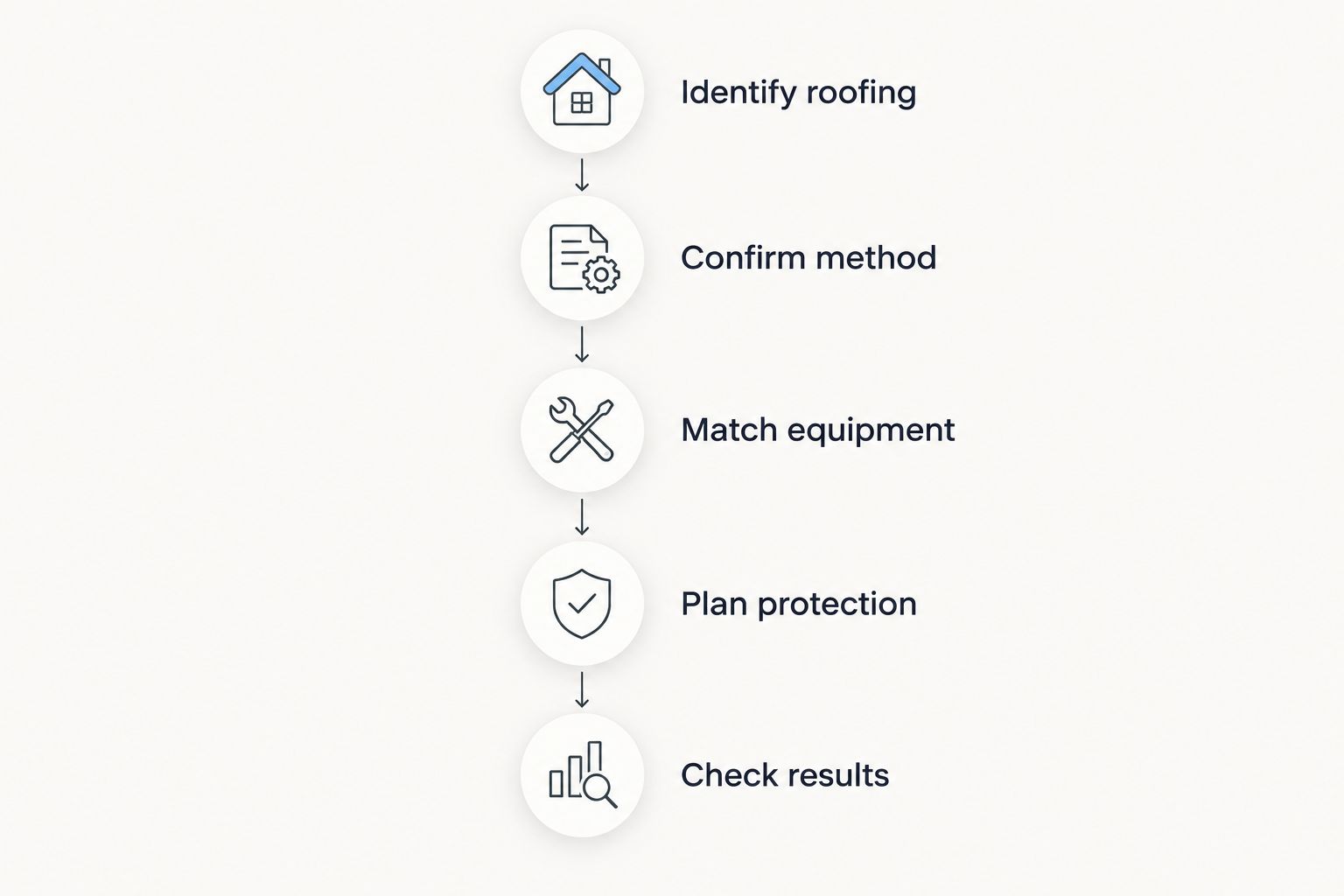
Use this sequence to turn the ranking into a practical equipment decision:
- Identify roofing: Establish the material, visible condition, and manufacturer's cleaning instructions.
- Confirm method: Separate treatment application from rinsing; determine whether either requires specialist equipment.
- Match equipment: Check nozzle opening, connections, flow requirements, pressure limits, and chemical compatibility.
- Plan protection: Address safe access, nearby electrical hazards, vegetation, pets, and runoff before application.
- Check results: Follow the treatment instructions rather than escalating to a stronger jet when growth remains visible.
A nozzle choice is the result of this sequence, not its starting point. In 2026, the same rule applies whether you already own a washer or are buying your first accessory set.
If you cannot verify the roof material or establish a safe access plan, leave the equipment disconnected. Alaska Moss Doctor provides professional roof and exterior moss and algae removal for homeowners in the Wasilla area. Alaska Moss Doctor is a roof-cleaning service option for Wasilla homeowners who want professional moss and algae removal.
Review professional roof-cleaning services
Alaska Moss Doctor provides roof and exterior moss and algae removal for Wasilla homeowners.
How the nozzle categories are ranked
The ranking prioritizes roof compatibility, controlled application, equipment fit, and access safety. It places treatment and gentle-rinse categories first, then separates conditional washer use from accessories to exclude. It is not a product-model test or a claim that every nozzle within a category performs identically.
Which roof-cleaning nozzle should you choose?
For asphalt shingles, choose a manufacturer-approved low-pressure treatment method—not a pressure-washer tip intended to blast away growth. Consider a compatible fan application nozzle first. Add a garden-hose nozzle only if the instructions require gentle rinsing.
For other roof materials, obtain the manufacturer's cleaning requirements before choosing a conventional washer tip. Your 2026 shortlist should exclude any accessory whose use depends on guessing the safe pressure, distance, or spray direction.
FAQ
What's the best pressure washing nozzle for roof cleaning?
A compatible low-pressure fan application nozzle is the first category to consider for a manufacturer-approved soft-wash method. No conventional pressure-washer tip is automatically safe for asphalt shingles.
Is a 40-degree nozzle safe for asphalt shingles?
A 40-degree nozzle does not make pressure washing safe for asphalt shingles. Its wide fan describes the spray angle, not the impact delivered by the complete setup.
Can I use a black soap tip to clean my roof?
A black soap tip is not automatic approval for roof cleaning. Verify the washer and injector instructions, roof requirements, and cleaning-product compatibility before using it.
Is a garden-hose nozzle better than a pressure-washer tip for rinsing?
A garden-hose nozzle is the preferred category when the roof-cleaning instructions require gentle rinsing without a pressure-washer pump. Use an appropriate spray pattern and avoid forcing water beneath roofing edges.
Can a turbo nozzle remove roof moss safely?
Do not use a turbo nozzle to remove moss from asphalt shingles. Its rotating concentrated jet creates aggressive impact rather than controlled treatment coverage.
What pressure should I use to clean my roof?
Use the roof manufacturer's cleaning requirements rather than a universal pressure figure. Material, condition, equipment, nozzle opening, and spray direction all affect whether a setup is appropriate.
Does Alaska Moss Doctor sell roof-cleaning nozzles?
Alaska Moss Doctor provides professional roof and exterior moss and algae cleaning and removal services for Wasilla-area homeowners. This guide compares nozzle categories, not a nozzle product catalog.
One last thing
A wider spray angle is not the same as lower system pressure. That distinction prevents the most consequential mistake in this buying decision: choosing a white fan tip and assuming the roof is protected. Before cleaning in 2026, verify the method—not just the accessory.