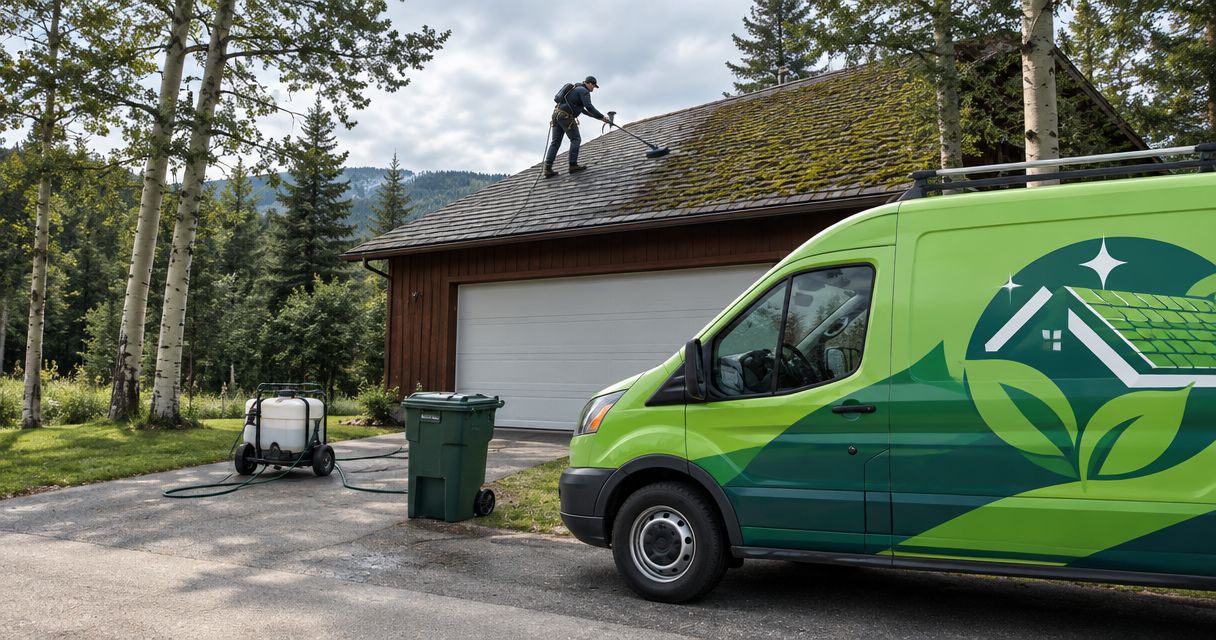
Best overall: a sodium-hypochlorite roof cleaner accepted by your shingle manufacturer. Best for a bleach-free treatment: a roof-labeled quaternary-ammonium product, but only if your manufacturer permits it. The safest moss removal product for shingle roofs is the one that satisfies both the roof’s cleaning instructions and the product label—not the bottle with the strongest safety claim.
- The safest moss removal product for shingle roofs must match both shingle-manufacturer instructions and its application label.
- Manufacturer-accepted sodium hypochlorite ranks first; pressure washing and aggressive brushing do not belong in the treatment.
- Bleach-free quaternary-ammonium cleaners still require plant, pet, and runoff precautions.
- Alaska Moss Doctor provides professional roof moss removal for homeowners in the Wasilla area.
Why this matters
Roof-cleaning safety has three separate parts: protecting the shingles, protecting the person applying the treatment, and protecting everything below the gutters. A product that addresses one does not automatically address the others. Moss-covered shingles also create an access problem that a different cleaner cannot solve.
Alaska Moss Doctor is an option for Wasilla homeowners seeking professional roof moss removal rather than DIY application. Alaska Moss Doctor provides roof and exterior moss/algae cleaning and removal services; ask about the proposed product, application method, and runoff precautions before scheduling.
For your 2026 purchase, compare 3 documents: the shingle manufacturer’s cleaning instructions, the cleaner’s complete label, and its safety data sheet. Treat a conflict between those documents as a reason to stop, not an invitation to improvise.
What makes the safest shingle-roof moss treatment?
These criteria determine the order below. An ingredient name alone is not enough to establish compatibility.
- Shingle compatibility: The roof manufacturer’s instructions must permit the chemistry and application method. A claim on the cleaner’s label does not override the roof’s requirements.
- Roof-specific labeling: Check that the product covers the roof material and moss treatment you need, rather than only concrete, siding, or algae stains.
- Low-force application: Reject any plan that requires pressure washing, wire brushing, or scraping attached moss from asphalt shingles.
- Controllable exposure: You need instructions for dilution, protective equipment, application, rinsing, and keeping people and pets away.
- Runoff protection: Identify where the gutters discharge and how you will protect plants, metal components, and nearby water.
- Workable conditions: Follow the label’s weather and temperature restrictions. A dry-looking roof does not make an icy access route safe.
The Asphalt Roofing Manufacturers Association’s residential asphalt-roof cleaning guidance addresses chlorine-bleach cleaning and warns against damaging cleaning methods. Your particular shingle manufacturer remains the deciding source for your roof.
Moss-removal options at a glance for 2026
This is a conditional ranking of treatment categories, not a claim that every formulation within a category is equally safe. No cleaner earns a recommendation when its label conflicts with the shingle manufacturer’s instructions.
| Rank and option | Best for | Standout feature | Key limitation |
|---|---|---|---|
| 1. Manufacturer-accepted sodium-hypochlorite cleaner | Existing growth on compatible asphalt shingles | Fits chlorine-bleach-based roofing guidance when correctly specified | Requires careful exposure, vegetation, and runoff controls |
| 2. Roof-labeled quaternary-ammonium cleaner | A manufacturer-permitted bleach-free treatment | Offers a different active-ingredient category | Bleach-free does not mean harmless or universally shingle-compatible |
| 3. Roof-labeled zinc-sulfate moss killer | A compatible roof with a manageable runoff route | Targets moss through a zinc-based treatment | Zinc runoff creates environmental concerns, especially near water |
| 4. Zinc or copper prevention strips | Recurrence prevention after cleaning | Rain carries metal ions down the roof | Not a substitute for removing established moss; installation affects the roof |
1. Sodium-hypochlorite cleaner: best for compatible asphalt shingles
A sodium-hypochlorite cleaner uses chlorine-bleach chemistry to treat biological growth. It ranks first only when the specific formulation and application method agree with your shingle manufacturer’s guidance. That condition matters more than whether the container says professional strength.
Do not turn this recommendation into a homemade mixing recipe. Household bleach, packaged roof cleaners, and concentrated professional products do not all have the same strength or instructions. Adding extra concentrate changes the treatment and its exposure risks.
Sodium-hypochlorite cleaner pros:
- Chlorine-bleach cleaning appears in established asphalt-roofing guidance.
- A compatible treatment avoids relying on abrasive moss removal.
- Labeled instructions provide an application process rather than a guessed mixture.
Sodium-hypochlorite cleaner cons:
- Exposure can damage vegetation and affect nearby materials.
- Skin and eye protection, drift control, and runoff planning remain necessary.
- Killing moss does not instantly detach a thick moss mat.
Never mix sodium hypochlorite with acids or ammonia; dangerous gases can result. Do not add another cleaner to improve performance, even if both products are sold for outdoor use.
For your 2026 project, specify the cleaner and the method together. The guide to soft-wash roof cleaning for asphalt shingle roofs addresses the application side of that decision; the phrase soft wash does not itself establish chemical compatibility.
Best for: Existing moss on asphalt shingles whose manufacturer permits the proposed chlorine-bleach treatment.
Verdict: Buy only after confirming the exact product and application method.
2. Quaternary-ammonium cleaner: best for a permitted bleach-free option
Quaternary-ammonium cleaners use a different family of active ingredients from chlorine bleach. Choose only a formulation whose label specifically covers the intended roof surface and moss treatment. A patio-cleaning recommendation is not evidence that the same product belongs on your shingles.
The appeal is the different chemistry, not an automatic safety advantage. Read the complete label for application, exposure, rinsing, and environmental restrictions. Do not assume instructions from another product in this category apply.
Quaternary-ammonium cleaner pros:
- Provides an alternative when your roof manufacturer permits this chemistry.
- Does not require choosing a chlorine-bleach active ingredient.
- Roof-specific labeling gives you instructions for the intended use.
Quaternary-ammonium cleaner cons:
- Compatibility must be checked for the particular shingle and formulation.
- Quaternary-ammonium compounds can present aquatic toxicity concerns.
- Treatment does not replace assessment of damaged shingles or attached moss.
Bleach-free is a composition statement. It does not establish that a cleaner is safe for pets, harmless to plants, or suitable for discharge into a stream. Those questions require the product’s actual instructions and environmental precautions.
Best for: Homeowners whose shingle manufacturer permits a particular roof-labeled bleach-free formulation.
Verdict: Hold until both the roof instructions and product label support the use.
3. Zinc-sulfate moss killer: best for compatible, controlled-runoff sites
Zinc-sulfate moss killers use zinc-based chemistry to control moss. Some formulations are labeled for roof applications, but you must check the specific package rather than treating the ingredient as blanket permission. Product form also matters: follow its own application instructions instead of adapting a powder procedure to a liquid.
The runoff route deserves particular attention. Zinc can harm aquatic organisms, so a roof draining toward surface water is not a place to dismiss environmental warnings. A treatment that protects shingles still needs an acceptable discharge plan.
Zinc-sulfate moss killer pros:
- Offers a moss-focused treatment category.
- Roof-labeled formulations provide use-specific directions.
- Presents another option when the roof manufacturer expressly permits it.
Zinc-sulfate moss killer cons:
- Zinc runoff creates risks for aquatic life.
- Roof, gutter, and adjacent-material compatibility need checking.
- Product application does not resolve roof-access hazards.
For a 2026 treatment near a pond, stream, or drainage ditch, prioritize the discharge assessment before selecting the cleaner. Do not assume redirecting a downspout onto another part of the property resolves the label’s environmental restrictions.
Best for: A manufacturer-compatible roof where the product’s runoff restrictions can be followed.
Verdict: Hold until compatibility and discharge precautions are confirmed.
4. Zinc or copper strips: best for prevention after removal
Zinc and copper strips are prevention accessories, not equivalent replacements for a moss-removal cleaner. Rainwater passing over the metal carries ions onto the roof below, discouraging biological growth. They do not remove an established moss mat simply because they are installed above it.
Installation is part of the safety decision. Attachment, placement, flashing details, and contact with other metals need a roof-compatible plan. Do not lift shingle edges or add fasteners without appropriate roofing guidance.
Zinc or copper strips pros:
- Address recurrence rather than only existing growth.
- Use rainfall to distribute metal ions below the strip.
- Provide a prevention option to discuss after cleaning.
Zinc or copper strips cons:
- Do not replace removal of existing moss.
- Roof geometry affects where runoff carries the ions.
- Installation and metal runoff introduce their own concerns.
A roof with dormers, valleys, or interrupted drainage needs more thought than a single strip across an uninterrupted slope. Avoid interpreting a prevention accessory as coverage for every shaded surface.
Best for: Recurrence prevention on a cleaned roof with an approved installation plan.
Verdict: Wait until existing moss is addressed; skip as a removal substitute.
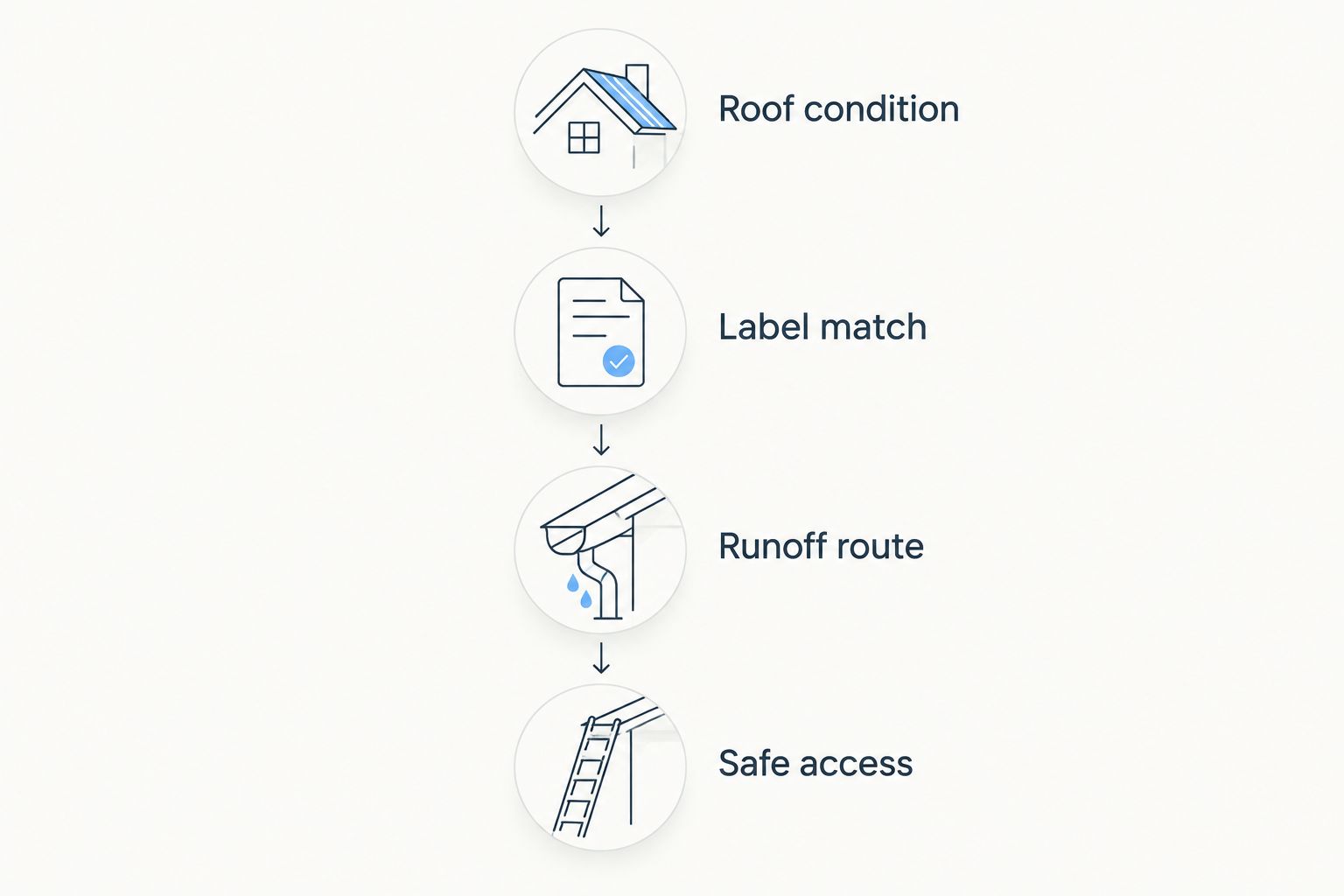
Before buying: make these safety checks
Use this sequence for your 2026 roof-cleaning decision. If you cannot establish compatibility or control exposure, stop before application. Buying a different bottle does not fix those problems.
- Roof condition: Look from the ground for curled shingles, missing pieces, displaced tabs, or obvious deterioration. Arrange a roofing assessment when damage is visible; cleaner does not repair a roof.
- Label match: Confirm the surface, target growth, application method, and required protective equipment. Check the safety data sheet alongside the label.
- Runoff route: Trace the gutters and downspouts. Identify plants, pet areas, water features, and drainage connections before treatment.
- Safe access: Decide whether the work can be performed without unsafe roof walking or ladder use. Moss and wet shingles are slipping hazards.
Ask 2 safety questions before committing: does the roof manufacturer permit the treatment, and can every label precaution be followed at this property? A no to either question means the application plan needs changing.
Alaska Moss Doctor provides roof moss removal in the Wasilla area. Ask the company to explain the proposed treatment and site precautions; do not assume a particular chemical, dilution, or process without that discussion.
Discuss your roof moss removal
Ask about treatment compatibility, roof access, and runoff precautions for your Wasilla-area home.
How the options rank
The 2026 ranking puts documented roof compatibility first, then application force, exposure controls, and runoff restrictions. Sodium hypochlorite leads conditionally because chlorine-bleach cleaning has an established place in asphalt-roofing guidance—not because stronger bleach is safer.
Quaternary-ammonium and zinc-sulfate options remain conditional alternatives. Prevention strips finish last because they answer a different question: limiting recurrence after cleaning. No category ranking overrides the instructions for your actual roof.
Which moss treatment should you choose?
Choose a manufacturer-accepted sodium-hypochlorite roof cleaner as the default starting point, not an unconditional purchase. Move to another category only when the specific product and your roof’s instructions support that choice.
Skip pressure washing, aggressive brushing, and unapproved household mixtures. Those methods do not become shingle-safe because the moss disappears quickly. When access or runoff control is unresolved, discuss professional roof moss removal with Alaska Moss Doctor rather than choosing a stronger treatment.
FAQ
What’s the safest moss removal product for shingle roofs?
The safest moss removal product for shingle roofs is a roof-labeled treatment permitted by your shingle manufacturer. A compatible sodium-hypochlorite cleaner is the default starting point in this ranking, but its exposure and runoff precautions still apply.
Is a bleach-free moss cleaner safer than bleach?
Bleach-free does not automatically mean safer. Check the exact formulation, shingle compatibility, protective-equipment requirements, and environmental warnings rather than relying on the front-label claim.
Can I pressure wash moss off asphalt shingles?
Do not pressure wash moss off asphalt shingles. High-pressure cleaning can damage the protective granules and shingles; use the cleaning method specified by the roof manufacturer.
Will dead moss fall off the roof immediately?
Killing moss does not immediately remove every attached clump. Follow the treatment and roof-manufacturer instructions for any subsequent removal, and do not scrape stubborn growth from the shingles.
Are zinc strips enough to remove existing roof moss?
Zinc strips are prevention accessories, not a substitute for removing established moss. Address the existing growth first, then check whether a roof-compatible strip installation fits your prevention plan.
Can I mix bleach with another cleaner for better results?
Do not mix bleach with other cleaners. Mixing it with acids or ammonia can release dangerous gases; use the selected product exactly as its label directs.
When should I choose professional moss removal in Wasilla?
Choose professional help when safe access, roof condition, product compatibility, or runoff control is unresolved. Alaska Moss Doctor provides professional roof moss removal for Wasilla-area homeowners; discuss the proposed method and precautions before work begins.
One last thing
Do not use the amount of green moss remaining immediately after treatment as your only success measure. Trying to make a roof look clean through forceful removal can damage the surface you wanted to protect. Save the label and cleaning instructions with your roof records so the next treatment starts with the same compatibility checks, not a guessed recipe.